
What are the continents of the world?
Answer in short
A continent is a large continuous expanse of land. Most often seven are counted: Asia, the largest, then Africa, North America, South America, Antarctica, Europe and Australia, the smallest. They can also be counted as four, five or six, because Europe and Asia form one landmass, Eurasia, and the Americas can be seen as one.
Stuck on a question? Take a photo and Lagnever AI explains it step by step. Try it for 7 days for ₹2. Get it on Google Play
What is a continent?
A little over one-fourth of the Earth’s surface is land. A large body of land is called a landmass, and a large continuous expanse of land is called a continent. The Northern Hemisphere holds more of this land than the Southern Hemisphere.
The seven continents
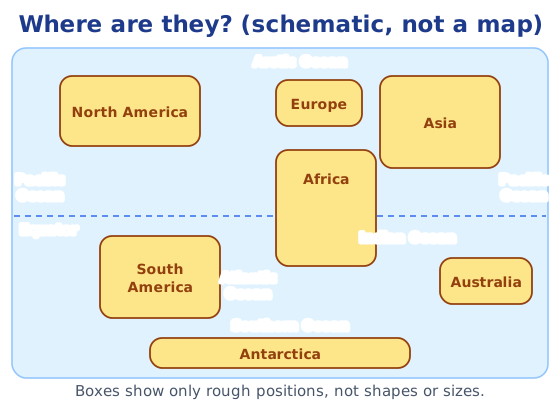
The most widely used list has seven continents: Africa, Antarctica, Asia, Australia, Europe, North America and South America. This rough sketch shows where they lie and which oceans surround them.
Four, five, six or seven?
Counting continents is not as simple as it looks. Depending on our choice, there can be anywhere from four to seven:
- North America and South America are usually two continents, but seen as one landmass they are one, America.
- Europe and Asia form a single landmass. For historical and cultural reasons they are usually counted as two, but geologists often treat them as one continent, Eurasia.
- Africa and Eurasia are usually two, but sometimes one.
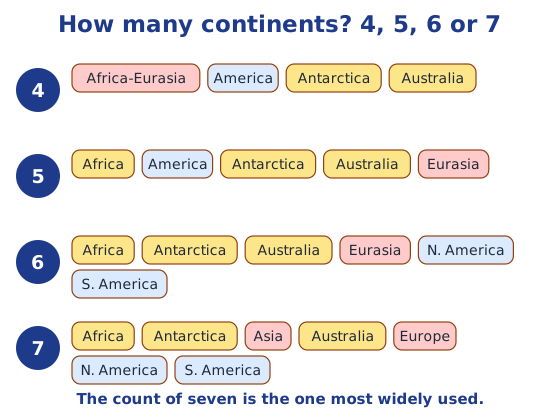
| Count | Continents (alphabetical) |
|---|---|
| Four | Africa-Eurasia, America, Antarctica, Australia |
| Five | Africa, America, Antarctica, Australia, Eurasia |
| Six | Africa, Antarctica, Australia, Eurasia, North America, South America |
| Seven | Africa, Antarctica, Asia, Australia, Europe, North America, South America |
The five Olympic rings stand for five inhabited continents: Africa, America, Asia, Australia and Europe.
The continents by size
The book compares the continents with a diagram of small squares that shows their relative sizes, not their shapes. Counting the squares gives this order:
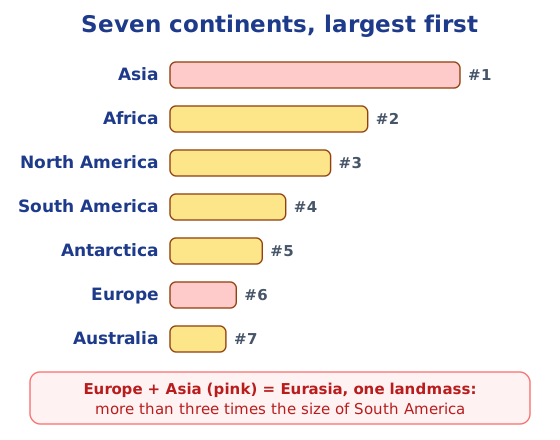
- Largest: Asia. Smallest: Australia.
- North America is larger than South America.
- Africa is larger than North America.
- Antarctica is larger than Australia.
- Eurasia (Europe plus Asia) is more than three times as large as South America.
From the smallest to the largest: Australia, Europe, Antarctica, South America, North America, Africa, Asia. India is part of Asia, the largest continent, and so of Eurasia.
Antarctica, the cold continent
Antarctica, around the South Pole, is the coldest continent, mostly covered with ice and with a harsh environment. Since 1981, the Indian Antarctica Programme has explored it. India set up its first scientific base there, Dakshin Gangotri, in 1983 and two more bases later. About 40 teams of Indian scientists have studied how its climate and environment have changed, and their settlement even has a library and a post office.
Islands
Continents do not include all land. Smaller pieces of land surrounded by water on all sides are islands. Continents are also surrounded by water, but they are so large that they are not called islands. There are lakhs of islands of very different sizes:
- Greenland is the largest island in the world; you would have to add the areas of the 10 largest States of India to reach its size.
- India has more than 1,300 small islands, including two major groups: the Andaman and Nicobar Islands in the Bay of Bengal and the Lakshadweep Islands in the Arabian Sea.
Try it yourself
Without looking at a map, draw the continents freehand and colour them, then compare your drawing with a world map in an atlas. Next, on an outline map of the world, label all seven continents and five oceans. Read about the water around them in oceans of the world, or see the whole chapter in the Chapter 2 notes.
Practice
-
Which is the largest continent?
Show answer
Answer: (b) Asia
-
Europe and Asia together form the landmass called:
Show answer
Answer: (b) Eurasia
-
Which is larger, Antarctica or Australia?
Show answer
Answer: (b) Antarctica
-
List the seven continents from the smallest to the largest.
Show answer
Answer: Australia, Europe, Antarctica, South America, North America, Africa, Asia.
-
Why are Europe and Asia counted as two continents though they form one landmass?
Show answer
Answer: For historical and cultural reasons: Europe's history developed very differently from Asia's. Geologists, though, often treat them as one continent, Eurasia.
Questions students ask
How many continents are there?
It depends on how they are counted: anywhere from four to seven. The most widely used count is seven: Africa, Antarctica, Asia, Australia, Europe, North America and South America.
Which is the largest and which is the smallest continent?
Asia is the largest continent and Australia the smallest. In between, from larger to smaller, come Africa, North America, South America, Antarctica and Europe.
What is the difference between a continent and an island?
Both are land surrounded by water, but continents are very large expanses of land. Smaller pieces of land surrounded by water on all sides are islands; Greenland is the largest island.
Stuck on a question?
Take a photo and Lagnever AI explains it step by step. Try it for 7 days for ₹2.
Get it on Google Play Open in browser
For parents: after the trial, the plan renews monthly by UPI or card autopay. You can cancel anytime in the app.