
Different names of India
Answer in short
India has had many names. Indian texts call the northwest Sapta Sindhava and the whole land Bhāratavarṣha, Jambudvīpa and Bhārata. Foreigners named it from the Sindhu (Indus) River: the Persians said Hind or Hindu, the Greeks Indoi, and the Chinese Yindu; later came Hindustān and India. The Constitution says ‘India, that is Bharat’.
Stuck on a question? Take a photo and Lagnever AI explains it step by step. Try it for 7 days for ₹2. Get it on Google Play
Many names, many sources
Over thousands of years, the land we call the Indian Subcontinent has been named both by its own inhabitants and by visitors from outside. These names come to us from ancient texts, from the accounts of travellers and pilgrims, and from inscriptions. Each name tells us something about who used it and how much of the land they meant.
Names given by Indians
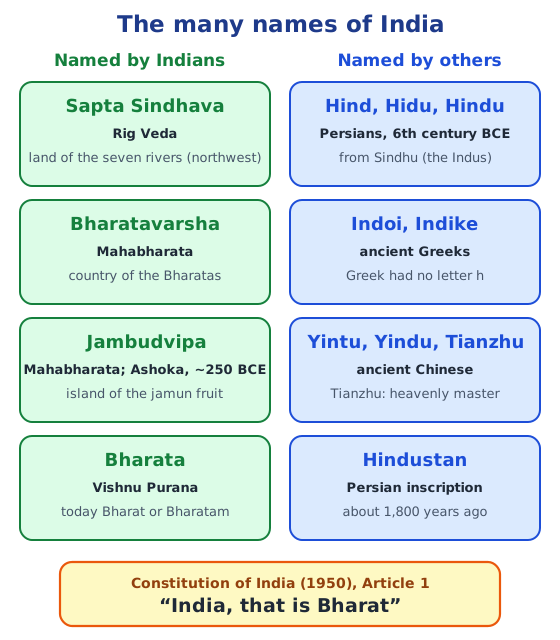
- Sapta Sindhava: the Ṛig Veda, India’s most ancient text, gives this name, ‘the land of the seven rivers’, to the northwest region. Sindhava comes from Sindhu, the Indus River, or at times any river.
- Bhāratavarṣha: the Mahābhārata, written from a few centuries BCE onward, uses this name for the entire Subcontinent. It means ‘the country of the Bharatas’. In the Ṛig Veda, the Bharatas are one of the main Vedic groups of people, and later texts mention several kings named Bharata.
- Jambudvīpa: also in the Mahābhārata, it means ‘the island of the fruit of the jamun tree’, a common tree native to India, also called the jambul or Malabar plum tree. In about 250 BCE, the emperor Aśhoka used Jambudvīpa in an inscription for the whole of India, which then included today’s Bangladesh, Pakistan and parts of Afghanistan.
- Bhārata: a few centuries later this became the usual name. The Viṣhṇu Purāṇa describes Bhārata as the country lying north of the ocean and south of the snowy mountains. Today it is generally Bharat in north India and Bharatam in south India.
A Tamil poem of about 2,000 years ago also pictures the land as one: it praises a king known from Kumari in the south to the great mountain in the north, and from the ocean in the east to the ocean in the west.
Names given by others
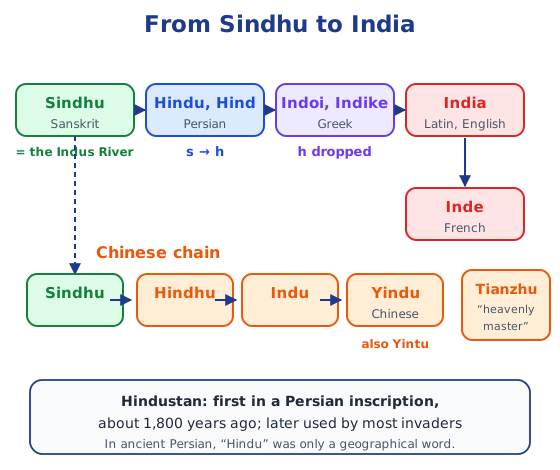
- Persians: the first foreigners to mention India. In the 6th century BCE, a Persian emperor took control of the Indus region, so in their records and stone inscriptions India became Hind, Hidu or Hindu, their way of saying Sindhu. In ancient Persian, ‘Hindu’ was a purely geographical word, not the name of a religion.
- Greeks: using Persian sources, they called the region Indoi or Indike, leaving out the h, which did not exist in Greek.
- Chinese: their texts say Yintu or Yindu, which also came from Sindhu (Sindhu, Hindhu, Indu, Yindu). Another Chinese word, Tianzhu, came from Sindhu too, but could also be understood as ‘heavenly master’, showing their respect for India as the land of the Buddha.
- Hindustān: first used in a Persian inscription some 1,800 years ago, and later by most invaders of India.
One land, names in many languages
| Language | Name for India |
|---|---|
| Persian | Hind, Hidu, Hindu |
| Greek | Indoi, Indike |
| Latin | India |
| Chinese | Yintu, Yindu, Tianzhu |
| Arabic and Persian | Hind, Hindustān |
| English | India |
| French | Inde |
India, that is Bharat
The Constitution of India, which came into force in 1950 and was first written in English, begins its very first article with the words ‘India, that is Bharat, shall be a Union of States’. Its Hindi version says ‘Bhārat arthāth India’. So both the name used by India’s own people and the name that travelled the world through Sindhu stand side by side.
For the whole chapter, see the Chapter 5 notes; for the textbook’s questions, see the Chapter 5 NCERT solutions.
Practice
-
Bhāratavarṣha means:
Show answer
Answer: (b) the country of the Bharatas
-
Which emperor used ‘Jambudvīpa’ for the whole of India in an inscription?
Show answer
Answer: (a) Aśhoka
-
‘Hindustān’ first appeared in:
Show answer
Answer: (b) a Persian inscription
-
How did ‘Sindhu’ become ‘Indoi’?
Show answer
Answer: The Persians said Hindu, changing the s to h. The Greeks, borrowing from the Persians, dropped the h because Greek did not have that letter, and said Indoi or Indike.
-
What does the Tamil poem of about 2,000 years ago tell us?
Show answer
Answer: It praises a king known from Kumari (Kanyakumari) in the south to the great mountain (the Himalayas) in the north and from ocean to ocean, so people in the south also saw the land as one, from the mountains to the seas.
Questions students ask
What are the different names of India?
From Indian texts: Sapta Sindhava, Bhāratavarṣha, Jambudvīpa and Bhārata. From other lands: Hind and Hindu (Persian), Indoi and Indike (Greek), Yintu, Yindu and Tianzhu (Chinese), Hindustān, and India.
What is the meaning of Jambudvīpa?
The island of the fruit of the jamun tree, a common tree native to India. The name came to mean the Indian Subcontinent, and Aśhoka used it for the whole of India in about 250 BCE.
Where does the name India come from?
From Sindhu, the Indus River. The Persians said Hindu, the Greeks Indoi or Indike, and from there came India in Latin and English.
Stuck on a question?
Take a photo and Lagnever AI explains it step by step. Try it for 7 days for ₹2.
Get it on Google Play Open in browser
For parents: after the trial, the plan renews monthly by UPI or card autopay. You can cancel anytime in the app.