
NCERT Solutions Class 6 Social Science Chapter 5: India, That Is Bharat
Answers to the Big Questions, every Let’s Explore and Think About It box and all 4 “Questions, activities and projects” in Chapter 5, India, That Is Bharat, of Exploring Society: India and Beyond (2026-27 session). The page numbers match the book. Imaginative and discussion questions have sample answers; yours may differ. Short notes: Chapter 5 notes.
The Big Questions (page 75)
1. How do we define India?
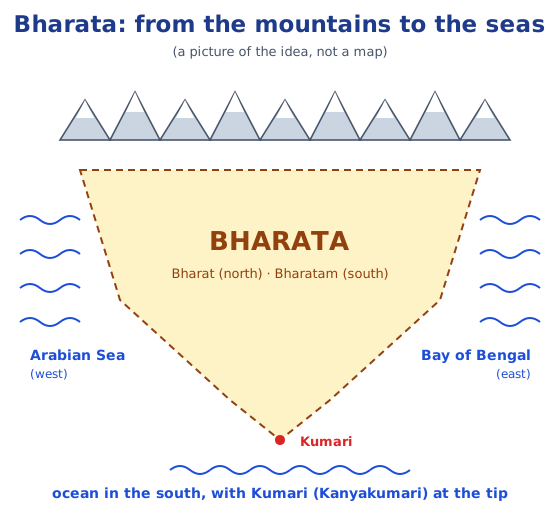
Today, India is defined as a modern nation with defined borders, defined states and a known population. In the past, its boundaries shifted, but Indians defined their land by its geography: the Viṣhṇu Purāṇa calls Bhārata the country north of the ocean and south of the snowy mountains, and a Tamil poem describes it from Kumari in the south to the great mountain in the north and from ocean to ocean. The chapter’s opening words from Sri Aurobindo add that the people of this land, between the Himalayas and the two seas, shared a spiritual and cultural unity from very early times.
2. What were the ancient names for India?
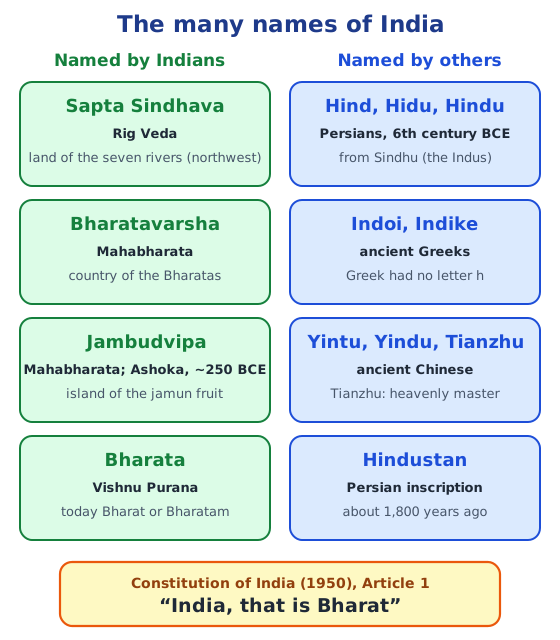
- Given by Indians: Sapta Sindhava (the northwest, in the Ṛig Veda), Bhāratavarṣha and Jambudvīpa (the Mahābhārata; Aśhoka also used Jambudvīpa) and Bhārata (the Viṣhṇu Purāṇa).
- Given by others: Hind, Hidu and Hindu (Persians), Indoi and Indike (Greeks), Yintu, Yindu and Tianzhu (Chinese), and later Hindustān.
Think About It: natural boundaries (page 77)
The physical map shows the Himalayas in the north and the Hindu Kush in the northwest, the Arabian Sea in the west and the Bay of Bengal in the east, and the ocean in the south. These mountains and seas form the Subcontinent’s natural boundaries.
Let’s Explore: regions on the map (page 78)
Sample answer: regions on the map that many students have heard of include Kāshi, Kosala, Magadha, Anga, Vanga, Kalinga, Gandhāra, Avanti, Vidarbha, Surāṣhṭra, Kerala, Chola and Pāṇḍya. (Extra: Kāshi is the area around Varanasi, Magadha is in today’s Bihar, Kalinga in Odisha, Avanti around Ujjain, Surāṣhṭra is Saurashtra in Gujarat, and the Chola and Pāṇḍya lands are in Tamil Nadu.)
Think About It: the snowy mountains (page 80)
The snowy mountains are the Himalayas. The description is broadly correct: the Subcontinent does lie between the Himalayas in the north and the ocean in the south, with seas to the west and east. In the Tamil poem, ‘the great mountain in the north’ is also the Himalayas, and Cape Kumari is Kanyakumari, the southern tip of India.
Let’s Explore: the first page of the Constitution (page 81)
Yes. Under the heading ‘Part I: The Union and its Territory’, the first line of Article 1 reads: ‘India, that is Bharat, shall be a Union of States.’ (Extra: the bull pictured above it comes from a seal of the Harappan period.)
Let’s Explore: the many names of India (page 83)
| Language | Name for India |
|---|---|
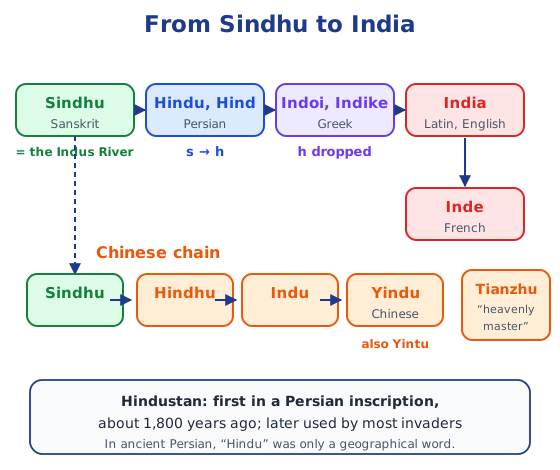
| Persian | Hind, Hidu, Hindu |
| Greek | Indoi, Indike |
| Latin | India |
| Chinese | Yintu, Yindu, Tianzhu |
| Arabic and Persian | Hind, Hindustān |
| English | India |
| French | Inde |
Questions, activities and projects (page 84)
1. The meaning of Sri Aurobindo’s words. Points for discussion: very early in India’s history, the people living between the Himalayas and the two seas, the Arabian Sea and the Bay of Bengal, came to share the same spiritual ideas and cultural ways. This unity was not just an idea of a few thinkers; it became part of the everyday life of this huge mass of people, even though they lived in different regions, spoke different languages and were ruled by different kings. That shared unity is one reason the whole land came to be seen as one country, Bhārata.
2. True or false?
- The Ṛig Veda describes the entire geography of India: False. It names only the northwest region, Sapta Sindhava.
- The Viṣhṇu Purāṇa describes the entire Subcontinent: True. It calls the land between the ocean and the snowy mountains Bhārata.
- In Aśhoka’s time, Jambudvīpa included today’s India, parts of Afghanistan, Bangladesh and Pakistan: True.
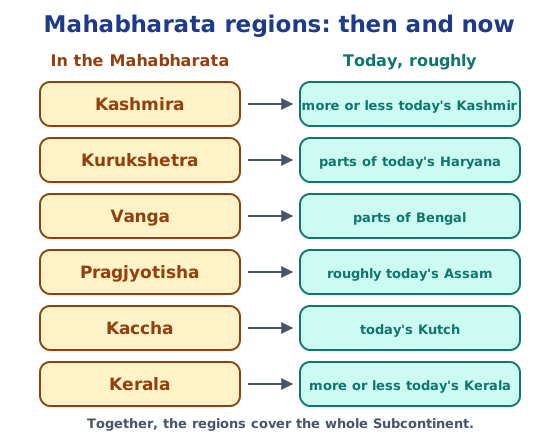
- The Mahābhārata lists many regions, including Kashmir, Kutch and Kerala: True (as Kāshmīra, Kaccha and Kerala).
- The term ‘Hindustān’ first appeared in a Greek inscription more than 2,000 years ago: False. It first appeared in a Persian inscription about 1,800 years ago.
- In ancient Persian, the word ‘Hindu’ refers to the Hindu religion: False. It was a purely geographical word for the land of the Sindhu.
- ‘Bhārata’ is a name given to India by foreign travellers: False. It comes from India’s own texts; foreign names came from Sindhu.
3. Naming our country 2,000 years ago. Sample answer: I might have chosen Jambudvīpa, because the jamun tree grows all over the land and everyone knows its fruit, or Bhārata, after the Bharatas, to honour the people. I could also invent a name such as ‘Himasāgara’, ‘from the snows to the seas’, because the land stretches from the snowy Himalayas to the ocean.
4. Why did people travel to India in ancient times? Several motivations:
- Trade: to buy and sell goods such as spices, cotton cloth and gems.
- Learning: to study with Indian teachers and collect texts, as Xuanzang did when he came from China in the 7th century CE and stayed 17 years.
- Pilgrimage: to visit the places of the Buddha’s life, since the Chinese respected India as the land of the Buddha.
- Conquest and rule: to gain land and wealth, as when a Persian emperor took the Indus region in the 6th century BCE, and later invaders.
- Diplomacy and curiosity: to visit kings as messengers, and simply to see and describe a famous land and its people.
For more on each name, read different names of India.
Practice
-
Which ancient text gives the northwest the name Sapta Sindhava?
Show answer
Answer: (b) The Ṛig Veda
-
In which century BCE did a Persian emperor gain control of the Indus region?
Show answer
Answer: (b) 6th
-
Xuanzang came to India from:
Show answer
Answer: (c) China
-
What does ‘Bhārat arthāth India’ mean, and where is it written?
Show answer
Answer: It means ‘Bharat, that is India’. It is how the Hindi version of the Constitution gives the phrase ‘India, that is Bharat’.
-
Name the region in the Mahābhārata that roughly matches today's Assam.
Show answer
Answer: Prāgjyotiṣha.
Stuck on a question?
Take a photo and Lagnever AI explains it step by step. Try it for 7 days for ₹2.
Get it on Google Play Open in browser
For parents: after the trial, the plan renews monthly by UPI or card autopay. You can cancel anytime in the app.