
Class 6 Social Science Chapter 9: Family and Community Notes
This chapter in five lines
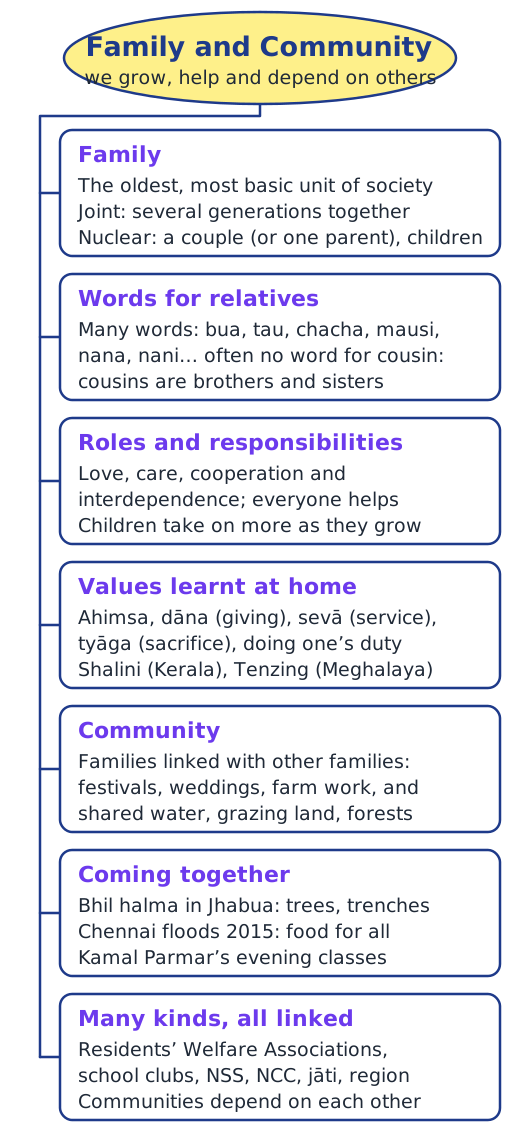
The family is the oldest and most basic unit of society. It can be a joint family, with several generations living together, or a nuclear family, with a couple or one parent and their children. Family members support each other through love, care and cooperation, and children learn values such as giving, service and sacrifice at home. A community is a larger group of connected families and people who help each other, and all communities depend on one another.
Why is the family important?
Almost all of us live in a family, and the family is the most basic and ancient unit of any society. It is where we are first cared for, and where we first learn how to live with others. In India today there are several types of families, from joint families to nuclear families.
Joint and nuclear families
A joint family has several generations living together: grandparents, parents, uncles and aunts, brothers, sisters and cousins. A nuclear family is limited to a couple and their children, or sometimes one parent and children. Read more in family and community roles.
Words for relatives
English has only a few words for relatives. Indian languages have many more: Hindi has bua, tau, tai, chacha, mausi, nana, nani and others, and languages such as Tamil even have separate words for an elder and a younger brother or sister. Yet most Indian languages have no word for ‘cousin’, because cousins are simply brothers and sisters. This shows the close bond among all the children of a family.
Roles and responsibilities
Family relationships are based on love, care, cooperation (working together) and interdependence. Each member has a role. Parents bring up their children to be happy and responsible members of society, and as children grow, they take on more work at home and learn the family’s traditions.
Values learnt in the family
Doing one’s duty, or dharma, is an important principle of Indian culture. The family is like a school where children learn values such as ahimsa (non-violence), dāna (giving), sevā (service) and tyāga (sacrifice). In Kerala, Shalini’s parents bought festival clothes for her uncle’s family as well, after he lost his job. In Meghalaya, Tenzing’s father shares the housework and cooking while his mother works in a handicraft cooperative, and his grandfather helps the whole neighbourhood.
What is a community?
Families are connected with other families and with the people around them. Such a group of connected people can be called a community. Members come together to celebrate festivals, organise feasts and weddings, and in some villages to prepare land, sow and harvest. Many communities, especially tribal communities, agreed long ago on how to share water, grazing land and forest produce. These rules were rarely written down, but they gave everyone secure access, and every family had duties to perform.
Communities that help
- The Bhils around Jhabua in Madhya Pradesh suffered an acute water crisis year after year. Following their halma tradition, they planted thousands of trees in hundreds of villages and dug trenches to save rainwater, without pay. In 2019, Mahesh Sharma of the Shivganga movement received the Padma Shri for his work with the Bhil communities.
- During the Chennai floods of 2015, many groups cooked large amounts of food and gave it to people in need.
- In Ahmedabad, workshop owner Kamal Parmar began teaching children from the street every evening after work and gave them dinner. Soon 150 children came regularly, and teachers and older students joined him.
New kinds of communities
Residents’ Welfare Associations in cities make their own rules about waste, clean common areas and pets, and residents help make them. Such a community still depends on traders for supplies and on municipal workers for waste, so communities are interdependent. ‘Community’ is a flexible word: it can mean a jāti, or the people of one religion, region, kind of work or interest, and in school it can mean your class, a sports team, the NSS, the NCC or a club.
Key terms
| Term | Meaning |
|---|---|
| Family | Relatives who live together and take care of each other; the most basic and ancient unit of society. |
| Joint family | A family in which several generations live together: grandparents, parents, uncles, aunts and cousins. |
| Nuclear family | A family of a couple and their children, or sometimes one parent and children. |
| Cooperation | Working together. |
| Interdependence | Depending on each other, as family members do, and as communities do. |
| Dharma | Doing one's duty, an important principle of Indian culture. |
| Ahimsa, dāna, sevā, tyāga | Values learnt in the family: non-violence, giving, service and sacrifice. |
| Community | A group of connected people, beyond one family, who come together and support each other. The word has several meanings. |
| Shared resources | Natural wealth used by everyone in a community, such as water, grazing land and forest produce. |
| Halma | A tradition of the Bhil community of coming together, without pay, to help any person or family in a crisis. |
| Residents' Welfare Association | A community of people living in one housing area in a town or city, who make rules together for things like waste and common areas. |
Topics in this chapter
Practice
-
A family of a couple and their children is called a:
Show answer
Answer: (b) nuclear family
-
‘Cooperation’ means:
Show answer
Answer: (b) working together
-
Which value means ‘service’?
Show answer
Answer: (c) sevā
-
The halma tradition belongs to which community?
Show answer
Answer: (a) The Bhils of Madhya Pradesh
-
A Residents' Welfare Association depends on municipal workers to:
Show answer
Answer: (b) handle its waste Communities are interdependent: the association also depends on traders for supplies.
Questions students ask
What are the main topics of Class 6 SST Chapter 9?
Types of families, words for relatives, roles and responsibilities in the family, values learnt at home, what a community is, examples of communities helping each other, Residents' Welfare Associations, and how communities depend on each other.
Is Family and Community in the new Exploring Society book?
Yes. It is Chapter 9 of Exploring Society: India and Beyond, the Class 6 Social Science textbook used in the 2026-27 session, and it opens the theme Governance and Democracy.
How many end-of-chapter questions does Chapter 9 have?
The “Questions, activities and projects” section has 3 questions. Our NCERT solutions page answers them, along with the Big Questions, the Let's Explore activities and the Think About It questions.
Stuck on a question?
Take a photo and Lagnever AI explains it step by step. Try it for 7 days for ₹2.
Get it on Google Play Open in browser
For parents: after the trial, the plan renews monthly by UPI or card autopay. You can cancel anytime in the app.