
NCERT Solutions Class 6 Social Science Chapter 9: Family and Community
Answers to the Big Questions, the Let’s Explore and Think About It activities, and the “Questions, activities and projects” of Chapter 9, Family and Community, in Exploring Society: India and Beyond. Most of these are discussion questions, so the answers below are model answers and ideas: use them to prepare, then add examples from your own family and neighbourhood. Short notes: Chapter 9 notes.
The Big Questions (page 137)
1. Why is the family unit important?
The family is the most basic and ancient unit of society. It gives us love, care, safety, food and a home when we cannot look after ourselves. It is also our first school, where we learn values such as cooperation, giving (dāna), service (sevā) and sacrifice (tyāga), and the traditions of our elders. Family members support each other in hard times, as Shalini’s parents did when her uncle lost his job, and they share work and decisions, as in Tenzing’s family. In this way the family prepares children to become happy, responsible members of society.
2. What is a community and what is its role?
A community is a group of connected people beyond one family, such as the families of a village or a housing society, or people who share a region, a kind of work or an interest. Its roles include:
- celebrating festivals and organising feasts and weddings together;
- working together, for example in sowing and harvesting;
- sharing and protecting resources like water, grazing land and forests through agreed rules;
- helping in a crisis, like the Bhils’ halma work in Jhabua or the food shared in the Chennai floods of 2015;
- serving those in need, like Kamal Parmar’s classes in Ahmedabad;
- making rules for shared spaces, as Residents’ Welfare Associations do.
Communities also depend on each other, so together they hold society together.
Let’s Explore activities
Types of families in your neighbourhood (page 138)
Count the households you know and note whether each is a joint or a nuclear family. In many towns and cities you may find more nuclear families, because people move for jobs and homes are smaller; in many villages you may find more joint families, because families farm together and live in the same house for generations. Compare your list with your classmates’ and discuss why the answers differ from place to place.
Family words in your language (page 139)
In Hindi, for example:
| Term | Meaning in English |
|---|---|
| chacha | father’s younger brother (uncle) |
| tau | father’s elder brother (uncle) |
| bua | father’s sister (aunt) |
| mama, mausi | mother’s brother, mother’s sister |
| dada, dadi | father’s father, father’s mother |
| nana, nani | mother’s father, mother’s mother |
| behen | sister, and also a cousin such as mother’s brother’s daughter |
Notice that one word in an Indian language often needs several English words to explain it exactly.
Who does what at home? (page 140)
There is no single right answer. Write down who buys things, cooks, cleans the floor, washes the utensils and helps with homework, and who the oldest person is. Then compare: is the work shared fairly, or does one person do most of it? Can you help more?
Shalini’s family (page 141)
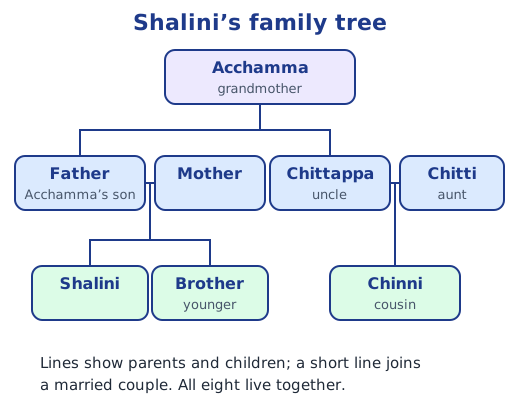
- The family tree: Acchamma (grandmother) is at the top. Below her are her sons, Shalini’s father (with Shalini’s mother) and Chittappa (with Chitti). Shalini and her younger brother are below her parents, and Chinni is below Chittappa and Chitti. The story names eight people; besides Shalini, there are seven.
- Why did Shalini’s parents buy clothes for everyone? Chittappa had just lost his job, so his family could not afford new clothes for Onam. Shalini’s parents shared what they had so that the whole family could celebrate together. This is how families support each other, through giving and a little sacrifice.
- What would you have done? Your own answer. For example: I would have accepted the simpler dress happily, like Shalini, because everyone getting something new matters more than one silk dress.
Think About It: Tenzing’s family (page 142)
- Why does Tenzing’s father consult his wife for special expenses? Both parents run the home and both earn, and a special expense affects the whole family. Deciding together shows respect and partnership, and two people plan better, for example to save money for unexpected needs.
- How do you feel about his share in household chores? It is fair and good. When Tenzing’s mother got busy with her work, his father took on cleaning, gardening and cooking. This is cooperation, and it sets a good example for children.
- What roles do the grandparents fulfil? The grandmother tells stories full of humour and wisdom and understands people well, so she passes on values. The grandfather helps with homework, takes Tenzing to the school bus stop, and serves the neighbourhood: he reports power failures and collected money to repair a neighbour’s house after a storm.
A family story, a drama, and joint or nuclear families (page 143)
For the story or play, choose a problem a family might face, such as an illness, a lost job or a move to a new town, and show how the members solve it together.
Some couples choose a nuclear family because of jobs in other cities, smaller homes, children’s studies, or a wish for more privacy and independence.
| Type | Advantages | Disadvantages |
|---|---|---|
| Joint family | More people to share work, care and costs; children grow up with grandparents; support in hard times | Less privacy; decisions can take longer; homes can be crowded |
| Nuclear family | More privacy and freedom; easier to move for work | Fewer hands for work and care; children may miss grandparents |
People coming together (page 144)
Examples you may know: community kitchens such as the langar at gurdwaras, where volunteers cook and serve meals to everyone who comes; blood donation camps; neighbours cleaning a park or a pond together; people collecting money or food for families hit by a flood or a fire.
Kamal Parmar’s classes (pages 146–147)
- What attitude towards the community does the story reveal? A caring and responsible attitude: Kamal saw a problem around him and used his own time and money to help, without being asked and without expecting anything in return.
- What values are reflected? Sevā (service), dāna (giving his time and food), compassion, dedication, and the belief that every child deserves to learn.
- Has society been unfair to these children? Yes, in a way. They missed school because of poverty and other problems they did not create, so they did not get the same chances as other children.
- What should society do so that all children can study? Have schools within reach of every home; help families with books, uniforms and meals; run special classes so that children who dropped out can catch up; and support volunteers and groups who teach children. Extra: India’s Right to Education Act (2009) makes schooling a right for every child aged 6 to 14.
People outside your family who support you (page 147)
Teachers, the school bus driver, doctors and nurses, farmers who grow our food, shopkeepers, sanitation and municipal workers, the milk and newspaper sellers, postal workers, electricians and plumbers, police, and many more.
Communities you belong to (page 148)
Your class and school, a sports team, a music, art or science club, your neighbourhood, and cultural or religious groups. A school club usually has a teacher in charge, members, sometimes a captain or secretary, regular meetings, simple rules, and activities that members plan and decide together.
Questions, activities and projects (page 148)
1. What are some of the rules you follow in your family and neighbourhood? Why are they important?
Family rules (examples): finish homework before play; share household chores; respect elders; tell parents where you are going; switch off lights and fans and do not waste water; limit screen time; eat meals together.
Neighbourhood rules (examples): do not litter, and put waste in the right bin; keep noise low at night; park vehicles properly; follow traffic rules; keep pets on a leash in shared spaces; do not damage parks and common property.
Why they matter: rules keep us safe and healthy, share work and resources fairly, keep shared places clean, and help many people live together peacefully. When everyone follows them, the family and the community run smoothly.
2. Do you think some rules are unfair to a few people in the family or community? Why?
Some rules can be unfair when they treat people unequally or are made without asking the people they affect. For example:
- if only the girls or women of a family are expected to cook and clean;
- if some children are allowed to play or study late but others are not;
- if a housing society does not let house helpers or delivery workers use the lift;
- if a rule ignores the needs of elderly or disabled people, such as having only stairs.
Extra: in the past, some customs kept certain groups away from shared wells or temples. India’s Constitution forbids such discrimination.
Unfair rules can be changed peacefully: by discussing them, by including everyone in making rules, and by asking whether a rule is fair to all.
3. Describe several situations that you have observed where community support makes a difference.
Model examples you can write about or draw:
- neighbours taking turns to bring food and help when a family member is ill;
- people collecting money for a neighbour’s medical treatment or to repair a house after a storm, as Tenzing’s grandfather did;
- a cleanliness or tree-planting drive organised by a housing society or a village;
- volunteers teaching children who cannot go to tuition, like Kamal Parmar;
- people sharing food, water and shelter after a flood or a cyclone.
In each case, people who are not one family help each other, and the problem becomes easier to solve.
Practice
-
Which festival was Shalini's family preparing for?
Show answer
Answer: (b) Onam
-
Where does Tenzing live?
Show answer
Answer: (b) A village in Meghalaya
-
In 2019, Mahesh Sharma of the Shivganga movement received the Padma Shri for his work with:
Show answer
Answer: (a) the Bhil communities
-
Give one rule that a Residents' Welfare Association may make.
Show answer
Answer: For example, a rule about separating and disposing of waste, keeping the common areas clean, or keeping pets on a leash in shared spaces.
-
Why do most Indian languages have no word for ‘cousin’?
Show answer
Answer: Because cousins are treated as brothers and sisters, which shows how close all the children of a family are.
Stuck on a question?
Take a photo and Lagnever AI explains it step by step. Try it for 7 days for ₹2.
Get it on Google Play Open in browser
For parents: after the trial, the plan renews monthly by UPI or card autopay. You can cancel anytime in the app.