
NCERT Solutions Class 7 Science Chapter 10: Life Processes in Plants
Answers to every question in Chapter 10, Life Processes in Plants, of Curiosity (Reprint 2026-27): the in-text questions and activities, all 10 “Let Us Enhance Our Learning” questions with reasons, and the exploratory projects. The page numbers match the book (pages 137–152). Activities have sample observations; yours may differ a little. Short notes: Chapter 10 notes.
How do plants grow? (pages 137–139)
Have you seen plants eat food as animals do? No. Plants do not eat. They make their own food in their green parts.
What changes do you notice when plants grow? New leaves and branches come out, the plant grows taller, the stem gets thicker, and later flowers, fruits and seeds form.
What do you think causes these changes? Possible explanations: water, sunlight, nutrients from the soil, and air. Activity 10.1 tests the first two.
Activity 10.1: sample observations for Table 10.1.
| Pot | Day 1 → after 2 weeks |
|---|---|
| A: sunlight, with water | 10 cm, 6 leaves → 15 cm, 10 leaves; green |
| B: sunlight, no water | 10 cm, 6 leaves → drooping, 2 dry leaves left; brown and yellow |
| C: dark, with water | 10 cm, 6 leaves → 12 cm but thin and weak, 7 leaves; pale yellow |
What differences did you observe? Which grew most and which least? The plant in pot A grew most, with the most green leaves. The plant in pot B grew least: it wilted and may have died. The plant in pot C grew a little but was weak and yellow.
What do you infer? Plants need both sunlight and water to grow well.
Leaves: the food factories (pages 140–143)
Activity 10.2: what happens to the decolourised leaf with iodine? It turns blue-black, showing that the leaf contains starch.
Why is the leaf decolourised first? Its green colour would hide the blue-black change. Removing the green makes the colour change easy to see. Boiling in water first softens the leaf.
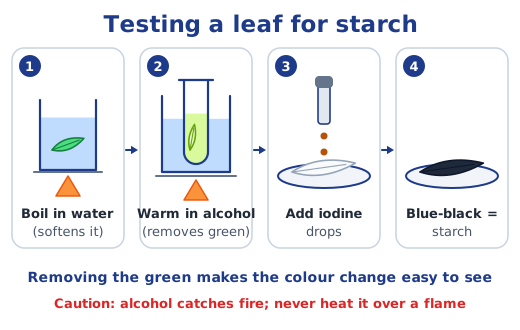
Dive Deeper: how does sunlight help make starch? (Activity 10.3) On the leaf from the plant kept in sunlight, the green patches turn blue-black and the non-green patches do not. The leaf from the plant kept in the dark for 36 hours shows no blue-black at all, so it made no starch.
Do the non-green patches have no chlorophyll at all? Not necessarily. They may have too little chlorophyll to make enough starch for the iodine test to show.
What do you infer from Table 10.2? Starch is made only where chlorophyll is present, and only in sunlight. Chlorophyll is essential for making food, which is why leaves are called the food factories of plants.
The role of air (pages 143–144)
Which gas from the air is needed to make food? Carbon dioxide.
Activity 10.4: sample observations for Table 10.3.
| Part of the leaf | Water, chlorophyll, sunlight, carbon dioxide → starch |
|---|---|
| Inside the bottle | yes, yes, yes, no → no starch |
| Outside the bottle | yes, yes, yes, yes → starch present |
What does this experiment show? The only difference between the two halves was carbon dioxide, which the caustic soda removed inside the bottle. So carbon dioxide from the air is needed to make starch.
What do Activities 10.3 and 10.4 show together? Which part makes starch? Sunlight, chlorophyll, carbon dioxide and water are all needed, and starch is made in the green parts, mainly the leaves. Other green parts with chlorophyll can also make food.
Oxygen is released (page 145)
Activity 10.5: what difference do you see between set-ups A and B? In set-up A, in sunlight, bubbles rise from the water plant and gas collects at the top of the test tube. In set-up B, in the dark, there are no bubbles.
Which gas is this? Oxygen. A lit matchstick burns with a brighter flame in it. So oxygen is given out during photosynthesis, which takes place in light.
Photosynthesis and stomata (pages 146–147)
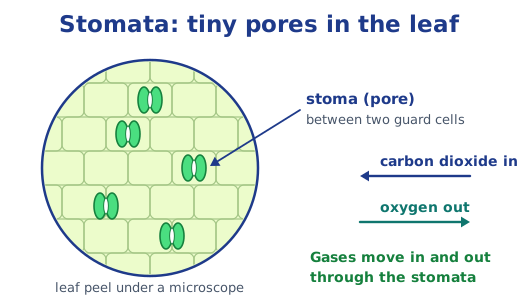
Which part of the plant exchanges carbon dioxide and oxygen? Tiny pores on the leaf surface called stomata.
Activity 10.6: what do you see in the leaf peel under the microscope? Many tiny pores, the stomata, among the cells of the lower surface. (Extra: each pore lies between two bean-shaped guard cells.)
Transport in plants (pages 147–148)
How do water and minerals taken in by the roots reach all parts? Through thin tube-like tissue called the xylem, which runs from the roots through the stem to the leaves.
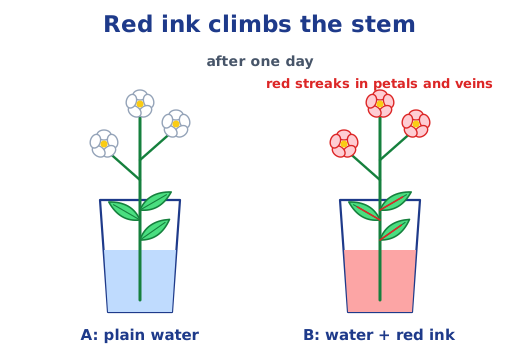
Activity 10.7: what do you notice the next day? How did the parts turn red? The stem, leaf veins and flowers of the twig in tumbler B show red colour; the twig in plain water does not change. The red water was carried up through the xylem. A cut across the stem above the water shows red spots, which are the xylem tubes.
How does food reach other parts of the plant? Through another set of thin tubes, the phloem, which carries food from the leaves to all parts. Some food is stored in parts such as roots and seeds.
Do plants respire? (page 149)
Activity 10.8: does the lime water turn milky in both test tubes? Why does the one joined to the flask turn milky? No. Only the lime water joined to the flask of germinating seeds turns milky; the open tube stays clear. The germinating seeds respire and give out carbon dioxide, which collects in the flask and turns the lime water milky.
Let Us Enhance Our Learning (pages 150–152)
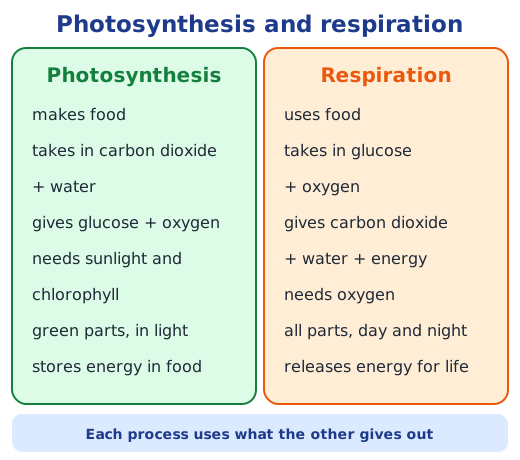
1. Complete the table comparing photosynthesis and respiration.
- Raw materials: photosynthesis uses carbon dioxide and water (with sunlight and chlorophyll); respiration uses glucose and oxygen.
- Products: photosynthesis gives glucose (stored as starch) and oxygen; respiration gives carbon dioxide, water and energy.
- Word equation: photosynthesis, carbon dioxide + water → glucose + oxygen (sunlight, chlorophyll); respiration, glucose + oxygen → carbon dioxide + water + energy.
- Importance: photosynthesis makes food for the plant, and in turn for animals, and adds oxygen to the air; respiration releases energy from food for growth and every life activity.
2. What if every organism that carries out photosynthesis disappeared? No new food would be made, so plant-eating animals would starve first, then the animals that eat them. Oxygen in the air would no longer be replaced while respiration kept using it up and adding carbon dioxide. In time, nearly all living things would die.
3. Where does the starch in a potato come from? The food is made in the leaves by photosynthesis, first as glucose. It is carried down through the phloem to the potato, where it is stored as starch, which is why a potato slice turns blue-black with iodine. (Extra: a potato is a swollen underground stem, called a tuber.)
4. Do broad, flat leaves help photosynthesis? Justify. Yes. A broad, flat leaf spreads a large surface to the sun, so more chlorophyll catches light. A large, thin leaf also has room for many stomata, so carbon dioxide reaches all its cells easily. More light and carbon dioxide mean more food.
5. X + Y → carbon dioxide + Z + energy. What are X, Y and Z? This is respiration: X is glucose, Y is oxygen and Z is water.
6. Krishna’s two potted plants, one in sunlight and one in a dark room. (i) She is testing whether sunlight is needed for a plant to stay healthy and make its food. (ii) The plant in sunlight is green, upright and healthy; the plant in the dark has pale yellow leaves and looks weak and drooping. (iii) The leaves of the plant kept in sunlight would turn blue-black with iodine, confirming starch. The plant in the dark cannot make starch and uses up what it had.
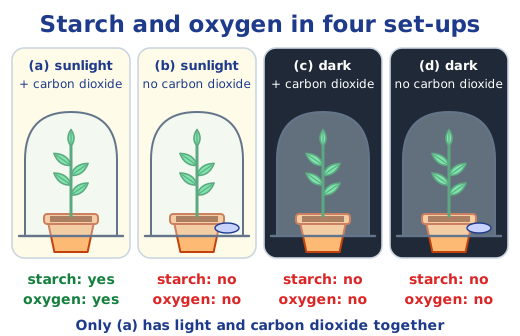
7. Vani’s four set-ups, all with enough water. (i) Starch is formed only in (a), sunlight with carbon dioxide. (ii) Starch is not formed in (b), (c) and (d): (b) lacks carbon dioxide, (c) lacks light, and (d) lacks both. (iii) Oxygen is given out only in (a). (iv) No oxygen is given out in (b), (c) and (d), because photosynthesis does not take place. This supports her idea. For a fair test, the plants should be destarched in the dark first.
8. Ananya’s four test tubes with a carbon dioxide indicator. She wants to find out how a snail and a water plant change the amount of carbon dioxide in water: the snail gives out carbon dioxide in respiration, and the plant uses carbon dioxide in photosynthesis. Tube D, with only water, is the control. Keeping the tubes in light for 2–3 hours, she compares each tube’s colour with its starting colour and with D. Tube A should change colour the most, showing more carbon dioxide; tube B should show less carbon dioxide than at the start; tube C should change little, because the plant uses what the snail gives out; tube D should not change. If her results match, she is correct. She could repeat the test, and also keep a set in the dark, where the plant stops using carbon dioxide.
9. Design an experiment to see whether water moves up faster in warm or cold conditions. Take two similar twigs with white flowers, cut under water, and two tumblers with equal amounts of water and equal drops of red ink. Stand one tumbler in a tray of warm water and the other in a tray of ice-cold water, in the same room and light. Note when red streaks first appear in each twig, and after the same time, say two hours, cut both stems at the same height and compare how far the red colour has risen. Keep everything else the same and repeat once more. The faster one shows the condition in which water moves up more quickly. (Extra: it is usually the warm one, because more water evaporates from warm leaves and pulls water up faster.)
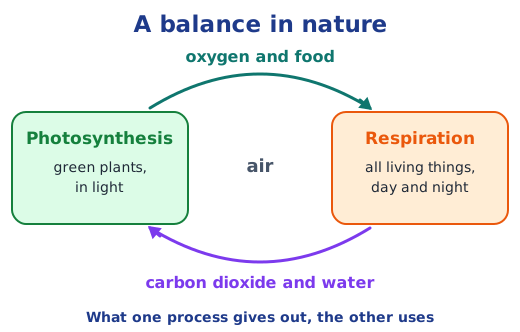
10. How do photosynthesis and respiration keep a balance in nature? Photosynthesis takes in carbon dioxide and gives out oxygen; respiration by plants, animals and other living things takes in oxygen and gives out carbon dioxide. Photosynthesis makes the food that respiration breaks down for energy. Because each process uses what the other gives out, the amounts of oxygen and carbon dioxide in the air stay roughly steady, and food and energy keep flowing to all living things.
Exploratory Projects (page 152)
1. A bottle garden. Put a layer of small pebbles, then charcoal and garden soil, into a large clean transparent bottle, plant a small spider plant or jade plant, water it lightly and keep it where it gets bright light but not harsh sun. Once it is growing well, seal the bottle. If the plant keeps growing, it is using the carbon dioxide from its own respiration for photosynthesis and the oxygen from photosynthesis for respiration. (Extra: water also goes round inside, evaporating from the leaves and soil and running back down the glass.)
2. Why plant processes matter for crops. Photosynthesis makes all the food that ends up in grains, fruits and vegetables, so crops need enough sunlight (proper spacing) and water. Transport through the xylem brings water and fertiliser minerals from the soil to the leaves, so irrigation and good soil matter. The phloem fills grains, fruits and tubers with food. Respiration gives the energy for growth; roots need air in the soil, so ploughing helps and waterlogging harms (Extra).
3. A greenhouse visit. Note how the growers control light (shade nets in strong sun, sometimes lamps), water (drip or sprinkler pipes and misting), air and carbon dioxide (opening and closing vents and fans; some add extra carbon dioxide, Extra) and temperature. Ask which crops they grow and why the covered space helps.
Practice
-
In the iodine test, the part of a leaf that turns blue-black contains:
Show answer
Answer: (b) starch
-
Tiny pores on leaves through which gases pass are called:
Show answer
Answer: (c) stomata
-
Which tissue carries water up from the roots?
Show answer
Answer: (b) Xylem
-
Which gas makes a lit matchstick burn brighter?
Show answer
Answer: (b) Oxygen
-
Give one reason why photosynthesis cannot happen in the roots of a plant.
Show answer
Answer: Roots grow in the dark soil and have no chlorophyll, so they cannot capture sunlight to make food. They get food from the leaves through the phloem.
Stuck on a question?
Take a photo and Lagnever AI explains it step by step. Try it for 7 days for ₹2.
Get it on Google Play Open in browser
For parents: after the trial, the plan renews monthly by UPI or card autopay. You can cancel anytime in the app.