
Class 7 Science Chapter 10: Life Processes in Plants Notes
This chapter in five lines
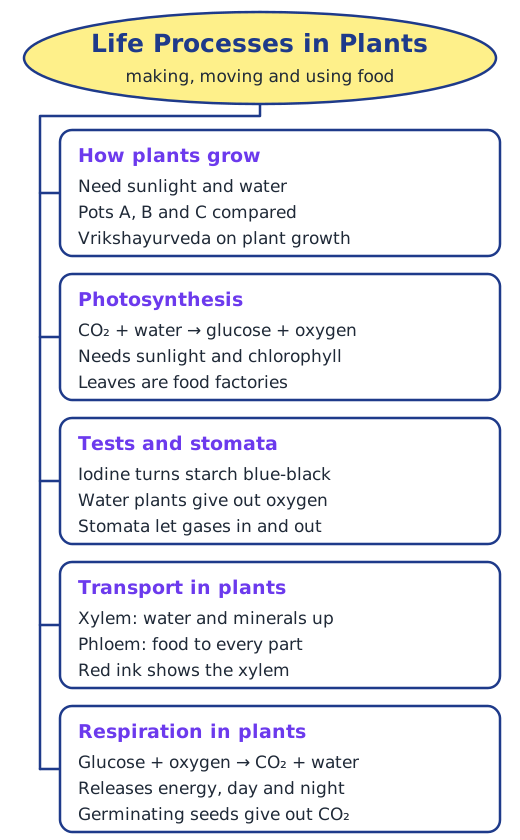
Life Processes in Plants explains how plants make, move and use food. In photosynthesis, green parts use carbon dioxide and water, with sunlight and chlorophyll, to make glucose and give out oxygen; glucose is stored as starch. Stomata let gases in and out of leaves. The xylem carries water and minerals up from the roots, and the phloem carries food to all parts. Plants also respire all the time, breaking down glucose with oxygen to release energy.
What is this chapter about?
Animals eat food, but plants never seem to eat. Yet they grow: new leaves and branches appear, they grow taller and their stems get thicker. This chapter finds out what plants need to grow, how they make their own food, how water and food move inside them, and how they use food to get energy, just as animals do.
What plants need to grow
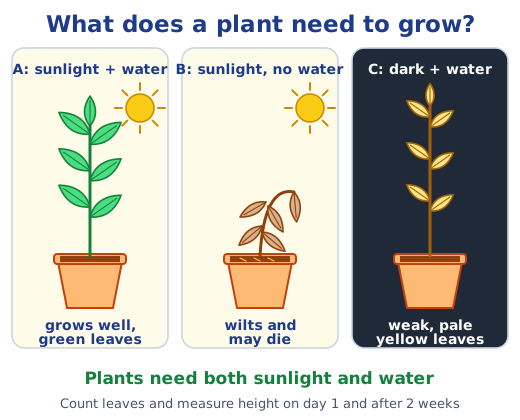
In Activity 10.1, three similar saplings are grown for two weeks: pot A in sunlight with water, pot B in sunlight without water, and pot C in the dark with water. The plant in pot A grows well with green leaves, the one in pot B wilts and may die, and the one in pot C becomes weak with pale yellow leaves. So plants need both sunlight and water. The ancient Indian text Vrikshayurveda also recorded careful observations about plant growth, soil and manure.
Leaves: the food factories
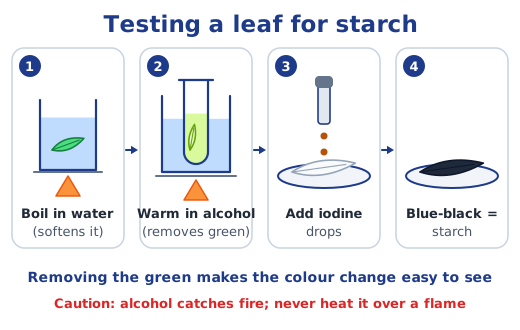
Plants store food as starch, a carbohydrate, and it is made in the leaves. Leaves are usually broad and flat, and green because of chlorophyll, a pigment that captures sunlight. To test a leaf for starch, soften it in boiling water, remove its green colour in alcohol warmed in a water bath (never over a flame), and add dilute iodine: a blue-black colour means starch.
Light, chlorophyll and carbon dioxide
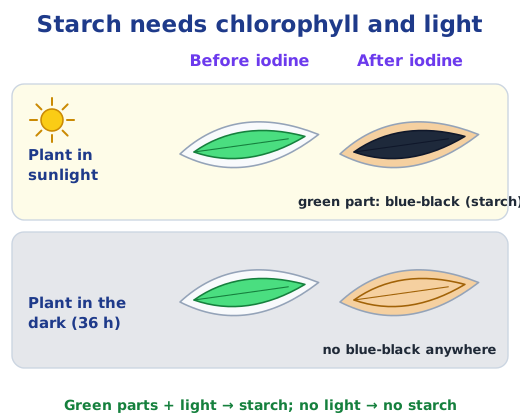
Leaves with green and white patches show where starch forms. On a plant kept in sunlight, only the green parts turn blue-black; on a plant kept in the dark for 36 hours, nothing does. So starch is made where there is chlorophyll, and only in light.
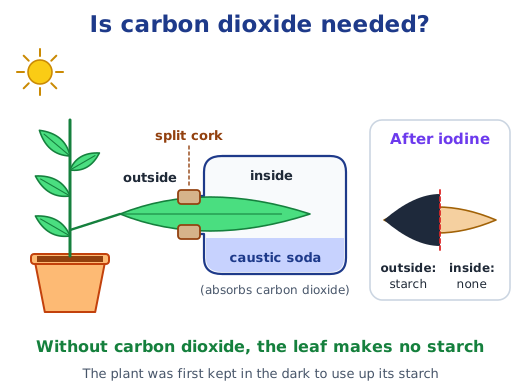
To check the role of air, half of a leaf of a destarched plant is put through a split cork into a bottle of caustic soda, which absorbs carbon dioxide. After some hours in sunlight, the half outside makes starch and the half inside does not: carbon dioxide is needed.
Oxygen is given out
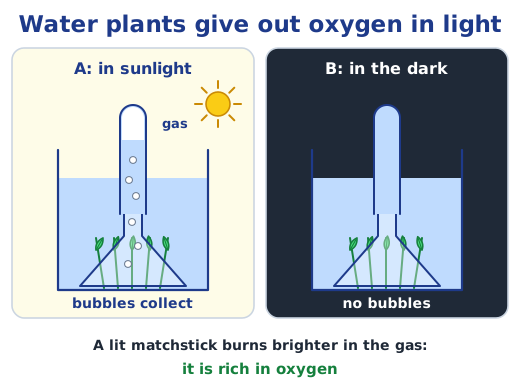
A water plant under a funnel in a beaker of water gives off bubbles in sunlight, but not in the dark. The gas collected in a test tube makes a lit matchstick burn brighter, so it is rich in oxygen.
Photosynthesis
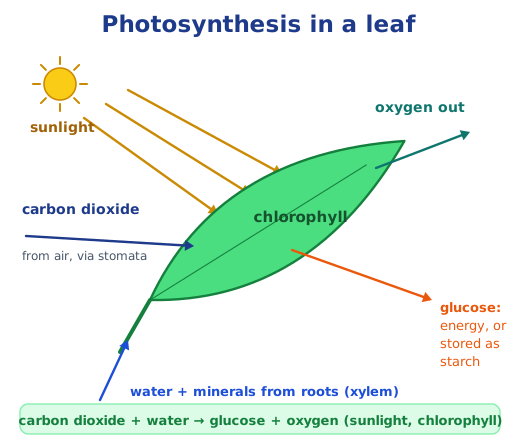
Plants make food from carbon dioxide and water, using sunlight and chlorophyll, and give out oxygen. This is photosynthesis: carbon dioxide + water → glucose + oxygen (in sunlight, with chlorophyll). Glucose gives energy at once or is changed to starch for storage. Leaves are the main site, but all green parts can do it. Gases pass through stomata, tiny pores on the leaf surface. In India, R. H. Dastur studied how water, temperature and the colour of light affect photosynthesis. Read more in photosynthesis.
Transport in plants
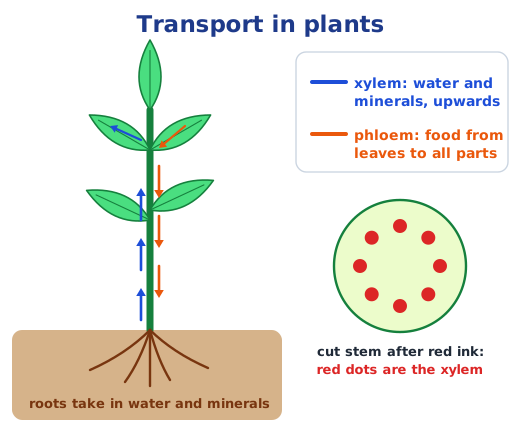
Roots take in water with dissolved minerals. A twig standing in water with red ink turns red in its veins and petals by the next day, and a cut stem shows red spots: the coloured water rises through the xylem. Food made in the leaves travels to all parts through the phloem, and some is stored in roots and seeds. See transport in plants.
Respiration in plants
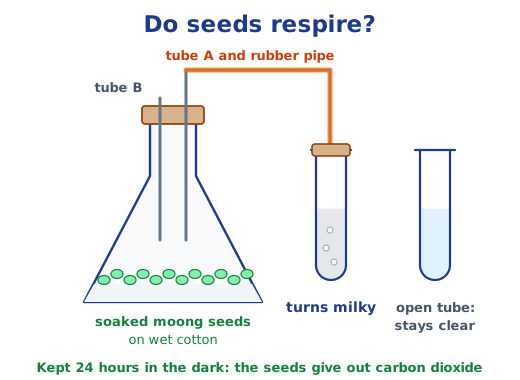
Plants respire, like all living things. Soaked moong seeds on wet cotton in a closed flask, kept in the dark for a day, turn lime water milky: they give out carbon dioxide. In respiration, glucose + oxygen → carbon dioxide + water + energy, and every part of the plant, green or not, does it all the time. Kamala Sohonie earned her PhD for work on respiration in plants and later improved the food value of plant foods. Read respiration in plants. Answers to every question are in the NCERT solutions for Chapter 10.
Key terms
| Term | Meaning |
|---|---|
| Photosynthesis | The process in which green plants make food (glucose) from carbon dioxide and water, using sunlight and chlorophyll, and give out oxygen. |
| Chlorophyll | The green pigment in leaves and other green parts that captures sunlight for photosynthesis. |
| Glucose | A simple carbohydrate made in photosynthesis. It gives energy at once or is changed into starch for storage. |
| Starch | The carbohydrate in which plants store food. Iodine turns it blue-black. |
| Destarching | Keeping a plant in the dark for two or three days so that it uses up its stored starch before a test. |
| Stomata | Tiny pores on the surface of leaves, mostly the lower surface, through which carbon dioxide and oxygen are exchanged. |
| Xylem | Thin tube-like tissue that carries water and dissolved minerals from the roots to the stem, leaves and other parts. |
| Phloem | Thin tube-like tissue that carries food made in the leaves to all parts of the plant. |
| Respiration | The process in which glucose is broken down with oxygen to release energy, giving carbon dioxide and water. Every part of a plant respires. |
| Caustic soda | Sodium hydroxide, a strong chemical that absorbs carbon dioxide; it is used to remove carbon dioxide from the air in an experiment. |
| Lime water | A clear liquid that turns milky when carbon dioxide passes through it. |
Topics in this chapter
Practice
-
Which pigment captures sunlight for photosynthesis?
Show answer
Answer: (b) Chlorophyll
-
Iodine turns a leaf blue-black. This shows the presence of:
Show answer
Answer: (b) starch
-
Which gas do green plants give out during photosynthesis?
Show answer
Answer: (c) Oxygen
-
Water and minerals move up a plant through the:
Show answer
Answer: (c) xylem
-
Which parts of a plant respire?
Show answer
Answer: (d) All parts
-
In Activity 10.4, the caustic soda in the bottle is there to:
Show answer
Answer: (b) absorb carbon dioxide
Questions students ask
What are the main topics of Class 7 Science Chapter 10?
How plants grow and what they need; how leaves make food by photosynthesis; the starch test; the roles of sunlight, chlorophyll and carbon dioxide; the oxygen given out; stomata; transport of water, minerals and food through the xylem and phloem; and respiration in plants.
Is Life Processes in Plants in the new Curiosity book?
Yes. It is Chapter 10 of Curiosity, the Class 7 Science textbook (Reprint 2026-27), on pages 137 to 152.
What is the difference between photosynthesis and respiration?
Photosynthesis makes food: it uses carbon dioxide and water in sunlight and gives glucose and oxygen, only in green parts. Respiration uses food: it breaks glucose down with oxygen into carbon dioxide and water, releasing energy, in every part of the plant, day and night.
Stuck on a question?
Take a photo and Lagnever AI explains it step by step. Try it for 7 days for ₹2.
Get it on Google Play Open in browser
For parents: after the trial, the plan renews monthly by UPI or card autopay. You can cancel anytime in the app.