
Transport in plants
Answer in short
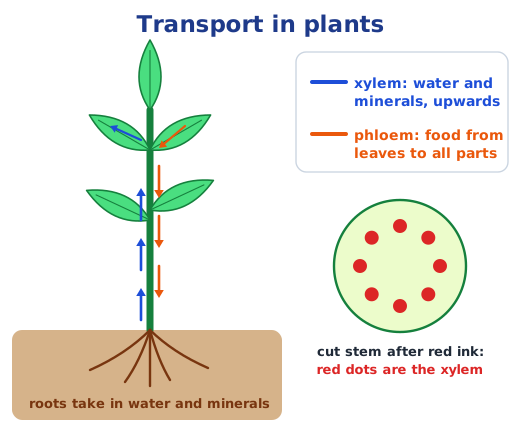
Plants have two sets of thin tubes for transport. The xylem carries water and dissolved minerals, taken in by the roots, up through the stem to the leaves and other parts. The phloem carries food made in the leaves to all parts of the plant, including the roots and seeds, where some of it is stored.
Stuck on a question? Take a photo and Lagnever AI explains it step by step. Try it for 7 days for ₹2. Get it on Google Play
Why plants need transport
A plant’s parts do different jobs in different places. The leaves make food but need water, which is in the soil. The roots take in water but cannot make food, because they are underground and have no chlorophyll. So water must travel up and food must travel to every part. Plants do this through two sets of thin, tube-like tissues: the xylem and the phloem.
Water and minerals: the xylem
Roots take in water together with minerals dissolved in it. Minerals are nutrients that plants need for healthy growth. The water and minerals then move up the stem, into the branches and leaves, through the xylem. Leaves use the water in photosynthesis and for many other jobs.
The red ink experiment
You can watch water rising. Take two tumblers, A and B, a third full of water, and add a few drops of red ink to B. Cut the stems of two similar tender twigs with white flowers, such as white sadabahar or balsam, at a slant while holding them under water, and place one in each tumbler. By the next day, the veins of the leaves and the petals of twig B show red streaks, while twig A looks unchanged.
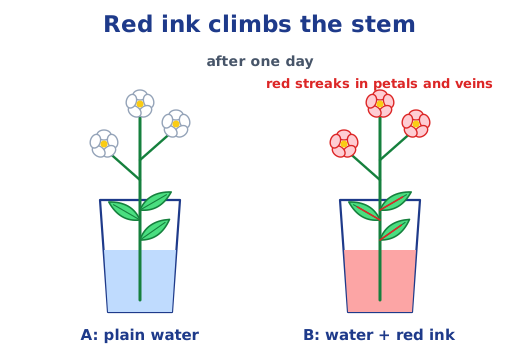
Now cut across the stem of twig B above the water level and look at the cut end with a magnifying glass. Small red spots are visible: these are the xylem tubes through which the coloured water climbed. In the same way, minerals dissolved in water travel up the plant. (Extra: cutting under water keeps air bubbles out of the tubes, and much of the upward pull comes from water evaporating from the leaves through the stomata.)
Food: the phloem
Leaves are the main site of photosynthesis, but every part of the plant needs food. The food made in the leaves is carried to all parts through another set of thin tubes, the phloem. Some of it is used at once for energy and growth, and some is stored, for example in seeds and roots. The starch in a potato, the sugar in sugarcane and the food in grains all arrive through the phloem.
Two systems working together
The xylem and the phloem run side by side through the roots, stem and leaves, like two sets of pipes. Water and minerals go up in the xylem to the leaves; food made there goes out in the phloem to the rest of the plant. If either system is damaged, for example when a ring of bark is stripped from a tree trunk, the parts beyond the damage start to suffer. (Extra: the phloem lies just under the bark, so a stripped ring stops food from reaching the roots.)
Why it matters
Farmers water crops and add fertilisers to the soil because the roots and xylem must supply water and minerals to the leaves. The phloem then fills grains, fruits and tubers with food. See how the food is made in photosynthesis and how it is used in respiration in plants. Answers to the textbook questions are in the NCERT solutions for Chapter 10; see all of Chapter 10 notes.
Practice
-
Which tissue carries food in a plant?
Show answer
Answer: (b) Phloem
-
A white flower on a twig standing in red ink turns reddish because coloured water rises through the:
Show answer
Answer: (b) xylem
-
Minerals from the soil reach the leaves:
Show answer
Answer: (b) dissolved in water, through the xylem
-
Where does the starch in a potato come from?
Show answer
Answer: It is made as food in the leaves by photosynthesis, carried down through the phloem, and stored in the potato.
-
Why do roots need food from the leaves?
Show answer
Answer: Roots grow underground, away from light, and have no chlorophyll, so they cannot make food. They get it from the leaves through the phloem and use it for energy and growth.
Questions students ask
What is the function of the xylem?
The xylem carries water and the minerals dissolved in it from the roots up through the stem to the leaves, flowers and other parts of the plant.
What is the function of the phloem?
The phloem carries food made in the leaves to all parts of the plant. Some of this food is stored in parts such as roots, fruits and seeds.
How can we see water moving up a stem?
Stand a freshly cut twig with white flowers in water coloured with red ink. By the next day the petals and leaf veins turn reddish, and a cut across the stem shows red spots where the xylem is.
Stuck on a question?
Take a photo and Lagnever AI explains it step by step. Try it for 7 days for ₹2.
Get it on Google Play Open in browser
For parents: after the trial, the plan renews monthly by UPI or card autopay. You can cancel anytime in the app.