
Respiration in plants
Answer in short
Plants respire all the time, in every part, green or not. In respiration, glucose is broken down using oxygen to release energy, and carbon dioxide and water are formed: glucose + oxygen → carbon dioxide + water + energy. Germinating seeds kept in a closed flask turn lime water milky, showing that they give out carbon dioxide.
Stuck on a question? Take a photo and Lagnever AI explains it step by step. Try it for 7 days for ₹2. Get it on Google Play
Plants respire too
All living beings respire, and plants are no exception. Making food by photosynthesis stores energy in glucose; to grow, make new leaves, flowers and seeds, a plant has to release that energy. It does this by respiration, breaking down glucose using oxygen. Unlike photosynthesis, which needs light and chlorophyll, respiration goes on in every part of the plant, green or not, day and night.
Seeds that give out carbon dioxide
Soak some moong seeds overnight and place them on wet cotton in a conical flask. Close the flask with a cork that has two holes and two tubes. Join tube A with a rubber pipe to a test tube of lime water, and keep a second test tube of lime water open for comparison. Leave the set-up in the dark for 24 hours.
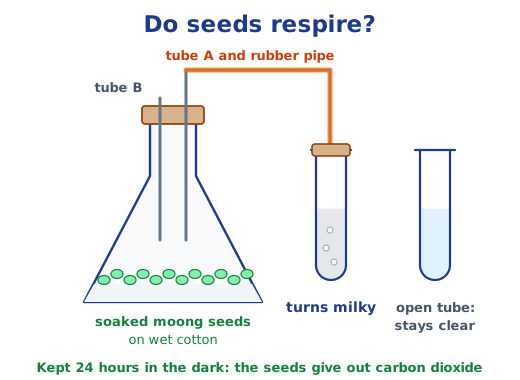
The lime water joined to the flask turns milky, but the open one stays clear. Lime water turns milky with carbon dioxide. Air has only a very small amount of carbon dioxide, so the extra must have come from the seeds: as they germinate, they respire and give out carbon dioxide.
The word equation
Glucose + oxygen → carbon dioxide + water + energy
Plants use this energy for their growth and development. Leaves take in the oxygen they need through their stomata, the same tiny pores that let carbon dioxide in for photosynthesis. Roots take oxygen from the air in the spaces between soil particles. (Extra: this is why waterlogged soil, with its air spaces full of water, harms many plants.)
Energy for growth
A germinating seed shows why respiration matters. Before its first leaves open, a seedling cannot make food, so it lives on the food stored in the seed. Respiration breaks down this stored food to release the energy for pushing out the root and the shoot. Once green leaves form, the plant makes its own food by photosynthesis and keeps respiring to use it. Stored grains, fruits and potatoes also respire, slowly using up their stored food.
Respiration and photosynthesis
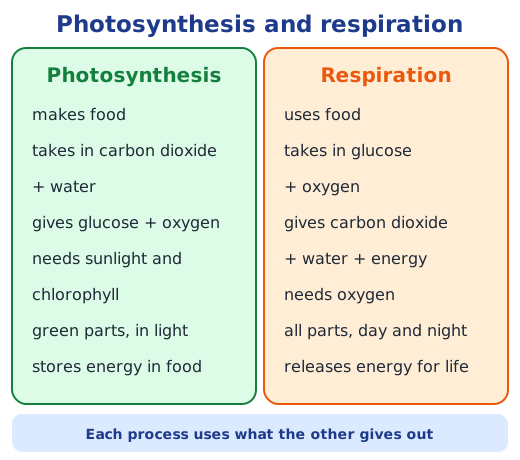
The two processes are almost opposites. Photosynthesis takes in carbon dioxide and water and gives out glucose and oxygen; respiration takes in glucose and oxygen and gives out carbon dioxide and water. Photosynthesis stores energy in food; respiration releases it. Photosynthesis happens only in green parts in light; respiration happens everywhere, all the time.
A balance in nature
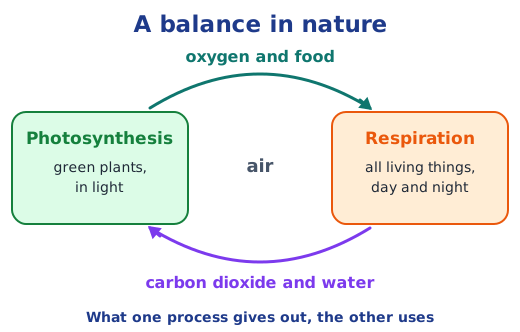
Because each process uses what the other gives out, together they keep the amounts of oxygen and carbon dioxide in the air in balance. A sealed bottle garden shows this on a small scale: a plant inside can keep growing for a long time, using the carbon dioxide from its own respiration for photosynthesis and the oxygen from photosynthesis for respiration. The Indian scientist Kamala Sohonie earned her PhD at Cambridge for research on respiration in plants.
Why it matters
Respiration is how a plant turns stored food into the energy of life. Revise how food is made in photosynthesis and how it travels in transport in plants. Answers to the textbook questions are in the NCERT solutions for Chapter 10; see all of Chapter 10 notes.
Practice
-
In respiration, glucose is broken down using:
Show answer
Answer: (b) oxygen
-
Germinating seeds in a closed flask turn lime water milky because they give out:
Show answer
Answer: (b) carbon dioxide
-
Which statement is true?
Show answer
Answer: (c) Roots and seeds also respire
-
Why are the seeds in the respiration experiment soaked and kept on wet cotton?
Show answer
Answer: Soaked seeds on wet cotton start to germinate. Germinating seeds are very active and respire fast, so they give out enough carbon dioxide to turn the lime water milky.
-
Write the word equation for respiration.
Show answer
Answer: Glucose + oxygen → carbon dioxide + water + energy.
Questions students ask
Do plants respire?
Yes. Like all living things, plants respire. Every part of a plant, including roots, stems, leaves, flowers and seeds, breaks down glucose with oxygen to release the energy it needs for growth and development.
How is respiration different from photosynthesis?
Photosynthesis makes food: it uses carbon dioxide and water and gives glucose and oxygen, only in green parts and only in light. Respiration uses food: it uses glucose and oxygen and gives carbon dioxide, water and energy, in all parts, day and night.
Why is the flask of germinating seeds kept in the dark?
In the dark no photosynthesis can take place in any green sprout, so no carbon dioxide is used up. All the extra carbon dioxide that turns the lime water milky then comes from respiration.
Stuck on a question?
Take a photo and Lagnever AI explains it step by step. Try it for 7 days for ₹2.
Get it on Google Play Open in browser
For parents: after the trial, the plan renews monthly by UPI or card autopay. You can cancel anytime in the app.