
Photosynthesis
Answer in short
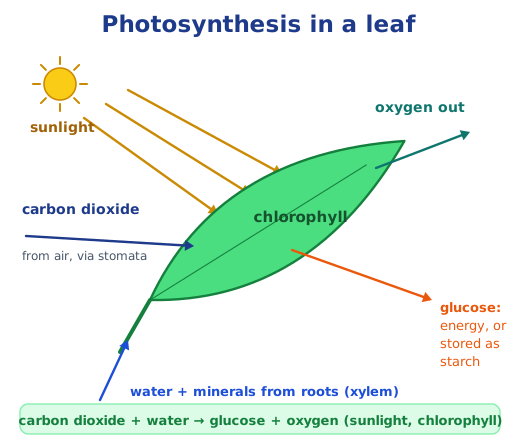
Photosynthesis is the process by which green plants make their own food. Using sunlight captured by chlorophyll, they combine carbon dioxide from the air with water from the soil to make glucose, and give out oxygen. The glucose gives energy or is stored as starch. Leaves, with their stomata, are the main food factories.
Stuck on a question? Take a photo and Lagnever AI explains it step by step. Try it for 7 days for ₹2. Get it on Google Play
Plants make their own food
Animals get food by eating plants, or by eating animals that ate plants. Plants do not eat at all: they make their food. The food is made mainly in the leaves and stored as starch, a carbohydrate. Leaves are generally broad and flat, and most are green because of chlorophyll, a pigment that captures sunlight. That is why leaves are called the food factories of a plant.
Testing a leaf for starch
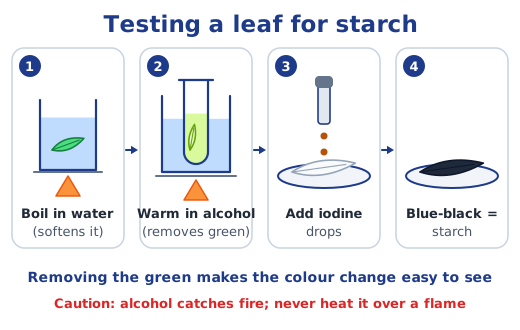
Iodine turns starch blue-black, but the green colour of a leaf would hide the change. So the leaf is softened in boiling water for about five minutes and then placed in a test tube of alcohol standing in hot water until it loses its green colour. Alcohol catches fire easily, so it is never heated directly over a flame. A few drops of dilute iodine on the pale leaf then turn it blue-black if starch is present.
Light and chlorophyll are needed
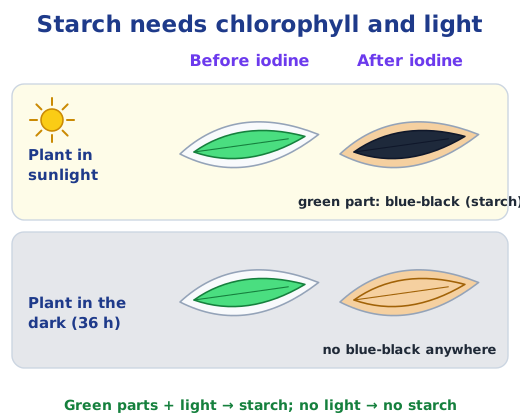
Some leaves have green and white patches. If such leaves are taken from a plant kept in sunlight and from one kept in the dark for 36 hours, and both are tested, only the green patches of the sunlit leaf turn blue-black. The leaf from the dark shows no starch at all. So starch forms only where there is chlorophyll, and only in light. White patches may have too little chlorophyll to make enough starch to detect. Leaves that look red, violet or brown also have chlorophyll, hidden by other pigments, and they too make starch.
Carbon dioxide is needed
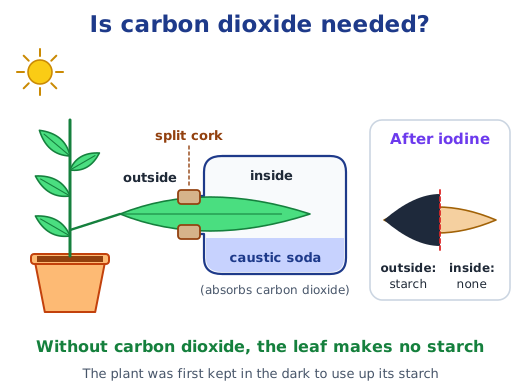
A plant is first kept in the dark for two or three days to destarch it. Then half of one of its leaves is pushed through a split cork into a bottle containing caustic soda, which absorbs carbon dioxide, and the set-up is kept in sunlight for a few hours. The part of the leaf outside the bottle turns blue-black in the iodine test, but the part inside does not. Both parts had water, chlorophyll and light; only the inside part lacked carbon dioxide. So carbon dioxide from the air is needed to make food.
Oxygen is given out
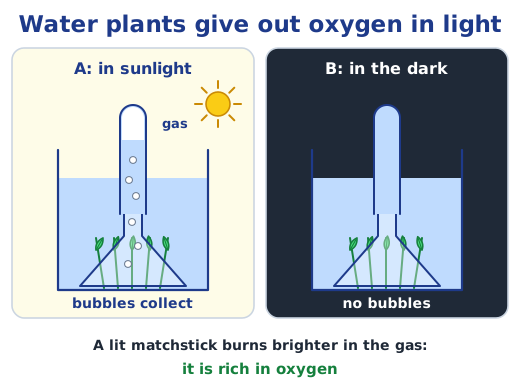
A water plant is placed under an upside-down funnel in a beaker of water, with a test tube full of water over the funnel’s stem. In sunlight, bubbles rise and gas collects at the top of the tube; in the dark, there are no bubbles. A lit matchstick put into the collected gas burns with a brighter flame, so the gas is rich in oxygen. Plants release oxygen while making food in light.
Putting it together
Photosynthesis is the making of food by green plants in the presence of sunlight and chlorophyll:
Carbon dioxide + water → glucose + oxygen (sunlight, chlorophyll)
Food is first made as glucose, a simple carbohydrate, which gives energy straight away or is changed into starch to be stored. Carbon dioxide enters and oxygen leaves through stomata, tiny pores mostly on the lower surface of leaves. Water reaches the leaves from the roots. Leaves are the main site, but any green part with chlorophyll can photosynthesise. The Indian plant scientist R. H. Dastur studied how water, temperature and the colour of light affect photosynthesis.
Why it matters
Almost every living thing depends on photosynthesis for food, and on the oxygen it gives out. Learn how water and food move in transport in plants and how food is used in respiration in plants. Answers to the textbook questions are in the NCERT solutions for Chapter 10; see all of Chapter 10 notes.
Practice
-
Which of these is not needed for photosynthesis?
Show answer
Answer: (c) Oxygen
-
A leaf is warmed in alcohol before the iodine test in order to:
Show answer
Answer: (b) remove its green colour
-
A plant is kept in the dark for two or three days before a starch test so that:
Show answer
Answer: (b) its stored starch is used up
-
Why are most leaves broad and flat?
Show answer
Answer: A broad, flat leaf has a large surface that catches more sunlight and has room for many stomata to take in carbon dioxide, so it can make more food.
-
How can you show that a water plant gives out oxygen in light?
Show answer
Answer: Keep the plant under an upside-down funnel in a beaker of water, with a test tube full of water over the funnel, in sunlight. Bubbles of gas collect in the tube, and a lit matchstick burns brighter in this gas, so it is rich in oxygen.
Questions students ask
What is photosynthesis?
Photosynthesis is the process by which green plants make food. In the presence of sunlight and chlorophyll, they turn carbon dioxide and water into glucose and give out oxygen.
What is the word equation for photosynthesis?
Carbon dioxide + water → glucose + oxygen, in the presence of sunlight and chlorophyll. The glucose is used for energy or stored as starch.
Why are leaves called the food factories of plants?
Because most of a plant’s food is made in its leaves. They are rich in chlorophyll, broad and flat to catch sunlight, and take in carbon dioxide through their stomata.
Stuck on a question?
Take a photo and Lagnever AI explains it step by step. Try it for 7 days for ₹2.
Get it on Google Play Open in browser
For parents: after the trial, the plan renews monthly by UPI or card autopay. You can cancel anytime in the app.