
NCERT Solutions Class 7 Science Chapter 9: Life Processes in Animals
Answers to every question in Chapter 9, Life Processes in Animals, of Curiosity (Reprint 2026-27): the in-text questions and activities, all 10 “Let Us Enhance Our Learning” questions with reasons, and the exploratory projects. The page numbers match the book (pages 121–136). Activities have sample observations; yours may differ a little. Short notes: Chapter 9 notes.
Food and the mouth (pages 122–123)
Observe your surroundings and notice what animals eat. Answers vary. Examples: cows and goats eat grass and leaves, sparrows eat grains, crows eat almost anything, butterflies, bees and sunbirds suck nectar, lizards eat insects, cats eat rats and fish, and puppies and calves drink their mother’s milk.
Think about your favourite food. Does your mouth feel watery? Yes. Just thinking about tasty food makes the mouth release more saliva.
What is the role of saliva? What do you feel when you chew chapati for 30–60 seconds? The chapati starts to taste sweet. Chapati contains starch, and a digestive juice in saliva breaks starch into sugar. Saliva also moistens and softens food so that it is easy to swallow.
Find out the ways our elders maintained oral hygiene. Answers vary. Elders often mention cleaning teeth with a neem or babool twig (datun), rubbing teeth with salt or tooth powder, rinsing the mouth after every meal, scraping the tongue, and gargling with salt water.
Activity 9.1: the action of saliva on starch (pages 123–124)
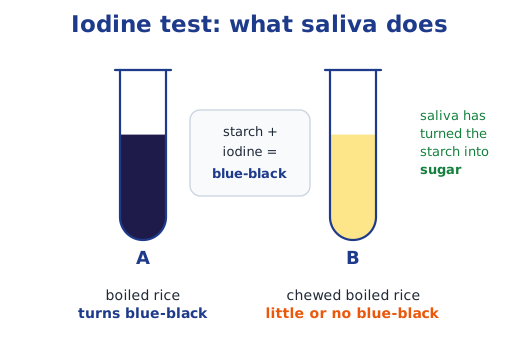
Sample observations for Table 9.1:
| Test tube | Colour before → after iodine, and reason |
|---|---|
| A: Boiled rice | Whitish → blue-black: starch is present |
| B: Chewed boiled rice | Whitish → no change, or very light blue-black: saliva has broken most of the starch into sugar |
What causes the change of colour in test tube A? Iodine reacts with the starch in the boiled rice and gives a blue-black colour.
If the colour still appears in test tube B, what changes would you make? Would it change if you chewed longer? Chew the rice for longer, say 2 minutes, use a smaller amount, and wait a few minutes before adding iodine so that saliva has more time to act. Chewing longer gives less blue-black colour, because more of the starch has been broken down.
Down the alimentary canal (pages 124–127)
How does the food move down the food pipe? Its walls tighten and loosen in waves, squeezing the food down to the stomach. This movement happens all along the alimentary canal.
Guess how long the small intestine is. About 6 m, nearly twice the height of a classroom. No other part of the canal is as long.
How are nutrients absorbed from the small intestine? Its inner lining is thin and has thousands of finger-like projections that increase the surface area. Digested nutrients pass through them into the blood, which carries them to all parts of the body.
What happens to the undigested food? It passes on to the large intestine, which absorbs water and some salts, leaving semi-solid stool. The stool is stored in the rectum and removed through the anus (egestion).
The large intestine is only about 1.5 m long. Why is it called large? Because it is wider than the small intestine.
Why do cows keep chewing even when they are not eating? Cows are ruminants. They swallow grass after chewing it a little; after partial digestion in the stomach, the food comes back to the mouth and is chewed slowly again. This is rumination.
Breathing (pages 129–131)
We can live for days without food, but only a few minutes without breathing. Why? Every part of the body needs oxygen all the time to release energy from food by respiration. Without breathing the supply of oxygen stops, so the body, and especially the brain, cannot get energy.
Have you noticed tiny hair inside your nostrils? Yes. Together with mucus, they catch dust and dirt in the incoming air, so it is better to breathe through the nose.
Activity 9.2: What happens to the balloons? When the rubber sheet is pulled down, the balloons inflate; when it is released upwards, they deflate.
What do the balloons and the rubber sheet represent? The balloons stand for the lungs and the rubber sheet for the diaphragm. Pulling the sheet down makes more space inside the bottle, just as the diaphragm moving down makes more space in the chest when we inhale.
What we breathe out (pages 131–132)
Activity 9.3: Do you observe any change in the colour of the lime water? Yes. In test tube B, into which we blow, it turns milky. The lime water in test tube A, through which room air is pushed with a pichkari, stays clear.
What does this indicate? Carbon dioxide turns lime water milky, so exhaled air carries more carbon dioxide than inhaled air: nearly 4–5%, against 0.04%.
How does the exchange of gases happen? In the alveoli. Their thin walls are surrounded by fine tubes containing blood. Oxygen moves from the air in the alveoli into the blood, which carries it all over the body, while carbon dioxide moves from the blood into the alveoli and is breathed out.
How does food give us energy? Food is broken down into simple substances such as glucose, and oxygen breaks down glucose to release energy: glucose + oxygen → carbon dioxide + water + energy. This is respiration.
How do birds and fish breathe? Birds breathe with lungs. Fish breathe with gills, which take in oxygen dissolved in water.
Let Us Enhance Our Learning (pages 135–136)
1. Complete the journey of food through the alimentary canal. Food → Mouth → Oesophagus (food pipe) → Stomach → Small intestine → Large intestine → Anus.
2. Sahil put chapati pieces in tube A, Neha chewed chapati in tube B and Santushti boiled mashed potato in tube C, and each added iodine. What would they observe? Give reasons. A: blue-black, because the chapati contains starch. B: no change, or only a very light blue-black, because saliva has broken most of the starch into sugar. C: blue-black, because potato is rich in starch; boiling and mashing only break it into small pieces and do not turn the starch into sugar.
3. What is the role of the diaphragm in breathing? (iii) To help in inhalation and exhalation. It moves down to let air in and up to push air out. Filtering is done by the hair and mucus in the nasal passages, and oxygen passes into the blood in the alveoli.
4. Match the parts with their functions. (i) Nostrils → (a) fresh air from outside enters. (ii) Nasal passages → (d) tiny hair and mucus trap dust and dirt. (iii) Windpipe → (e) air reaches the lungs through it. (iv) Alveoli → (b) exchange of gases occurs. (v) Rib cage → (c) protects the lungs.
5. Anil says respiration and breathing are the same. What questions can Sanvi ask him? Sanvi can ask: Where does each one happen? Breathing happens in the nose, windpipe and lungs, but respiration happens inside all parts of the body. Is it a movement of air or a change in substances? Breathing only moves air in and out, a physical process; respiration breaks glucose into carbon dioxide and water, a chemical process. Which one releases energy from food? Only respiration. What happens to the oxygen after it enters the blood? It is used in respiration. Answering these will show Anil that they are different processes, although breathing supplies the oxygen that respiration uses.
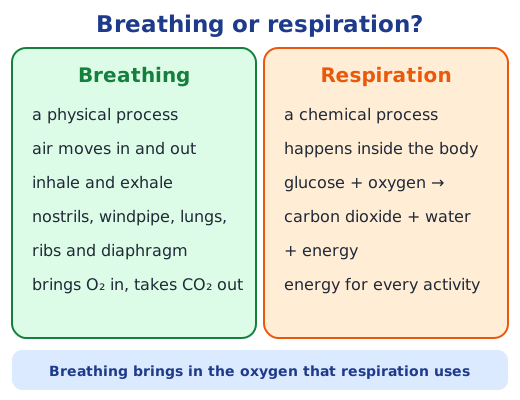
6. Anu: we inhale air. Shanu: we inhale oxygen. Tanu: we inhale air rich in oxygen. Which is correct and why? Anu is correct. We breathe in air, which is a mixture of gases; only about 21% of it is oxygen. Shanu is wrong, because we do not breathe in pure oxygen. Tanu is only partly right: inhaled air has more oxygen than exhaled air (nearly 21% against 16–17%), but it is not rich in oxygen, since most of it is other gases, mainly nitrogen (Extra: about 78%).
7. We often sneeze when we inhale a lot of dusty air. What could the explanations be? The hair and mucus in the nasal passages trap dust. When a lot of dust enters, it irritates the lining of the nose, and a sneeze, a sudden strong burst of air through the nose and mouth, throws the dust out. This keeps the nasal passages clear and stops the dust from reaching the lungs. Some people also sneeze more because tiny particles in dust, such as pollen, trouble them more than others (Extra).
8. After running, Anusha was breathing faster than Paridhi. Give two possible explanations. (i) Anusha may have run faster or longer, so her body used more energy and needed more oxygen for respiration, and made more carbon dioxide to remove. (ii) She may not run as regularly as Paridhi, so her body needs more breaths to get enough oxygen. Other possibilities: she counted her breaths sooner after stopping, or she had a cold or a blocked nose.
9. Yadu added saliva to rice flour and water in tube B, waited 35–45 minutes and added iodine to both tubes. What is he testing? He is testing whether saliva breaks down starch. Tube A, without saliva, turns blue-black, so its starch is still there. Tube B, with saliva, shows no blue-black and keeps the brown colour of iodine, so its starch has been broken down into sugar. Tube A is the control: it is the same in every way except for the saliva.
10. Rakshita passed inhaled air through lime water in tube A and blew exhaled air through tube B. What is she investigating, and how can she confirm it? She is investigating whether the air we breathe out has more carbon dioxide than the air we breathe in. The lime water in B turns milky, while A stays clear or turns milky only very slowly. To confirm it, she can repeat the test a few times, and with friends, using equal amounts of fresh lime water and passing air for the same time in both tubes, and then compare how quickly each tube turns milky.
Exploratory Projects (page 136)
1. Good practices for oral hygiene. Brush twice a day and clean the tongue; rinse the mouth after every meal; eat fewer sticky, sugary snacks; drink plenty of water; and see a dentist regularly. Add what elders tell you, such as the neem datun and salt water gargles, and note which practices they still follow.
2. Keeping the digestive system healthy. Eat fibre-rich food (fruits, vegetables, whole grains, millets and pulses), fermented foods such as curd, buttermilk and kanji, and drink enough water. Chew food well, eat at regular times, avoid overeating and too much fried or junk food, stay active, and wash your hands before eating. Spices such as ginger, black pepper and cumin help digestion when used in moderation, as the Charaka Samhita advises.
3. A 3-D clay model of the digestive system. Use a different colour for each part: mouth, food pipe, stomach, liver, pancreas, a coiled small intestine, the wider large intestine around it, rectum and anus. Place the liver and pancreas next to the small intestine, and label every part with black paper strips.
4. Air quality and AQI. (Extra) The Air Quality Index (AQI) is a number from 0 to 500 that tells how polluted the air is. In India it has six categories: Good (0–50), Satisfactory (51–100), Moderately polluted (101–200), Poor (201–300), Very poor (301–400) and Severe (401–500). People who work outdoors or near smoke and dust for many hours, such as farmers near burning crop stubble or pesticide sprays, factory workers near fumes and dust, and street vendors beside busy roads, more often suffer from coughing, breathlessness, asthma and other lung problems. Masks, good ventilation and regular health check-ups help.
5. Box breathing. Breathe in for a count of 4, hold for 4, breathe out for 4 and hold for 4, then repeat, as in the four sides of a box (Fig. 9.17). (Extra) It slows breathing down and is used to calm the mind, reduce stress and improve focus, for example before an examination.
6. How can birds fly high where there is little oxygen? (Extra) Besides their lungs, birds have air sacs. Air flows through their lungs in one direction both when they breathe in and when they breathe out, so fresh air passes over the gas-exchange surfaces almost all the time, and they take more of the oxygen from each breath. Bar-headed geese use this to fly over the Himalaya. This fits the book’s note that some animals take a bigger share of the oxygen from the air they breathe in.
Practice
-
Iodine is added to boiled mashed potato. The colour will be:
Show answer
Answer: (c) blue-black Potato is rich in starch, and iodine turns starch blue-black.
-
In the bottle model of breathing, the rubber sheet stands for the:
Show answer
Answer: (c) diaphragm
-
Which part of the respiratory system protects the lungs?
Show answer
Answer: (b) Rib cage
-
Inhaled air has nearly 21% oxygen. Exhaled air has nearly:
Show answer
Answer: (b) 16–17% oxygen Not all the oxygen we breathe in is used up.
-
Give two reasons why a person may breathe faster after running.
Show answer
Answer: Running uses a lot of energy, so the body needs more oxygen for respiration and makes more carbon dioxide; breathing faster brings in more oxygen and removes the extra carbon dioxide. A person who ran faster or longer, or who does not run often, will breathe faster still.
Stuck on a question?
Take a photo and Lagnever AI explains it step by step. Try it for 7 days for ₹2.
Get it on Google Play Open in browser
For parents: after the trial, the plan renews monthly by UPI or card autopay. You can cancel anytime in the app.