
Class 7 Science Chapter 9: Life Processes in Animals Notes
This chapter in five lines
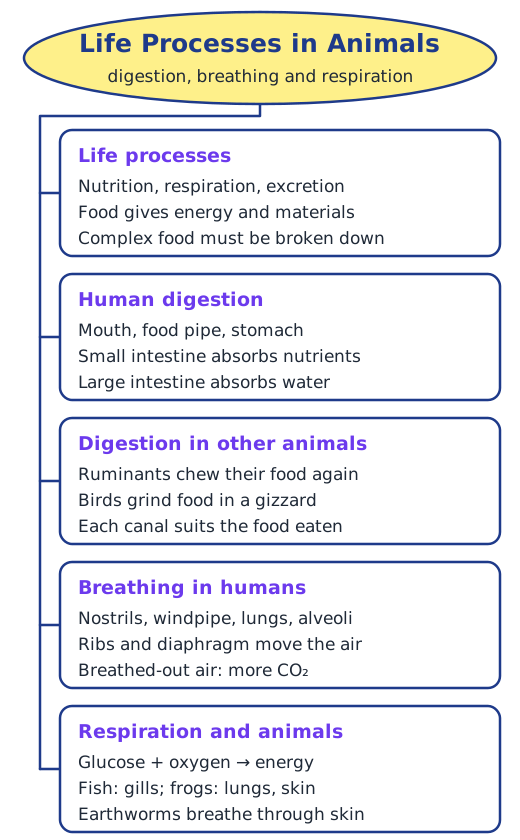
Life Processes in Animals explains nutrition and respiration. Food is broken down in the alimentary canal: saliva starts digesting starch, the stomach works on proteins, and the small intestine finishes digestion and absorbs nutrients into the blood, while the large intestine absorbs water. Breathing moves air in and out of the lungs, where oxygen enters the blood in the alveoli. Respiration uses that oxygen to break down glucose and release energy.
What is this chapter about?
Living beings need life processes such as nutrition, respiration, circulation, excretion and reproduction to stay alive. This chapter looks closely at two of them. Nutrition: how complex food is broken down and absorbed, in humans and in animals such as cows and birds. Respiration: how we breathe, what happens to the oxygen we take in, and how fish, frogs and earthworms get their oxygen.
The journey of food
Animals eat many kinds of food: bees and sunbirds suck nectar, infants drink milk, a python swallows its prey whole, and some water animals filter tiny particles. Food contains complex components such as carbohydrates, proteins and fats, which the body can use only after they are broken into simpler forms. This happens in the alimentary canal, a long tube from the mouth to the anus.
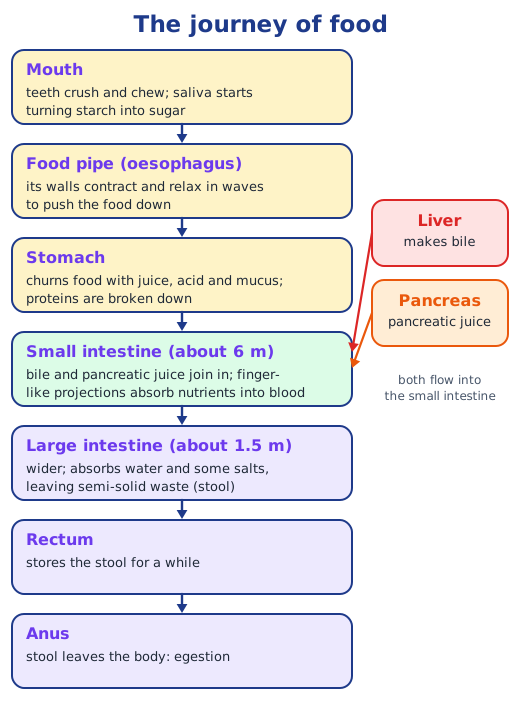
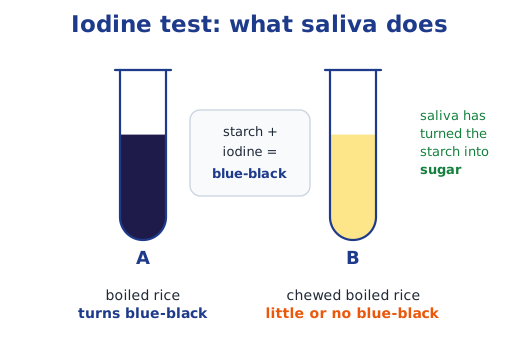
In the mouth, teeth crush and chew the food (mechanical digestion) and saliva softens it and starts breaking starch into sugar, which is why a chapati tastes sweet after long chewing. Activity 9.1 shows it with iodine, which turns starch blue-black: boiled rice turns blue-black, but chewed rice shows little or no blue-black.
Stomach and small intestine
The tongue pushes the soft food into the food pipe (oesophagus), whose walls contract and relax in waves to move it to the stomach. The stomach churns the food and adds a juice that breaks down proteins, an acid that helps with this and kills many harmful bacteria, and mucus that protects the stomach lining. Much of this was first seen in 1822, when a doctor, William Beaumont, studied digestion through a wound that never closed in the stomach of a patient, Alexis St. Martin.
The small intestine is about 6 m long, the longest part of the canal. It receives bile from the liver, which neutralises the stomach acid and breaks fats into tiny droplets, and juice from the pancreas, which works on carbohydrates, proteins and fats. Its own juice finishes the job. Thousands of finger-like projections on its inner lining absorb the nutrients into the blood, which carries them around the body. Read more in nutrition and digestion in animals.
Large intestine and gut health
The undigested food moves into the large intestine, about 1.5 m long but wider. It absorbs water and some salts, leaving semi-solid stool, which is stored in the rectum and leaves through the anus: egestion. Fibre in fruits, vegetables and whole grains keeps the large intestine working well, and its bacteria break down fibre and make useful nutrients; fermented foods such as curd, buttermilk, kanji, gundruk and poita bhat support them. The Charaka Samhita advised easily digestible food and spices such as ginger and cumin.
Digestion in other animals
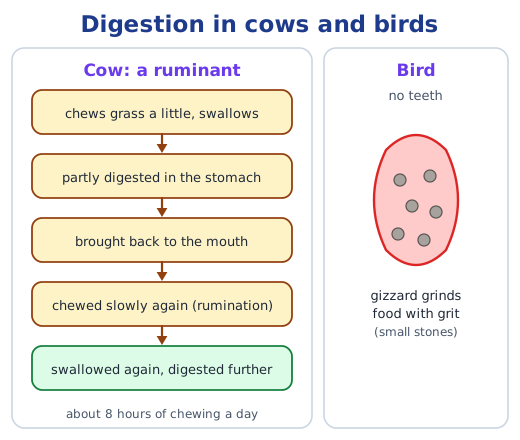
Cows and buffaloes chew grass a little and swallow it; after partial digestion in the stomach, it comes back to the mouth to be chewed slowly again. This is rumination, and such animals are ruminants; a cow chews for about 8 hours a day. Birds have no teeth: their gizzard grinds food, often with grit. Each animal’s canal suits the food it eats.
Breathing
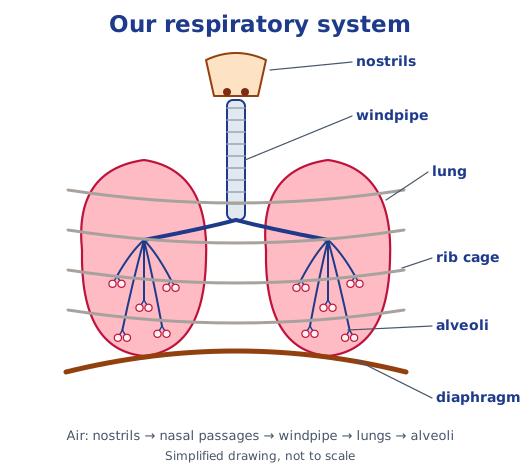
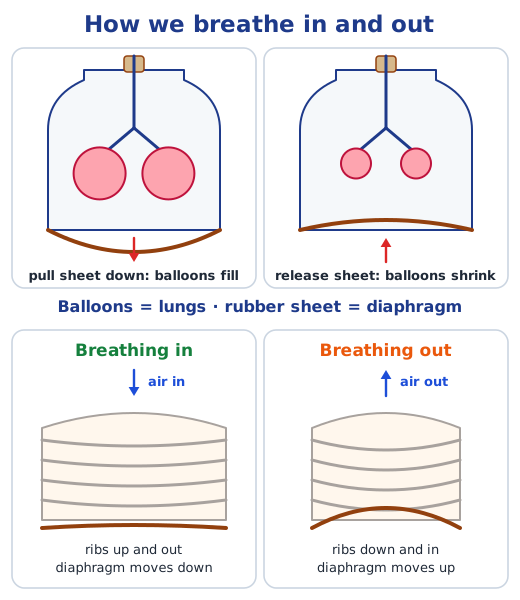
Breathing is taking air in (inhaling) and pushing it out (exhaling). Air enters through the nostrils; hair and mucus in the nasal passages trap dust, so it is better to breathe through the nose. It passes down the windpipe, which branches into the two lungs, and the branches end in tiny sacs called alveoli. The rib cage protects the lungs. When we breathe in, the ribs move up and out and the diaphragm moves down, giving the lungs more space; when we breathe out, they move back and push air out. A bottle model with balloons (the lungs) and a rubber sheet (the diaphragm) shows this.
What we breathe out
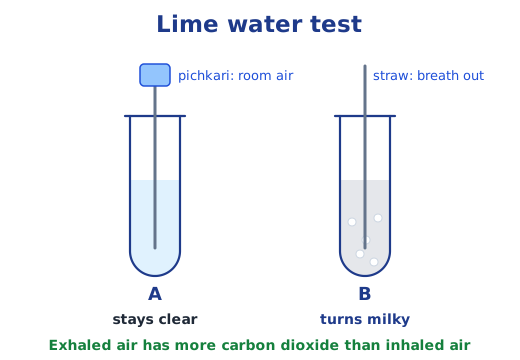
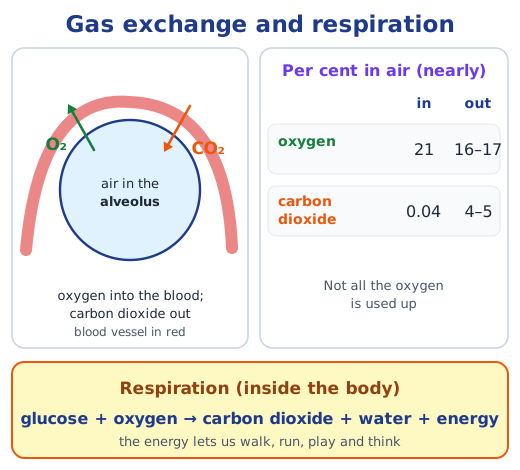
When breath is blown through lime water it turns milky, but room air pushed in with a pichkari does not, so exhaled air has more carbon dioxide. Inhaled air has nearly 21% oxygen and 0.04% carbon dioxide; exhaled air has nearly 16–17% oxygen and 4–5% carbon dioxide.
Gas exchange and respiration
In the thin-walled alveoli, oxygen passes into the blood and carbon dioxide passes out of it to be breathed away. The blood, pumped by the heart through blood vessels (the circulatory system), takes oxygen and nutrients all over the body. There, respiration releases energy: glucose + oxygen → carbon dioxide + water + energy. Breathing is a physical process; respiration is a chemical one.
How other animals breathe
Birds, elephants, cows, lizards and snakes breathe with lungs, though their lungs differ. Fish use gills to take oxygen dissolved in water. Tadpoles use gills; adult frogs use lungs on land and their skin in water. Earthworms breathe through their moist skin. Read respiration in animals. Answers to all the questions are in the NCERT solutions for Chapter 9.
Key terms
| Term | Meaning |
|---|---|
| Life processes | Processes needed to stay alive, such as nutrition, respiration, circulation, excretion and reproduction. |
| Alimentary canal | The long tube from the mouth to the anus through which food passes and is digested: mouth, food pipe, stomach, small intestine, large intestine and anus. |
| Mechanical digestion | Breaking food into small pieces by crushing and chewing with the teeth. |
| Digestion | Breaking complex food components such as starch, proteins and fats into simpler forms the body can use. |
| Saliva | The watery juice in the mouth that softens food and starts breaking starch into sugar. |
| Bile | A mildly basic juice made by the liver. It neutralises the acid from the stomach and breaks fats into tiny droplets. |
| Absorption | The passing of digested nutrients from the small intestine into the blood, through thousands of finger-like projections. |
| Egestion | Getting rid of undigested waste (stool) through the anus. |
| Rumination | Bringing partly digested food back from the stomach to the mouth to chew it again, as cows and buffaloes do. |
| Gizzard | A muscular chamber in birds that grinds food, often with small stones (grit) the bird has swallowed. |
| Breathing | Taking air into the lungs (inhalation) and pushing it out (exhalation). It is a physical process. |
| Diaphragm | A dome-shaped muscle below the lungs. It moves down when we breathe in and up when we breathe out. |
| Alveoli | Tiny balloon-like air sacs at the ends of the finest tubes in the lungs, where oxygen and carbon dioxide are exchanged with the blood. |
| Respiration | The chemical process in which oxygen breaks down glucose to release energy, giving carbon dioxide and water. |
| Gills | Breathing organs of fish, rich in blood vessels, that take in oxygen dissolved in water. |
Topics in this chapter
Practice
-
Where are most digested nutrients absorbed into the blood?
Show answer
Answer: (b) Small intestine
-
Which juice is made by the liver?
Show answer
Answer: (b) Bile
-
Lime water turns milky when air is blown into it from the mouth because exhaled air has more:
Show answer
Answer: (c) carbon dioxide
-
When we breathe in, the diaphragm:
Show answer
Answer: (b) moves down
-
Fish take in oxygen through their:
Show answer
Answer: (c) gills
-
Which statement is correct?
Show answer
Answer: (c) Respiration uses oxygen to break down glucose
Questions students ask
What are the main topics of Class 7 Science Chapter 9?
Nutrition and digestion in humans, from the mouth to the anus; the action of saliva on starch; digestion in cows and birds; breathing and the human respiratory system; what we breathe out; gas exchange and respiration; and how fish, frogs and earthworms breathe.
Is Life Processes in Animals in the new Curiosity book?
Yes. It is Chapter 9 of Curiosity, the Class 7 Science textbook (Reprint 2026-27), on pages 121 to 136.
What is the difference between breathing and respiration?
Breathing is the physical process of taking air into the lungs and pushing it out. Respiration is the chemical process inside the body in which oxygen breaks down glucose to release energy, producing carbon dioxide and water.
Stuck on a question?
Take a photo and Lagnever AI explains it step by step. Try it for 7 days for ₹2.
Get it on Google Play Open in browser
For parents: after the trial, the plan renews monthly by UPI or card autopay. You can cancel anytime in the app.