
Respiration in animals
Answer in short
Breathing moves air into and out of the lungs; respiration is the chemical process in which oxygen breaks down glucose to release energy, giving carbon dioxide and water. In our lungs, gases are exchanged with the blood in tiny sacs called alveoli. Fish breathe with gills, frogs with lungs and skin, and earthworms through moist skin.
Stuck on a question? Take a photo and Lagnever AI explains it step by step. Try it for 7 days for ₹2. Get it on Google Play
Breathing and the respiratory system
We can live for days without food and a day or two without water, but usually only a few minutes without breathing. Breathing means inhaling air into the lungs and exhaling it out. It happens through the respiratory system.
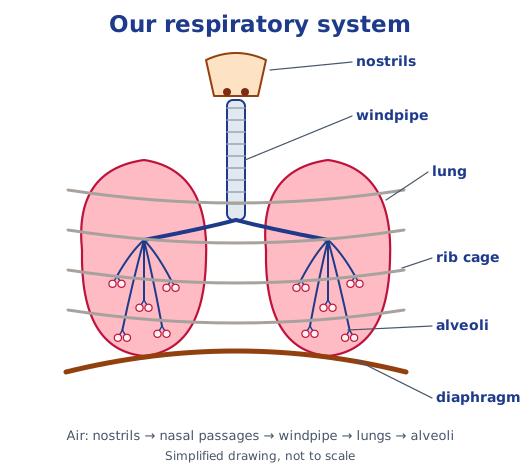
Air enters through the two nostrils into the nasal passages, where tiny hair and mucus trap dust and dirt; that is why breathing through the nose is better. The air goes down the windpipe, which divides into two branches, one for each lung. Inside the lungs the branches divide again and again, ending in tiny balloon-like sacs, the alveoli. The rib cage protects the lungs.
How air moves in and out
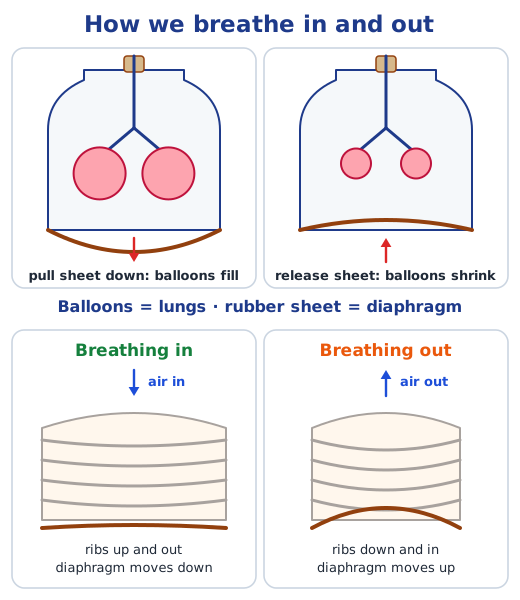
In Activity 9.2, a bottle has two balloons on a Y-shaped tube and a rubber sheet over its base. Pulling the sheet down makes the balloons inflate; letting it go up makes them deflate. The balloons stand for the lungs and the sheet for the diaphragm, the dome-shaped muscle under the lungs. When we inhale, the ribs move up and outwards and the diaphragm moves down, so the chest has more space and air flows in. When we exhale, the diaphragm moves up and the ribs move down and inwards, pushing air out.
What we breathe out
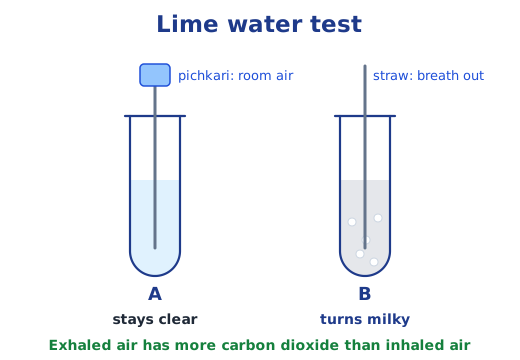
In Activity 9.3, room air pushed through lime water with a pichkari leaves it clear, but breath blown through a straw turns it milky. Lime water turns milky with carbon dioxide, so exhaled air has more carbon dioxide.
| Gas | Inhaled air → exhaled air (nearly) |
|---|---|
| Oxygen | 21% → 16–17% |
| Carbon dioxide | 0.04% → 4–5% |
So not all the oxygen we breathe in is used up.
Gas exchange and respiration
The alveoli have thin walls wrapped in fine blood vessels. Oxygen passes from the air in the alveoli into the blood, and carbon dioxide passes from the blood into the alveoli to be breathed out. The heart pumps the blood through blood vessels, the circulatory system, carrying oxygen and nutrients everywhere.
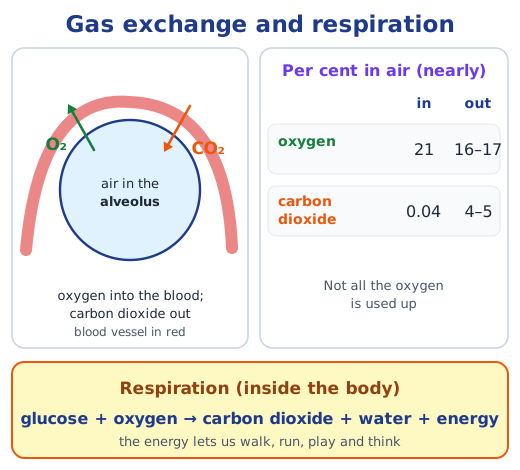
Inside the body, oxygen breaks down glucose from digested food to release energy. This is respiration:
Glucose + oxygen → carbon dioxide + water + energy
The energy lets us walk, run, play and think. Breathing is a physical process; respiration is a chemical process.
Looking after our lungs
Smoking damages the lungs and raises the risk of lung cancer, and others nearby suffer from passive smoking. Some infections, such as the virus that caused COVID-19, attack the respiratory system. Breathing practices such as pranayama, and Tummo breathing in Ladakh, have long been used to improve breathing and relaxation.
How other animals breathe
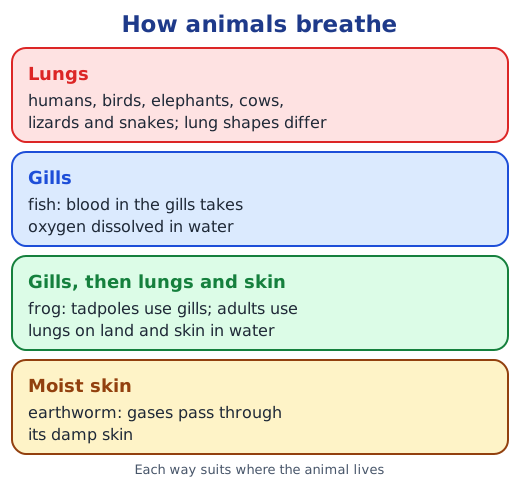
Cows, goats, lions, elephants, birds, lizards and snakes all breathe with lungs, though their lungs differ in structure. Most aquatic animals, such as fish, have gills, rich in blood vessels, that take in oxygen dissolved in water. Frogs use gills as tadpoles, and as adults use lungs on land and their skin in water. Earthworms exchange gases through their moist skin. Each way suits the animal’s habitat.
Why it matters
Every movement and every thought needs energy, and that energy comes from respiration, which depends on breathing. Review how food is broken down in nutrition and digestion in animals. Answers to the textbook questions are in the NCERT solutions for Chapter 9; see all of Chapter 9 notes.
Practice
-
Where are oxygen and carbon dioxide exchanged in our lungs?
Show answer
Answer: (c) Alveoli
-
When we breathe out, the ribs move:
Show answer
Answer: (b) down and inwards
-
Earthworms take in oxygen through their:
Show answer
Answer: (c) moist skin
-
Why should we breathe through the nose and not the mouth?
Show answer
Answer: The nasal passages have tiny hair and mucus that trap dust and dirt from the air, so cleaner air reaches the lungs.
-
Write the word equation for respiration.
Show answer
Answer: Glucose + oxygen → carbon dioxide + water + energy.
Questions students ask
What is respiration?
Respiration is the process by which nutrients are turned into usable energy. Inside the body, oxygen breaks down glucose to release energy, and carbon dioxide and water are formed.
What does the diaphragm do in breathing?
The diaphragm is a dome-shaped muscle below the lungs. When it moves down, the chest gets more space and air rushes in; when it moves up, the space shrinks and air is pushed out. So it helps in inhalation and exhalation.
How do frogs breathe?
As tadpoles they breathe with gills. Adult frogs use lungs on land, and when they are in water they exchange gases through their skin.
Stuck on a question?
Take a photo and Lagnever AI explains it step by step. Try it for 7 days for ₹2.
Get it on Google Play Open in browser
For parents: after the trial, the plan renews monthly by UPI or card autopay. You can cancel anytime in the app.