
Nutrition and digestion in animals
Answer in short
Digestion breaks complex food into simpler forms the body can use. In humans it happens in the alimentary canal: teeth and saliva work in the mouth, the stomach churns food with juice, acid and mucus, and the small intestine finishes digestion and absorbs nutrients. The large intestine absorbs water, and waste leaves through the anus.
Stuck on a question? Take a photo and Lagnever AI explains it step by step. Try it for 7 days for ₹2. Get it on Google Play
Why food must be digested
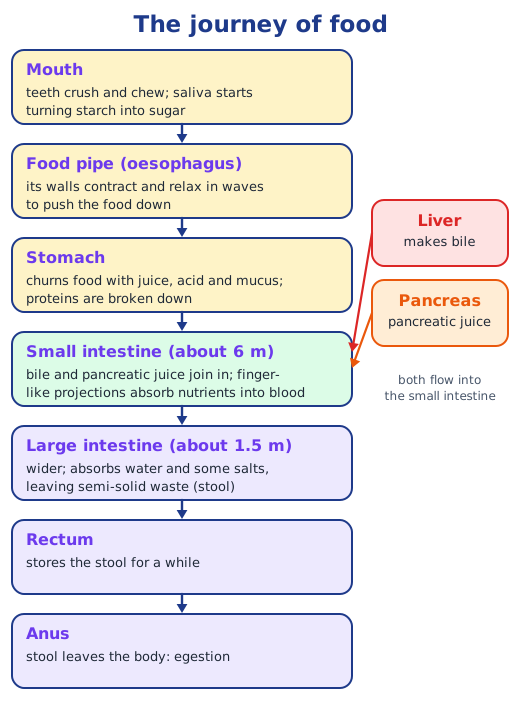
Food gives animals the energy and materials for all their life processes. But most food is made of complex components, carbohydrates, proteins and fats, that the body cannot use directly. Digestion breaks them into simpler forms. In humans this happens step by step in the alimentary canal, a long tube that begins at the mouth and ends at the anus.
In the mouth
The teeth crush and chew food into fine pieces; this is mechanical digestion. Saliva moistens the food so it is easy to swallow and contains a juice that breaks starch into sugar. Thinking of your favourite food makes more saliva flow, and chewing a piece of chapati for a minute makes it taste sweet.
You can test this (Activity 9.1). Put plain boiled rice in test tube A and well-chewed boiled rice in test tube B, add water and a few drops of iodine solution. Iodine turns starch blue-black.
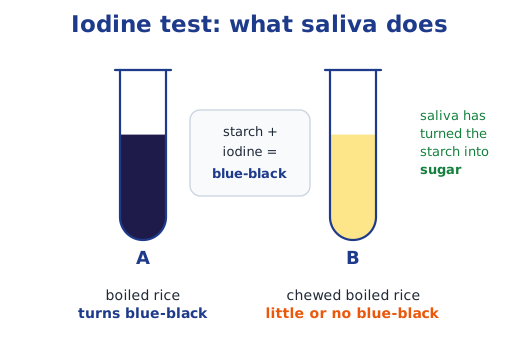
Tube A turns blue-black, but tube B stays almost unchanged, because saliva has already broken its starch into sugar. Chewing longer leaves even less starch.
Down to the stomach
The tongue pushes the soft food into the food pipe (oesophagus). Its walls contract and relax in a wave that moves the food down; the same kind of movement pushes food along the whole canal. The stomach churns the food and mixes it with a secretion of digestive juice, which breaks down proteins, acid, which helps and kills many harmful bacteria, and mucus, which protects the stomach lining. The food becomes a semi-liquid mass. Much of this was learnt after 1822, when Dr William Beaumont watched digestion through a gunshot wound in Alexis St. Martin’s stomach that never fully closed.
The small intestine
Though called small, it is about 6 m long, the longest part of the canal. Three juices act here: bile from the liver, which is mildly basic, neutralises the acid and breaks fats into tiny droplets; pancreatic juice, also basic, which works on carbohydrates, proteins and fats; and the juice of the intestine wall, which completes digestion. The inner lining has thousands of finger-like projections that give a huge surface for absorption, the passing of nutrients into the blood. In celiac disease, gluten, a protein in wheat, barley and rye, damages this lining; millets such as jowar, bajra and ragi contain no gluten and are good substitutes.
The large intestine
It is about 1.5 m long but wider than the small intestine. It absorbs water and some salts, leaving semi-solid stool, which is stored in the rectum and passed out through the anus, a process called egestion. Fibre-rich food such as fruits, vegetables and whole grains keeps it working well, and helpful bacteria living there break down fibre; fermented foods such as curd and buttermilk support them.
Cows and birds
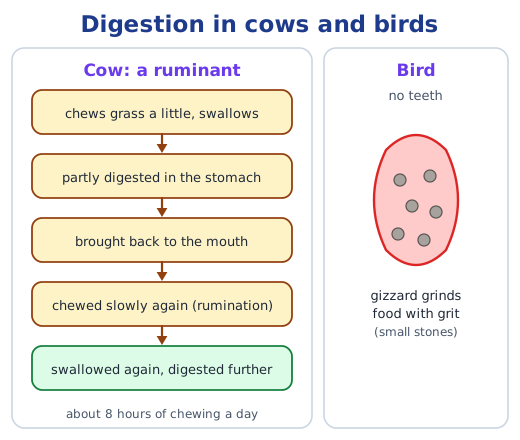
Cows and buffaloes chew grass partly and swallow it. After partial digestion in the stomach, the food returns to the mouth and is chewed slowly again, rumination, before going on; a cow chews for about 8 hours a day. Birds have no teeth; the walls of their gizzard grind food, often with swallowed grit.
Why it matters
Knowing how digestion works explains healthy habits: chewing well, eating fibre, brushing and cleaning the tongue, and eating at regular times without overeating. Continue with respiration in animals. Answers to the textbook questions are in the NCERT solutions for Chapter 9; see all of Chapter 9 notes.
Practice
-
Which part of the alimentary canal is the longest?
Show answer
Answer: (c) Small intestine
-
What protects the stomach lining from its own acid?
Show answer
Answer: (b) Mucus
-
Ruminants such as cows:
Show answer
Answer: (b) chew partly digested food again
-
Why does a chapati start tasting sweet if you chew it for a long time?
Show answer
Answer: Chapati contains starch. Saliva in the mouth breaks starch down into sugar, so the longer you chew, the more sugar forms and the sweeter it tastes.
-
How does the small intestine absorb so much food?
Show answer
Answer: Its inner lining is thin and has thousands of finger-like projections. They greatly increase the surface area, so digested nutrients pass easily into the blood in the vessels inside them.
Questions students ask
What is digestion?
Digestion is the breaking down of complex food components, such as starch, proteins and fats, into simpler forms that the body can absorb and use. In humans it happens in the alimentary canal, from the mouth to the anus.
What are the parts of the human digestive system?
The alimentary canal (mouth, food pipe or oesophagus, stomach, small intestine, large intestine, rectum and anus) and two glands linked to it, the liver and the pancreas, which send their juices into the small intestine.
How do birds digest food without teeth?
Birds have a muscular chamber called the gizzard. Its walls contract and relax to grind the food, often helped by small stones, or grit, that the bird swallows.
Stuck on a question?
Take a photo and Lagnever AI explains it step by step. Try it for 7 days for ₹2.
Get it on Google Play Open in browser
For parents: after the trial, the plan renews monthly by UPI or card autopay. You can cancel anytime in the app.