
NCERT Solutions Class 7 Social Science Chapter 2: Understanding the Weather
Answers to every question in Chapter 2, Understanding the Weather, of Exploring Society: India and Beyond Grade 7 Part 1 (Reprint 2026-27): the Big Questions, every Let’s Explore and Think About It, the question in Don’t Miss Out, the questions on the IMD warning map and all four questions and activities. Page numbers follow the book (pages 27–44). Answers that depend on where you live are given as samples to adapt. Short notes: Chapter 2 notes.
The Big Questions (page 27)
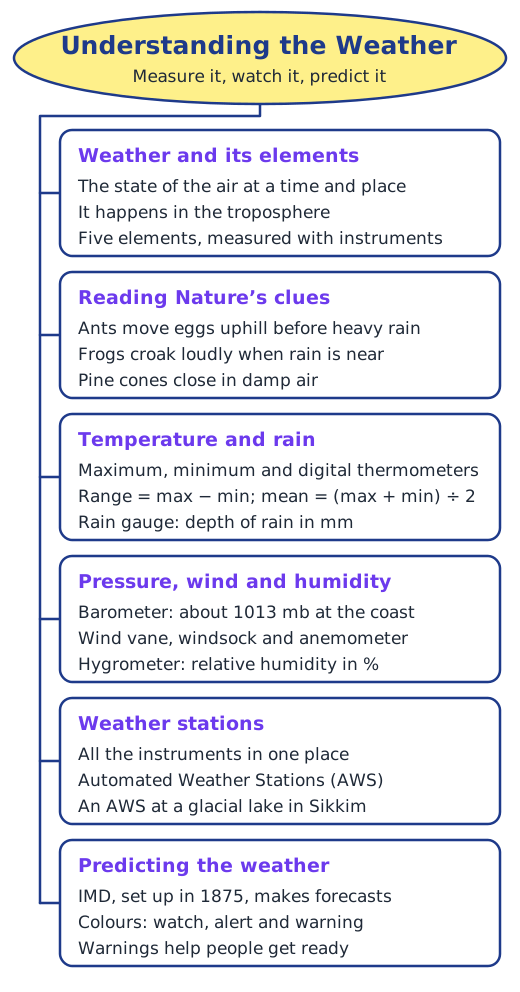
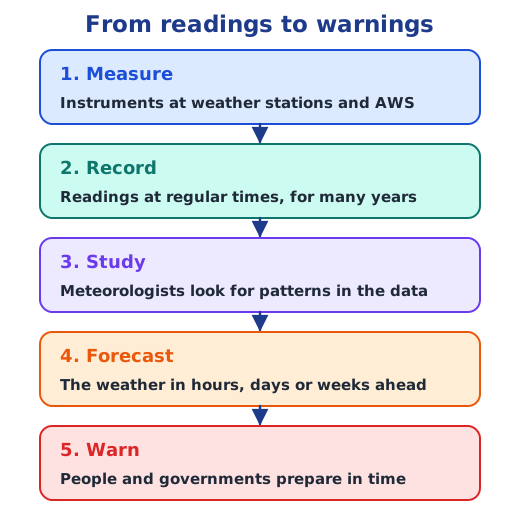
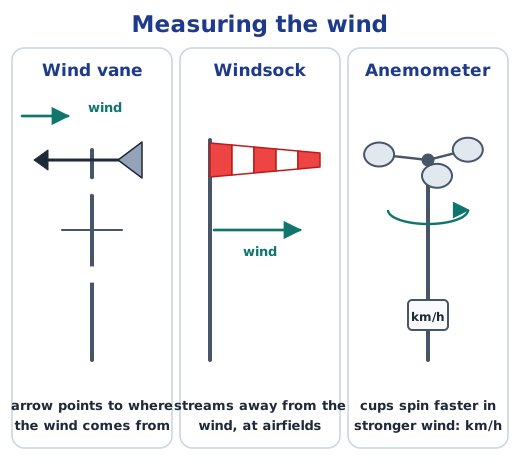
1. How can we measure and monitor the weather around us? With an instrument for each element: a thermometer for temperature, a rain gauge for precipitation, a barometer for atmospheric pressure, a wind vane, windsock and anemometer for wind, and a hygrometer for humidity. Weather stations, many of them automated, take readings at regular intervals, and the India Meteorological Department (IMD) gathers them over years to monitor the weather. You can monitor it yourself too, with a thermometer or a home-made rain gauge read at the same time every day.
2. How do weather predictions help us prepare for heavy rain, storms, drought and heat waves? They give time to act. Before heavy rain, drains can be cleared and people moved from low-lying areas; before a storm or cyclone, fishermen stay ashore and coasts can be evacuated; a forecast of weak rains helps farmers choose crops and save water for a drought; and a heat-wave warning tells people to stay out of the midday sun and drink water, schools to change timings and hospitals to get ready.
Let’s Explore (page 28)
Words for the weather in your language. A sample from Hindi: garmi (heat), sardi or thand (cold), umas (sticky, humid heat), loo (the hot, dusty summer wind), kohra (fog), paala (frost), baarish (rain) and aandhi (a dust storm). In Bengali, kalbaishakhi is the name for the sudden, violent storms of spring. Ask at home for the words in your own language.
Think About It (page 29)
How will Krishnan explain to Amir how cold it is? By giving a measurement. “Chilly” depends on what each person is used to, but a temperature such as 20°C, read on a thermometer and an agreed scale, means the same to both.
Let’s Explore (page 29)
Other reasons to measure the weather precisely. Knowing the weather hours or days ahead helps plan when to sow, water or harvest crops; whether fishing boats can go out; flights, trains and road journeys; school trips, matches and weddings; and when to dry clothes or grain. Precise records also warn of heat waves, floods and cyclones, and show how the weather of a place is changing over the years.
Let’s Explore (page 30)
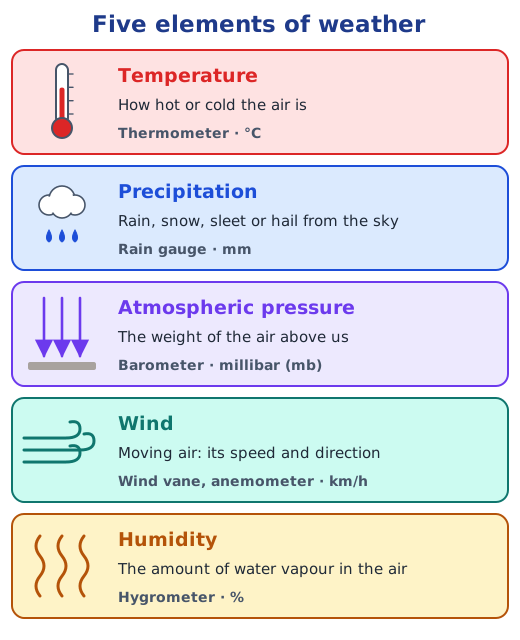
Ask elders how they predict the weather. Answers will vary. Signs people often mention: ants carrying their eggs to higher ground, frogs croaking loudly, dragonflies or birds flying low, peacocks calling, a ring around the moon, and clouds building up on a still, heavy afternoon. Write down any sayings you hear. A well-known English one is “Red sky at night, shepherd’s delight; red sky in the morning, shepherd’s warning.”
Don’t Miss Out (page 32)
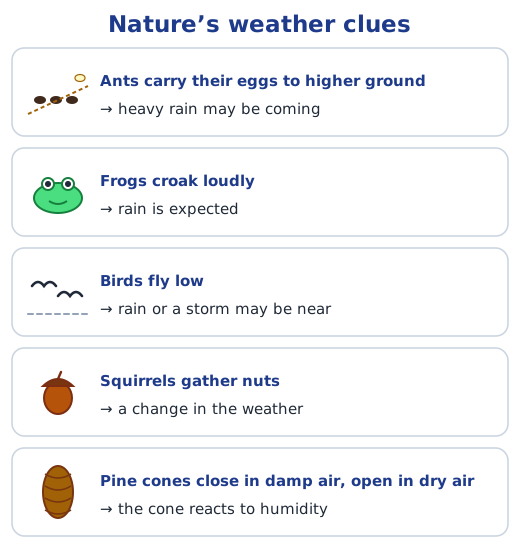
Why does rain arise from the sun? The sun heats the seas, lakes, rivers and land, and water evaporates into the air as vapour. As the moist air rises it cools, the vapour condenses into clouds, and the drops grow and fall as rain. The sun’s uneven heating also creates the pressure differences that drive winds, including the monsoon winds that carry moisture from the sea over India. Without the sun there would be no rain, and, as the IMD’s motto goes on, no food and no life.
Let’s Explore (pages 32–33)
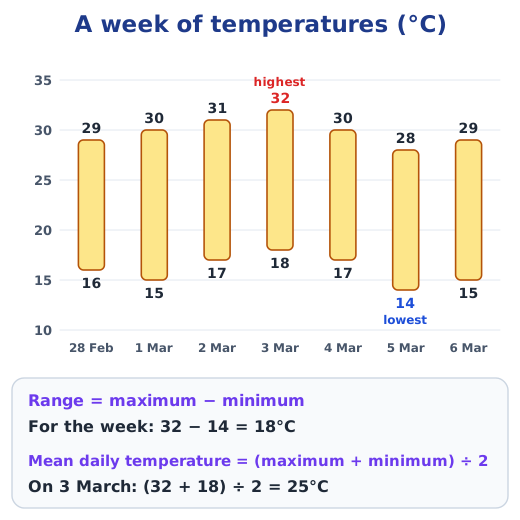
The temperature chart of a city in Madhya Pradesh. The maximum temperature recorded in the week is 32°C (3 March 2025), and the minimum is 14°C (5 March 2025). The range for the week is 32 − 14 = 18°C. (Each day’s own range is 13 to 15°C, for example 29 − 16 = 13°C on 28 February.)
What might Amir say when Krishnan reports 20°C and feels a little cold? Amir would probably smile: Kashmir’s winter days are often close to or below 0°C, so 20°C would feel pleasantly mild to him. But now both of them know exactly how warm Chennai is.
Precipitation (page 33)
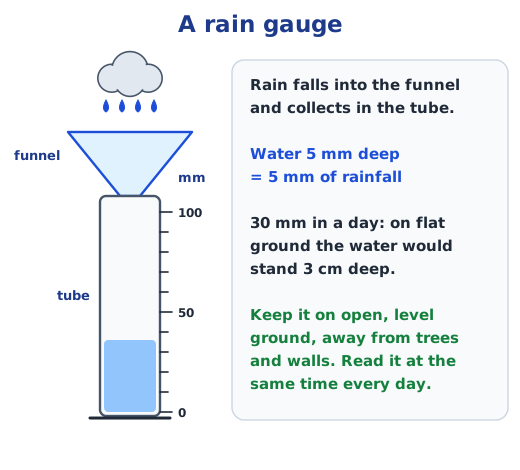
What does 30 mm of rainfall in a day mean? The rain that fell that day would cover flat ground with water 30 mm, or 3 cm, deep, if none of it soaked in, ran off or evaporated. It is measured with a rain gauge.
Let’s Explore (page 34)
Make a rain gauge and compare weekly rainfall. Use a clear, straight-sided bottle or jar whose opening is as wide as its body, so the depth you read is the real rainfall (with a wider funnel, the scale would need adjusting). Stick a millimetre scale on it from the bottom, weigh it down so it cannot tip, and place it on level ground in the open, away from trees and walls. Read it at the same time every day, then empty it. For each week, add the seven readings and divide by 7. A sample week: 0, 4, 12, 0, 0, 6 and 3 mm make 25 mm, about 3.6 mm a day. Rainfall usually varies a lot from week to week, because rain comes in spells with dry days between.
Think About It (page 35)
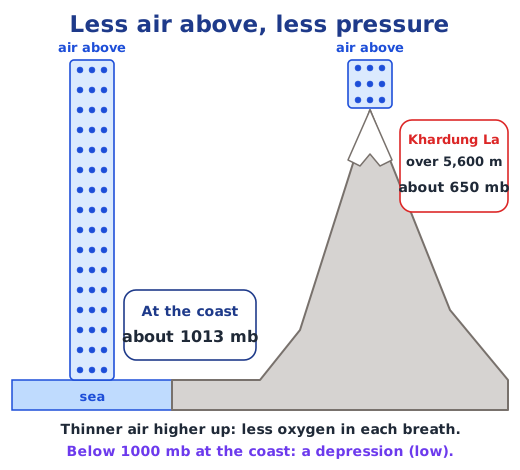
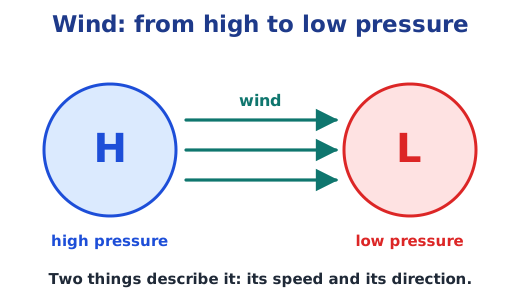
Why measure atmospheric pressure, and who uses the readings? A falling barometer warns of a depression, which can bring storms or a cyclone, and pressure differences drive the wind, so pressure is key to forecasting. Meteorologists and the IMD, pilots, sailors and fishermen, mountaineers and soldiers at high altitude, and disaster management officers all use it. (Extra: an aircraft’s altimeter works out height from air pressure.)
Khardung La, about 650 millibars. That is roughly two-thirds of the 1013 mb at the coast, so each breath brings in about a third less oxygen. This is why travellers are told to go up in stages: the body needs a few days to acclimatise.
Think About It (page 36)
Seeds flying in the wind: what if there were no wind? Seeds like those in the pictures have fluffy hairs or light plumes that the wind carries far from the parent plant. With no wind they would drop close to it, crowd together and compete for light, water and space, and the plant could not spread to new places.
Let’s Explore (page 37)
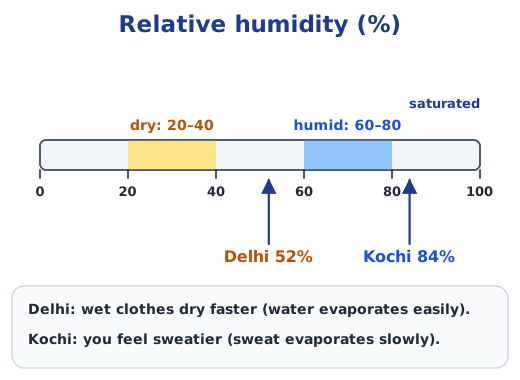
Kochi or Jaipur: where is humidity likely to be higher? Most likely Kochi, on the coast, where water evaporates from the sea and rain is heavy; Jaipur is inland, near the Thar Desert, and mostly dry. To know for sure, measure relative humidity with a hygrometer in both cities at the same times over many days, or compare IMD records. For Kochi and Mangaluru, both on the coast, guessing is harder, so compare the readings or averages for the same dates and times.
Think About It (page 38)
Delhi at 52%, Kochi at 84%. Wet clothes dry faster in Delhi, because its drier air takes up water vapour more easily. You are likely to sweat more in Kochi: in humid air sweat evaporates slowly, so it stays on the skin and cools you less.
Let’s Explore (page 41)
Situations where weather predictions help. A sample list, grouped into categories:
- Farming: when to sow, water, spray or harvest, and how to protect stored grain.
- Fishing and shipping: whether boats can go out safely.
- Travel: flights, trains and road journeys, especially in the hills.
- Disasters: preparing for cyclones, floods, landslides, heat waves and cold waves.
- Health: protecting people from heat stroke and the cold.
- Daily life: clothes, umbrellas and drying the washing.
- Schools, sports and events: school timings, matches, fairs and weddings.
- Services and work: electricity and water supply, building and outdoor work, tourism and mountaineering.
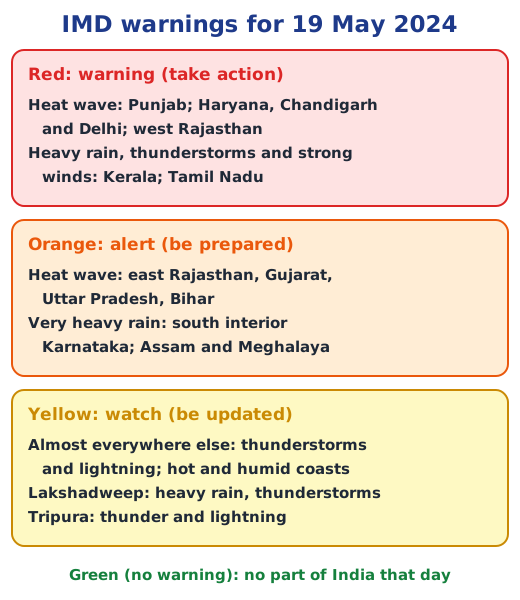
Questions on the IMD map of 19 May 2024.
- What was happening that day, and what was IMD alerting people to? A heat wave gripped north-west and north India, while the far south and the north-east had heavy rain with thunderstorms, and thunder and lightning were expected over most of the rest. The alerts were for heat waves, thunder and lightning, heavy and very heavy rain, strong surface winds and hot, humid weather.
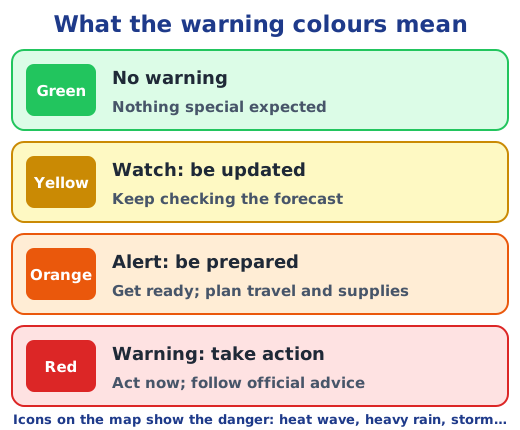
- Which states have warning signs? In red (warning: take action): Punjab; Haryana, Chandigarh and Delhi; west Rajasthan; Kerala; and Tamil Nadu. In orange (alert: be prepared): east Rajasthan, Gujarat, Uttar Pradesh, Bihar, south interior Karnataka, and Assam and Meghalaya. Almost every other state has a yellow watch with icons.
- Which parts are likely to escape severe weather? No region is green, so every part has something to watch. The yellow regions, such as much of central India, Telangana, Andhra Pradesh, Odisha, Jharkhand, West Bengal, the northern hill states and the islands, expect the least severe weather, mostly thunderstorms.
- Which states are likely to face heat-wave conditions? Heat-wave icons appear over Punjab, Haryana with Chandigarh and Delhi, Rajasthan, Gujarat, Uttar Pradesh, Madhya Pradesh, Bihar, Himachal Pradesh and southern West Bengal; the worst, in red, are Punjab, Haryana with Delhi, and west Rajasthan.
- What are the causes for warning in Tripura and Lakshadweep? Lakshadweep: heavy rain with thunder and lightning. Tripura: thunderstorms with lightning, while the neighbouring Assam and Meghalaya were on alert for very heavy rain. Both are yellow, a watch.
Questions and activities (pages 42–43)
1. Match the instrument with the element it measures.
- (1) Hygrometer: (d) humidity
- (2) Anemometer: (c) wind direction and speed
- (3) Barometer: (b) atmospheric pressure
- (4) Thermometer: (e) temperature
- (5) Rain gauge: (a) precipitation
Strictly, a cup anemometer gives the wind’s speed; the wind vane mounted with it gives the direction.
2. Advice for Jyotsna’s trip to Mumbai in June (29°C, 84% humidity). It will be warm and very humid, and June is when the monsoon reaches Mumbai. Pack light, loose cotton clothes that let sweat dry, a few extra sets because things dry slowly, an umbrella or raincoat, and sandals or shoes that can get wet. Leave the woollens and heavy clothes at home, and carry a water bottle.
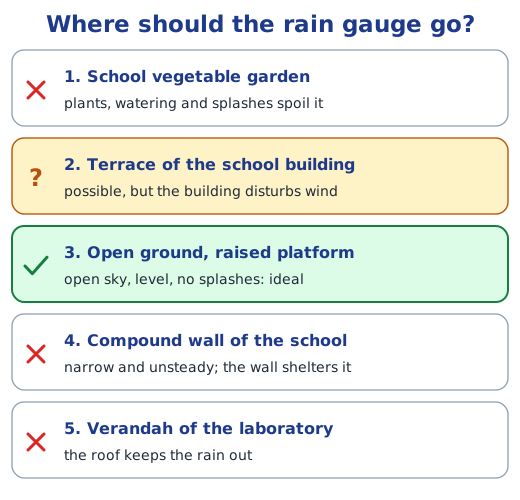
3. Choosing a site for the rain gauge. The most suitable choice is 3, open ground with an elevated platform: the sky above is open, nothing blocks or drips into the gauge, the platform keeps it level and steady and stops splashes from the ground, and it is easy to reach every day. The vegetable garden is a poor site, since plants and watering add or block water and soil splashes in; the terrace is possible, but the building disturbs the wind and the parapet can shelter the gauge; the compound wall is narrow and unsteady, and the wall itself blocks rain from one side; and a verandah roof keeps the rain out.
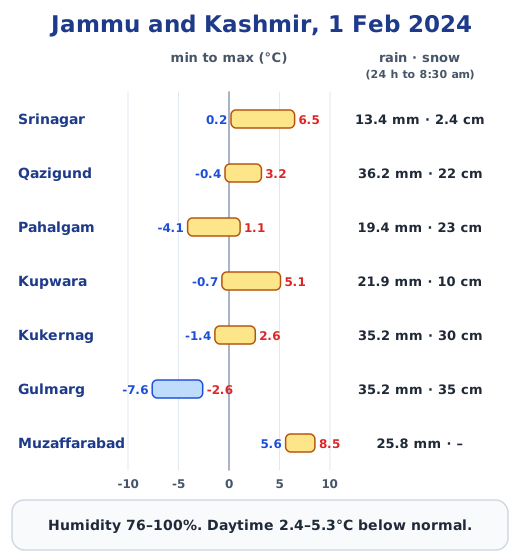
4. A weather report for Jammu and Kashmir, 1 February 2024 (evening). A sample script:
“Good evening. It was a cold, wet and snowy day across the Kashmir valley. Daytime temperatures stayed well below normal everywhere: Srinagar reached only 6.5°C, 2.4 degrees below normal, Qazigund 3.2°C, a full 5.3 degrees below normal, and Gulmarg did not climb above −2.6°C. Nights were a little milder than usual, with Srinagar’s minimum at 0.2°C, but Gulmarg was the coldest place at −7.6°C. The day’s range was small, between about 3 and 6 degrees: 6.3°C in Srinagar and 3.6°C in Qazigund. In the 24 hours up to 8:30 this morning, Qazigund received 36.2 mm of rain and 22 cm of snow, Kukernag 35.2 mm and 30 cm, and Gulmarg 35.2 mm with 35 cm of fresh snow, while Pahalgam had 23 cm of snow and Srinagar 13.4 mm of rain and 2.4 cm of snow. More rain and snow fell during the day, though Srinagar had only a trace. The air was very damp, with relative humidity between 76 and 100 per cent. Drive carefully and keep warm.”
Practice
-
Which instrument measures wind speed?
Show answer
Answer: (b) Anemometer
-
On the IMD map of 19 May 2024, what colour were Kerala and Tamil Nadu?
Show answer
Answer: (d) Red
-
Which site suits a school rain gauge most?
Show answer
Answer: (c) Open ground on a raised platform
-
Delhi has 52% humidity and Kochi 84%. Where will wet clothes dry faster, and why?
Show answer
Answer: In Delhi. Its air holds less water vapour, so water evaporates from the clothes faster.
-
Which station in the Jammu and Kashmir chart was coldest on 1 February 2024?
Show answer
Answer: Gulmarg. Its maximum was −2.6°C and its minimum −7.6°C, and it received 35 cm of snow in the 24 hours to 8:30 am.
Stuck on a question?
Take a photo and Lagnever AI explains it step by step. Try it for 7 days for ₹2.
Get it on Google Play Open in browser
For parents: after the trial, the plan renews monthly by UPI or card autopay. You can cancel anytime in the app.