
Class 7 Social Science Chapter 2: Understanding the Weather Notes
This chapter in five lines
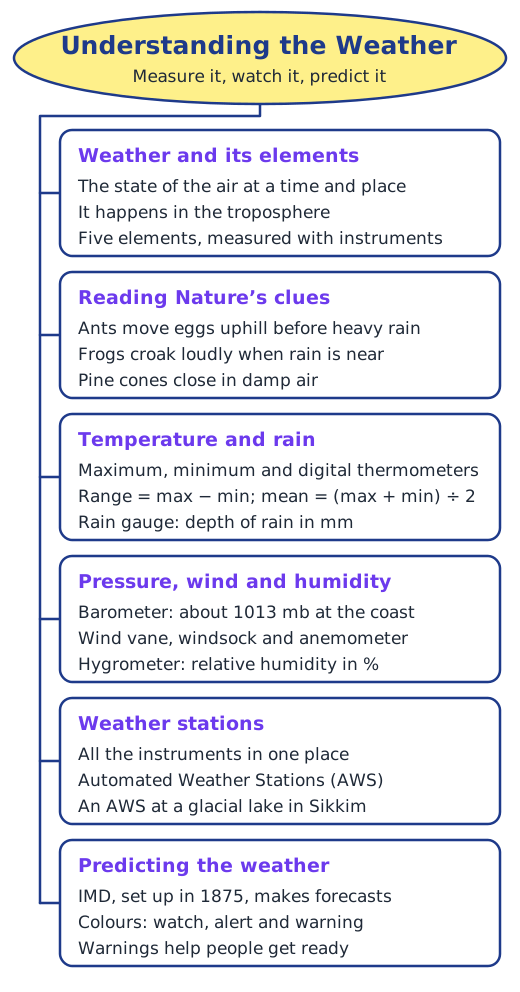
Understanding the Weather explains what weather is and how we measure it. Weather is the state of the atmosphere at a given time and place, described by five elements: temperature, precipitation, atmospheric pressure, wind and humidity. Thermometers, rain gauges, barometers, wind vanes, anemometers and hygrometers measure them, weather stations collect the readings, and the India Meteorological Department uses them to forecast the weather and issue warnings.
What is this chapter about?
On a winter morning you shiver and pull on a sweater; in summer you pick light clothes. Your body is sensing the weather. This chapter turns that feeling into numbers. It asks two big questions: how can we measure and monitor the weather around us, and how do weather predictions help us prepare for heavy rain, storms, drought and heat waves?
Weather and the atmosphere
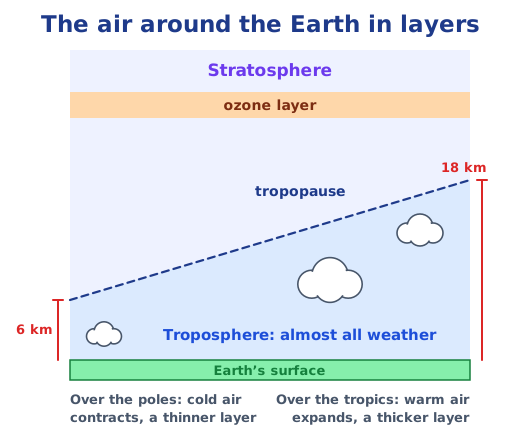
Weather is the state of the atmosphere at a particular time and place. The atmosphere is the layer of gases, which we call air, around the Earth. Like a cake, it has layers. The lowest is the troposphere, where plants, animals and people live and where almost all weather happens. It is about 6 km thick over the poles, where cold air contracts, and about 18 km over the tropics, where warm air expands.
The five elements of weather
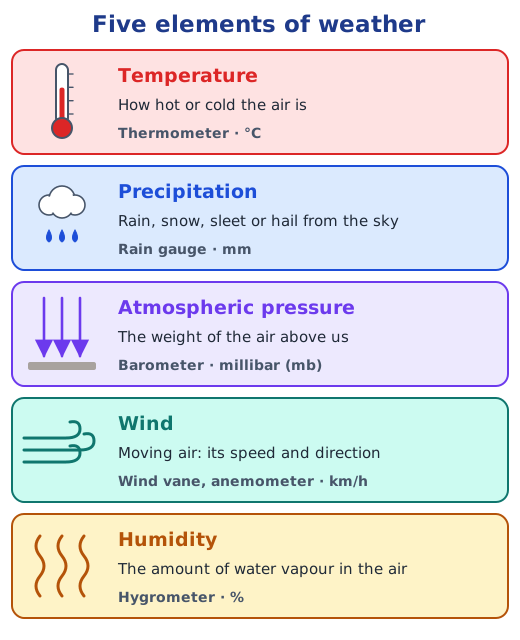
Words such as hot, rainy, windy and humid describe five elements of weather: temperature (how hot or cold the air is), precipitation (rain, snow, sleet or hail), atmospheric pressure (how hard the air overhead presses down), wind (moving air, with its speed and direction) and humidity (the water vapour in the air). Saying “it is chilly” means different things in Chennai and in Kashmir, so we need agreed units to share the weather. Read more in elements of weather.
Nature’s clues
Long before instruments, people read signs in Nature. Ants shifting their eggs to higher ground, frogs croaking loudly, birds flying low and squirrels gathering nuts hinted at coming rain or storms, and pine cones close in damp air and open in dry air. In many parts of India such traditional knowledge is still used, especially to guess when the monsoon will arrive.
Measuring the weather
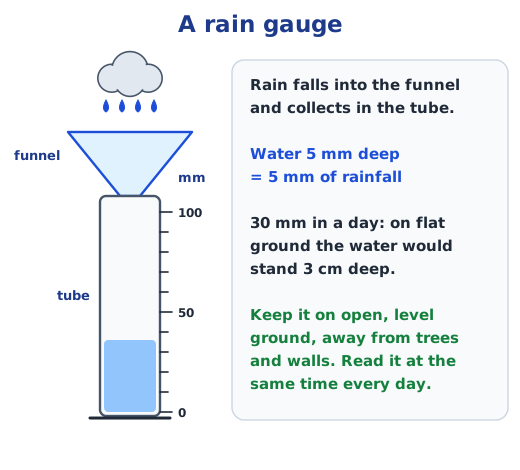
Today meteorologists, who study the weather, use instruments. Thermometers measure temperature, often recording the day’s maximum and minimum; from these come the range (maximum − minimum) and the mean daily temperature ((maximum + minimum) ÷ 2). A rain gauge measures rainfall as the depth of water collected: 5 mm of water means 5 mm of rain. A barometer measures pressure in millibars, about 1013 mb at the coast. Pressure falls as you climb, which is why people feel breathless high up; at Khardung La in Ladakh, over 5,600 m above sea level, it is about 650 mb. A sudden fall near the coast, below about 1000 mb, is a depression, which can grow into a storm or cyclone.
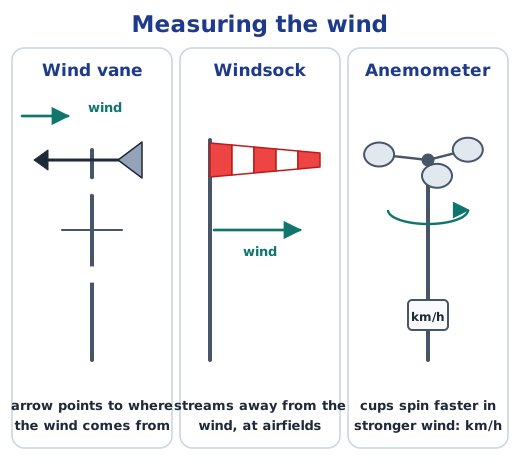
Wind blows from high to low pressure. A wind vane or windsock shows its direction and an anemometer, with spinning cups, its speed in km/h. A hygrometer measures relative humidity: 20–40% is dry weather and 60–80% is humid. See weather instruments.
Weather stations
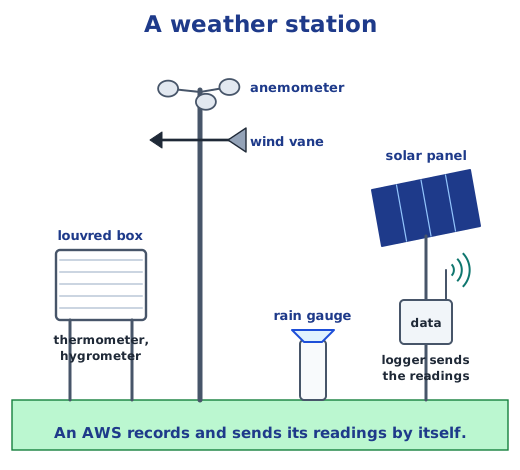
A weather station keeps all these instruments in one place, and readings are taken at regular intervals. An Automated Weather Station (AWS) records and sends the data by itself. In 2023 an AWS was installed by the National Disaster Management Authority beside a glacial lake in Sikkim, more than 4,800 m above sea level, to give early news of the weather there.
Predicting the weather
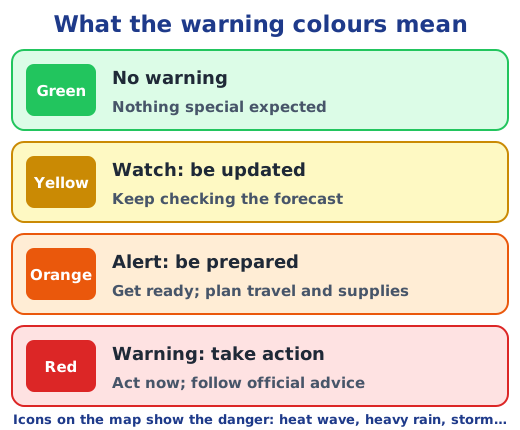
Meteorologists study data collected over long periods and use scientific methods to forecast the weather. Forecasts matter more as climate change makes droughts, floods and cyclones more frequent. The India Meteorological Department (IMD), set up in 1875, issues warning maps in four colours: green for no warning, yellow to watch, orange to be prepared and red to take action. Warnings let governments get ready, keep fishermen ashore before a storm and move people away from a coast before a cyclone. Read weather forecasts and warnings.
Before we move on
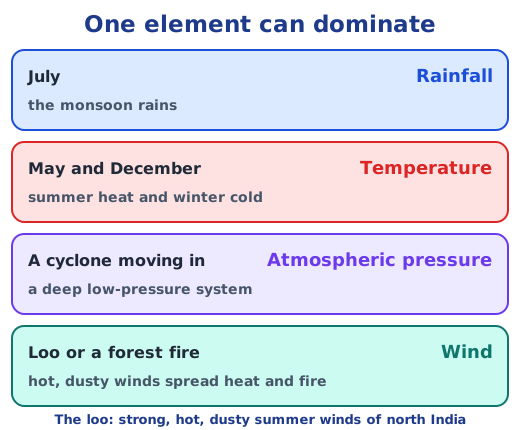
Together the five elements describe the weather of a place, and instruments let us monitor and predict them. At times one element dominates: rainfall in July, temperature in May and December, pressure when a cyclone moves in, and wind when the hot, dusty loo blows across north India or a forest fire spreads. Weather is closely linked to climate, the subject of the next chapter. Answers to every question in the chapter are in the NCERT solutions for Chapter 2.
Key terms
| Term | Meaning |
|---|---|
| Weather | The condition of the air at a given place and moment: how hot, wet, windy or humid it is. |
| Atmosphere | The layer of gases around some planets. Around the Earth we call these gases air. |
| Troposphere | The lowest layer of the atmosphere, where we live and where almost all weather happens. It is about 6 km thick over the poles and 18 km over the tropics. |
| Precipitation | Water that falls from the sky in any form: rain, snow, sleet (frozen or partly frozen rain) or hail (small balls of ice). |
| Atmospheric pressure | The weight of the air above a place pressing on the Earth’s surface, measured with a barometer in millibars (mb). |
| Depression | A low-pressure system: pressure near the coast falls below about 1000 mb. It can grow into a storm or a cyclone. |
| Wind | Air moving from an area of high pressure to an area of low pressure, described by its speed and direction. |
| Relative humidity | How much water vapour the air holds, as a percentage: 0 per cent means none at all and 100 per cent means the air is saturated. |
| Meteorology | The systematic study of weather and how it changes. It is the basis of weather forecasting. |
| Automated Weather Station (AWS) | A weather station whose sensors record temperature, humidity, wind, rain and pressure by themselves, without anyone reading the instruments. |
| Forecast | A prediction of the weather made in advance, for the next few hours, days or weeks. |
Topics in this chapter
Practice
-
Which instrument measures atmospheric pressure?
Show answer
Answer: (b) Barometer
-
In which layer of the atmosphere does almost all weather happen?
Show answer
Answer: (c) Troposphere
-
Water in a rain gauge is 5 mm deep. How much rain fell?
Show answer
Answer: (b) 5 mm
-
The maximum temperature is 32°C and the minimum 18°C. What is the range?
Show answer
Answer: (c) 14°C
-
Which pressure reading near the coast points to a depression?
Show answer
Answer: (c) 995 mb
-
On an IMD warning map, what does orange mean?
Show answer
Answer: (c) Alert: be prepared
Questions students ask
What are the main topics of Class 7 SST Chapter 2?
What weather is and where it happens (the troposphere); the five elements of weather; Nature’s clues used to forecast rain; the instruments that measure each element, from the thermometer and rain gauge to the barometer, wind vane, anemometer and hygrometer; weather stations, including automated ones; and how weather predictions and IMD warnings help people prepare.
Is Understanding the Weather in the new Class 7 Social Science book?
Yes. It is Chapter 2 of Exploring Society: India and Beyond, Grade 7 Part 1 (Reprint 2026-27), in the theme India and the World: Land and the People, on pages 27 to 44. The next chapter, Climates of India, builds on it.
Which instruments measure the weather?
A thermometer measures temperature, a rain gauge precipitation, a barometer atmospheric pressure, a wind vane or windsock the wind’s direction, an anemometer the wind’s speed, and a hygrometer humidity. A weather station brings them together, and an Automated Weather Station records the readings by itself.
How is weather different from climate?
Weather is the state of the air at one place and time, and it can change within hours. Climate, which the next chapter explains, is the usual pattern of weather of a place over a long period. A rainy afternoon in Jaipur is weather; Jaipur being mostly dry through the year is its climate.
Stuck on a question?
Take a photo and Lagnever AI explains it step by step. Try it for 7 days for ₹2.
Get it on Google Play Open in browser
For parents: after the trial, the plan renews monthly by UPI or card autopay. You can cancel anytime in the app.