
Weather instruments and weather stations
Answer in short
Each element of weather has its own instrument: a thermometer for temperature in °C, a rain gauge for rainfall in millimetres, a barometer for atmospheric pressure in millibars, a wind vane or windsock for wind direction, an anemometer for wind speed in km/h and a hygrometer for relative humidity in per cent. A weather station brings them all together.
Stuck on a question? Take a photo and Lagnever AI explains it step by step. Try it for 7 days for ₹2. Get it on Google Play
From clues to instruments
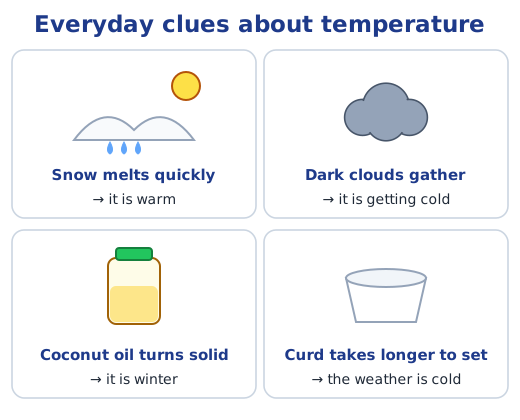
Everyday life already tells us about temperature: snow melts quickly when it is warm, coconut oil turns solid in winter and curd takes longer to set on a cold day. Over the last few centuries, scientists built instruments that measure each element of weather precisely, so that the weather can be monitored and forecast.
Thermometers
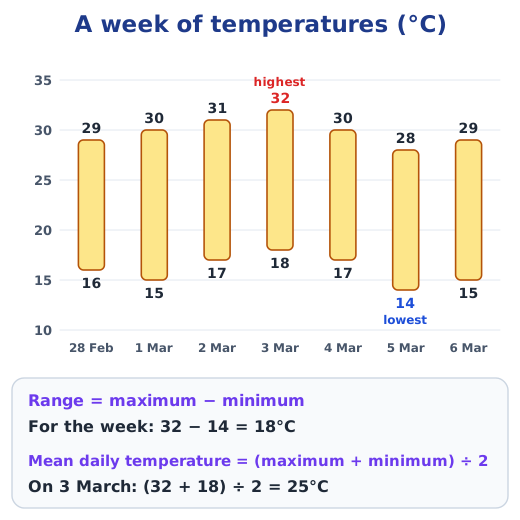
In Class 6 Science you met clinical and laboratory thermometers and two scales, Celsius and Fahrenheit: 15°C is the same as 59°F. Weather thermometers come in several types. Some show the ambient temperature, that of the surroundings, while others record the day’s maximum and minimum. Many use a coloured liquid that expands as it warms, but digital thermometers are now preferred because they are more precise and store more data. Recorded temperatures give useful statistics:
- Range = maximum − minimum, usually over 24 hours.
- Mean daily temperature = (maximum + minimum) ÷ 2.
For a week in a city in Madhya Pradesh, the highest maximum was 32°C and the lowest minimum 14°C, a range of 18°C for the week.
Rain gauge
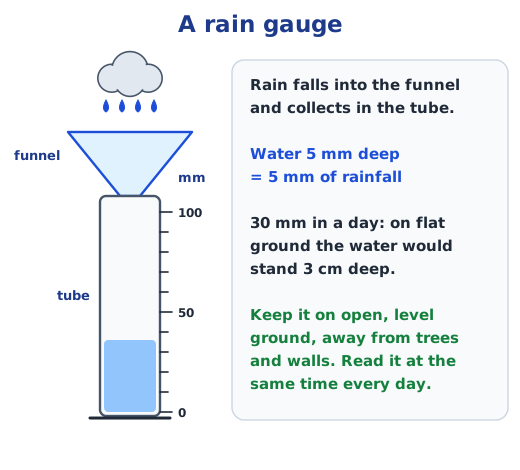
A rain gauge measures precipitation. Rain falls into a collecting funnel and gathers in a measuring tube marked with a scale. The depth of water is the rainfall: water 5 mm deep means 5 mm of rain. Place it in the open on a flat, steady surface, away from anything that blocks the rain, and read it at the same time every day; melt any snow before measuring. Extra: if you make one at home, use a straight-sided jar or bottle with an opening as wide as its body, so the depth you read is the real rainfall.
Barometer
A barometer measures atmospheric pressure, usually in millibars (mb). Normal pressure at the coast is about 1013 mb. A reading below about 1000 mb signals a depression, which can become a storm or a cyclone, so pilots, sailors, fishermen and weather forecasters watch the barometer closely.
Wind vane, windsock and anemometer
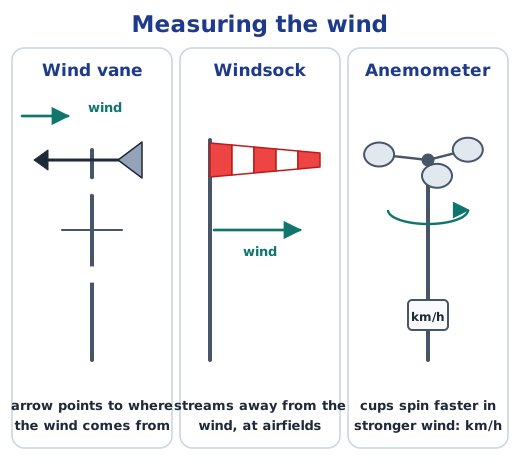
A wind vane is an arm that can swing round, with a pointer on one end and a broad tail on the other. The wind pushes the tail, so the pointer swings round to face the wind; even a light breeze moves it. A windsock on an airfield streams away from the wind and shows pilots its direction during take-off and landing; industries that release ash or gases use similar socks. An anemometer has three or four cups on a vertical shaft. The stronger the wind, the faster they spin, and a meter turns the spins into a speed in km/h. Extra: the cups measure speed; a vane fixed beside them gives the direction.
Hygrometer
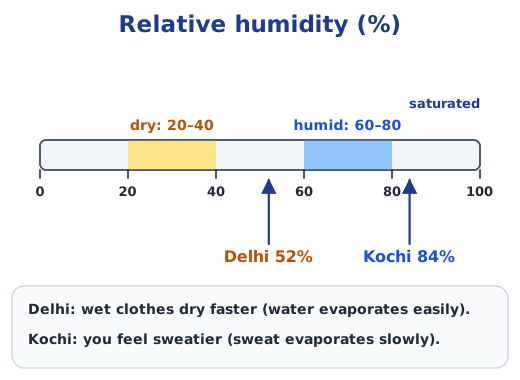
A hygrometer measures humidity as relative humidity. Air with no water vapour at all, which never happens in nature, would be 0 per cent, and air saturated with vapour is 100 per cent. Dry weather is usually 20–40% and humid weather 60–80%. Hygrometers work on different principles, and they matter beyond forecasts: food factories control humidity, and museums keep the air dry to protect their exhibits.
Weather stations
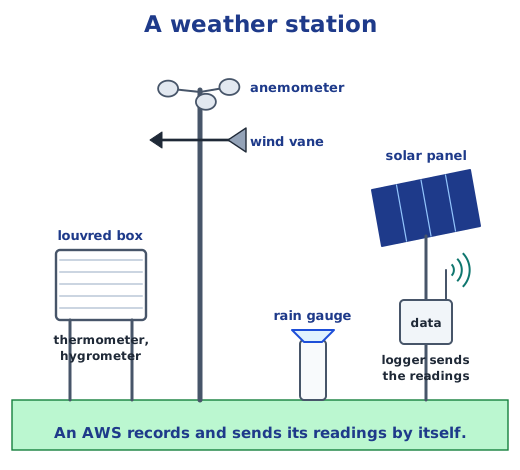
A weather station keeps all these instruments together, and readings taken at regular intervals help map and forecast the weather. An Automated Weather Station (AWS) uses sensors to record temperature, humidity, wind, rainfall and pressure without anyone reading them, and is used in farming, aviation, navigation and environmental monitoring.
Why it matters
Instruments turn “it feels cold” into numbers that anyone can compare and that forecasters can use. The elements themselves are explained in elements of weather, and the step from readings to warnings in weather forecasts and warnings. Worked answers to every textbook question are in the NCERT solutions for Chapter 2; see all of the Chapter 2 notes.
Practice
-
Which instrument measures humidity?
Show answer
Answer: (b) Hygrometer
-
In what unit does a barometer usually show pressure?
Show answer
Answer: (b) Millibars
-
The maximum temperature is 30°C and the minimum 17°C. What is the mean daily temperature?
Show answer
Answer: (b) 23.5°C
-
What does 30 mm of rainfall in a day mean?
Show answer
Answer: If none of the rain soaked in, ran off or dried up, it would cover flat ground with water 30 mm, or 3 cm, deep. A rain gauge measures this depth.
-
What is an Automated Weather Station?
Show answer
Answer: A weather station whose sensors measure temperature, humidity, wind speed and direction, rainfall and pressure and record the data by themselves, so no one has to read the instruments.
Questions students ask
Which instruments are used to measure weather?
A thermometer measures temperature, a rain gauge measures precipitation, a barometer measures atmospheric pressure, a wind vane or windsock shows wind direction, an anemometer measures wind speed, and a hygrometer measures humidity. There are several types of most of these instruments, and digital ones are now common.
How does a rain gauge work?
Rain falls into a funnel and collects in a measuring tube with a scale. The depth of water in the tube is the rainfall: if the water stands 5 mm deep, the place received 5 mm of rain. The gauge must stand level in the open, away from trees and walls, and be read at the same time every day.
What is a weather station?
A place where the weather instruments are kept together so that the weather can be measured and tracked easily. Readings are taken at regular intervals and help in mapping and forecasting. An Automated Weather Station does this by itself; in 2023 one was set up at a glacial lake in Sikkim, more than 4,800 m above sea level.
Stuck on a question?
Take a photo and Lagnever AI explains it step by step. Try it for 7 days for ₹2.
Get it on Google Play Open in browser
For parents: after the trial, the plan renews monthly by UPI or card autopay. You can cancel anytime in the app.