
The five elements of weather
Answer in short
Weather is described by five elements: temperature, how hot or cold the air is; precipitation, water falling as rain, snow, sleet or hail; atmospheric pressure, the push of the air overhead; wind, air moving from high to low pressure; and humidity, the water vapour in the air. All five change from place to place and hour to hour.
Stuck on a question? Take a photo and Lagnever AI explains it step by step. Try it for 7 days for ₹2. Get it on Google Play
What is weather?
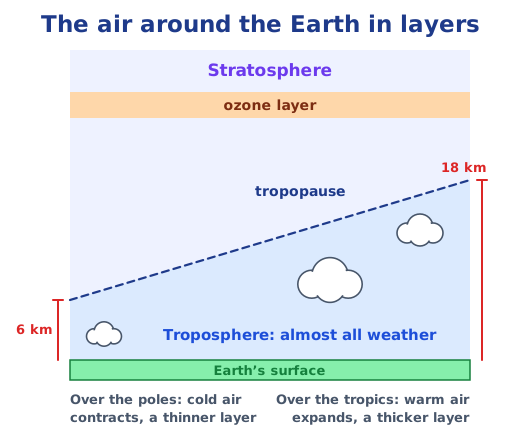
You feel the weather before you name it: you shiver on a winter morning and look for light clothes in summer. Weather is the condition of the Earth’s atmosphere at a given place and time. The atmosphere is the blanket of gases around the planet, which we call air. Like a layered cake, it has several layers, and the lowest, the troposphere, is where land plants, animals and people live and breathe. Almost all weather happens here. It reaches 6 to 18 km above the ground: less over the poles, where cold air contracts, and more over the tropics, where warm air expands.
The five elements
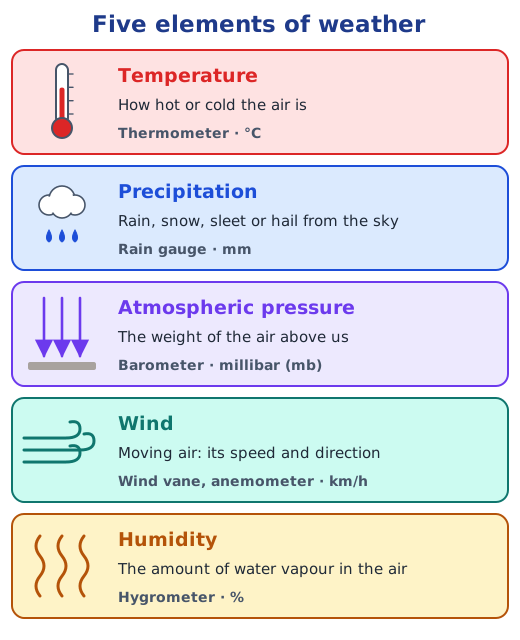
We describe weather with words such as hot, cold, rainy, cloudy, humid, snowy and windy. Each word is about one of five elements of weather:
- Temperature: how hot or cold the air is.
- Precipitation: water falling from the sky in any form: rain, snow, sleet (frozen or partly frozen rain) or hail (small, hard balls of ice).
- Atmospheric pressure: how hard the air overhead presses down on the ground below it.
- Wind: moving air, with its speed and its direction.
- Humidity: the amount of water vapour, water in the form of a gas, in the air.
Why measure them?
Imagine Krishnan in Chennai telling Amir in Kashmir that it turned chilly after last night’s rain. Amir cannot tell how cold that is, because what feels cold to one person may feel pleasant to another. If Krishnan says it is 20°C, both of them understand the same number. Measuring every element with agreed units lets people compare places and days, and it lets meteorologists forecast the weather.
Pressure changes with height
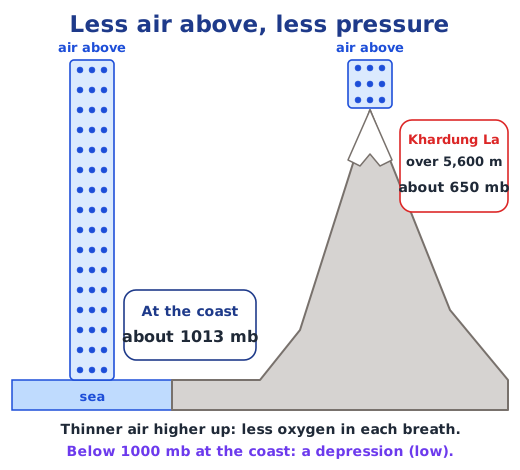
Before a thunderstorm the air can feel heavy; that is related to atmospheric pressure, the push of the air above and around us. It is higher at the coast and lower up in the mountains, where the air is thinner. Thin air means less oxygen in each breath, so climbers and visitors can feel breathless, dizzy or tired, and are advised to stop on the way up so the body can acclimatise. Soldiers serve at Khardung La in Ladakh, over 5,600 m above sea level, where the pressure is about 650 millibars instead of about 1013 at the coast. Pressure can also drop sharply on the plains or the coast, forming a depression, a low-pressure system that may grow into a storm or a cyclone.
Wind and humidity
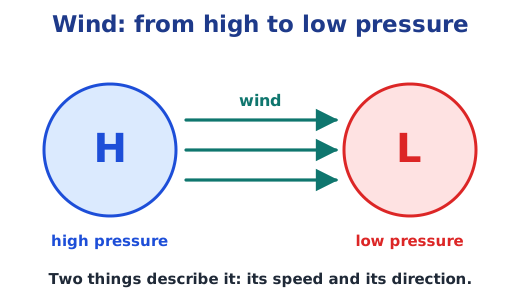
Wind is air moving from an area of high pressure to an area of low pressure, and we describe it by its speed and direction. Pilots, sailors and farmers watch it closely, and a strong wind dries the soil faster. Many seeds, with their feathery hairs, travel on it; without wind they would fall close to the parent plant.
Humidity depends on temperature, wind, pressure and location. When the air already holds a lot of water vapour, as on a rainy day, water evaporates slowly. So wet clothes dry faster in dry air, and sweat stays on the skin in humid air, which is why a humid day feels sticky.
When one element dominates
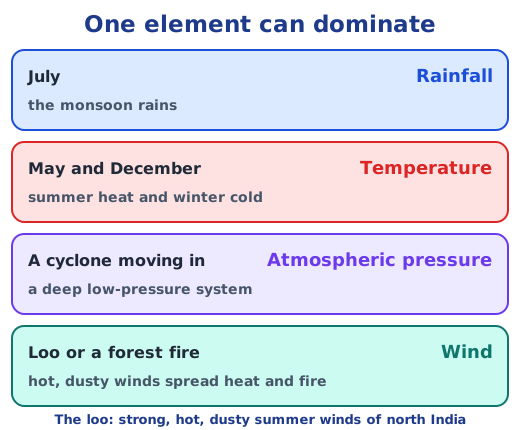
At different times one element matters most: rainfall in July, temperature in May and December, pressure when a cyclone moves in, and wind when the loo, the strong, hot and dusty summer wind of north India, is blowing or a forest fire is spreading.
Why it matters
Knowing the elements of weather helps you read a forecast, dress for the day and understand warnings. How each element is measured is explained in weather instruments, and how the readings become forecasts in weather forecasts and warnings. Worked answers to every textbook question are in the NCERT solutions for Chapter 2; see all of the Chapter 2 notes.
Practice
-
Which element of weather is the weight of all the air overhead?
Show answer
Answer: (b) Atmospheric pressure
-
Hail is:
Show answer
Answer: (c) Small, hard balls of ice that fall like rain
-
Which way does wind blow?
Show answer
Answer: (b) From high to low pressure
-
Why do people feel breathless at high places such as Khardung La?
Show answer
Answer: The air is thinner and the pressure lower (about 650 mb there, against about 1013 mb at the coast), so each breath carries less oxygen and the body has to work harder.
-
Krishnan says it is chilly in Chennai. Why can Amir in Kashmir not tell how cold it is?
Show answer
Answer: Feeling cold is personal: what is cold for Krishnan may be pleasant for Amir. A measured temperature, such as 20°C, gives both of them the same number to compare.
Questions students ask
What are the elements of weather?
Temperature, precipitation, atmospheric pressure, wind and humidity. Temperature is how hot or cold the air is; precipitation is any water falling from the sky; pressure is the weight of the air above us; wind is moving air, with a speed and a direction; and humidity is how much water vapour the air holds.
Where in the atmosphere does weather happen?
In the troposphere, the lowest layer, which starts at the ground. It is about 6 km thick over the poles, where cold air contracts, and about 18 km thick over the tropics, where warm air expands. Above it lie the stratosphere and the ozone layer.
Why does atmospheric pressure fall as we go up a mountain?
Pressure is the weight of the air above a place. On a mountain there is less air above you than at the coast, so the pressure is lower: about 1013 millibars at the coast and about 650 millibars at Khardung La in Ladakh, more than 5,600 m above sea level.
Stuck on a question?
Take a photo and Lagnever AI explains it step by step. Try it for 7 days for ₹2.
Get it on Google Play Open in browser
For parents: after the trial, the plan renews monthly by UPI or card autopay. You can cancel anytime in the app.