
NCERT Solutions Class 7 Social Science Part 2 Chapter 7: Infrastructure: Engine of India’s Development
Answers to every question in Part 2 Chapter 7, Infrastructure: Engine of India’s Development, of Exploring Society: India and Beyond Grade 7 (2026-27): the Big Questions, every Think About It and Let’s Explore box, the question about airports and all seven questions and activities. Page numbers follow the book (pages 169–192). Answers to activities give samples to adapt to your own area. Short notes: Part 2 Chapter 7 notes.
The Big Questions (page 169)
1. What is physical infrastructure, and how has it changed over the years in India? Physical infrastructure is the network of real structures that keeps cities and villages working: transport (roads, bridges, railways, metros, airports, ports), utilities (electricity, water pipelines), communication networks (internet, phone lines, towers) and energy systems (windmills, solar parks, pipelines). It has changed enormously. Ancient trade routes and runners have given way to national highways and expressways; railways that began in 1853 with steam engines now run almost entirely on electricity, with trains such as the Vande Bharat; metros run in 23 cities; India has 159 airports and busy ports; and messages that once went by pigeon or telegraph now travel instantly over mobile networks and 5G.
2. How has the growth of infrastructure affected the quality of life? Travel is faster and safer, so people reach schools, hospitals, markets and jobs more easily. Farmers like Satish sell fresh produce at good prices. Online classes, digital payments, e-governance and disaster alerts reach even remote villages. Infrastructure also creates jobs, directly and indirectly. At the same time, it brings duties: waste, potholes and pollution must be handled, and public property must be cared for.
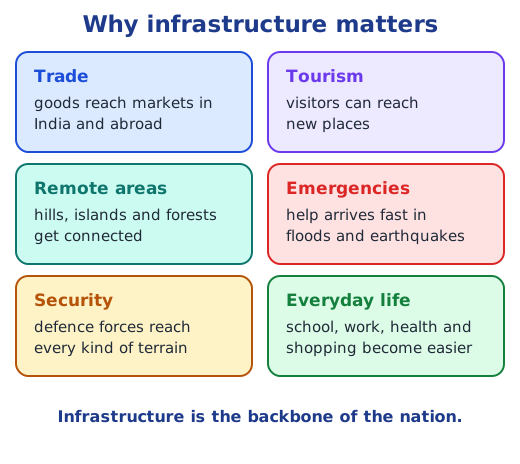
3. What is the role of infrastructure in the nation’s development and prosperity? It is the backbone of all economic activity. It links producers to markets, so trade grows within India and abroad; it brings tourists, creates jobs (Indian Railways alone employed about 1.21 million people in 2024, besides many indirect jobs), connects remote areas, speeds up help in emergencies and lets the defence forces reach every terrain. Better infrastructure raises incomes and makes living easier.
Think About It (page 173)
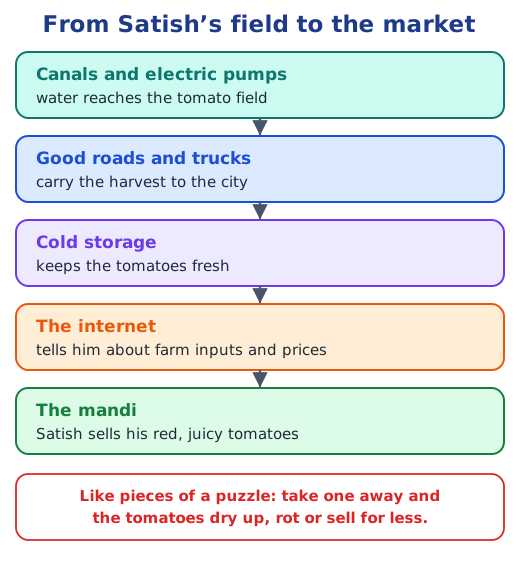
What might happen to Satish’s efforts if any part of the infrastructure is missing? Without canals and electric pumps his field may not get enough water and the crop may fail. Without good roads, trucks cannot carry the tomatoes to the city on time. Without cold storage they rot. Without the internet he may buy poor seeds or fertiliser and sell at a low price. Each missing piece cuts his income.
What happens when a new highway is built near a village? Villagers reach towns, markets, hospitals and colleges faster; farmers get better prices; shops, dhabas, fuel stations and repair shops open and create jobs; and land becomes more valuable. But there can also be problems: loss of farmland and trees, noise, dust and accidents, so safe crossings and underpasses are needed.
What if there were no internet or phone services? People who work online, from shops to offices, would struggle; online payments and banking would stop; students could not join online classes or use digital libraries; families far apart could not stay in touch; and warnings and help during emergencies would be slow.
Let’s Explore (page 180)
A trip by train or metro: what economic activities did you see around the stations? Sample answer: food stalls and tea vendors, shops selling water, snacks, books and newspapers, porters carrying luggage, auto-rickshaws and taxis waiting outside, parking attendants, cleaners and security staff, ATMs and cloakrooms. Each is a job that exists because of the station.
Which airport is closest to your home? (page 181)
Answers depend on where you live; use the book’s map and list. For example, a student in western Uttar Pradesh might name Indira Gandhi International Airport in Delhi or the Noida International Airport at Jewar, and a student near Bengaluru would name Kempegowda International Airport.
Think About It (page 185)
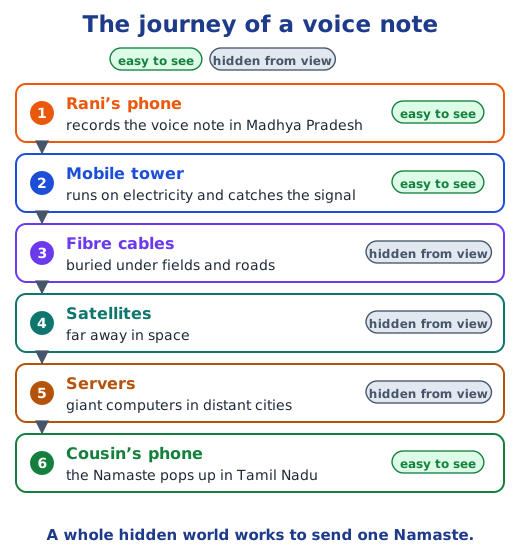
Which parts of the voice note’s journey are easy to see, and which are invisible? Easy to see: the two phones, the mobile tower near the village and the electricity lines that power it. Almost invisible: the fibre cables buried under fields and roads, the satellites in space, the servers in distant cities and the radio signals travelling through the air.
Think About It (page 187)
Calls cost up to ₹17 a minute in the 1990s, with charges even for incoming calls. How did rates become so cheap? More telecom companies entered and competed on price; the number of users grew hugely, so the cost of towers and cables was shared by many; phones and network equipment became cheaper; charges for incoming calls ended; and cheap mobile data let people call and send messages over the internet. By 2025 India counted 1,160 million wireless phone users and close to 900 million internet connections.
Ask your family how they sent long-distance messages before mobile phones. Sample answers: letters, postcards and inland letters by post; telegrams for urgent news; trunk calls booked through an operator; calls from STD and PCO booths; and later landline phones at home. Many remember waiting days for a letter, and the excitement of the first mobile phone that let them call from anywhere.
Think About It (page 188)
How does social infrastructure support the wellbeing and development of communities? Schools, colleges and training centres educate people and build skills; hospitals and health centres keep them healthy; police and fire stations keep them safe; courts give justice; parks, libraries and community centres give space to relax, read and meet. A healthy, educated and safe community can work better, earn more and live together peacefully.
Let’s Explore (page 190)
A Community Responsibility Pact. Sample pact: We will throw litter only in dustbins and sort wet and dry waste. We will not write or stick posters on walls, buses or monuments. We will report potholes, broken streetlights and leaking pipes to the municipality or panchayat. We will save water and electricity in public places. We will look after parks, benches and toilets as if they were our own. We will help elderly and disabled people use public places.
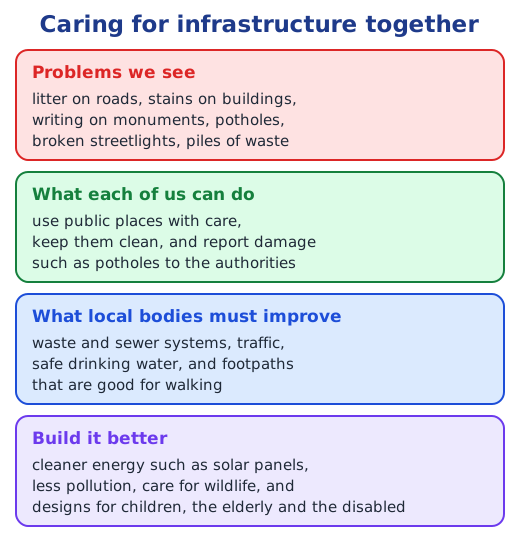
Making the school more eco-friendly. Solar panels on the roof, rainwater harvesting, LED lights and fans, compost pits for food and garden waste, separate bins for dry and wet waste, more trees and a kitchen garden, taps that do not drip, and a safe space for bicycles.
Five problems and their solutions (sample). Potholes: report them on the municipal helpline or app. Overflowing garbage bins: more bins, daily collection and sorting at home. Broken streetlights: report and follow up. No footpath near school: ask the municipality for a footpath and a zebra crossing. Waterlogging after rain: clean the drains before the monsoon.
Questions and activities (pages 191–192)
1. Infrastructure built in your area in the last decade, how it helps, and what you would build. Sample answer: a new bridge or highway, a metro line in a nearby city, a renovated railway station, new mobile towers with faster internet, or solar streetlights. They cut travel time, help families reach hospitals and markets, and let children study online. If I could build something, I would build a public library with a quiet reading room, open to everyone, or a safe, well-lit playground.
2. How do ports, highways and airports create jobs? What are the indirect benefits? They need workers to build and run them: engineers, construction workers, dock workers, drivers, pilots and cabin crew, customs and security staff. Around them grow hotels, dhabas, fuel stations, warehouses, repair shops, taxis and tourism. Indirectly, goods become cheaper and arrive faster, farmers and factories reach distant markets, and new businesses and factories open near good transport.
3. Why think about the environment when building roads or airports? Can development and protection go together? Building can cut forests, block the paths of animals, harm rivers and wetlands and add to pollution. Yes, they can go hand in hand: plan routes that avoid forests and wetlands, build underpasses for animals and alarm systems where they cross railway tracks, plant trees, use eco-friendly materials, run airports and stations on solar power (like the solar project at Cochin airport), and choose electric trains and metros to cut pollution.
4. How can better infrastructure help during floods or earthquakes? Strong roads and bridges let rescue teams and supplies reach people; the Dhola Sadiya Bridge, for example, keeps hospitals reachable even in floods. Aircraft reach mountains, islands and cut-off areas quickly. Ships and trains carry large amounts of relief. Phones, SMS alerts and apps warn people and help teams work together.
5. People misusing public spaces: consequences and solutions. Scribbling on walls, breaking streetlights and damaging benches make places ugly and unsafe, waste public money on repairs and make life harder for everyone, especially children and the elderly. Solutions: awareness drives in schools and colleges, enough dustbins, proper places for art and notices, reporting damage quickly, cameras in some places, fines as the Arthashastra once suggested, and community clean-up days.
6. Scenario posters.
- A new factory: roads and, if possible, a rail or port link for raw materials and finished goods; reliable electricity; water supply and drainage; waste treatment; internet and phone lines; transport and housing for workers; and a nearby hospital and fire station.
- A city of the future: self-cleaning roads, underground highways and bullet trains, plus ideas such as smart traffic lights, solar roofs on every building, rainwater storage, sensors that find water leaks, clean electric buses and easy access for wheelchairs.
- Upgrades for your terrain: in coastal areas, cyclone shelters, early-warning systems and raised roads; in mountains, tunnels, all-weather roads, barriers against landslides and helipads; in the plains, flood embankments, good drains and raised highways; in earthquake zones, buildings designed to resist shaking.
- A new railway or metro station: ramps, lifts and clean toilets, drinking water, shaded seating, clear signs and announcements in several languages, a small play and reading corner, local art on the walls, a solar roof and safe, well-lit exits.
7. Innovations that improve ease of living or mobility. Examples: electric vehicles and charging stations, electronic toll collection such as FASTag, digital payments such as UPI, solar-powered stations and airports, rapid rail and metro systems, ropeways in hilly towns, smart traffic signals and apps that show bus and train times.
Practice
-
Which of these is energy infrastructure?
Show answer
Answer: (b) A solar park
-
Who builds state highways?
Show answer
Answer: (b) The state, through its public works department
-
About what share of India’s railway network was electrified in 2024?
Show answer
Answer: (d) 97 per cent
-
Name two ways communication infrastructure makes life easier.
Show answer
Answer: Students in remote areas can take online classes and use digital libraries, and through e-governance people can request certificates, register complaints or store papers in DigiLocker. Online payments, e-commerce and disaster alerts are other examples.
-
What did the Arthashastra say about people who damage public works?
Show answer
Answer: It recommends punishments and fines: a heavy penalty for anyone who breaks a reservoir’s dam, and fines for breaking a hedge to get into a public park or for blocking paths to waterworks and forests.
Stuck on a question?
Take a photo and Lagnever AI explains it step by step. Try it for 7 days for ₹2.
Get it on Google Play Open in browser
For parents: after the trial, the plan renews monthly by UPI or card autopay. You can cancel anytime in the app.