
Class 7 Social Science Part 2 Chapter 7: Infrastructure: Engine of India’s Development Notes
This chapter in five lines
Infrastructure: Engine of India’s Development is about the physical structures that keep a country running: roads, bridges, railways, metros, airports, ports, power, water and communication networks. They link farms and factories to markets, make daily life easier, help in disasters and create jobs. The chapter traces how India’s roads, railways, air, sea and communication systems grew, and why caring for public infrastructure is everyone’s duty.
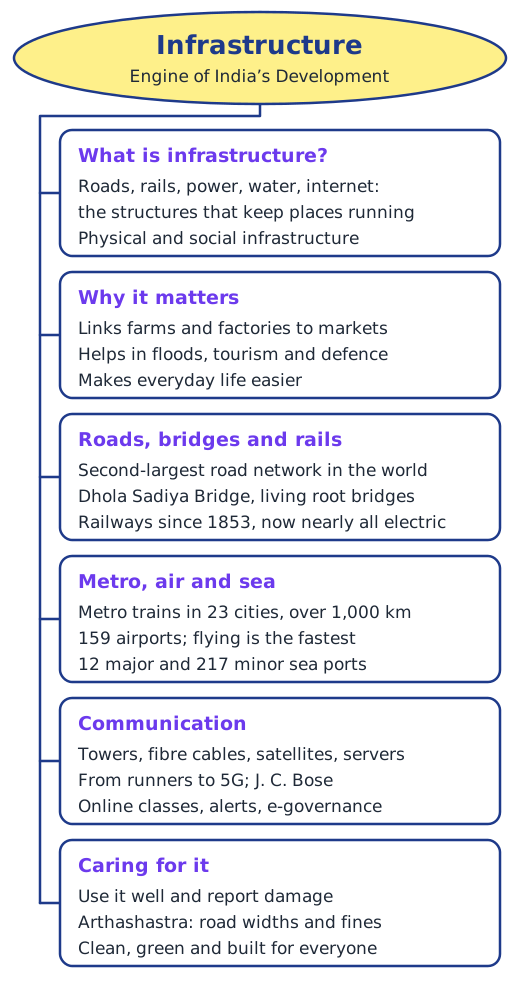
What is this chapter about?
Picture a morning with no roads, no buses, no phone signal, no lights and a dry tap. Getting to school, or getting groceries to the market, would be almost impossible. The chapter calls the things we would miss physical infrastructure: the large network of real structures that keeps cities and villages working. It includes transport, utilities such as electricity and water pipelines, communication networks and energy systems such as windmills, solar parks and pipelines. Schools, hospitals, police stations and parks form social infrastructure.
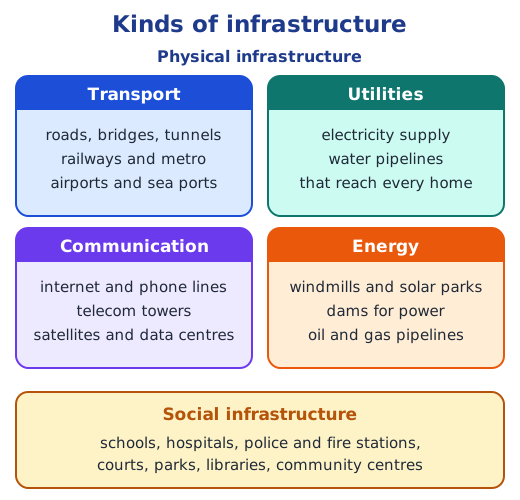
Why infrastructure matters
Rishabh travels home from Delhi to Talegaon near Nashik by car, metro, train, bus and auto-rickshaw, sharing his location by phone on the way. On the bus he meets Satish, a tomato farmer. Canals and electric pumps water Satish’s field, roads carry his crop to the city, cold storage keeps it fresh and the internet tells him prices. Like puzzle pieces, every part is needed. Infrastructure connects producers to markets, supports trade inside and outside India, helps tourism, reaches remote areas, speeds up help in floods and earthquakes, and lets the defence forces reach every terrain. Read more in what is infrastructure.
Transport infrastructure
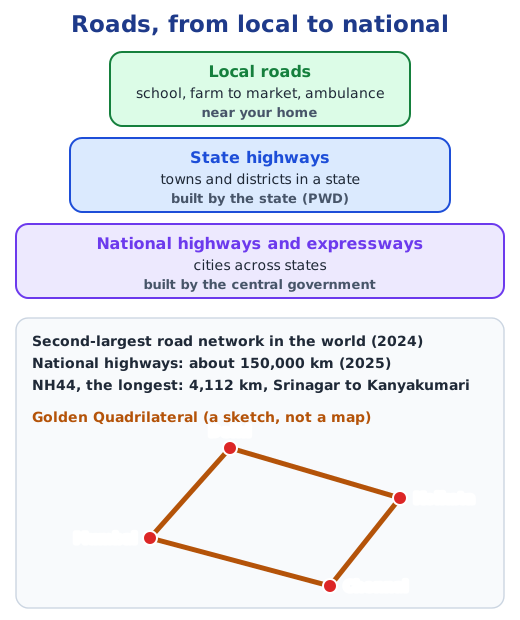
India’s road network is the second largest in the world, from local roads to state highways, national highways and expressways. National highways are about 150,000 km long, and NH44 runs 4,112 km from Srinagar to Kanyakumari. Bridges such as the Dhola Sadiya Bridge cross wide rivers, and Meghalaya’s living root bridges are grown from tree roots.
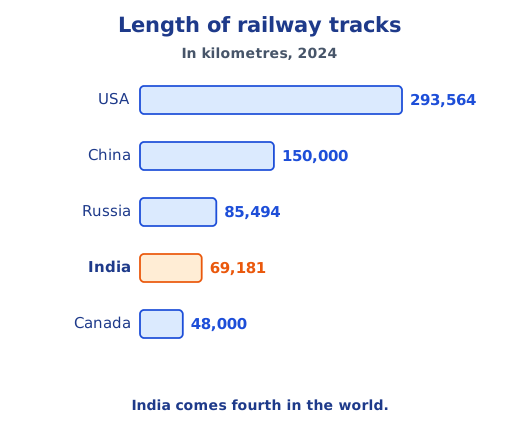
The British brought railways in 1853 to carry raw materials to ports and control the country. Today trains carry over 20 million passengers a day, use far less energy than trucks for cargo and run almost entirely on electricity. Metro trains run in 23 cities, India has 159 airports, and its ports handle more and more cargo. See transport infrastructure in India.
Communication infrastructure
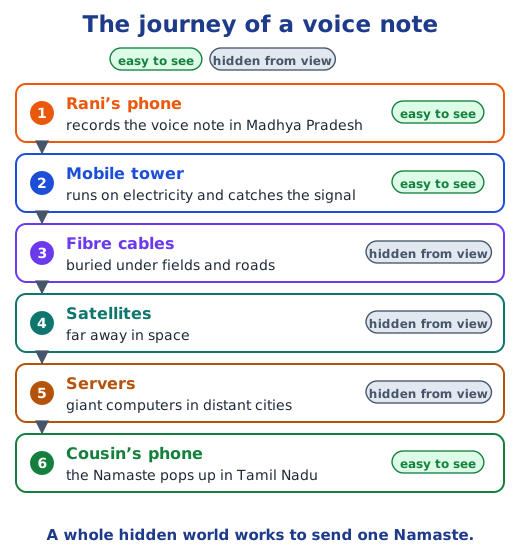
When Rani, in a Madhya Pradesh village, records a voice note for a cousin in Tamil Nadu, the message travels through a mobile tower, underground fibre cables, satellites and distant servers. Messages once went by pigeons and runners; then came newspapers, the telegraph, the telephone, radio, television and the internet. J. C. Bose showed wireless signals in Calcutta in 1895. Today this network brings online classes, disaster alerts, e-commerce and e-governance. Read communication infrastructure.
Caring for infrastructure together
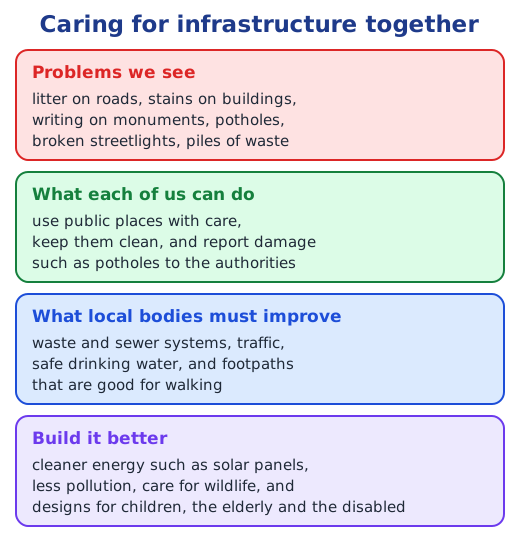
Litter, stained walls, writing on monuments and potholes make life harder for everyone. Local bodies must improve waste management, sewers, traffic, drinking water and footpaths, and new projects should use cleaner energy and suit children, the elderly and disabled people. Long ago, Kautilya’s Arthashastra fixed road widths and fines for damaging public works. Citizens must use infrastructure with care and report damage. Answers to every question are in the NCERT solutions for Part 2 Chapter 7.
Key terms
| Term | Meaning |
|---|---|
| Physical infrastructure | The network of real structures that keeps villages and cities working: transport, utilities such as electricity and water pipelines, communication networks and energy systems. |
| Social infrastructure | Facilities that serve people’s wellbeing, such as schools, hospitals, police and fire stations, courts, parks, libraries and community centres. |
| State highway | A road that links towns and districts within a state, built and kept up by the state through its public works department. |
| National highway | A main road that joins cities across states, built and kept up by the central government. NH44 is the longest, 4,112 km from Srinagar to Kanyakumari. |
| Expressway | A super-fast road that joins cities across states, built by the central government, such as the Delhi–Meerut Expressway. |
| Golden Quadrilateral | A highway network that links four major cities: Delhi, Mumbai, Chennai and Kolkata. |
| Living root bridge | A bridge grown from the roots of the Indian rubber tree by the Khasi and Jaintia people of Meghalaya; in Khasi it is called jingkieng jri. |
| Electrification | Running trains on electricity instead of coal or diesel. About 97 per cent of India’s railway network was electrified in 2024. |
| TEU | Twenty-foot Equivalent Unit: a measure of container-ship capacity and port traffic. One TEU is about 33 cubic metres. |
| E-commerce | Buying or selling goods and services on online platforms or over the internet. |
| E-governance | Government services given through communication technology, such as the DigiLocker app that keeps documents like an Aadhaar card online. |
| Patent | A right given by a government or institution to be the only person or company allowed to make, sell or use an invention for a set number of years. |
Topics in this chapter
Practice
-
Which of these is social infrastructure?
Show answer
Answer: (b) A hospital
-
Who builds and keeps up national highways?
Show answer
Answer: (c) The central government
-
The Dhola Sadiya Bridge connects Assam with:
Show answer
Answer: (b) Arunachal Pradesh
-
In which year did the British bring railways to India?
Show answer
Answer: (b) 1853
-
Which is the fastest way to move people and goods?
Show answer
Answer: (c) Air transport
-
Who showed wireless signals with microwaves in Calcutta in 1895?
Show answer
Answer: (b) J. C. Bose
Questions students ask
What are the main topics of Class 7 SST Part 2 Chapter 7?
What physical infrastructure is and why it matters, through Rishabh’s journey and Satish’s tomatoes; transport infrastructure (roads, bridges, railways, metro trains, air transport, shipping and ports); communication infrastructure, from runners to 5G and J. C. Bose; social infrastructure; and our shared responsibility for public infrastructure, with rules from Kautilya’s Arthashastra.
Is Infrastructure: Engine of India’s Development in the new NCERT book?
Yes. It is Chapter 7 of Exploring Society: India and Beyond, the Class 7 Social Science textbook Part 2 (2026-27), on pages 169 to 192, in the theme Economic Life Around Us. It comes after The State, the Government, and You.
Why is infrastructure called the engine of development?
Because almost every economic activity depends on it. Roads, railways, ports and airports move goods to markets, power and water keep farms and factories running, and communication links buyers and sellers. Good infrastructure creates jobs, raises incomes and makes life easier, so the whole economy moves faster.
Stuck on a question?
Take a photo and Lagnever AI explains it step by step. Try it for 7 days for ₹2.
Get it on Google Play Open in browser
For parents: after the trial, the plan renews monthly by UPI or card autopay. You can cancel anytime in the app.