
Communication infrastructure: how messages travel
Answer in short
Communication infrastructure is the network of mobile towers, fibre cables, satellites, servers and data centres that carries our calls, messages and videos. Even a voice note passes through all of them. Over centuries, messages moved from runners and pigeons to the telegraph, telephone, radio and internet. Today this network brings online classes, disaster alerts, e-commerce and e-governance to remote places.
Stuck on a question? Take a photo and Lagnever AI explains it step by step. Try it for 7 days for ₹2. Get it on Google Play
What carries a message?
Phones, computers and tablets have made communication fast and easy. Behind them is communication infrastructure: cables, wireless devices, mobile towers, satellites and data centres that carry messages, pictures and videos.
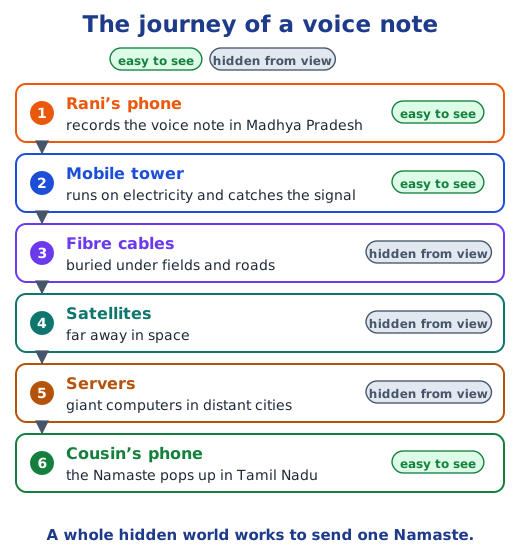
Think of Rani, in a village in Madhya Pradesh, who records a voice note for a cousin living in Tamil Nadu. She just taps, records and sends. But electricity first powers the mobile tower near her village. The note then races along fibre-optic cables laid beneath farms and roads, reaches satellites in space and passes through huge servers humming in distant cities, before it pops up on her cousin’s phone. A hidden world works together to carry one little Namaste across India.
Seen and unseen
Some parts are easy to see: the two phones, the mobile tower and the power lines. Others are almost invisible: fibre cables underground, satellites far above us, servers in data centres and the radio signals that carry the message through the air.
How communication changed
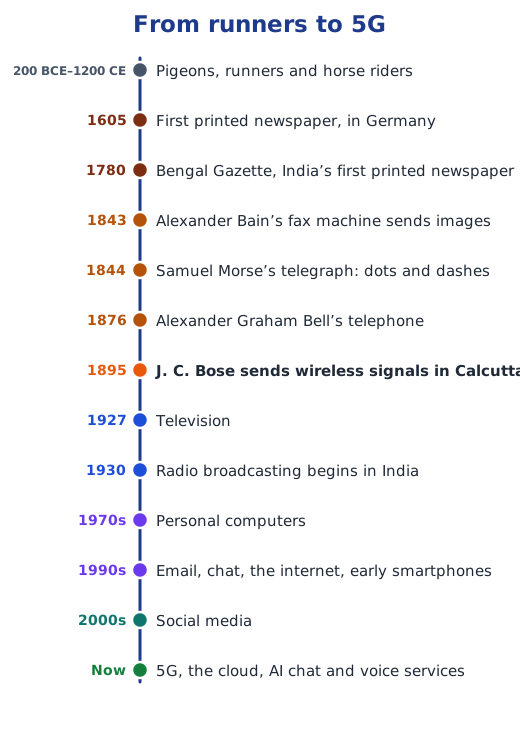
For centuries, pigeons, runners and horse riders carried messages. Printing brought newspapers; India’s first printed newspaper, the Bengal Gazette, appeared in 1780. In the 1840s Alexander Bain’s fax machine sent images and Samuel Morse’s telegraph sent messages in dots and dashes. Alexander Graham Bell invented the telephone in 1876. Then came radio, television, personal computers, email and the internet, social media, and today 5G, cloud services and AI-driven chat and voice. In 1947, Shanmukham Chetty broadcast the budget on All India Radio.
J. C. Bose and wireless signals
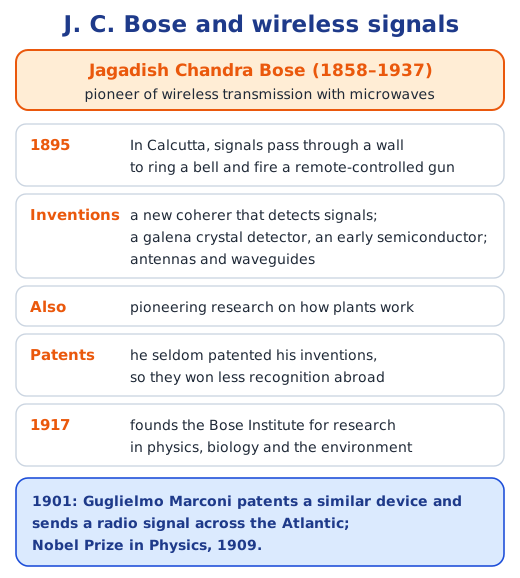
Jagadish Chandra Bose (1858–1937) pioneered wireless transmission using microwaves. In 1895, in Calcutta, he showed that signals could pass through a wall, ringing a bell and firing a remote-controlled gun. He designed a new kind of coherer, the part of early radio receivers that picked up signals, and a galena crystal detector, an early semiconductor, as well as antennas and waveguides. In 1901 Guglielmo Marconi patented a similar device and sent radio signals across the Atlantic, and in 1909 he received the Nobel Prize in Physics. Bose worked in hard conditions and seldom took patents, so his work won less recognition abroad, though he received many honours. He also studied how plants work and founded the Bose Institute in 1917.
From costly calls to cheap data
The telephone has changed from early sets in the 1880s to dial phones, push-button phones, mobile phones and today’s smartphones. In the 1990s a mobile call in India cost up to ₹17 a minute, and even incoming calls were charged. Now Indian mobile and internet rates are among the lowest in the world. In 2025 India had 1,160 million wireless phone users and close to 900 million internet connections.
What the network makes possible
Students in remote areas can join online classes, use digital libraries and watch educational videos. Quick SMS alerts and apps warn people about natural disasters. Small and large businesses sell across the world through e-commerce, and people pay online in seconds. Through e-governance, citizens apply for documents, file complaints and get information easily, for example keeping documents in the DigiLocker app.
Why it matters
Much of the infrastructure we depend on is invisible, so it is easy to forget how much work goes into a single message. Compare it with roads and railways in transport infrastructure in India, and see the bigger picture in what is infrastructure. Answers to the textbook questions are in the NCERT solutions for Part 2 Chapter 7; see all of Part 2 Chapter 7 notes.
Practice
-
Which part of a voice note’s journey is hidden from view?
Show answer
Answer: (c) Fibre cables under the roads
-
The DigiLocker app is an example of:
Show answer
Answer: (b) E-governance
-
Who invented the telephone in 1876?
Show answer
Answer: (b) Alexander Graham Bell
-
In the 1990s a call could cost ₹17 a minute, yet Indian rates are now among the lowest anywhere. How did this happen?
Show answer
Answer: Many companies began competing on price, the number of users grew so the cost of towers and cables was shared by many, phones and network equipment became cheaper, and charges for incoming calls ended. Cheap mobile data then let people call over the internet too.
-
How does communication infrastructure help in a disaster?
Show answer
Answer: Quick SMS alerts and apps warn people early, phones let families and rescue teams stay in touch, and officials can share information and coordinate relief even in remote areas.
Questions students ask
What is communication infrastructure?
It is everything behind our phones, computers and tablets that lets messages, pictures and videos travel: cables, wireless devices, mobile towers, satellites and data centres. Electricity powers the towers, fibre cables run under fields and roads, and servers in distant cities pass the data on.
Who was J. C. Bose?
Jagadish Chandra Bose (1858–1937), an Indian scientist, was among the first to send signals without wires, using microwaves. In 1895 in Calcutta he sent signals through a wall. He built a new coherer and a galena crystal detector, an early semiconductor, studied plant life and founded the Bose Institute in 1917.
What are e-commerce and e-governance?
E-commerce is buying or selling goods and services online, which lets small and large businesses sell across the world. E-governance is the government using communication technology to serve citizens, for example to apply for documents, file complaints or keep papers such as an Aadhaar card in the DigiLocker app.
Stuck on a question?
Take a photo and Lagnever AI explains it step by step. Try it for 7 days for ₹2.
Get it on Google Play Open in browser
For parents: after the trial, the plan renews monthly by UPI or card autopay. You can cancel anytime in the app.