
What is infrastructure?
Answer in short
Infrastructure is the network of structures and services that keeps villages and cities working. Physical infrastructure includes transport such as roads, railways and ports, utilities such as electricity and water pipelines, communication networks and energy systems. Social infrastructure means schools, hospitals, police stations, courts and parks. Together they make life easier, support trade and jobs, and help in emergencies.
Stuck on a question? Take a photo and Lagnever AI explains it step by step. Try it for 7 days for ₹2. Get it on Google Play
A day without infrastructure
Imagine stepping out for school and finding no road, no bus, no phone signal, no electricity and no water in the tap. Nothing would reach the market and you could not reach school. Everything we would miss is physical infrastructure: a large network of solid structures that keep our towns and villages running. India’s Delhi–Meerut Expressway, the Chenab Rail Bridge, the world’s highest railway bridge, and Atal Setu, India’s longest sea bridge, are recent examples.
Kinds of infrastructure
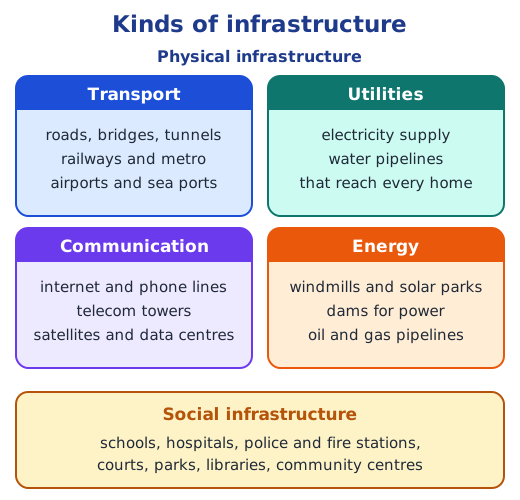
Physical infrastructure has four main kinds. Transport includes roads, bridges, tunnels, railways, airports and sea ports. Utilities bring electricity and water to homes through power lines and pipelines. Communication networks include the internet, telephone lines and telecom towers. Energy infrastructure includes windmills, solar parks and oil and gas pipelines, such as the wind farm at Muppandal in Tamil Nadu or the solar plant at Cochin airport.
One journey, many structures
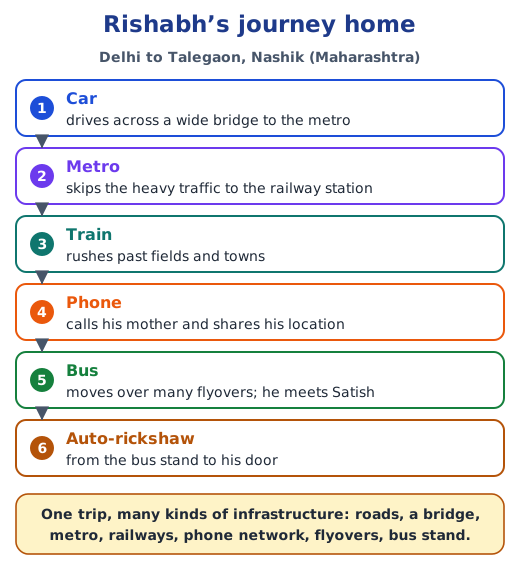
Rishabh is heading home from Delhi to Talegaon, in Nashik, Maharashtra. He drives across a wide bridge, takes the metro to avoid traffic, boards a train, calls his mother and shares his location by phone, rides a bus over many flyovers and finally takes an auto-rickshaw home. One trip uses roads, a bridge, the metro, railways, the mobile network, flyovers and a bus stand.
From field to market
On the bus Rishabh meets Satish, a tomato farmer coming back from the mandi. His tomatoes are not only a gift of sun and rain. Canals and electric pumps water his field, good roads let trucks take the crop to the city, cold storage keeps it fresh, and the internet tells him about farm inputs and market prices. If one piece is missing, the whole chain breaks.

Why it is the backbone of the nation
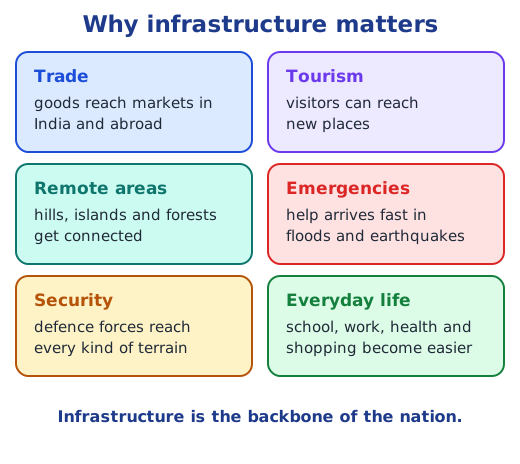
Infrastructure makes life easier for people, communities and businesses, and helps the government work smoothly. Transport links the places where goods are grown or made with markets, so trade grows inside India and abroad, just as old trade routes did in the past. It also supports tourism, connects remote areas, speeds up help in floods or earthquakes, and strengthens national security by letting the defence forces reach every kind of terrain.
Social infrastructure
Hospitals and health centres, schools, colleges and training centres, police and fire stations, courts, parks, libraries and community centres are social infrastructure. They keep people educated, healthy, safe and connected, which helps communities and the whole society grow.
Caring for it together
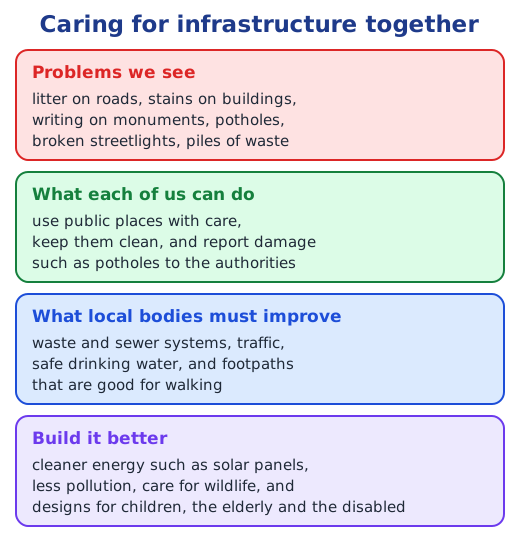
Public infrastructure suffers when roads are littered, walls are stained and monuments are written on, and every citizen pays the price. Panchayats and municipalities need better waste management, sewers, traffic control, safe drinking water and footpaths fit for walking. New infrastructure should use cleaner energy, such as solar panels, harm nature less, protect animals that cross railway tracks, and suit children, elderly people and people with disabilities. Citizens, in turn, should use it with care and report damage such as potholes.
Lessons from the Arthashastra
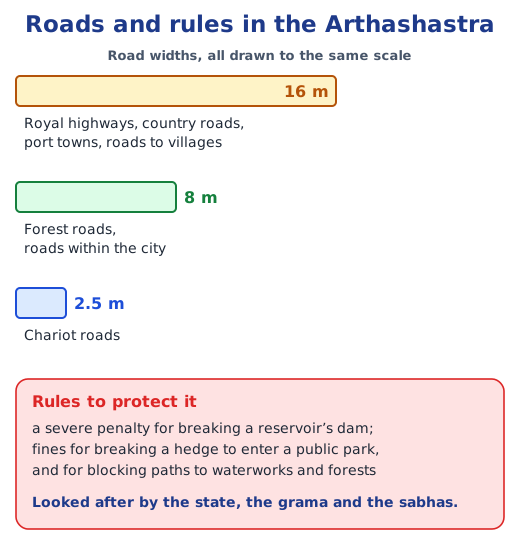
Kautilya’s Arthashastra describes how the state, the grama and the sabhas built and maintained roads and waterways. It set road widths by the kind of traffic: 16 m for royal highways and roads to villages, 8 m for forest and city roads and 2.5 m for chariot roads. It also fined people who broke a reservoir’s dam, broke a park hedge or blocked paths to waterworks and forests.
Why it matters
Seeing infrastructure as linked pieces helps you notice what your area has and what it lacks. Read on in transport infrastructure in India and communication infrastructure. Answers to the textbook questions are in the NCERT solutions for Part 2 Chapter 7; see all of Part 2 Chapter 7 notes.
Practice
-
Which of these is part of physical infrastructure?
Show answer
Answer: (b) A water pipeline
-
In the chapter, what kept Satish’s tomatoes fresh?
Show answer
Answer: (a) Cold storage
-
According to the Arthashastra, how wide should royal highways be?
Show answer
Answer: (c) 16 m
-
What might happen to Satish’s work if one part of the infrastructure were missing?
Show answer
Answer: Without canals and pumps his crop could dry up; without good roads the tomatoes would reach the city late; without cold storage they would rot; and without the internet he might buy poor inputs or sell too cheaply. Any missing piece means a loss for him.
-
What is social infrastructure? Give three examples.
Show answer
Answer: Facilities that support people’s wellbeing and the growth of communities, such as schools, hospitals and police stations. Fire stations, courts, parks, libraries and community centres are other examples.
Questions students ask
What is physical infrastructure?
It is the large network of real structures built to keep cities and villages working: transport systems such as roads, bridges and railways; utilities such as electricity and water pipelines; communication networks such as the internet, phone lines and telecom towers; and energy systems such as windmills, solar parks and oil and gas pipelines.
How is physical infrastructure different from social infrastructure?
Physical infrastructure moves people, goods, power, water and information: roads, railways, power lines and towers. Social infrastructure serves people’s wellbeing directly: schools and colleges, hospitals and health centres, police and fire stations, courts, parks, libraries and community centres. A community needs both.
What did Kautilya’s Arthashastra say about infrastructure?
It says the state, the village (grama) and assemblies (sabhas) built and looked after roads and waterways. It sets road widths, such as 16 m for royal highways and roads to villages, 8 m for forest and city roads and 2.5 m for chariot roads, and it fines people who damage public works.
Stuck on a question?
Take a photo and Lagnever AI explains it step by step. Try it for 7 days for ₹2.
Get it on Google Play Open in browser
For parents: after the trial, the plan renews monthly by UPI or card autopay. You can cancel anytime in the app.