
NCERT Solutions Class 7 Social Science Part 2 Chapter 8: Banks and the Magic of Finance
Answers to every question in Part 2 Chapter 8, Banks and the Magic of Finance, of Exploring Society: India and Beyond Grade 7 (2026-27): the Big Questions, every Let’s Explore and Think About It box and all twelve questions and activities. Page numbers follow the book (pages 193–212). Answers to surveys and activities are samples to adapt to your own family and area. Short notes: Part 2 Chapter 8 notes.
The Big Questions (page 193)
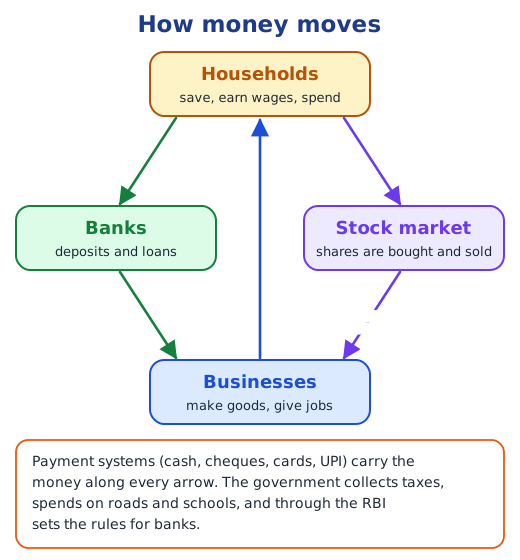
1. What is financial infrastructure, and what does it comprise? It is the network that lets people, businesses and the government save, borrow, pay and invest. It is made up of banks; payment systems such as cash, cheques, debit cards, net banking and UPI; stock markets, where shares are traded; and other institutions such as post offices, NABARD and IFCI, all under the rules of the Reserve Bank of India.
2. What are the main functions of banks, and how do they affect people’s lives? Banks accept deposits and keep them safe, pay interest, give loans for homes, education and business, and offer ways to pay, such as cheques, cards and UPI. As a result savings grow, people like Rima can start or expand businesses, and wages and scholarships reach people directly, as the Jan Dhan Yojana has shown.
3. How does financial infrastructure contribute to a nation’s progress? It turns the small savings of millions into loans and investment for farms, businesses and infrastructure, makes payments quick and recorded, brings more people into banking and creates jobs. This boosts economic activity and, in the end, the nation’s prosperity.
Let’s Explore (page 194)
What are the people in the bank doing? Sample answer: some stand in a queue at the cash counter to deposit or withdraw money, some fill in deposit or withdrawal slips, someone updates a passbook, and others talk to a bank officer about opening an account or taking a loan. Family members may add that they visit the bank to deposit cash, get a debit card, update KYC documents or ask about fixed deposits.
Think About It (page 196)
Why does Navdeep think saving at the bank is better than keeping cash at home? Cash at home can be stolen, lost or spent without thinking. In the bank it is safe, it earns interest that grows over time, and every deposit is recorded.
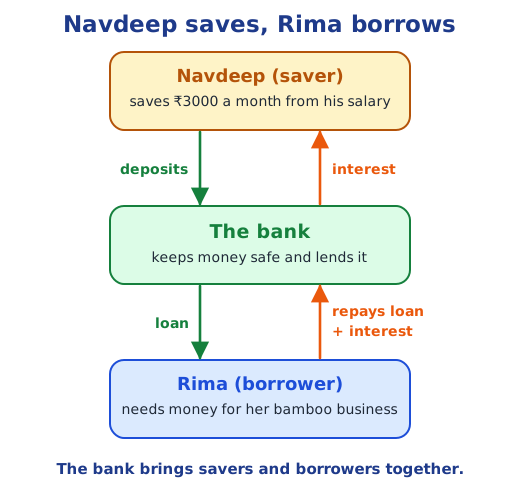
Can Navdeep and Rima lend to each other directly, without the bank? What could happen? They could, but it is risky. Navdeep may not know Rima well or trust her; his small monthly savings may not match the larger sum she needs right now; they would have to agree on interest and dates themselves; and if her business fails, Navdeep could lose his money, with no record to settle a quarrel. A bank collects money from many savers, checks borrowers, spreads the risk and keeps records, so both sides are safer.
Think About It (page 198)
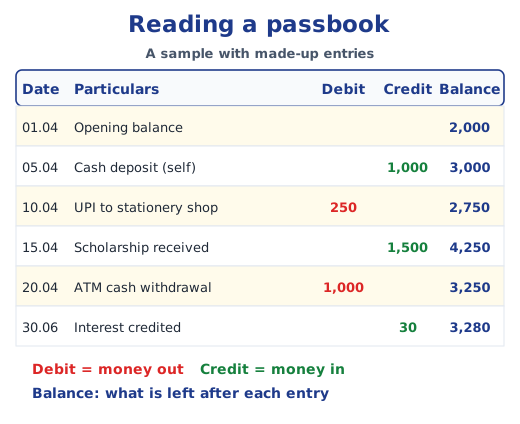
Look at the passbook. Why is keeping records of financial transactions important? Records show the balance at any time, so you know what you can spend. They help you spot mistakes, unknown charges or fraud, prove that a payment was made (for rent or fees), plan a budget, and support applications for loans or scholarships. In the book’s passbook, salary and interest appear as credits (money in), while rent, cinema and coffee-house payments and SMS charges appear as debits (money out).
Think About It (page 202)
Temples as banks. The box shows that lending money is very old in India. Temples did not take public deposits, but they lent to artisans, merchants and local governments, often for building works, and the agreements were cut on copper plates that still survive. A 13th-century inscription from Kodumbalur in Tamil Nadu records communities borrowing from the Tirumudukunramudaiya-Nayanar temple and agreeing to pay interest, much like a loan today.
Think About It (page 207)
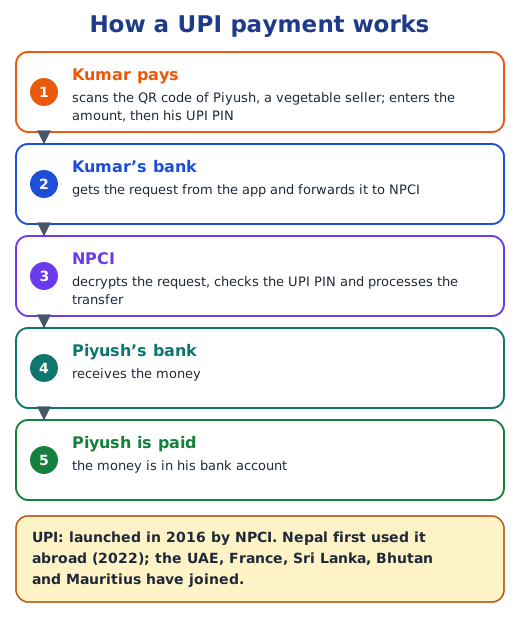
UPI across borders. Nepal adopted UPI in 2022, and the UAE, France, Sri Lanka, Bhutan and Mauritius have followed. Indians abroad can pay with familiar apps, visitors to India can pay easily too, and the system’s speed and safety have made it India’s gift to the world of payments.
Think About It (page 209)
Why do companies issue shares, why do people buy them, and are there benefits? Companies issue shares to raise money to grow, without having to borrow and pay interest. People buy them to own a part of a company and hope the share price will rise; they may also share in the profits. The benefits come with risk: prices can fall and bring losses.
Questions and activities (pages 211–212)
1. What is financial infrastructure, and how does it complement physical infrastructure? Financial infrastructure is made up of banks, payment systems and stock markets, along with other financial institutions; together they move and manage money. Physical infrastructure moves goods, people, power and messages; financial infrastructure pays for it and makes trade possible. Loans and investment fund roads, ports and power plants; workers are paid through bank accounts; farmers and businesses that use the roads are paid by UPI or cheque. Each needs the other.
2. How does a bank account help people? Should everyone be required to have one? A bank account keeps money safe, earns interest, gives access to loans, cards and UPI, records every payment and lets wages, scholarships and government benefits arrive directly, without middlemen. Almost everyone gains from having one, which is why the Jan Dhan Yojana made accounts easy to open. But forcing it could be hard for people who live far from a bank or lack documents, so it is better to make accounts easy and useful for everyone, and to teach people how to use them safely.
3. Advantages and disadvantages of compound interest for savers and borrowers. For savers, compounding is an advantage: money left untouched grows faster every year, and starting early helps most. The catch is that the money must stay in the bank for a long time. For borrowers it is mostly a disadvantage: unpaid interest adds to the debt, so a loan can grow quickly if repayments are missed. Knowing this encourages borrowers to repay on time.
4. How does financial infrastructure help money flow between households and businesses? How can the government help? Households deposit savings in banks, which lend them to businesses; households also buy shares, which give companies money to grow. Businesses pay wages and interest back to households, and people pay for goods with cash, cards or UPI. The government helps by opening accounts for all (Jan Dhan), sending benefits directly into accounts, supporting payment systems such as UPI, setting rules through the RBI, teaching people about money and running the 1930 helpline against fraud.
5. Why do fixed deposits earn more interest than savings accounts? In a fixed deposit the saver agrees not to touch the money for a set time, such as 3 or 5 years. The bank can then lend it out for longer and plan with confidence, so it rewards the saver with a higher rate. Savings account money can be taken out at any time, so the bank pays less.
6. Sahil’s prize money. ₹10,000 at 12% a year, compounded:
| Year | Interest for the year | Amount at the end |
|---|---|---|
| 1 | 12% of 10,000 = ₹1,200 | ₹11,200 |
| 2 | 12% of 11,200 = ₹1,344 | ₹12,544 |
| 3 | 12% of 12,544 = ₹1,505.28 | ₹14,049.28 |
After 3 years Sahil would have ₹14,049.28. (If interest were paid only on the first ₹10,000, he would have ₹13,600; compounding gives him ₹449.28 more.)
7. How does the stock market gather people’s savings, and how do companies gain by issuing shares? Many people each buy a few shares, so small savings add up to large sums for companies. Companies gain money to expand, buy machines or launch products without borrowing, share their risks with many owners and become better known. Savers in turn get a chance to grow their savings, though prices can also fall.
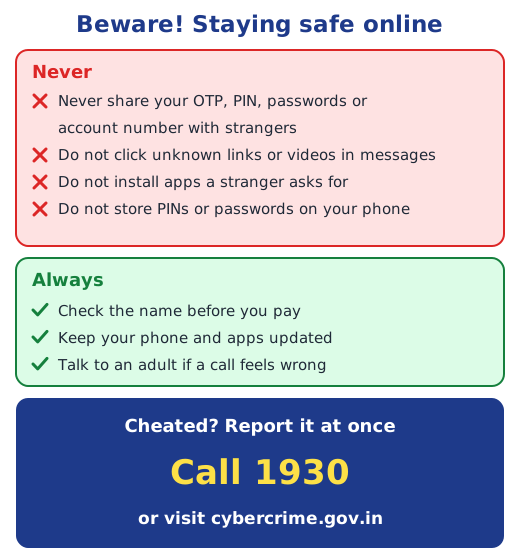
8. How can we balance the convenience of digital payments with the risk of cyber fraud? Keep using digital payments for their speed and records, but follow safety habits: never share an OTP, PIN or password; check the payee’s name before paying; do not click unknown links or install apps a stranger suggests; use strong PINs and keep apps updated; turn on payment alerts; and report any fraud at once on 1930 or cybercrime.gov.in. Banks and the government help with PINs, alerts and awareness campaigns.
9. Survey of family and neighbours. A sample summary:
| Question | Sample findings |
|---|---|
| How they save | bank savings account, fixed deposit, post office scheme, some cash at home |
| Use of UPI, ATM, cheques | UPI for shopping and bills; ATM for cash; cheques for rent or school fees |
| UPI or cash? | most prefer UPI: quick, no change needed, a record of every payment; some older people still prefer cash |
| Experience of fraud | a fake call asking for an OTP; they refused, blocked the number and told the bank |
One surprising insight (sample): even small shops in the village now accept UPI.
10. A financial safety poster. Sample poster: “Never share your OTP, PIN or password.” “Don’t click unknown links.” “Check the name before you pay.” “Cheated? Call 1930 or visit cybercrime.gov.in.” Hang it in the corridor or library.
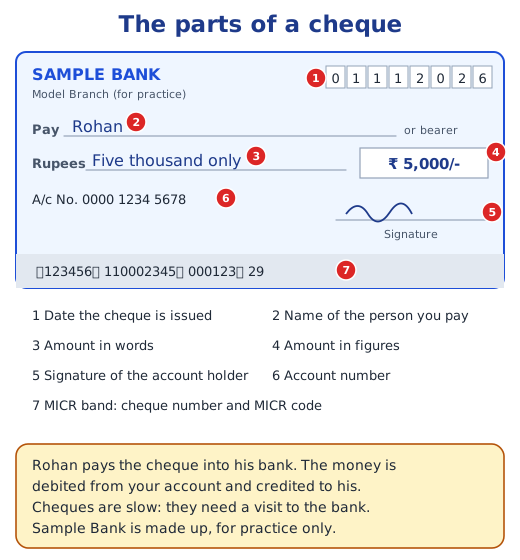
11. Filling in cheques for utility bills. With a parent’s permission: write the date; write the name of the company or office to be paid, such as the electricity board; write the amount in words and in figures; and let the account holder sign. Extra: two lines across the top corner with “A/c payee” written between them mean the money can go only into the payee’s account.
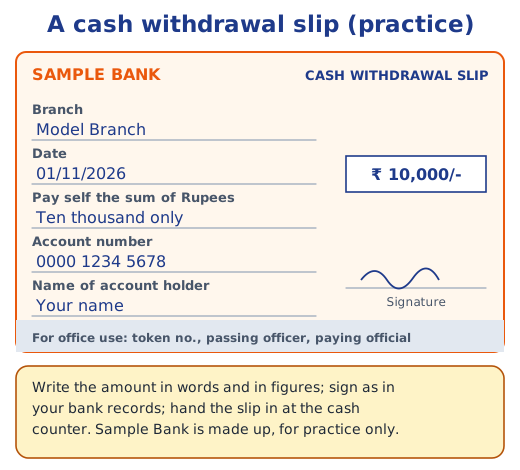
12. Filling in a cash withdrawal slip for ₹10,000. Write the branch and the date, your account number and your name; write the amount in words, “Ten thousand only”, and in figures, ₹10,000; and sign as in the bank’s records. Hand the slip in at the cash counter; the part for office use is filled in by the bank.
Practice
-
₹5000 is kept in a bank at 10% a year, compounded. How much is there after 2 years?
Show answer
Answer: (b) ₹6050
-
Which of these is a savings scheme offered by post offices?
Show answer
Answer: (b) Kisan Vikas Patra
-
In a passbook, a salary paid into the account is shown as:
Show answer
Answer: (b) a credit
-
A bank pays 3% on deposits and charges 8% on loans. If ₹1000 is deposited and lent out for a year, what does the bank earn?
Show answer
Answer: The depositor gets 3% of ₹1000 = ₹30, and the borrower pays 8% of ₹1000 = ₹80. The bank earns ₹80 − ₹30 = ₹50.
-
Give two signs that a call or message may be a fraud.
Show answer
Answer: It asks for your OTP, PIN, password or bank details, or it pushes you to click a link or install an app in a hurry, often with a prize or a threat. Genuine banks never ask for these.
Stuck on a question?
Take a photo and Lagnever AI explains it step by step. Try it for 7 days for ₹2.
Get it on Google Play Open in browser
For parents: after the trial, the plan renews monthly by UPI or card autopay. You can cancel anytime in the app.