
Class 7 Social Science Part 2 Chapter 8: Banks and the Magic of Finance Notes
This chapter in five lines
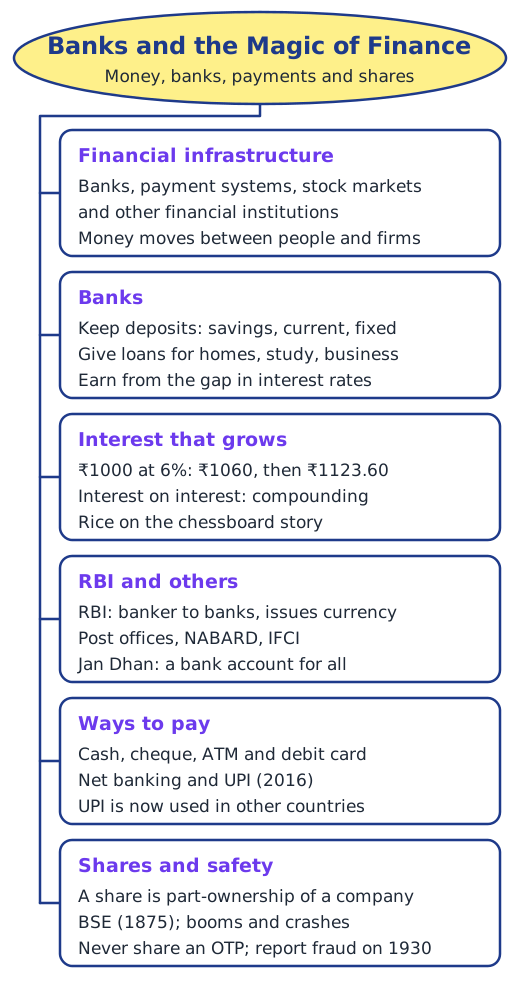
Banks and the Magic of Finance is about financial infrastructure: the banks, payment systems, stock markets and other institutions that move money between people, businesses and the government. Banks keep deposits safe, pay interest that grows by compounding and lend to borrowers, under the rules of the Reserve Bank of India. Payments have moved from cash and cheques to cards and UPI, shares let people own parts of companies, and everyone must guard against fraud.
What is this chapter about?
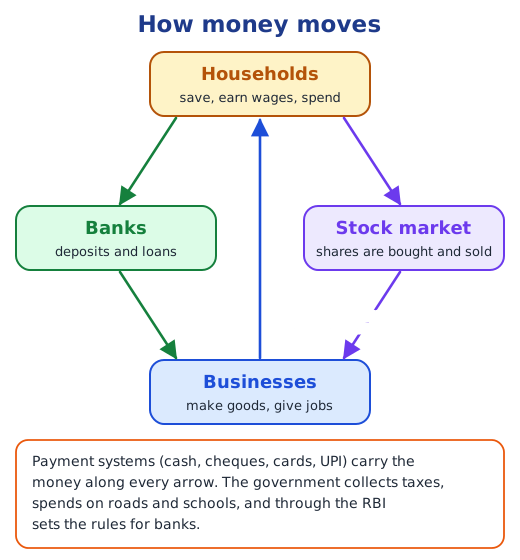
The last chapter showed the roads, railways and networks that carry goods and people. But who pays the workers, how do shoppers pay shopkeepers, and where does the money for a new highway come from? The answer is financial infrastructure: banks, payment systems, stock markets and other institutions through which people, businesses and the government move and manage money.
Banks: deposits and loans
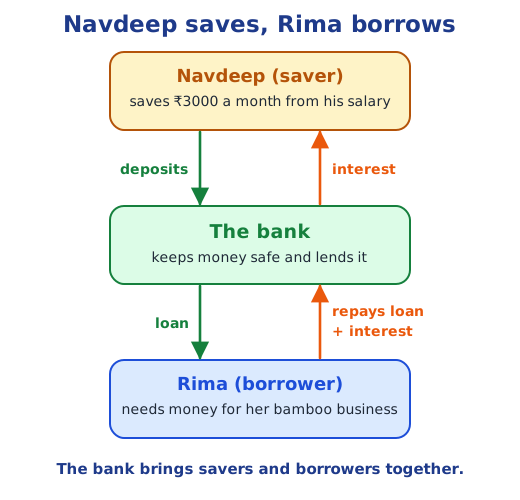
Navdeep saves ₹3000 a month, but cash in a cupboard is not safe, so he deposits it in a bank. Rima, who makes bamboo products, needs more money for her business than friends can lend, so she borrows from the bank. The bank keeps Navdeep’s money safe, pays him interest and lends it to Rima, who repays it with interest. Banks offer savings accounts for regular savers, current accounts for businesses and fixed deposits for money set aside for a few years. Read more in how banks work.
The magic of compounding
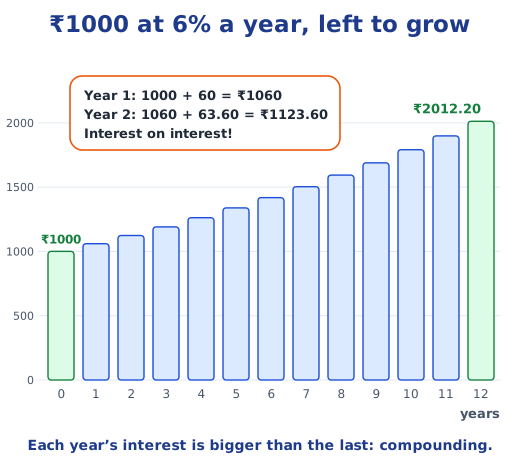
Interest is the reward for saving and the price of borrowing. If ₹1000 earns 6% a year, it becomes ₹1060 after one year. In the second year interest is paid on ₹1060, so the total becomes ₹1123.60. Earning interest on interest is compounding; after 12 years the ₹1000 grows to about ₹2012.20. A story from Ambalappuzha in Kerala makes the same point: a sage asked a king for rice that doubled on every square of a chessboard, and by the 32nd square the grains passed 210 crore.
The RBI and banking for all
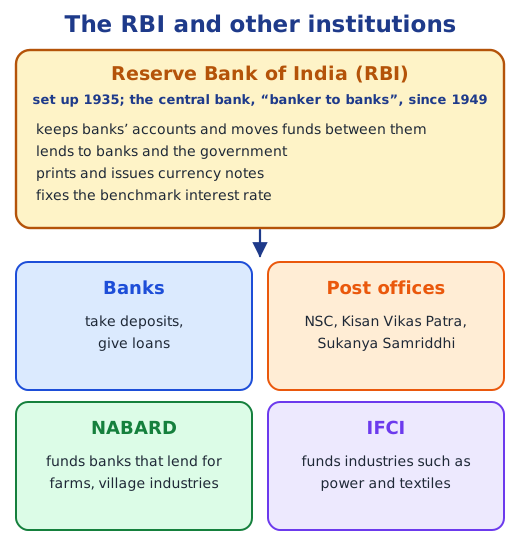
Banks pay depositors a lower rate than they charge borrowers, and the gap is their income. The Reserve Bank of India, set up in 1935 and the central bank since 1949, supervises them, keeps their accounts, issues currency and fixes the benchmark interest rate. Post offices, NABARD and IFCI also provide financial services. The Jan Dhan Yojana of 2014 opened over 50 crore bank accounts, so wages and scholarships now reach people directly.
Ways to pay
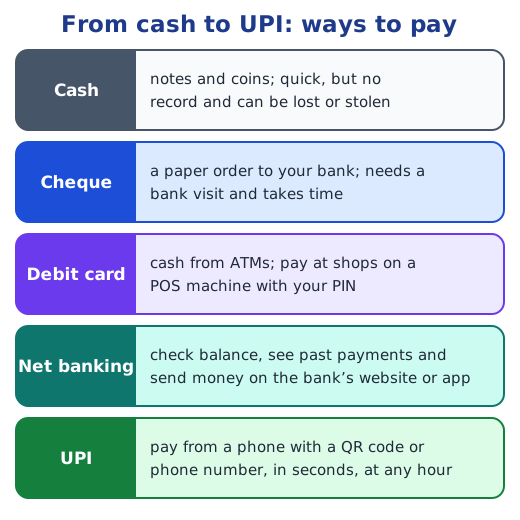
Money can be taken out with a withdrawal slip or from an ATM with a debit card. A cheque pays someone from your account but takes time. Debit cards, net banking and above all UPI, launched in 2016, make payments instant: scan a QR code, enter the amount and the UPI PIN, and the money moves. Nepal, the UAE, France, Sri Lanka, Bhutan and Mauritius have adopted UPI. See digital payments and UPI.
Shares and staying safe
A share is a piece of ownership in a company, bought and sold at a stock exchange such as the Bombay Stock Exchange, set up in 1875. Share prices rise and fall, so shares can bring gains or losses. Read shares and the stock market. Finally, digital money brings new risks: fraudsters use fake calls and messages to steal OTPs and bank details. Report any fraud on the 1930 helpline. Answers to every question are in the NCERT solutions for Part 2 Chapter 8.

Key terms
| Term | Meaning |
|---|---|
| Financial infrastructure | All the banks, payment systems, stock markets and other money institutions that let people, firms and the government pay, save and manage money. |
| Bank | An institution that takes people’s savings as deposits and lends that money to borrowers as loans. |
| Deposit | Money kept in a bank account; it can be taken out under the bank’s rules and often earns interest. |
| Savings, current and fixed deposit accounts | A savings account suits people who save and earns interest; a current account suits businesses, has no limit on transactions and earns no interest; a fixed deposit keeps money for a set time for higher interest. |
| Interest | The amount charged for borrowing money, or earned for lending it, usually given as a percentage. |
| Compounding | Earning interest on earlier interest as well as on the original amount, so money grows faster and faster over time. |
| Loan | Money borrowed from a bank or financial institution that must be repaid later with interest. |
| Reserve Bank of India (RBI) | India’s central bank, the banker to banks: it supervises banks, issues currency and fixes the benchmark interest rate. |
| Benchmark interest rate | The base interest rate at which the RBI lends to commercial banks. |
| UPI | Unified Payments Interface: a fast digital payment system launched by NPCI in 2016 that sends money from a phone using a QR code or phone number. |
| Share | A unit of ownership in a company. Owning shares makes you a part-owner of the company. |
| OTP | One-Time Password: a short temporary code used to confirm who you are or to approve a payment. It must never be shared. |
Topics in this chapter
Practice
-
Which account suits businesses that make many payments, and earns no interest?
Show answer
Answer: (b) Current account
-
₹1000 earns 6% interest a year, compounded. How much is there after 2 years?
Show answer
Answer: (b) ₹1123.60
-
Which is called the banker to banks in India?
Show answer
Answer: (b) The Reserve Bank of India
-
Which organisation launched UPI in 2016?
Show answer
Answer: (b) NPCI
-
A share is:
Show answer
Answer: (b) part-ownership of a company
-
What should you do if you are cheated in a digital payment?
Show answer
Answer: (b) Call the 1930 helpline
Questions students ask
What are the main topics of Class 7 SST Part 2 Chapter 8?
What financial infrastructure is; what banks do, through Navdeep, who saves, and Rima, who borrows; types of accounts; interest and compounding, with the rice-on-the-chessboard story; loans and how banks earn; the Jan Dhan Yojana; the RBI and other institutions; ways to pay, from cheques to UPI; shares and the stock market; and how to avoid financial fraud.
Is Banks and the Magic of Finance in the new NCERT book?
Yes. It is Chapter 8, the last chapter of Exploring Society: India and Beyond, the Class 7 Social Science textbook Part 2 (2026-27), on pages 193 to 212, in the theme Economic Life Around Us. It follows Infrastructure: Engine of India’s Development.
What is financial infrastructure?
It is the network of banks, payment systems such as UPI, stock markets and other financial institutions such as post offices and NABARD. It lets people save, borrow, pay and invest, helps businesses raise money and pays for building and maintaining physical infrastructure like roads and railways.
Stuck on a question?
Take a photo and Lagnever AI explains it step by step. Try it for 7 days for ₹2.
Get it on Google Play Open in browser
For parents: after the trial, the plan renews monthly by UPI or card autopay. You can cancel anytime in the app.