
Digital payments and UPI
Answer in short
Money can move by cash, cheque, debit card, net banking or UPI. A cheque needs a bank visit and takes time, while electronic payments are instant. UPI, launched by NPCI in 2016, lets anyone pay from a phone with a QR code or phone number. Digital payments are easy, but never share an OTP or PIN.
Stuck on a question? Take a photo and Lagnever AI explains it step by step. Try it for 7 days for ₹2. Get it on Google Play
How money changes hands
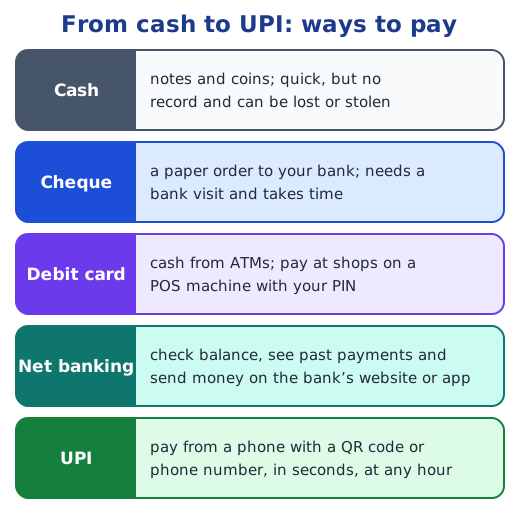
These modes and systems form a core part of financial infrastructure: they carry money from one person to another. The old modes are cash and cheques. Debit cards, net banking and the Unified Payments Interface (UPI) are newer, and UPI has become a quick, convenient favourite.
Taking money out
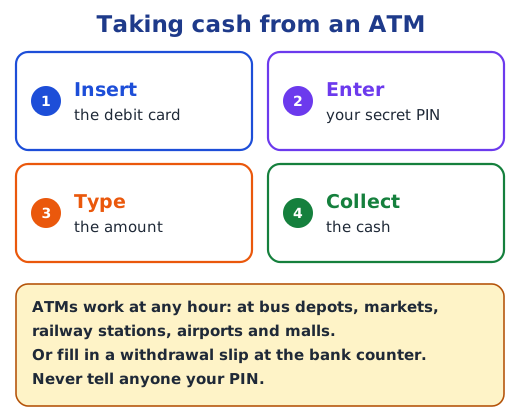
You can fill in a withdrawal slip and hand it in at the bank’s cash counter. Or you can use the debit card the bank gives you at an ATM, a self-service machine that works day and night at bus depots, markets, railway stations, airports and malls. Insert the card, enter your secret PIN (a 4 to 6 digit code), type the amount and collect the cash.
Paying by cheque
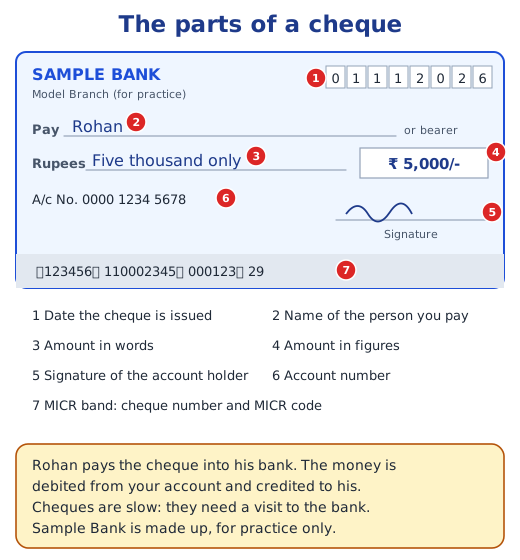
A cheque lets you pay someone directly from your bank account. Say you owe your friend Rohan ₹5,000: you write the date, his name, the amount in words and figures, and sign it. Rohan deposits it in his bank; the amount is debited from your account and credited to his. Cheques need a visit to the bank and take time.
Cards and net banking
Electronic payments move money at once. At a shop, a debit card is swiped or inserted in a POS (point of sale) machine; the amount is entered and the customer types the PIN, and the money leaves the account immediately. Net banking, through the bank’s website or app, lets account holders check their balance and past transactions and send money from a computer or phone.
UPI: India’s gift to the world
Earlier, sending money meant filling in a cheque and dropping it at the bank, so many people avoided banks and used cash, leaving huge amounts of money unrecorded. In 2016 UPI was launched by the National Payments Corporation of India (NPCI). Apps such as BHIM (Bharat Interface for Money) use it to send money with a QR code or a phone number, and to check balances and past payments without updating a passbook.
When Kumar buys vegetables from Piyush, he scans Piyush’s QR code, enters the amount and then his UPI PIN. The app sends the request to Kumar’s bank, which passes it to NPCI. NPCI decrypts it, checks the PIN and processes the transfer; Piyush’s bank receives the money and credits his account, all in seconds.
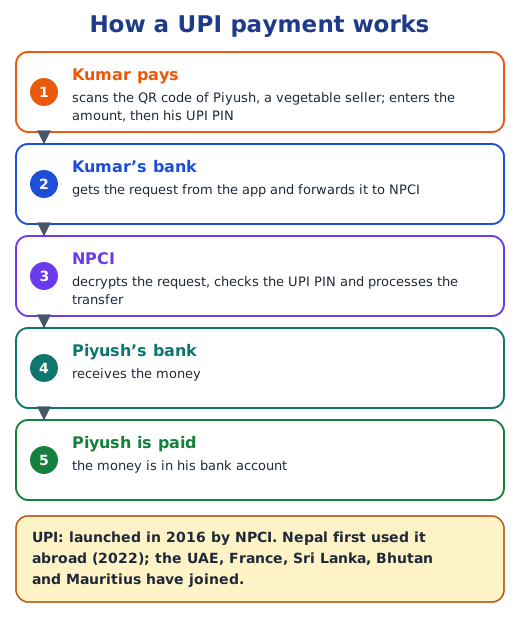
During the COVID-19 pandemic, when people had to keep their distance, UPI made cashless payments popular, and it works in many languages. Nepal became the first country to adopt it, in 2022; the UAE, France, Sri Lanka, Bhutan and Mauritius have followed.
Staying safe from fraud
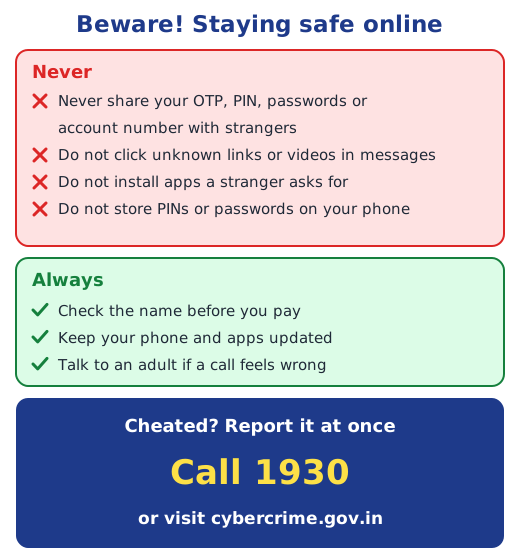
Digital payments bring new tricks. Fraudsters send fake calls or messages to make people install harmful apps or reveal bank details or OTPs (one-time passwords), and then empty their accounts. Never share an OTP, PIN, password or account number with strangers, do not click unknown links, and do not store PINs on your phone. If you are cheated, call the 1930 helpline or report it on the National Cybercrime Reporting Portal, cybercrime.gov.in.
Why it matters
Paying digitally saves time and keeps a record, as long as you stay alert. See where the money in your account comes from in how banks work, and how savings can be invested in shares and the stock market. Answers to the textbook questions are in the NCERT solutions for Part 2 Chapter 8; see all of Part 2 Chapter 8 notes.
Practice
-
What do you need to take cash out of an ATM?
Show answer
Answer: (b) A debit card and its PIN
-
Which country first adopted UPI outside India, in 2022?
Show answer
Answer: (b) Nepal
-
In a UPI payment, who checks the UPI PIN and processes the transfer?
Show answer
Answer: (b) NPCI
-
Why did UPI become popular during the COVID-19 pandemic?
Show answer
Answer: People had to keep their distance to stop the infection spreading. UPI let them pay without handing over cash, just by scanning a QR code, and its design in many languages made it easy for everyone to use.
-
How can we enjoy digital payments safely?
Show answer
Answer: Use them for convenience but follow simple rules: never share an OTP, PIN or password, do not click unknown links or install apps a stranger suggests, check the name before paying, and report any fraud at once on 1930 or cybercrime.gov.in.
Questions students ask
How can money be taken out of a bank account?
Fill in a withdrawal slip and hand it in at the bank’s cash counter, or use the debit card the bank gives you at an ATM: insert the card, enter your PIN, type the amount and collect the cash. ATMs work at any hour at bus depots, markets, stations, airports and malls.
How does a UPI payment work?
The buyer scans the seller’s QR code in a payment app, enters the amount and then the UPI PIN. The app sends the request to the buyer’s bank, which forwards it to NPCI. NPCI checks the PIN and processes the transfer, the seller’s bank receives the money, and it reaches the seller’s account.
What is a cheque?
A cheque is a paper order to your bank to pay someone from your account. You write the date, the payee’s name, the amount in words and in figures, and sign it. The payee deposits it in their bank; the amount is debited from your account and credited to theirs, which takes time.
Stuck on a question?
Take a photo and Lagnever AI explains it step by step. Try it for 7 days for ₹2.
Get it on Google Play Open in browser
For parents: after the trial, the plan renews monthly by UPI or card autopay. You can cancel anytime in the app.