
Shares and the stock market
Answer in short
A share is a piece of ownership in a company. Companies sell shares to raise money, and people buy them hoping their value will rise. Shares trade at a stock exchange such as the Bombay Stock Exchange, set up in 1875. Prices rise and fall with a company’s results and with events such as new laws or wars.
Stuck on a question? Take a photo and Lagnever AI explains it step by step. Try it for 7 days for ₹2. Get it on Google Play
A piece of a company
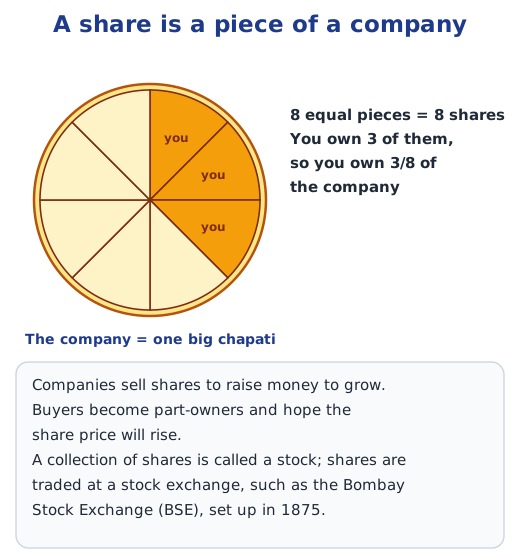
Picture the stock market as a huge online bookshop, except that people buy and sell shares instead of books. Each share is a slice of ownership in a company. If the company were a big chapati, each share would be one piece of it; the more pieces you own, the larger your part of the company.
Why companies sell shares
Suppose you run a small restaurant and want to add new dishes, but you do not have enough money. Friends could give you money in return for part of the profits, becoming part-owners. Companies do the same on a large scale: by issuing shares they raise money for their work. People who buy shares put their savings where they expect the value to rise. A collection of shares is called a stock.
The stock exchange
Shares change hands at a stock exchange. India’s Bombay Stock Exchange (BSE), set up in 1875, is one of the oldest in the world. Trades were once done by hand using paper tickets, and owners held paper share certificates; today computers and other devices handle every trade.
Why prices rise and fall
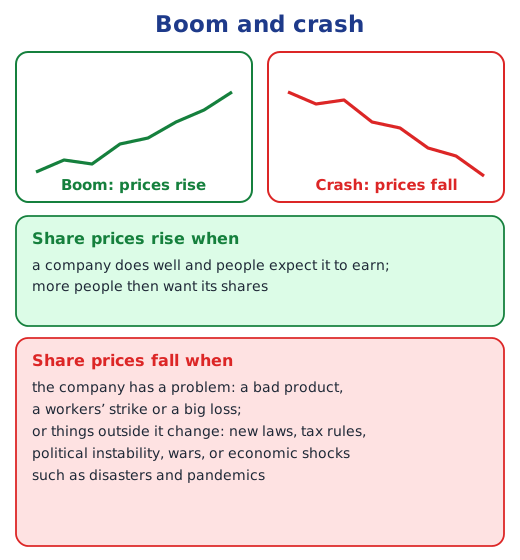
Like the prices of goods, share prices go up and down, so trading shares can bring gains or losses. When a company does well and is expected to earn more, demand for its shares grows and the price rises. When it runs into trouble, such as a poor product, a strike by workers or heavy losses, demand drops and so does the price. Events outside the company count too: changes in laws or taxes, unstable politics, war and sudden economic shocks such as earthquakes, floods or a pandemic. When the prices of many companies rise together, the market has a boom; when they fall together, it crashes.
Words to know
Investment means putting money into something that is expected to gain value over time, such as shares. Tax is a compulsory payment that people and businesses make to the government on their income and profits; it is also added to the price of some goods and services, and the government sets the rules for it. An economic shock is a sudden, unexpected event, such as an earthquake, a flood, a war, a pandemic or a sharp change in prices or government policy, that changes how people in a country earn, spend and save.
How the stock market helps
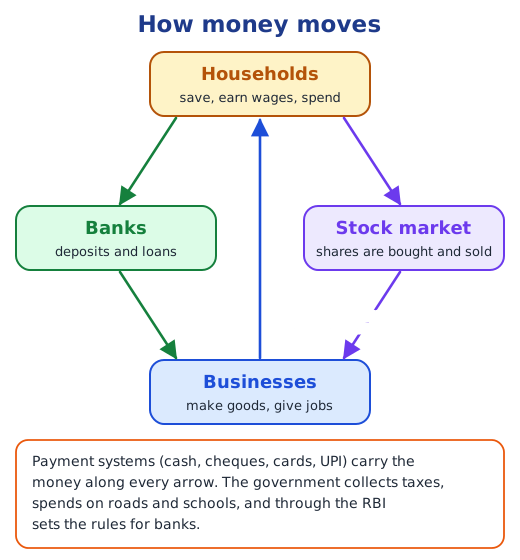
A bank deposit grows steadily with interest, while the value of shares can rise faster or fall. The stock market gathers the small savings of many people and puts them to work in companies. Companies get money to grow without borrowing, and the risk is shared among many owners. Savers get a chance to share in a company’s success, but they must remember that prices can fall as well as rise.
Why it matters
Understanding shares helps you see how companies raise money and why investing always carries risk. Compare it with the steady growth of bank savings in how banks work, and with paying for things in digital payments and UPI. Answers to the textbook questions are in the NCERT solutions for Part 2 Chapter 8; see all of Part 2 Chapter 8 notes.
Practice
-
Imagine a company as a big chapati. A share is then:
Show answer
Answer: (b) one piece of it
-
If the share prices of many companies drop at the same time, the market has:
Show answer
Answer: (b) a crash
-
Where are shares bought and sold?
Show answer
Answer: (b) At a stock exchange
-
What do companies gain by issuing shares, and what do buyers hope for?
Show answer
Answer: Companies issue shares to raise money for their work, such as new machines or products, without taking a loan. People buy shares to own a part of a company and hope its value rises, so their savings grow; owners may also get a part of the profits.
-
What could make a company’s share price fall?
Show answer
Answer: Trouble inside the company, such as a poor product, a strike by workers or heavy losses, so that fewer people want its shares; or outside events such as changes in laws or taxes, unstable politics, war or sudden economic shocks.
Questions students ask
What is a share?
Each share stands for a small slice of ownership in a company. If a company is a big chapati, each share is one piece, so the more shares you own, the bigger your part of the company. A collection of shares is called a stock.
What is a stock exchange?
It is the marketplace where shares and similar securities are bought and sold. India’s Bombay Stock Exchange, set up in 1875, is one of the oldest in the world. Trades were once done by hand with paper tickets and certificates; today computers handle them.
What is a stock market crash?
When prices of many companies’ shares drop together, the market crashes. The opposite, when many prices rise together, is a boom. Crashes can follow bad news for companies or shocks such as wars, pandemics or sudden policy changes.
Stuck on a question?
Take a photo and Lagnever AI explains it step by step. Try it for 7 days for ₹2.
Get it on Google Play Open in browser
For parents: after the trial, the plan renews monthly by UPI or card autopay. You can cancel anytime in the app.