
How do banks work?
Answer in short
A bank collects people’s savings as deposits and lends them to borrowers as loans. Depositors earn interest, which grows faster over time through compounding, while borrowers repay their loans with a higher rate of interest; the gap is the bank’s income. Savings, current and fixed deposit accounts suit different needs, and the Reserve Bank of India regulates all banks.
Stuck on a question? Take a photo and Lagnever AI explains it step by step. Try it for 7 days for ₹2. Get it on Google Play
Saving and borrowing
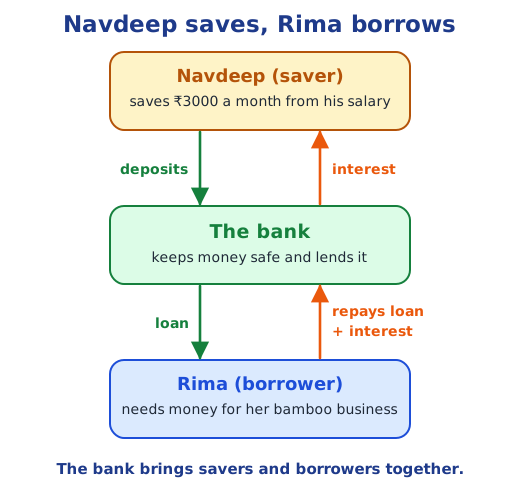
Every month Navdeep puts aside ₹3000 of his salary. Keeping it in a cupboard is risky, so he deposits it in a bank. Rima runs a business making bamboo products and needs more money than friends and family can lend, so she takes a loan from the bank and will repay it later. The bank uses Navdeep’s spare money to give Rima her loan. A bank is the meeting point of savers and borrowers. To use it, a person or business first opens an account and becomes an account holder.
Kinds of bank accounts
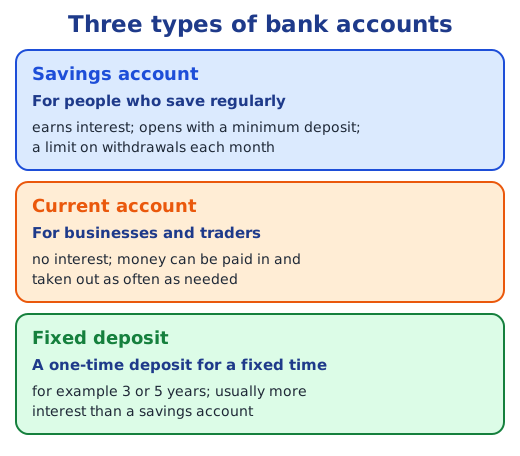
A savings account is for people who save regularly. It earns interest, opens with a small minimum deposit and limits how often money can be taken out each month. A current account is for businesses and traders who pay and receive money often; it earns no interest, but there is usually no limit on transactions. A fixed deposit is a one-time deposit for a set period, such as 3 or 5 years, and usually earns more interest than a savings account.
Interest and compounding
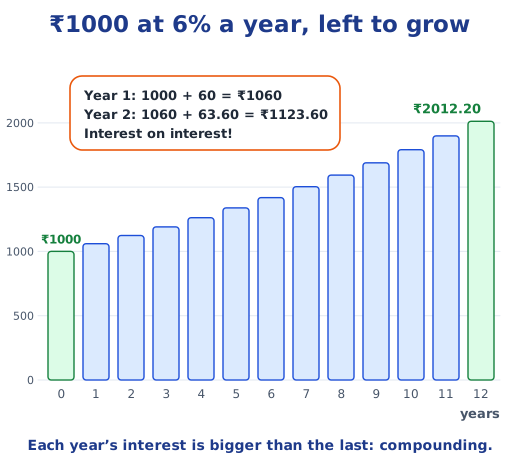
Banks keep deposits safe and also lend them out, so they pay depositors interest, monthly, every quarter or once a year. Suppose you deposit ₹1000 at 6% a year. After a year you have ₹1060. In the second year the interest is 6% of ₹1060, which is ₹63.60, so you have ₹1123.60. Earning interest on interest is called compounding. Left for 12 years, the ₹1000 grows to about ₹2012.20.
The king, the sage and the chessboard
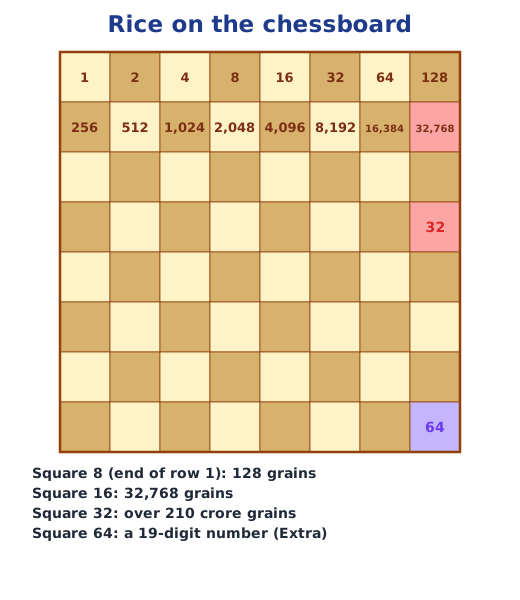
A chess-loving king of Ambalappuzha in Kerala lost a game to a visiting sage, who asked for a modest-looking prize: a single grain on the first square, then twice as many on each square after it: 2, 4, 8 and so on. The top row ended with 128 grains, the 16th square had 32,768, and the 32nd had over 210 crore. Like compounding, doubling makes small amounts huge.
Loans and how banks earn
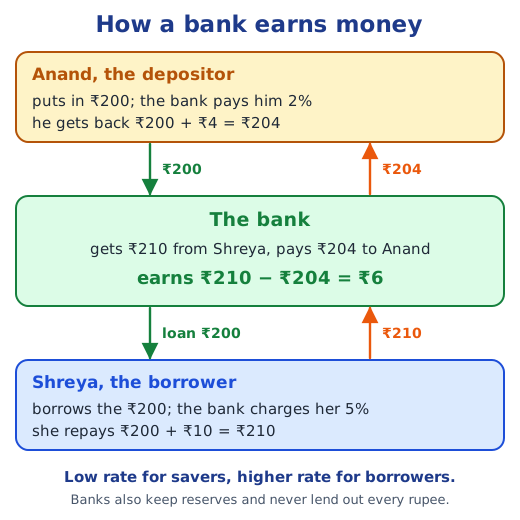
Banks lend money as loans to buy a house or a vehicle, to study, or to help businesses buy machines and raw materials and launch products. Borrowers repay the loan with interest. Banks pay savers a lower rate than they charge borrowers. If Anand deposits ₹200 at 2%, he gets back ₹204; if the bank lends that ₹200 to Shreya at 5%, she repays ₹210, and the bank earns ₹6. Banks also keep reserves and never lend out every rupee.
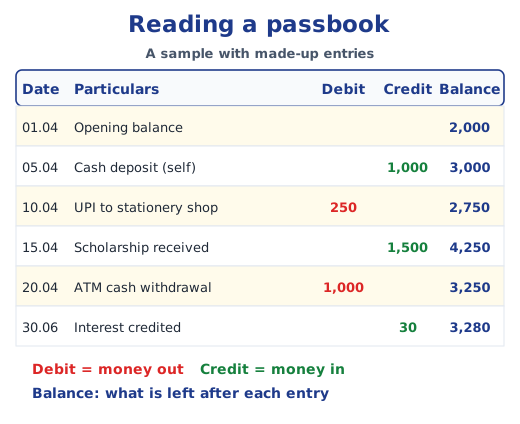
Keeping records: the passbook
A passbook is a diary-like record of every deposit and withdrawal, updated at the bank. A debit is money taken out of the account; a credit is money received. Records help you know your balance, spot mistakes or fraud and plan your spending.
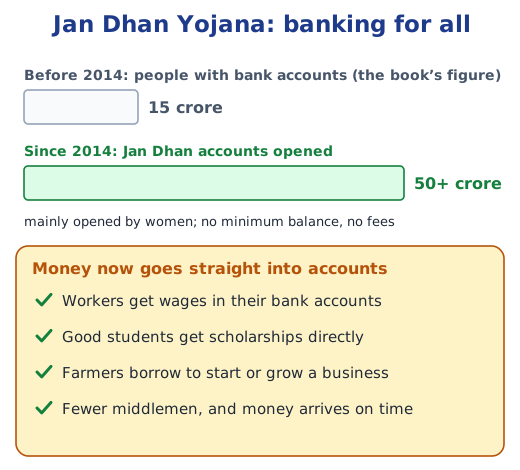
Banking for all
According to the book, before 2014 only about 15 crore Indians had bank accounts, and most relied on cash. That year the government began the Pradhan Mantri Jan Dhan Yojana, which offered accounts with no minimum balance and no fees; over 50 crore have been opened, mainly by women. Wages and scholarships now go straight into accounts, which cuts out middlemen.
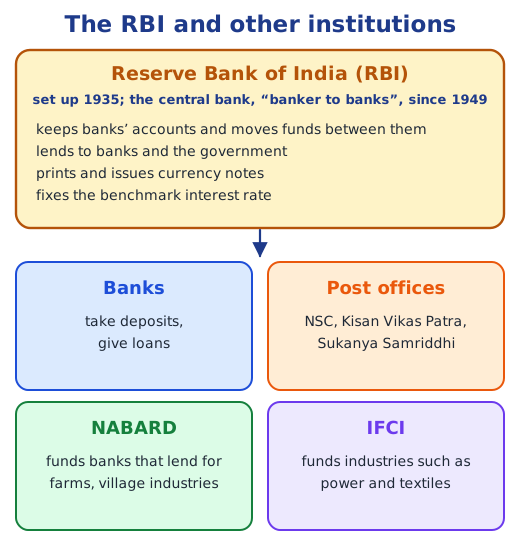
The RBI and other institutions
The Reserve Bank of India supervises the banking system. Set up in 1935, it has worked as the central bank, the banker to banks, since 1949. It keeps banks’ accounts, lends to banks and the government, prints and issues currency and fixes the benchmark interest rate. Post offices offer savings schemes such as National Savings Certificates, Kisan Vikas Patra and Sukanya Samriddhi; NABARD funds banks that lend for farming and village industries, and IFCI funds industries such as power and textiles. Long ago, temples too lent money, recording the deals on copper plates.
Why it matters
Knowing how banks work helps you save wisely, borrow carefully and read your own passbook. Learn how money moves in digital payments and UPI, and how savings can become part-ownership in shares and the stock market. Answers to the textbook questions are in the NCERT solutions for Part 2 Chapter 8; see all of Part 2 Chapter 8 notes.
Practice
-
Which account usually pays the highest interest?
Show answer
Answer: (c) Fixed deposit
-
Anand deposits ₹200 at 2%, and the bank lends it at 5%. What does the bank earn?
Show answer
Answer: (b) ₹6
-
When was the Reserve Bank of India set up?
Show answer
Answer: (b) 1935
-
Why is it better to save in a bank than at home?
Show answer
Answer: Money at home can be stolen, lost or spent on a whim. In a bank it is safe, it earns interest that grows by compounding, and every deposit and withdrawal is recorded in the passbook.
-
What does a passbook record?
Show answer
Answer: Every transaction in the account, with its date and details: debits (money going out, such as payments and withdrawals), credits (money coming in, such as salary, deposits and interest) and the balance left after each entry.
Questions students ask
What does a bank do?
It accepts deposits and keeps them safe, pays interest to savers, gives loans for homes, vehicles, education and business, and charges interest on them. It also offers accounts, passbooks, cheques, debit cards, ATMs and digital payments, so money can be saved, withdrawn and moved easily.
What is compound interest?
It is interest earned on earlier interest as well as on the original amount. ₹1000 at 6% a year becomes ₹1060 after one year; the next year’s 6% is worked out on ₹1060, giving ₹1123.60. Left for 12 years it reaches about ₹2012.20, so savings grow faster and faster.
What does the RBI do?
The Reserve Bank of India is the central bank. It supervises all banks, keeps their accounts and helps them exchange funds, lends to banks and the government, prints and issues currency notes and fixes the benchmark interest rate at which it lends to commercial banks.
Stuck on a question?
Take a photo and Lagnever AI explains it step by step. Try it for 7 days for ₹2.
Get it on Google Play Open in browser
For parents: after the trial, the plan renews monthly by UPI or card autopay. You can cancel anytime in the app.