
NCERT Solutions Class 8 Maths Chapter 3: A Story of Numbers
Answers to the questions inside the chapter and all nine Figure it Out sets in Chapter 3, A Story of Numbers, of Ganita Prakash, Grade 8 Part 1. Page numbers follow the book (pages 48–81). Several questions ask you to invent something, so other answers are possible; ours are examples. Short notes: Chapter 3 notes.
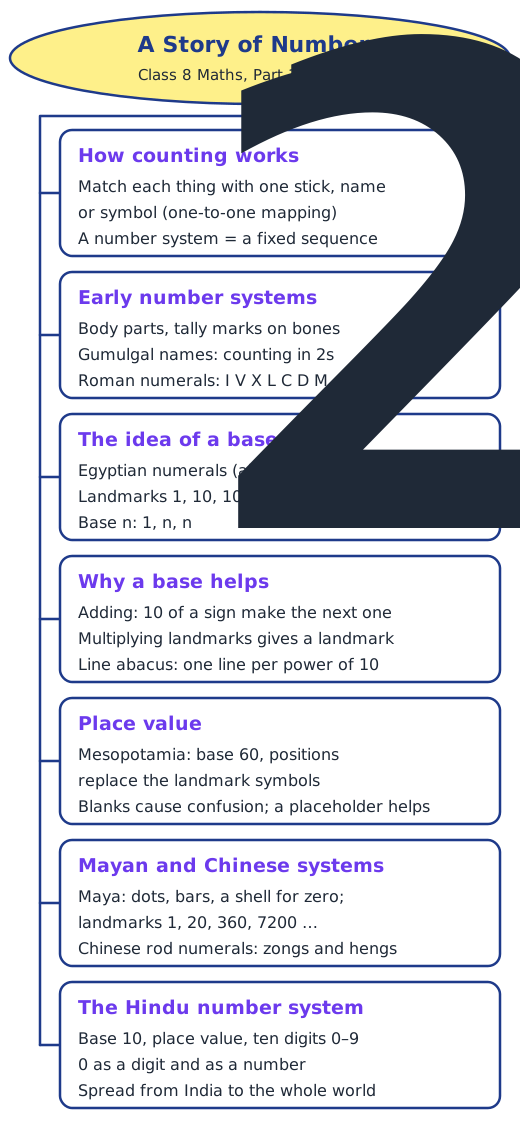
Reema’s questions (pages 48–49)
Since when have humans counted? At least since the Stone Age. Bones more than 20,000 years old seem to carry tally marks.
What did they need to count? Their food, their animals, goods they traded and offerings in rituals. They also counted days, to know when the new moon, the full moon or a new season would come.
How would the Mesopotamians write 20, 50 and 100? In their later base-60 numerals, 20 is two corner wedges (two 10s) and 50 is five corner wedges. 100 = 1 × 60 + 40, so it is one upright wedge in the 60s place followed by four corner wedges in the 1s place.
Since when have people written numbers in the modern form? The digits 0 to 9 took shape in India about 2000 years ago. The first known writing with all ten digits, with 0 as a dot, is the Bakhshali manuscript (c. 3rd century CE).
The mechanism of counting (pages 51–54)
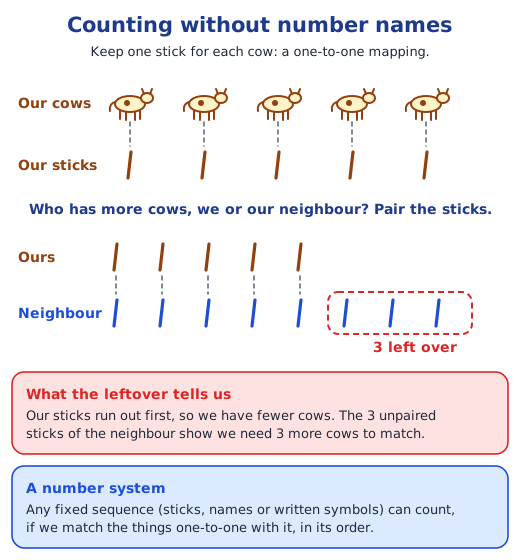
Math Talk: using sticks for Q2 and Q3. Keep one stick per cow for our herd and for our neighbour’s. Pair our sticks one-to-one with theirs. If ours run out first, we have fewer cows (Q2). Each of the neighbour’s sticks left unpaired stands for one more cow we would need (Q3).
How many numbers can the letters of your language name? As many as there are letters in its alphabet: 26 for English. Count the letters of your own language. Hindi has more letters than English, but every alphabet ends, so this method always stops somewhere.
Extending the written symbols beyond 20. Keep the pattern: XXI, XXII, …, XXIX, XXX for 30, then XXXI, … But to stay short, new letters are needed now and then: L for 50, C for 100, D for 500 and M for 1000. Without them, 100 would be ten Xs in a row.
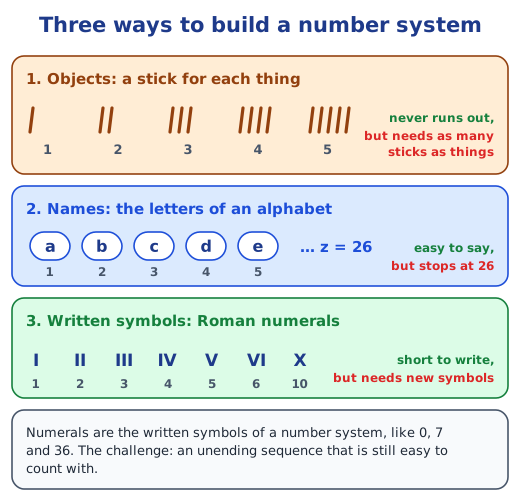
Figure it Out (page 54)
1. With sticks only:
- Add: put the two collections together in one heap. The heap is the sum.
- Subtract: pair the sticks of the smaller collection one-to-one with the bigger one and remove the pairs. The unpaired sticks left over are the difference.
- Multiply (A × B): for each stick in B, lay out a copy of A by one-to-one matching. Put all the copies together.
- Divide (A ÷ B): keep taking out of A a group that matches B one-to-one, and put one stick aside for each group taken. The sticks put aside are the quotient; the sticks of A left over, too few for a full group, are the remainder.
2. One neat way: a to z stand for 1 to 26, then come two-letter strings in dictionary order, aa (27), ab (28), …, az (52), ba (53), …, zz (702), then three letters, aaa (703), and so on. Every number gets exactly one string, so the system never runs out. Extra: spreadsheet programs name their columns in this same way (A to Z, then AA, AB, …). A simpler way, aa, bb, …, zz for 27 to 52 and then aaa, bbb, …, also works, but the strings grow long quickly.
3. Any system that keeps a fixed order will do. Example: a dot for 1, a line for a group of 5 dots, and a square for a group of 5 lines (25). Then 38 = 25 + 5 + 5 + 3 is a square, 2 lines and 3 dots.
Some early number systems (pages 54–58)
How are the Gumulgal names formed? Each name strings together ukasar (2) as many times as needed, and adds urapon (1) at the end for an odd number: 3 = 2 + 1 is ukasar-urapon, 5 = 2 + 2 + 1 is ukasar-ukasar-urapon, 6 = 2 + 2 + 2 is ukasar-ukasar-ukasar.
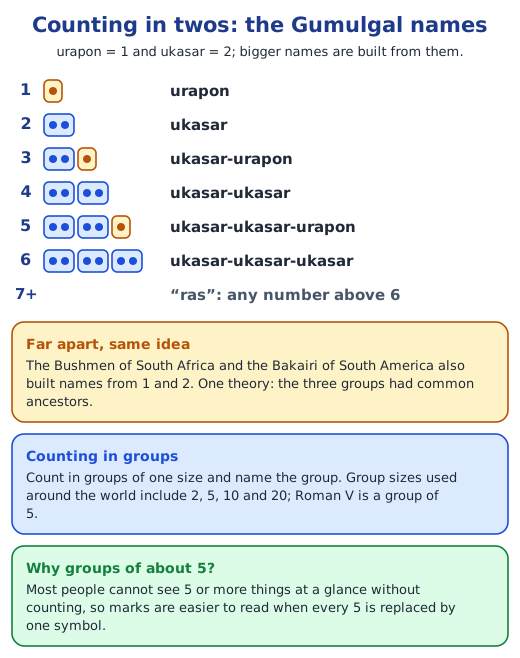
Quick count: up to what size can you see a group at once? Small groups, such as 1 dog, 2 hens, 3 pyramids or 4 dolls, can be seen at a glance. Bigger groups, such as the pencils, apples, grapes or steps, need counting or grouping. For most people the limit is about 4.
Math Talk: counting only in groups of one size. For large numbers you still need very many copies of the group symbol, so numerals become long and hard to read, check or compare. Counting only by 5s, 1345 = 269 × 5, so it needs 269 copies of the 5-symbol. The fix is to group the groups as well, which leads to landmark numbers.
Roman numerals (pages 58–60)
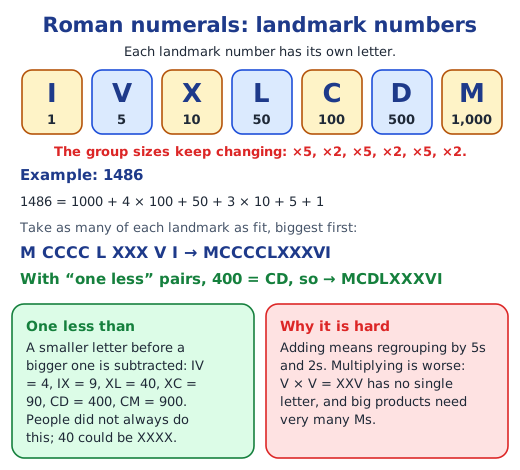
Figure it Out (page 59)
1. (i) 1222 = 1000 + 100 + 100 + 10 + 10 + 1 + 1 = MCCXXII. (ii) 2999 = 1000 + 1000 + 900 + 90 + 9 = MMCMXCIX, using the one-less pairs CM = 900, XC = 90 and IX = 9. By grouping alone it is MMDCCCCLXXXXVIIII. (iii) 302 = 100 + 100 + 100 + 1 + 1 = CCCII. (iv) 715 = 500 + 100 + 100 + 10 + 5 = DCCXV.
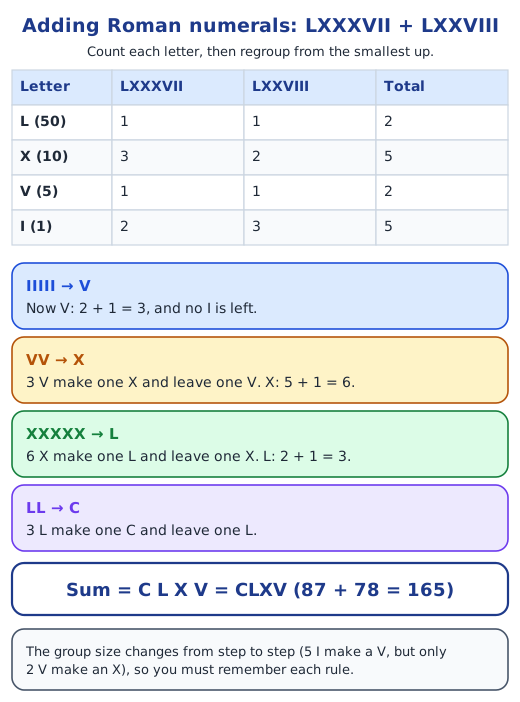
Example (b): LXXXVII + LXXVIII. Count the letters: L 2, X 5, V 2, I 5. Five I make a V, so V becomes 3. Two V make an X, leaving one V, so X becomes 6. Five X make an L, leaving one X, so L becomes 3. Two L make a C, leaving one L. The sum is CLXV (87 + 78 = 165).
Try This: multiplying Roman numerals. Without changing to our numerals, multiply every letter of one number by every letter of the other (the distributive law), using a table of products of letters, then add and regroup. For the landmark pairs:
- V × L = 250 = CCL.
- L × D = 25,000. There is no letter above M, so it is 25 Ms in a row.
- V × D = 2500 = MMD.
- VII × IX: VII = V + I + I, so VII × IX = (V × IX) + (I × IX) + (I × IX) = XLV + IX + IX = LXIII (63).
The daredevil contest: CCXXXI × MDCCCLII. This is 231 × 1852 = 4,27,812. With M as the largest letter it needs 427 Ms followed by DCCCXII, a numeral hundreds of letters long. No wonder people preferred the abacus.
Figure it Out (pages 60–61)
1. Possible reasons: the name for a count may also tell what kind of thing is counted (people, boats, long or round objects); some things are always counted in pairs or bundles; and trade or tradition may have fixed different counting words for different goods. We do something similar when we buy a jodi of shoes or a darjan (dozen) bananas.
2. Write every number as ukasars and at most one urapon.
- Add: join the two strings; two urapons together make an ukasar.
- Subtract: cancel equal words from both strings (an ukasar can be split into urapon-urapon if needed); what is left is the answer.
- Multiply: repeat the first string once for every urapon’s worth in the second (twice for each ukasar, once for an urapon), then join and regroup.
- Divide: take the second string out of the first again and again; the number of times, written in ukasars and urapons, is the answer.
(i) (4 ukasars + urapon) + (3 ukasars + urapon) = 7 ukasars + 2 urapons = ukasar written 8 times (16). (ii) (4 ukasars + urapon) − (3 ukasars) = ukasar-urapon (3). (iii) ukasar-ukasar is worth 4 urapons, so write the first string 4 times: 16 ukasars + 4 urapons = ukasar written 18 times (36). (iv) Taking ukasar-ukasar out of 8 ukasars works 4 times, so the answer is ukasar-ukasar (4).
3. Our Hindu number system:
- uses only ten symbols, 0 to 9, for every number, while Roman numerals need more and more letters;
- has one fixed base, 10, so ten of a place always make one of the next, while Roman group sizes keep changing (×5, ×2);
- uses place value, so numerals are short: 3888 is 4 digits but MMMDCCCLXXXVIII is 15 letters;
- has 0 as a digit and a number, so no numeral can be read two ways;
- allows simple written methods for +, −, × and ÷, while Roman sums needed an abacus.
4. Improve your system from page 54 by giving groups of groups their own symbols (landmark numbers), so that large numbers stay short. Better still, make every landmark the same number of times the one before.
The Egyptian number system (pages 61–62)
We name the Egyptian signs by their shapes: a stroke (1), an arch (10), a coil (100), a lotus (1000), a finger (10,000), a tadpole (1,00,000) and a figure with raised arms (10,00,000).
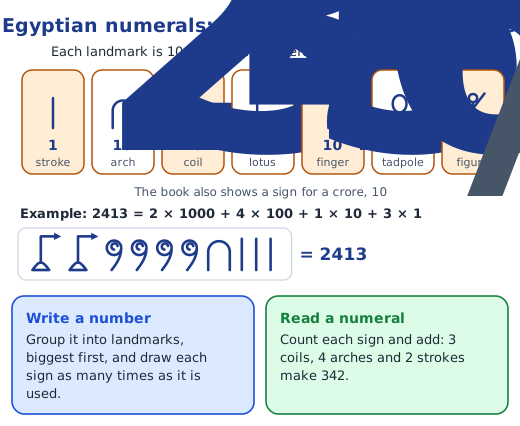
Figure it Out (page 62)
1.
- 10458 = 10,000 + 4 × 100 + 5 × 10 + 8: 1 finger, 4 coils, 5 arches, 8 strokes.
- 1023 = 1000 + 2 × 10 + 3: 1 lotus, 2 arches, 3 strokes (no coils).
- 2660 = 2 × 1000 + 6 × 100 + 6 × 10: 2 lotuses, 6 coils, 6 arches (no strokes).
- 784 = 7 × 100 + 8 × 10 + 4: 7 coils, 8 arches, 4 strokes.
- 1111: 1 lotus, 1 coil, 1 arch, 1 stroke.
- 70707 = 7 × 10,000 + 7 × 100 + 7: 7 fingers, 7 coils, 7 strokes.
2. (i) 2 coils, 7 arches and 6 strokes: 200 + 70 + 6 = 276. (ii) 4 lotuses, 3 coils, 2 arches and 2 strokes: 4000 + 300 + 20 + 2 = 4322.
Base-n systems (pages 62–63)
Can we group 5 at a time instead of 10? Can 5 be any positive integer? Yes: grouping by 5s gives landmarks 1, 5, 25, 125, … Any whole number from 2 upwards works. 1 does not, because 1 × 1 = 1 and the landmarks would never grow.
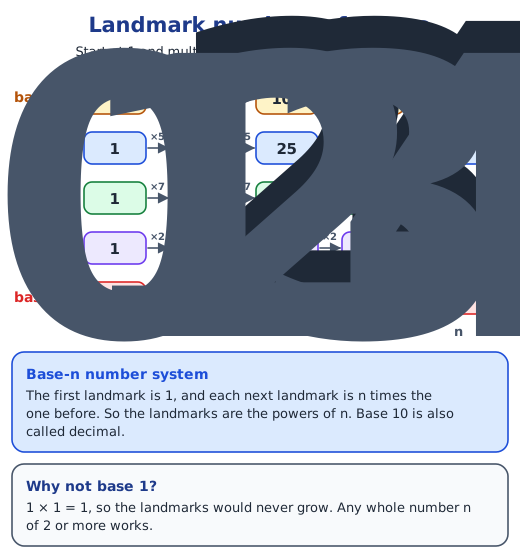
Figure it Out (page 63)
The shapes are triangle (1), square (5), hexagon (25), circle (125), wave (625) and arrow (3125).
1. 15 = 3 × 5: 3 squares. 50 = 2 × 25: 2 hexagons. 137 = 125 + 2 × 5 + 2: 1 circle, 2 squares, 2 triangles. 293 = 2 × 125 + 25 + 3 × 5 + 3: 2 circles, 1 hexagon, 3 squares, 3 triangles. 651 = 625 + 25 + 1: 1 wave, 1 hexagon, 1 triangle.
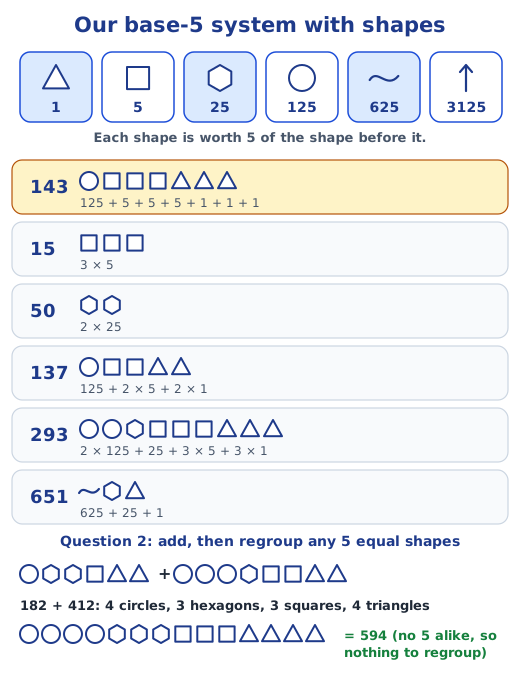
2. Every counting number can be written: group it by the biggest landmark that fits, then the next, and so on, using each shape at most 4 times. But 0 cannot be written, because the system has no symbol for “nothing”. (It was also not made for fractions or negative numbers.)
3. Base 7: 7⁰ = 1, 7¹ = 7, 7² = 49, 7³ = 343, 7⁴ = 2401, … In general, the landmarks of a base-n system are n⁰ = 1, n¹ = n, n², n³, …
Advantages of a base (pages 64–68)
Figure it Out (page 65)
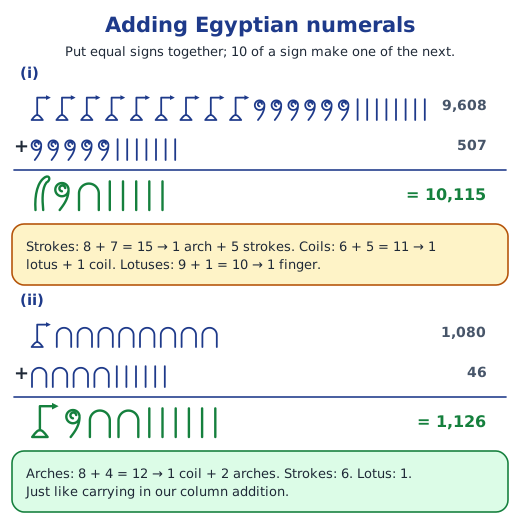
1. (i) The first numeral is 9 lotuses, 6 coils and 8 strokes (9608); the second is 5 coils and 7 strokes (507). Strokes: 8 + 7 = 15, which is 1 arch and 5 strokes. Coils: 6 + 5 = 11, which is 1 lotus and 1 coil. Lotuses: 9 + 1 = 10, which is 1 finger. Sum: 1 finger, 1 coil, 1 arch, 5 strokes = 10,115. (ii) The first is 1 lotus and 8 arches (1080); the second is 4 arches and 6 strokes (46). Arches: 8 + 4 = 12, which is 1 coil and 2 arches. Sum: 1 lotus, 1 coil, 2 arches, 6 strokes = 1126.
2. The first is 1 circle, 2 hexagons, 1 square and 2 triangles (182); the second is 3 circles, 1 hexagon, 2 squares and 2 triangles (412). Putting equal shapes together: 4 circles, 3 hexagons, 3 squares, 4 triangles = 594. No shape reaches 5, so nothing needs regrouping.
Question 1 (page 66): multiplying by an arch (10). (i) arch × arch = coil (100). (ii) coil × arch = lotus (1000). (iii) lotus × arch = finger (10⁴). (iv) finger × arch = tadpole (10⁵). Each time the power of 10 goes up by 1, giving the next landmark.
Question 2 (page 66): multiplying by a coil (10²). (i) arch × coil = lotus (10³). (ii) coil × coil = finger (10⁴). (iii) lotus × coil = tadpole (10⁵). (iv) finger × coil = figure with raised arms (10⁶). The power goes up by 2, two steps up.
More products (page 67). (i) arch × tadpole = 10 × 10⁵ = 10⁶ (figure). (ii) coil × lotus = 10² × 10³ = 10⁵ (tadpole). (iii) lotus × lotus = 10³ × 10³ = 10⁶ (figure). (iv) finger × figure = 10⁴ × 10⁶ = 10¹⁰. This is still a landmark, a power of 10, though the Egyptian signs in the book stop at 10⁷, so there is no single sign for it.
Math Talk: is this true in base 5, and in any base? Yes. In base 5 the landmarks are powers of 5, and 5ᵃ × 5ᵇ = 5ᵃ⁺ᵇ is again a power of 5: a square times a hexagon is 5 × 25 = 125, a circle. In any base n, nᵃ × nᵇ = nᵃ⁺ᵇ.
What happens when a number is multiplied by an arch? Every sign turns into the next bigger sign: strokes become arches, arches become coils, coils become lotuses, and so on.
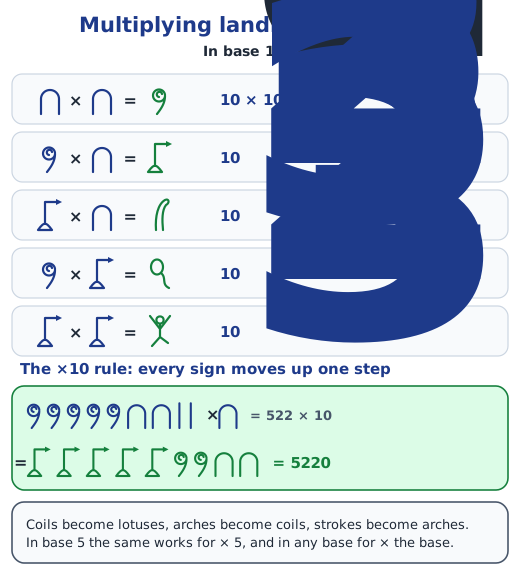
Now find the products (page 68). (i) (5 coils, 2 arches, 2 strokes) × arch = 5 lotuses, 2 coils, 2 arches: 522 × 10 = 5220. (ii) (1 lotus, 1 arch) × arch = 1 finger, 1 coil: 1010 × 10 = 10,100.
A simple rule for multiplying by an arch: move every sign up one step. In our numerals this is the same as writing a 0 at the end.
The abacus: 2907 + 43 (page 69). Bring the counters on each line together. Ones: 7 + 3 = 10, so take the 10 counters off and put 1 counter on the tens line. Tens: 4 + 1 = 5, so swap the 5 counters for one counter just above the tens line. Hundreds stay 9 (4 on the line and 1 above), and thousands stay 2. The board shows 2950.
If a line gets 10 or more counters: take 10 off and put 1 counter on the next line up, just like carrying. If 5 or more are still left, swap 5 of them for one counter above the line.
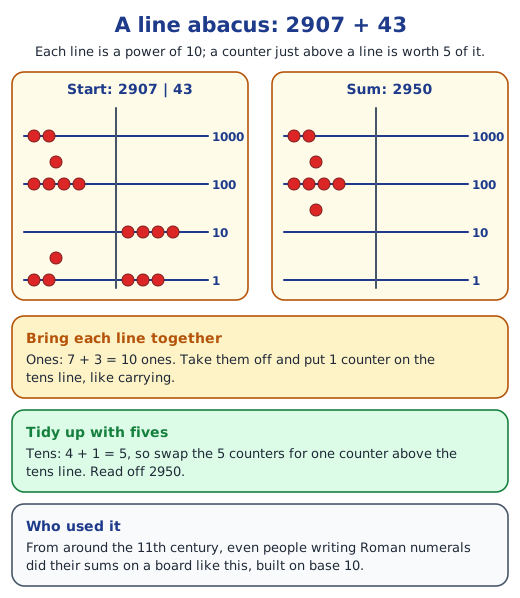
Figure it Out (pages 69–70)
1. No. Whenever a sign would appear 10 times, those 10 make one of the next sign, so in the usual way of writing no sign appears more than 9 times. The only trouble is beyond the largest sign: with signs only up to 10⁷, a number like 10⁸ would need ten 10⁷-signs. That is exactly the weak point of the Egyptian system.
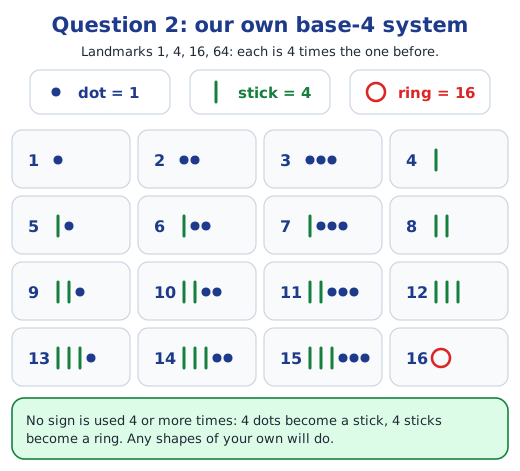
2. One possible base-4 system: a dot for 1, a stick for 4, a ring for 16 (and a star for 64, if needed). Then 1 to 16 are: 1 •, 2 ••, 3 •••, 4 |, 5 |•, 6 |••, 7 |•••, 8 ||, 9 ||•, 10 ||••, 11 ||•••, 12 |||, 13 |||•, 14 |||••, 15 |||•••, 16 ○.
3. Replace every shape by the next bigger one: triangles by squares, squares by hexagons, hexagons by circles, circles by waves and waves by arrows. This works because 5 × 5ᵃ = 5ᵃ⁺¹. For example, 2 squares and 1 triangle (11) times 5 is 2 hexagons and 1 square (55).
The Mesopotamian number system (pages 70–74)
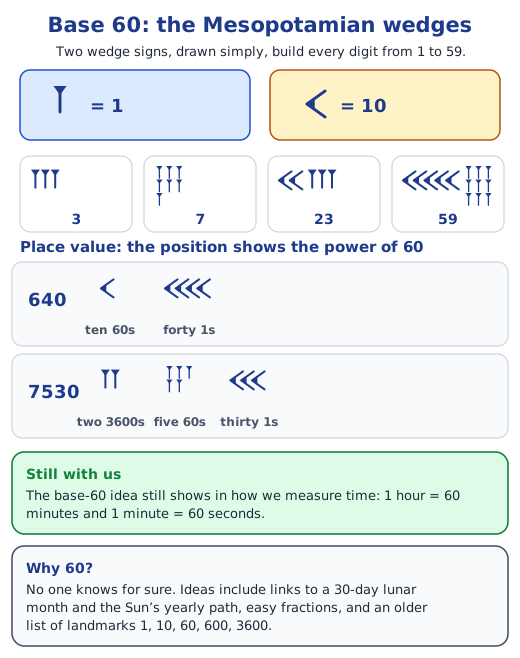
Figure it Out (page 73)
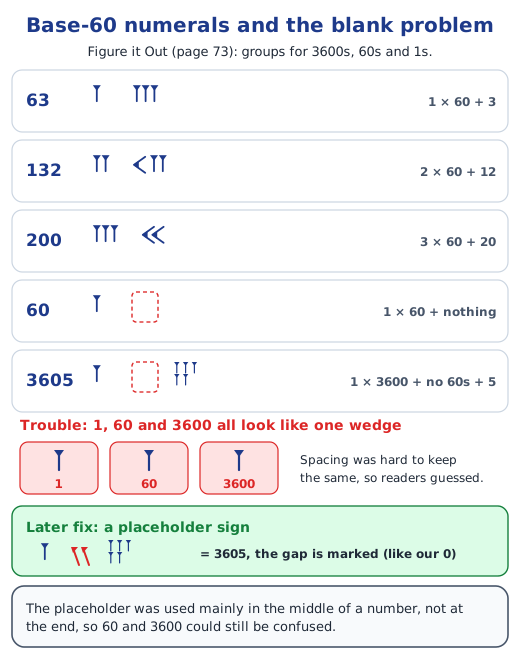
1. Write the groups from left to right for 3600s, 60s and 1s, with a gap for an empty place: (i) 63 = 1 × 60 + 3: one upright wedge, then three upright wedges. (ii) 132 = 2 × 60 + 12: two upright wedges, then one corner wedge and two upright wedges. (iii) 200 = 3 × 60 + 20: three upright wedges, then two corner wedges. (iv) 60 = 1 × 60 + 0: one upright wedge followed by a blank, which looks just like 1. (v) 3605 = 1 × 3600 + 0 × 60 + 5: one upright wedge, a blank, then five upright wedges.
What is the representation of 3600? 3600 = 1 × 60², so it is again a single upright wedge, now with two empty places after it. So 1, 60 and 3600 all look alike, and only the spacing, which was hard to keep the same, could tell them apart.
The Mayan number system (pages 74–76)
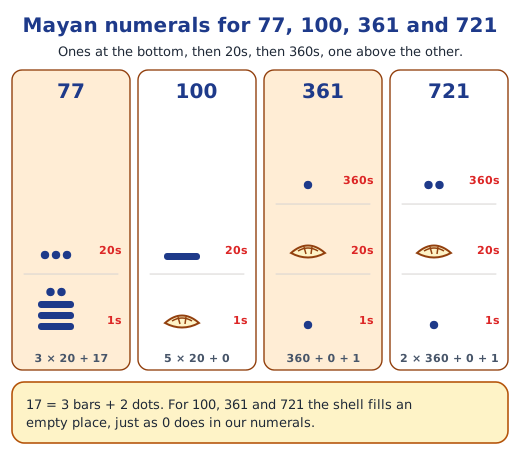
Represent 77, 100, 361 and 721 (page 76). The landmarks are 1, 20 and 360. A dot is 1, a bar is 5 and a shell is 0, and the 1s place is at the bottom. (i) 77 = 3 × 20 + 17: 3 dots on top; 3 bars and 2 dots below. (ii) 100 = 5 × 20 + 0: 1 bar on top; a shell below. (iii) 361 = 1 × 360 + 0 × 20 + 1: a dot, a shell, a dot (top to bottom). (iv) 721 = 2 × 360 + 0 × 20 + 1: 2 dots, a shell, a dot (top to bottom).
The Chinese and Hindu number systems (pages 76–79)
What are the landmark numbers of the Hindu number system, and does it use place value? Its landmarks are the powers of 10: 1, 10, 10², 10³, … It is a place value system: in 375, the 3 counts hundreds, the 7 tens and the 5 ones, only because of their positions. With 0 as a digit, each place holds exactly one digit.
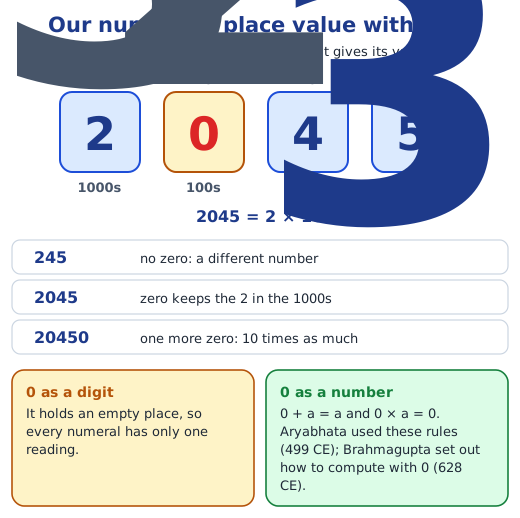
Figure it Out (page 80)
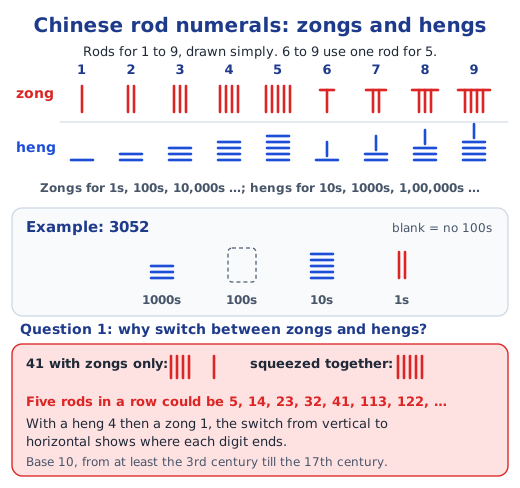
1. Switching between zongs and hengs makes neighbouring places look different, so you can see where one digit ends and the next begins even if the gaps are uneven. With zongs only, 41 is four upright rods and then one upright rod. Without a clear gap that is just five upright rods, which could also be read as 5, 14, 23, 32, 113, 122, 131, 212, 221, 311, … or even 11111.
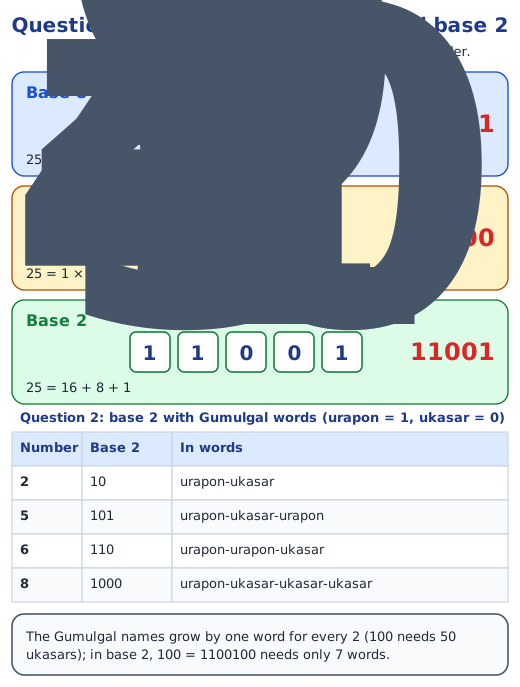
2. Base 2 needs two digits, 0 and 1. Let urapon be the digit 1 and ukasar the digit 0 (the opposite choice works just as well; the NCERT answer key uses it). The places are 1, 2, 4, 8, … from the right:
- 1 = urapon; 2 = 10 = urapon-ukasar; 3 = 11 = urapon-urapon; 4 = 100 = urapon-ukasar-ukasar;
- 5 = 101 = urapon-ukasar-urapon; 6 = 110 = urapon-urapon-ukasar; 7 = 111 = urapon-urapon-urapon; 8 = 1000 = urapon-ukasar-ukasar-ukasar.
Comparison: the Gumulgal names add up 2s and 1s, so they grow by one word for every 2 (100 would need 50 ukasars), and they stopped at 6 (ras). Base-2 place value never runs out and grows slowly: 100 = 1100100 needs only 7 words. In base 2 the position of each word matters; in the Gumulgal names it does not.
3. Hindu numerals and 0 are everywhere: prices and bills, money and bank accounts, phone numbers and pincodes, dates, clocks, cricket scores, page numbers. Shopkeepers, accountants, engineers, doctors (doses), scientists, pilots and computer programmers use them all day. Without them, writing big numbers would be clumsy, sums would need an abacus or specially trained people, and science and technology would have grown far more slowly.
4. With 8 fingers we would probably count in base 8, using the digits 0 to 7 and places 1, 8, 64, 512, …; then “10” would mean eight. In base 5 we would use only 0 to 4 and places 1, 5, 25, …
- Base 8: 25 = 3 × 8 + 1, so 25 is written 31.
- Base 5: 25 = 1 × 25 + 0 × 5 + 0, so it is 100.
- Base 2: 25 = 16 + 8 + 1 = 1 × 2⁴ + 1 × 2³ + 0 × 2² + 0 × 2 + 1, so it is 11001.
Practice
-
What is DCCCXLIX in our numerals?
Show answer
Answer: (a) 849
-
Which number is written with 2 coils, 3 arches and 4 strokes in Egyptian numerals?
Show answer
Answer: (b) 234
-
How is 20 written in base 3?
Show answer
Answer: (b) 202
-
Write 3725 in base-60 place-value form.
Show answer
Answer: 3725 − 3600 = 125 = 2 × 60 + 5, so 3725 = 1 × 3600 + 2 × 60 + 5, written as the groups 1 | 2 | 5.
-
Write 45 in Mayan numerals.
Show answer
Answer: 45 = 2 × 20 + 5, so the 20s place on top has 2 dots, and the 1s place below has 1 bar.
Stuck on a question?
Take a photo and Lagnever AI explains it step by step. Try it for 7 days for ₹2.
Get it on Google Play Open in browser
For parents: after the trial, the plan renews monthly by UPI or card autopay. You can cancel anytime in the app.