
Class 8 Maths Chapter 3: A Story of Numbers Notes
This chapter in five lines
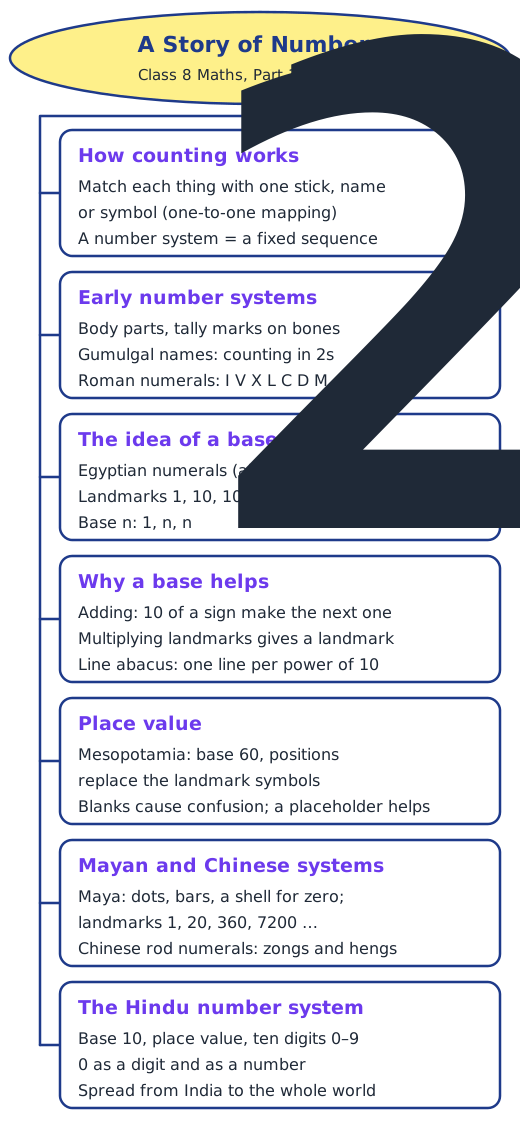
People first counted by matching things one-to-one with sticks, names or marks. Counting in groups, and then giving landmark numbers their own symbols (like Roman V, X and L), made numbers shorter. When the landmarks are powers of one number we get a base, which makes sums easy. Place value and zero, developed in India, let ten digits write every number.
What is this chapter about?
This is the third chapter of Ganita Prakash, Grade 8 Part 1. It starts with Reema, who finds a page of strange Mesopotamian number signs in an old book, and her father, who tells her how people learnt to write numbers. The chapter is not a list of dates. It follows the main ideas, one after another, that led to the numerals we write today.
How can you count without numbers?
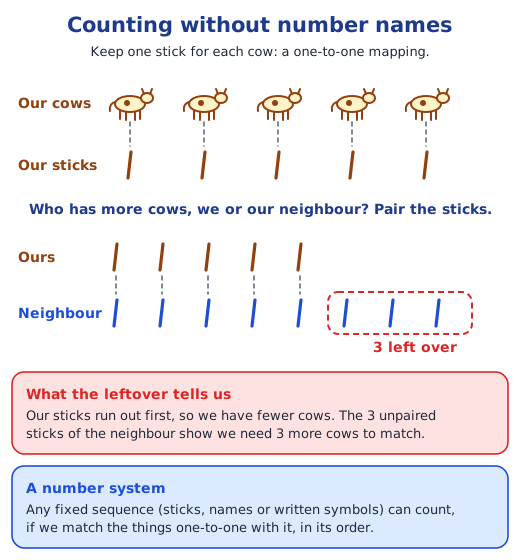
Imagine a Stone Age herder with no number words. For every cow that goes out to graze, she keeps one stick. When the cows return, each cow takes back its stick; a stick left over means a cow is missing. This kind of pairing, where each thing gets a stick of its own, is a one-to-one mapping. A fixed sequence used like this, whether of sticks, names or written symbols, is a number system. Read early number systems.
Early number systems
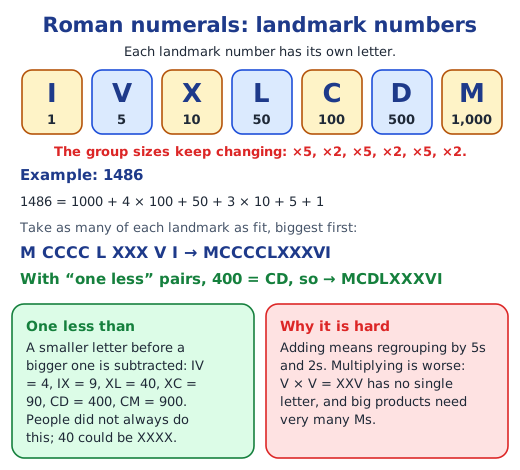
People have counted with body parts (one group in Papua New Guinea still does) and with notches on bones. The Lebombo bone from South Africa, with 29 notches, is thought to be about 44,000 years old. The Gumulgal of Australia had just two words, urapon (1) and ukasar (2), and built the others from them: 5 was ukasar-ukasar-urapon. Counting in groups like this is a big step. The Roman system went further: new letters for landmark numbers (I, V, X, L, C, D, M), so 2026 is MMXXVI. But Roman numerals are awkward for sums.
The idea of a base
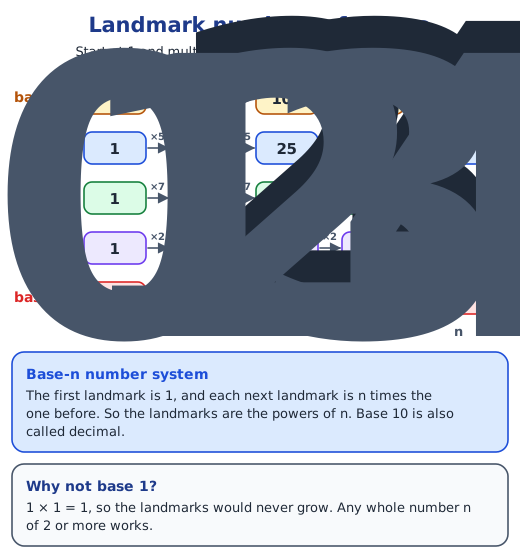
The Egyptians, around 3000 BCE, chose their landmarks cleverly: 1, 10, 100, 1000, …, each 10 times the one before, with a sign for each power of 10 up to a crore. A system whose landmarks are 1, n, n², n³, … is called a base-n system; base 10 is the decimal system. With a base, 10 of one sign always make one of the next, so adding is regular, and the product of two landmarks is another landmark, so multiplying is easy. Read the idea of a base.
The weak point: every new power of 10 needs a new sign, and numbers never end.
Place value: let the position do the work
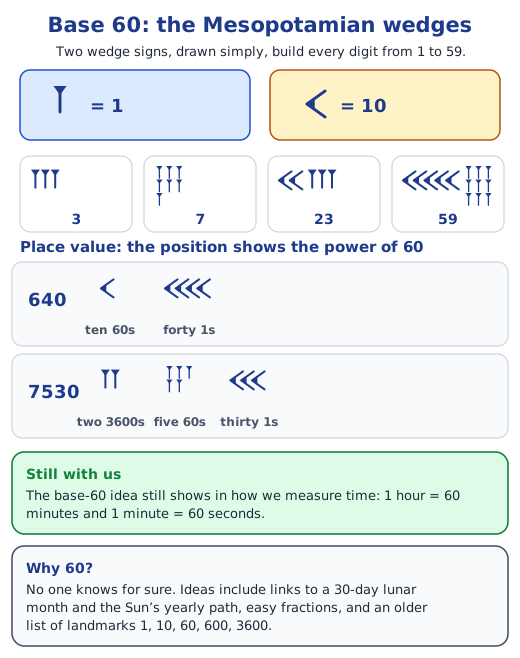
The Mesopotamians used base 60. Instead of a sign for each power of 60, they let the position of a group show whether it counted 1s, 60s or 3600s. This is a place value system. Its trouble was blank places: 1, 60 and 3600 could all look like one wedge, until later scribes used a placeholder sign. The Mayans of Central America also used place value, with a shell for zero, and the Chinese used rod numerals in base 10. Read place value and zero.
Our numerals: the Hindu number system
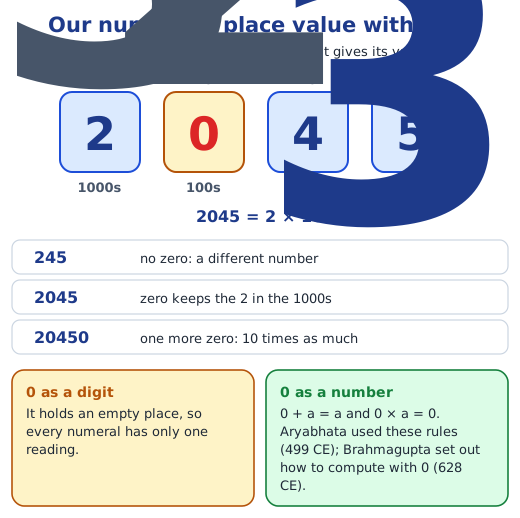
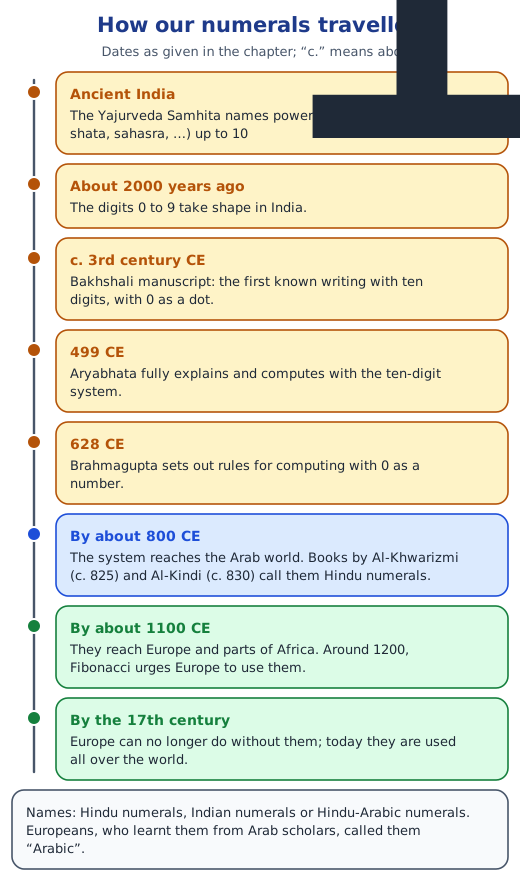
Our system puts all the ideas together: base 10, place value, only ten digits, and 0 both as a digit for an empty place and as a number. So 2045 can be read in only one way. Aryabhata used the rules of 0 in 499 CE, and Brahmagupta set out how to compute with 0 as a number in 628 CE.
These numerals took shape in India about 2000 years ago. They reached the Arab world by about 800 CE, where scholars called them Hindu numerals, and then Europe by about 1100 CE. Today the whole world uses them.
Five big ideas in one picture
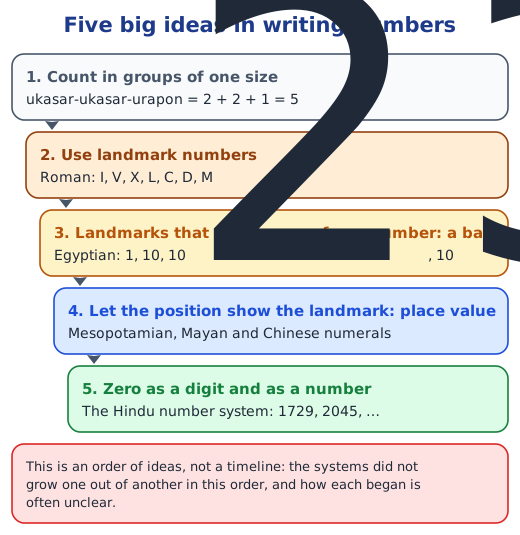
The chapter’s story can be told as five ideas: count in groups, use landmark numbers, choose powers of one number as landmarks, let the position show the landmark, and use zero. It is an order of ideas, not of history; the real systems grew in different places and times.
Before we move on
Powers came in Chapter 2, Power Play, and every place value is a power of 10 (powers of 10). Brahmagupta’s rules for zero and negative numbers were in Class 6 (The Other Side of Zero). Answers to every question in this chapter and all nine Figure it Out sets are in the NCERT solutions for Chapter 3.
Key terms
| Term | Meaning |
|---|---|
| One-to-one mapping | Pairing each thing being counted with exactly one stick, name or mark, so that no two things share the same one. |
| Number system | A fixed, ordered list of things, names or written signs that we go through, one by one, to count. |
| Numeral | A written symbol for a number, such as 7, 36 or XII. |
| Tally marks | One cut or mark made for each thing counted, on a bone, a stick or a wall. |
| Landmark numbers | Numbers that get a new basic symbol of their own, such as V (5), X (10) and L (50) in Roman numerals. |
| Base-n number system | A system whose landmark numbers are 1, n, n², n³, …, each n times the one before. The Egyptian system is base 10. |
| Decimal system | Another name for a base-10 system, with landmarks 1, 10, 100, 1000, … |
| Abacus | A counting board with one line for each power of 10. Counters on the lines show a number, and moving them does sums. |
| Sexagesimal system | The base-60 system of ancient Mesopotamia. Our 60 minutes in an hour still show its influence. |
| Place value (positional) system | A system with a base in which the position of a symbol tells which landmark number it counts. |
| Placeholder | A sign that marks an empty place in a numeral, as 0 does in 205. |
| Rod numerals | Chinese base-10 numerals made of rods: upright zongs and lying hengs, used in turn for neighbouring places. |
| Hindu number system | Our base-10 place value system with the ten digits 0 to 9, also called Indian or Hindu-Arabic numerals. |
| Zero (0) | A digit that fills an empty place, and a number in its own right: 0 + a = a and 0 × a = 0. |
Topics in this chapter
Practice
-
What is 1648 in Roman numerals?
Show answer
Answer: (a) MDCXLVIII
-
Which are the landmark numbers of a base-6 system?
Show answer
Answer: (b) 1, 6, 36, 216, …
-
In base-60 place value, which number do the groups 2 | blank | 15 stand for?
Show answer
Answer: (c) 7215
-
Which Mayan landmark number shows that their system is not a true base 20?
Show answer
Answer: (c) 360
-
Which feature lets our numerals write any number with just ten symbols?
Show answer
Answer: (b) Place value, with 0 as a digit
-
Who used the arithmetic rules of 0 in the Āryabhaṭīya in 499 CE?
Show answer
Answer: (b) Aryabhata
Questions students ask
What are the main topics of Class 8 Maths Chapter 3?
Counting by one-to-one matching; early number systems such as body parts, tally marks, the Gumulgal names and Roman numerals; Egyptian numerals and the idea of a base; adding and multiplying with a base and the line abacus; place value in Mesopotamian, Mayan and Chinese numerals; and our Hindu number system with zero.
Is A Story of Numbers in the new NCERT Class 8 Maths book?
Yes. It is Chapter 3 of Ganita Prakash, Grade 8 Part 1, on pages 48 to 81 of the book marked Reprint 2026-27.
Why are our numerals called Hindu or Indian numerals?
Because the system began in India. Arab scholars such as Al-Khwarizmi and Al-Kindi called them Hindu numerals, while Europeans, who learnt them from the Arab world, called them Arabic numerals. Here ‘Hindu’ means the land and its people, not a religion.
Why is zero so important in our number system?
Zero holds an empty place, so 205 and 25 can never be mixed up, and it is also a number with its own rules. With place value it lets ten digits write every number, and it makes written calculation simple.
Stuck on a question?
Take a photo and Lagnever AI explains it step by step. Try it for 7 days for ₹2.
Get it on Google Play Open in browser
For parents: after the trial, the plan renews monthly by UPI or card autopay. You can cancel anytime in the app.