
Place value and zero: how our numerals came to be
Answer in short
In a place value system, the position of a symbol shows which power of the base it counts, so a few symbols can write any number. Mesopotamian, Mayan and Chinese numerals used place value, but blank places caused confusion. Our Hindu numerals, from India, add 0 as a digit and as a number, so every numeral has one clear reading.
Stuck on a question? Take a photo and Lagnever AI explains it step by step. Try it for 7 days for ₹2. Get it on Google Play
What is a place value system?
Egyptian numerals needed a new sign for every power of 10. Place value removes that need. Use a base, write how many of each power you have, and let the position of each group show which power it counts. Then a small set of symbols can write every number. A system like this is called a positional or place value system.
How did the Mesopotamians use base 60?
In ancient Mesopotamia (much of present-day Iraq and nearby lands), numbers came to be written in base 60, the sexagesimal system. Two wedge-shaped signs, one for 1 and one for 10, built every digit from 1 to 59. The rightmost group counted 1s, the group to its left counted 60s, the next 3600s (60²), and so on.
So 640 = 10 × 60 + 40 was written as a group for 10, then a group for 40. And 7530 = 2 × 3600 + 5 × 60 + 30 needed three groups. No place ever holds 60 or more: 60 of one power make one of the next.
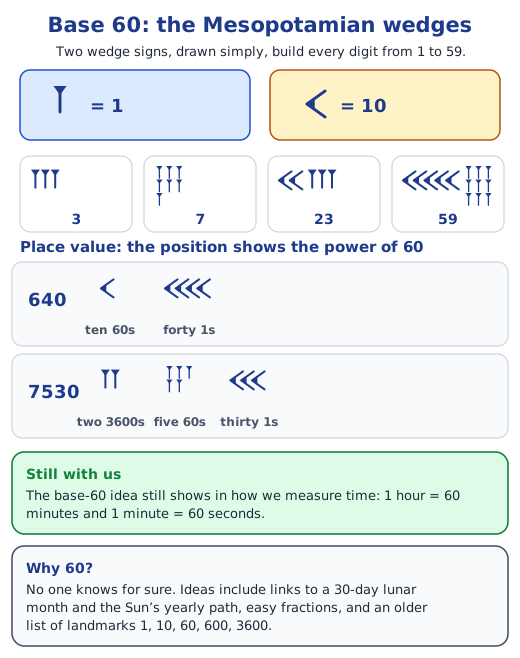
Why 60? Nobody knows for sure. Ideas include links with a 30-day lunar month and the Sun’s yearly path, the ease of fractions, and an older list of landmarks 1, 10, 60, 600, 3600. The idea still shows in our clocks: 60 seconds make a minute and 60 minutes an hour.
What went wrong with blank places?
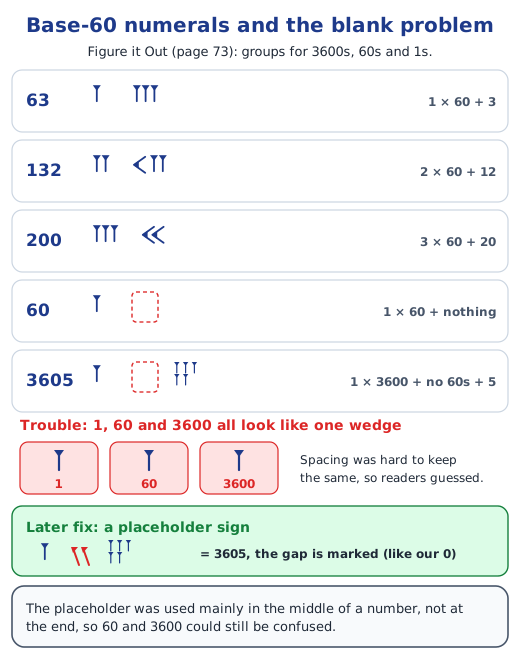
When a power of 60 was missing, the scribe just left a gap. But gaps were hard to keep the same size by hand. A single wedge could mean 1, 60 or 3600, and two groups could be read in different ways. Later scribes used a placeholder sign for a gap in the middle of a number, like our 0. They still did not use it at the end, so 60 and 3600 stayed confusing.
How did the Mayans write numbers?
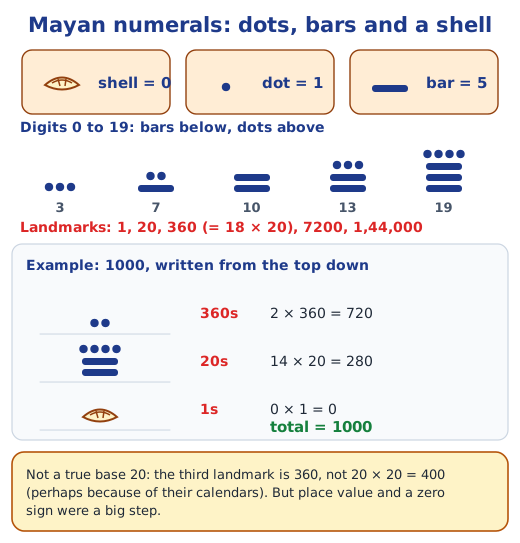
The Mayan civilisation of Central America flourished from the 3rd to the 10th century CE and designed a place value system on its own. A dot was 1, a bar was 5, and a shell was the placeholder 0. Digits from 0 to 19 were stacked, and the places were written one above another: 1s at the bottom, then 20s, then 360s, then 7200s. So 1000 = 2 × 360 + 14 × 20 + 0 is 2 dots, above 2 bars and 4 dots, above a shell.
The third landmark is 360, not 20 × 20 = 400, perhaps because of their calendars. So it is not a true base-20 system and lacks some of a base’s advantages for computing. Base 20 still hides in a few European number names. Extra: in French, 80 is quatre-vingts, “four twenties”.
What were Chinese rod numerals?
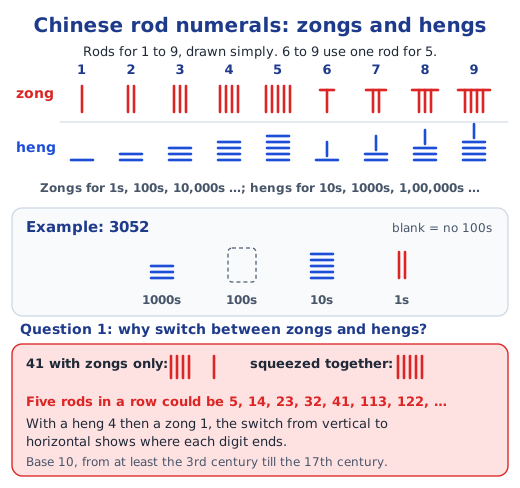
The Chinese had a written system for recording amounts and a system of rods for calculating, which developed by at least the 3rd century CE and was used till the 17th century. Rod numerals are base 10 with place value. The digits 1 to 9 come in two forms: upright zongs for 1s, 100s, 10,000s, … and lying hengs for 10s, 1000s, … Switching form at each place shows where one digit ends. An empty place was left blank, which was easier to spot than in Mesopotamian numerals. With a sign for zero, it would have been a complete place value system.
What makes our numerals special?
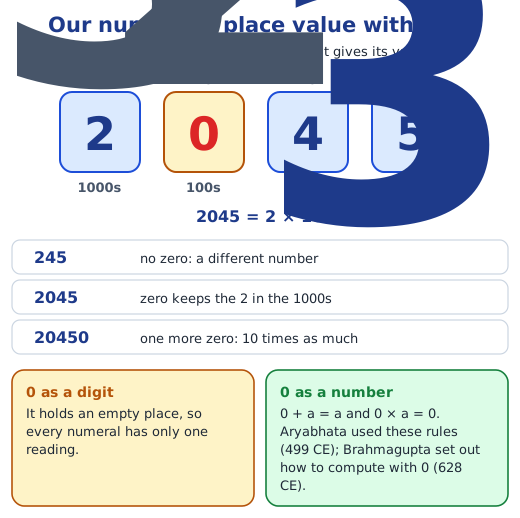
The Hindu number system that we use is base 10 with place value, and it has a symbol for 0 that, the chapter says, goes back at least to 200 BCE. Each place holds exactly one digit, and 0 fills an empty place, so a numeral like 2045 has only one reading.
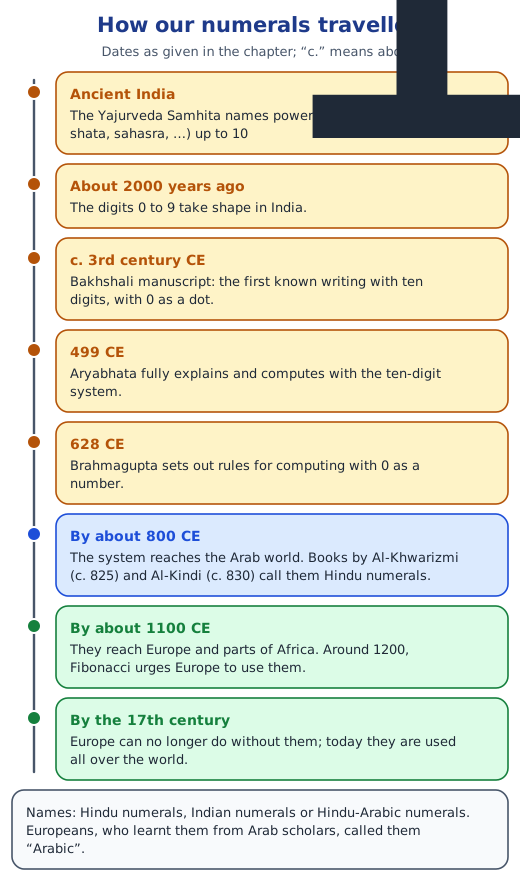
In India, 0 also became a number, with rules like 0 + a = a and 0 × a = 0. Aryabhata used these rules in his Āryabhaṭīya (499 CE), and Brahmagupta set out how to compute with 0 in his Brāhmasphuṭasiddhānta (628 CE). Together with negative numbers, this laid foundations for algebra.
How did our numerals spread?
They reached the Arab world by about 800 CE, where Al-Khwarizmi (c. 825) and Al-Kindi (c. 830) wrote about the “Hindu numerals”. By about 1100 CE they reached Europe and parts of Africa, and around 1200 Fibonacci urged Europe to adopt them. Europeans called them “Arabic” numerals because they learnt them from Arab scholars; today “Hindu”, “Indian” or “Hindu-Arabic” numerals is more accurate.
Read next: the chapter notes, early number systems, the idea of a base and NCERT solutions.
Practice
-
In base-60 place value, which number do the groups 1 | 30 stand for?
Show answer
Answer: (b) 90
-
A Mayan numeral has a dot on top, a shell in the middle and a bar at the bottom. What number is it?
Show answer
Answer: (d) 365
-
Why did Chinese rod numerals switch between zongs and hengs?
Show answer
Answer: (b) So that neighbouring places look different
-
Why are the zeros needed in 3005?
Show answer
Answer: They show that there are no hundreds and no tens. Without them the numeral would be 35, a different number.
-
Write 1000 in the Mayan system.
Show answer
Answer: 1000 = 2 × 360 + 14 × 20 + 0, so 2 dots on top, then 2 bars with 4 dots, and a shell at the bottom.
Questions students ask
What is a place value system?
It is a number system with a base in which the position of each symbol tells which power of the base it counts. In 375, the 3 counts hundreds only because of where it stands. It needs only a few symbols for all numbers.
Did the Mesopotamians have a zero?
Later Mesopotamian scribes used a placeholder sign for an empty place in the middle of a number, which works like our 0. They did not use it at the end of a number. In Indian mathematics, 0 went further and became a number in its own right.
Why are there 60 minutes in an hour?
Our units of time still show the influence of the Mesopotamian base-60 system: 1 hour is 60 minutes and 1 minute is 60 seconds.
When did the numerals 0 to 9 begin?
The chapter says they took shape in India about 2000 years ago. The Bakhshali manuscript (c. 3rd century CE) is the first known writing that uses ten digits, with 0 shown as a dot.
Stuck on a question?
Take a photo and Lagnever AI explains it step by step. Try it for 7 days for ₹2.
Get it on Google Play Open in browser
For parents: after the trial, the plan renews monthly by UPI or card autopay. You can cancel anytime in the app.