
Early number systems: from sticks to Roman numerals
Answer in short
The first number systems counted by matching things one-to-one with objects, body parts, tally marks or names. Later, people counted in groups, like the Gumulgal of Australia, who built every name from 1 and 2. The Romans gave landmark numbers their own letters, I, V, X, L, C, D and M, which made numbers shorter but sums hard.
Stuck on a question? Take a photo and Lagnever AI explains it step by step. Try it for 7 days for ₹2. Get it on Google Play
How did people count before number names?
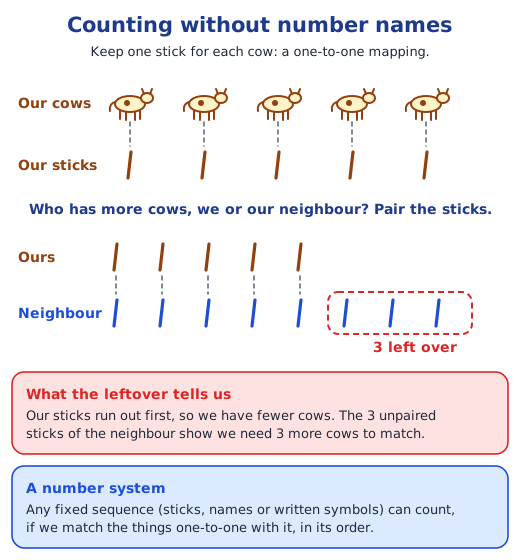
Long before anyone wrote 1, 2, 3, people needed to count: their food, their animals, the goods they traded, and the days until the next full moon. Without number words, the simplest trick is to match. Keep one stick for each cow. When the cows come home, each cow “returns” its stick. If a stick is left over, a cow is missing.
This pairing, with each thing getting its own stick and no stick shared, is a one-to-one mapping. It can also compare two herds: pair your sticks with your neighbour’s. Whoever runs out first has fewer cows, and the unpaired sticks tell you how many more you need.
What makes a number system?
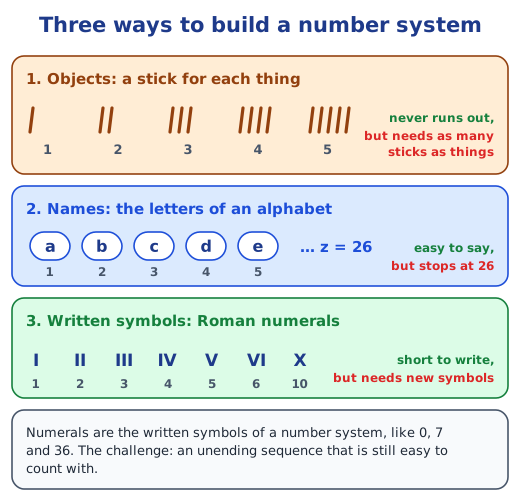
To count, you need a standard sequence with a fixed order, and you match the things with it one by one. We call such a sequence a number system. It can be built from:
- objects, like sticks or pebbles: they never run out, but you need as many as the things you count;
- names, like the letters a, b, c, …: easy to say, but the English alphabet stops at 26;
- written symbols, like I, II, III, IV, V: short, but bigger numbers keep needing new symbols.
The written symbols of a system are called numerals. The real challenge is a sequence that never ends and is still easy to use.
What were the first ways of keeping count?
Many groups have counted on their body parts. A group in Papua New Guinea uses a fixed order of body points, starting at the fingers of one hand, going up the arm, across the face and down to the other hand; the book’s picture marks 27 such points. They still count this way today.
Another very old method is tally marks: one notch for each thing counted, cut on a bone, a stick or a cave wall. Archaeologists have found bones more than 20,000 years old that seem to carry tally marks. The Ishango bone from the Democratic Republic of Congo (20,000 to 35,000 years old) has notches in columns, possibly a calendar. The Lebombo bone from South Africa, with 29 notches, is estimated to be about 44,000 years old.
How did the Gumulgal count in twos?
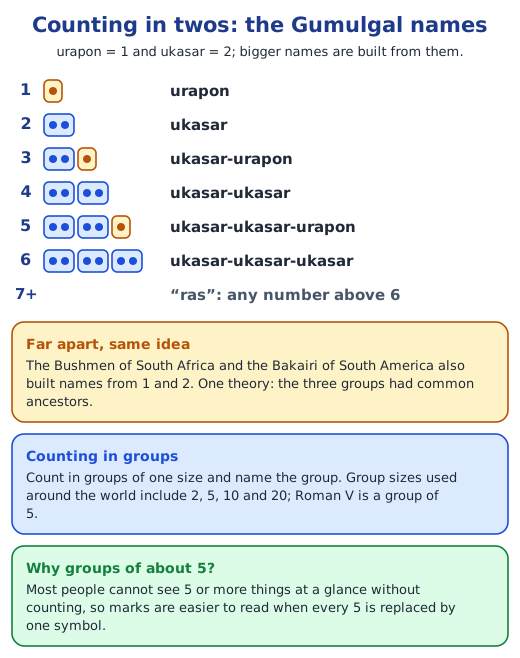
The Gumulgal of Australia had number words built from just two: urapon (1) and ukasar (2). Three was ukasar-urapon (2 + 1), four was ukasar-ukasar (2 + 2), and six was ukasar-ukasar-ukasar. Anything above 6 was simply ras.
Strangely, the Bushmen of South Africa and the Bakairi of South America built their number names in the same way, though the three groups lived far apart with no known contact. One theory is that they shared ancestors long ago.
Why count in groups?
Counting in groups of one size, and naming the group, is shorter than one mark per thing. Group sizes of 2, 5, 10 and 20 have all been used. One reason may be our eyes: most people cannot see 5 or more things at a glance without counting, so swapping each bundle of 5 marks for one new sign makes them easier to read. But a single group size still makes big numbers long. In 5s, 1345 needs 269 copies of the 5-symbol.
How do Roman numerals work?
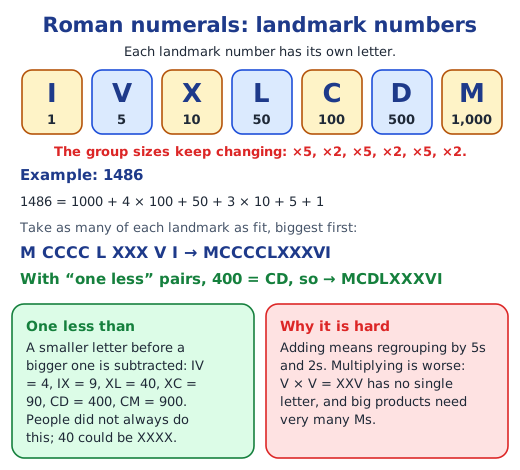
The Roman system gives several landmark numbers their own letters: I (1), V (5), X (10), L (50), C (100), D (500) and M (1000). To write a number, take as many of the biggest landmark as fit, then the next, and so on: 1486 = M + CCCC + L + XXX + V + I = MCCCCLXXXVI. A smaller letter placed before a bigger one is subtracted, so 4 is IV and 40 is XL, and 1486 is usually written MCDLXXXVI.
Why is it hard to calculate with Roman numerals?
To add, count each letter and regroup. But the group sizes keep changing: 5 I make a V, 2 V make an X, 5 X make an L, 2 L make a C. Multiplying is worse, because the product of two landmarks, like V × V = 25, is often not a landmark. That is why people who wrote Roman numerals did their sums on an abacus.
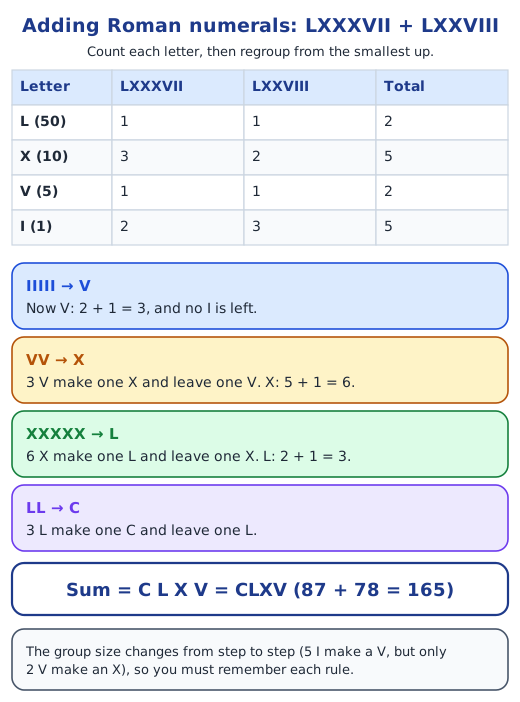
Read next: the chapter notes, the idea of a base, place value and zero and NCERT solutions.
Practice
-
What is CDXLIV in our numerals?
Show answer
Answer: (a) 444
-
In the Gumulgal system, what number is ukasar-ukasar-ukasar-urapon?
Show answer
Answer: (c) 7
-
Why is counting with the letters a to z alone not enough?
Show answer
Answer: (b) It cannot count more than 26 things
-
Add XXVII and XIII without changing them to our numerals.
Show answer
Answer: Count the letters: X 3, V 1, I 5. Five I make a V, so V is 2; two V make an X, so X is 4. The sum is XXXX, usually written XL (40).
-
You have 7 sticks and a friend has 11. Without number names, how do you find who has more, and by how much?
Show answer
Answer: Pair your sticks one-to-one with your friend’s. Yours run out first, so your friend has more, and the 4 unpaired sticks show the difference.
Questions students ask
What are the oldest known counting records?
Notched bones. The chapter names the Lebombo bone from South Africa, with 29 notches and about 44,000 years old, and the Ishango bone from the Democratic Republic of Congo, dated 20,000 to 35,000 years old.
What is a one-to-one mapping?
It is a pairing in which each thing gets its own stick, name or mark, and no two things share one. It lets you compare or keep track of a collection without any number words.
Why did people using Roman numerals need an abacus?
Multiplying and dividing with Roman letters is very hard, because their products have no simple pattern. So calculations were done on a counting board, the abacus, by specially trained people.
Where did Roman numerals come from?
The chapter says it seems to have developed in Rome from the number system of ancient Greece, around the 8th century BCE. It spread across Europe with the Roman empire and was used there for centuries.
Stuck on a question?
Take a photo and Lagnever AI explains it step by step. Try it for 7 days for ₹2.
Get it on Google Play Open in browser
For parents: after the trial, the plan renews monthly by UPI or card autopay. You can cancel anytime in the app.