
The idea of a base: Egyptian numerals and base-n systems
Answer in short
A number system has a base n when its landmark numbers are 1, n, n², n³, …, each n times the one before. Egyptian numerals of about 3000 BCE were base 10, with a sign for each power of 10. A base makes sums regular: n of one sign make the next, and two landmarks multiply to give another landmark.
Stuck on a question? Take a photo and Lagnever AI explains it step by step. Try it for 7 days for ₹2. Get it on Google Play
How did the Egyptians write numbers?
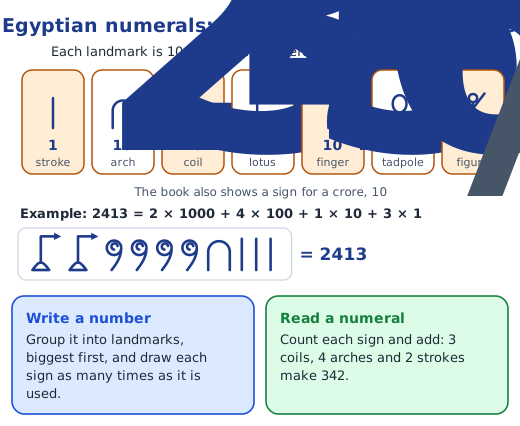
Around 3000 BCE, the Egyptians built a written number system on a very neat sequence of landmark numbers. Start with 1. Ten 1s make the next landmark, 10. Ten 10s make 100, ten 100s make 1000, and so on. Every landmark is 10 times the one before, so all of them are powers of 10, and each one had its own sign, up to a crore (10⁷).
We can name the signs by their shapes: a stroke (1), an arch (10), a coil (100), a lotus (1000), a finger (10,000), a tadpole (1,00,000) and a figure with raised arms (10,00,000). To write a number, group it into landmarks, biggest first, and draw each sign as many times as needed. So 2413 is 2 lotuses, 4 coils, 1 arch and 3 strokes. To read a numeral, add up its signs.
What is a base-n number system?
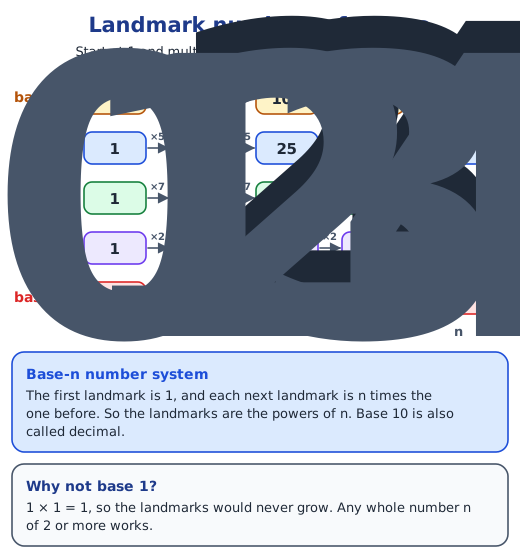
Nothing is special about 10. Group 5 ones to make the next landmark, 5 of those to make the next, and so on, and you get landmarks 1, 5, 25, 125, 625, … A system whose
- first landmark is 1, and
- each next landmark is a fixed number n times the one before
is called a base-n number system. Its landmarks are the powers of n: n⁰ = 1, n, n², n³, … The Egyptian system is base 10, also called a decimal system. Any whole number n from 2 upwards works; base 1 fails, because 1 × 1 = 1 and the landmarks never grow.
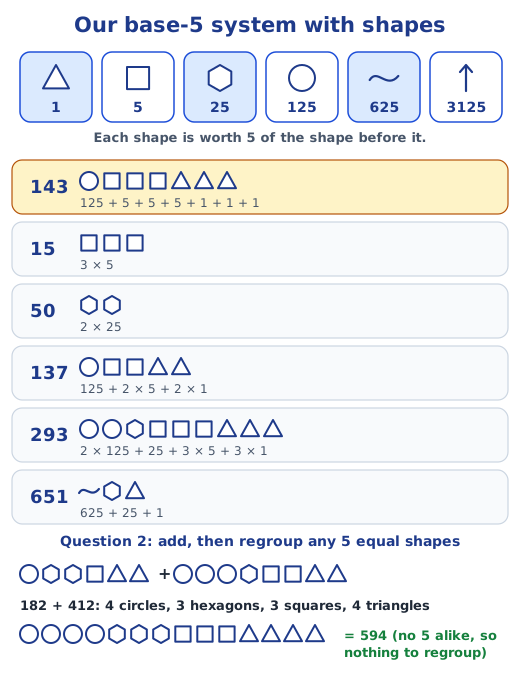
In the chapter, base 5 gets shapes: triangle (1), square (5), hexagon (25), circle (125), wave (625) and arrow (3125). Then 87 = 3 × 25 + 2 × 5 + 2 is 3 hexagons, 2 squares and 2 triangles. Notice that no shape is ever needed 5 times: five of one shape would make the next.
How does a base make adding easier?
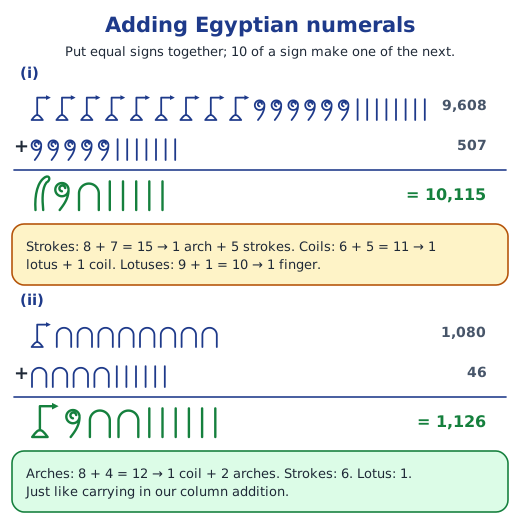
To add two Egyptian numerals, put all the equal signs together, then regroup from the smallest: every 10 strokes become 1 arch, every 10 arches 1 coil, and so on. For 9608 + 507, the 15 strokes become 1 arch and 5 strokes, the 11 coils become 1 lotus and 1 coil, and the 10 lotuses become 1 finger: the sum is 10,115. This is exactly how carrying works in our column addition. In Roman numerals the group size changes at each step, which is why adding them needs more care.
How does a base make multiplying easier?
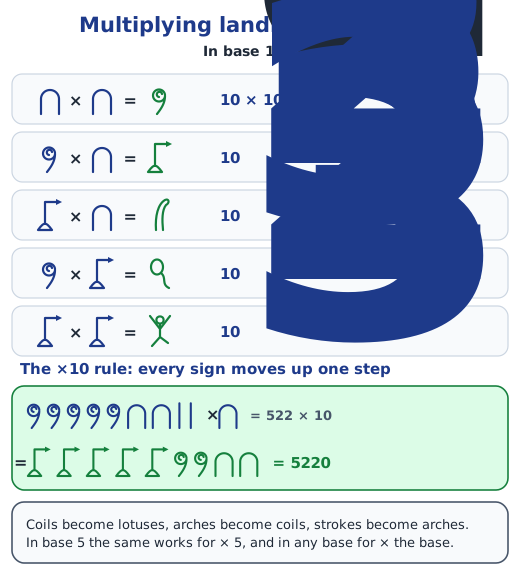
Multiply two landmarks of a base and you always get another landmark, because the powers add: 10² × 10³ = 10⁵. In Egyptian signs, an arch times an arch is a coil, and a coil times a lotus is a tadpole. This gives a simple rule: multiplying by 10 moves every sign up one step. With the distributive law, 522 × 10 = (500 + 20 + 2) × 10, so 5 coils, 2 arches and 2 strokes become 5 lotuses, 2 coils and 2 arches, which is 5220. The same is true in base 5 for multiplying by 5. Roman numerals have no such rule, since V × V = 25 is not a landmark.
How did a line abacus use base 10?
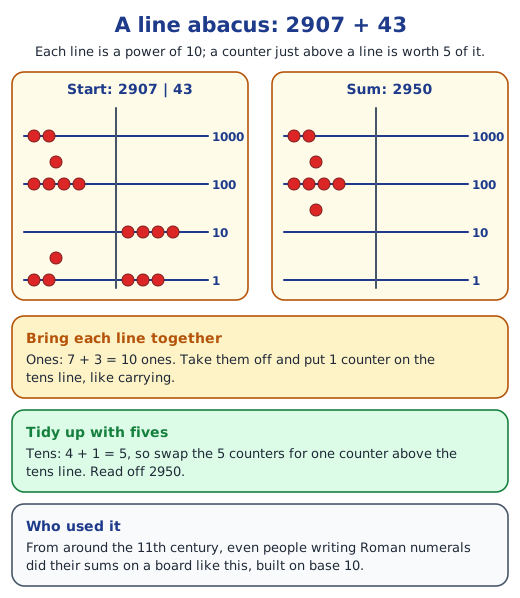
From around the 11th century, even people who wrote Roman numerals calculated on a board with lines: one for 1, one for 10, one for 100, and so on. Counters on a line showed how many of that power there were, and a counter just above a line stood for 5 of it. To add 2907 and 43, bring the counters on each line together. The 7 ones and 3 ones make 10 ones, which become one counter on the tens line. The answer reads 2950.
What was the weak point?
A base made Egyptian numerals compact and easy to compute with, up to about a crore. But each higher power of 10 needed a brand new sign, and numbers never end. Solving that problem needed one more idea: place value.
Read next: the chapter notes, early number systems, place value and zero and NCERT solutions.
Practice
-
Which of these is a landmark number of a base-3 system?
Show answer
Answer: (b) 9
-
In Egyptian numerals, a coil (100) multiplied by a lotus (1000) gives:
Show answer
Answer: (b) a tadpole (10⁵)
-
With triangle 1, square 5, hexagon 25 and circle 125, what is 2 circles, 1 square and 4 triangles?
Show answer
Answer: (b) 259
-
Write 3204 in Egyptian numerals.
Show answer
Answer: 3204 = 3 × 1000 + 2 × 100 + 4, so 3 lotuses, 2 coils and 4 strokes. No arches are needed, because there are no tens.
-
Why can 1 not be used as a base?
Show answer
Answer: The landmarks would be 1, 1 × 1 = 1, 1, … and would never grow, so bigger numbers would never get a landmark.
Questions students ask
What is the base of a number system?
It is the fixed number n by which each landmark number is multiplied to get the next one, starting from 1. In base 10 the landmarks are 1, 10, 100, 1000, …; in base 5 they are 1, 5, 25, 125, …
Is the Egyptian number system a place value system?
No. It has a base, 10, but each power of 10 has its own sign, and a numeral is read by adding up the values of its signs. In a place value system the position of a digit tells its value instead.
Why is multiplying easier in a system with a base?
Because the product of two landmark numbers is another landmark number: 10² × 10³ = 10⁵. Using the distributive law, any product breaks into such pieces, so you only need to move signs up and add.
What was the weakness of the Egyptian system?
It needed a new sign for every higher power of 10. Its signs went up to a crore (10⁷), so writing much larger numbers would need more and more new symbols.
Stuck on a question?
Take a photo and Lagnever AI explains it step by step. Try it for 7 days for ₹2.
Get it on Google Play Open in browser
For parents: after the trial, the plan renews monthly by UPI or card autopay. You can cancel anytime in the app.