
NCERT Solutions Class 8 Social Science Part 2 Chapter 5: Citizenship: Rights and Duties
Answers to the Big Questions, every Let’s Explore, Think About It and Don’t Miss Out box, and all ten Questions and activities in Chapter 5, Citizenship: Rights and Duties, of Exploring Society: India and Beyond, Grade 8 Part 2. Page numbers follow the book (pages 143–166). Short notes: Part 2 Chapter 5 notes.
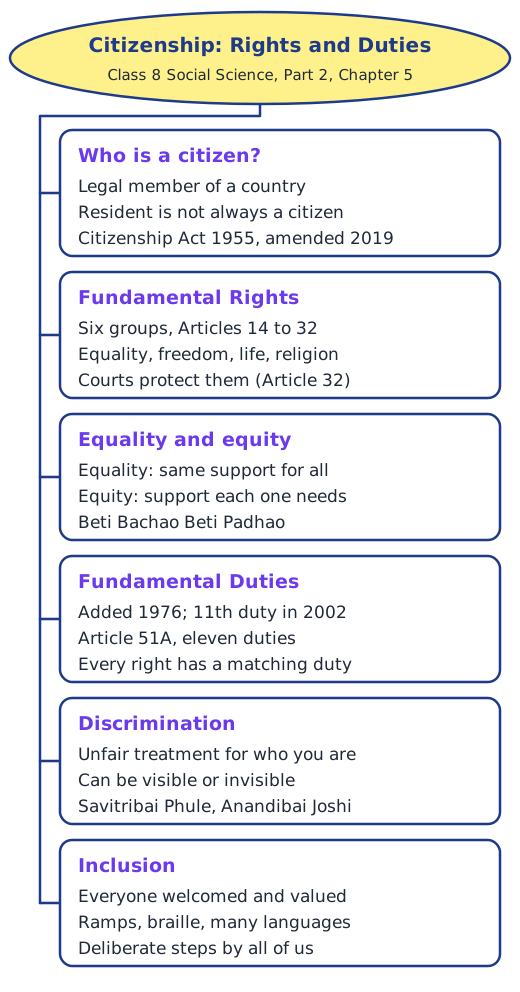
The Big Questions (page 143)
1. What does it mean to be a citizen, not just legally, but in everyday life? Legally, a citizen is a member of the country who can take part in its decisions. In everyday life it means acting on shared values: obeying laws, paying taxes, keeping surroundings clean, helping others, standing up against unfairness, and making sure people like Kruti feel they belong.
2. Why are both rights and duties essential? Rights let each person live with dignity and protect them from misuse of power. Duties make sure we use our freedom without harming others. If everyone claimed rights but ignored duties, people’s rights would clash and no one’s rights would be safe.
3. How can we help build a fair, respectful and inclusive society? By knowing and using our rights through proper channels, doing our duties, refusing to discriminate, speaking up when others are excluded, and taking deliberate steps such as ramps, several languages and patient group work so that everyone can take part.
Boxes in the chapter (pages 144–163)
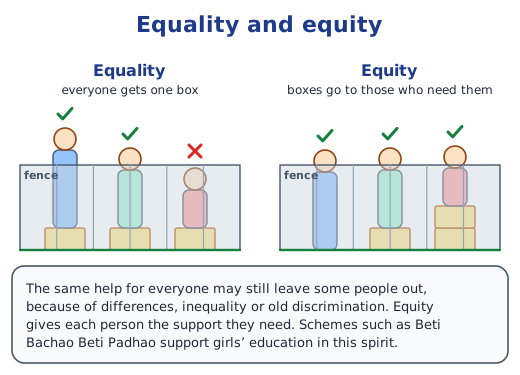
Equality and equity (pages 148–149). In the first picture everyone gets the same support, but the shortest still cannot see; in the second, support goes to those who need it, and everyone can see. That is equity. Other examples: scholarships for students from poor families, mid-day meals in schools, ramps and braille books, seats for children from weaker sections in private schools under the Right to Education Act, and bicycles for girl students in some states.
Sports Day uniform (page 149). Yes, the student was exercising freedom of speech by raising a concern calmly in a discussion. It could also be raised by writing to the principal or the student council with a suggestion, such as a sports kit for Sports Day. Schools should listen, explain the reasons for rules, and change them where a request is fair, while students keep following the rule until it changes.
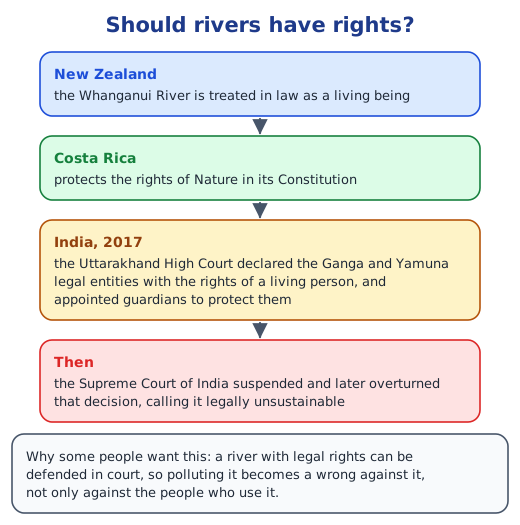
Rights for rivers (page 150). Giving nature legal rights means a river or forest can be defended in court through its guardians, so harming it becomes a legal wrong, not just a loss to people. It treats nature as living and makes polluters answer for damage, which can help protect the environment.
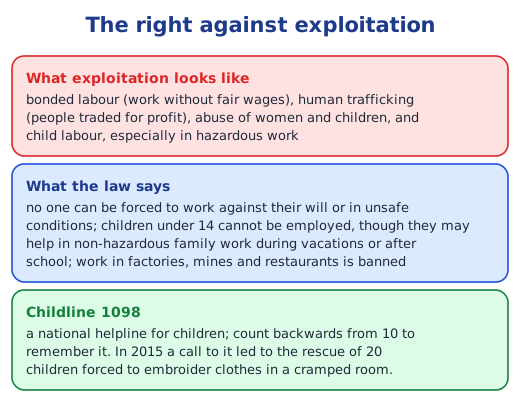
A child working instead of being in school (page 152). One step: tell a teacher or the principal, or call Childline 1098. Do not confront an employer alone; trained people, like the team in the 2015 rescue, can step in safely.
Why do we need a way to protect rights? (page 153). Without a remedy, rights would be promises on paper. Article 32 lets anyone whose rights are violated, even by the government, go to the Supreme Court, which can order the violation to stop. That is why Dr Ambedkar called it the heart and soul of the Constitution.
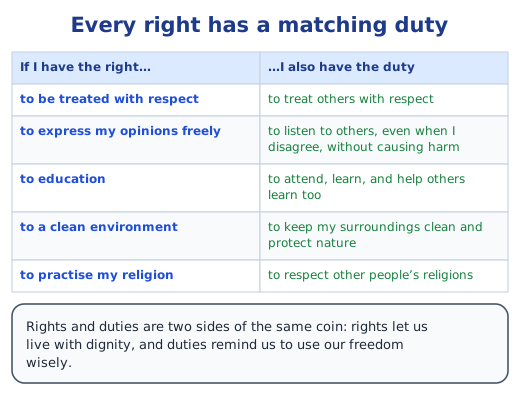
A duty that matches the right to education (page 159). To attend school regularly, learn sincerely, respect teachers and help others learn; and for parents and guardians, the eleventh duty, to make sure children aged 6 to 14 go to school.
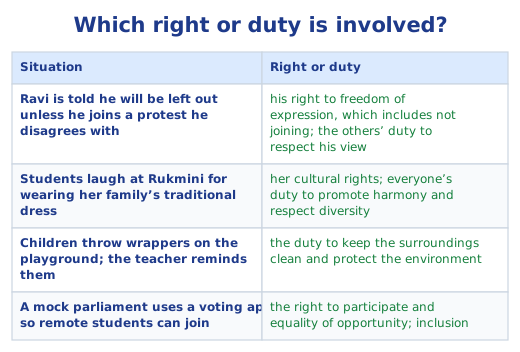
Which right or duty is involved? (pages 159–160). Ravi: his freedom of expression includes choosing not to join a protest, and the others have a duty to respect his view. Rukmini: her cultural rights, and everyone’s duty to promote harmony and respect diversity. The wrappers: the duty to keep surroundings clean and protect the environment. The voting app: the right to take part, with inclusion of students in remote areas. Can we demand rights without doing our duties? No: our duties protect other people’s rights, just as their duties protect ours.
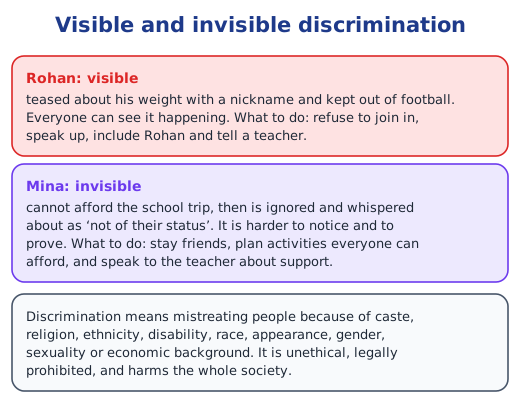
Rohan and Mina (page 162). Rohan faces open, visible discrimination about his appearance; Mina faces quieter, invisible discrimination about her family’s economic background. If I were in either group, I would refuse to join in, speak up, include them in the game or the plan, and tell a teacher if it continued. When facing discrimination yourself, talk to someone you trust and do not accept the label.
A classmate who learns differently (page 163). Be patient, explain clearly, give them a role and make sure they get a turn to speak. To make the classroom more inclusive: mixed groups, more time where needed, and no teasing.
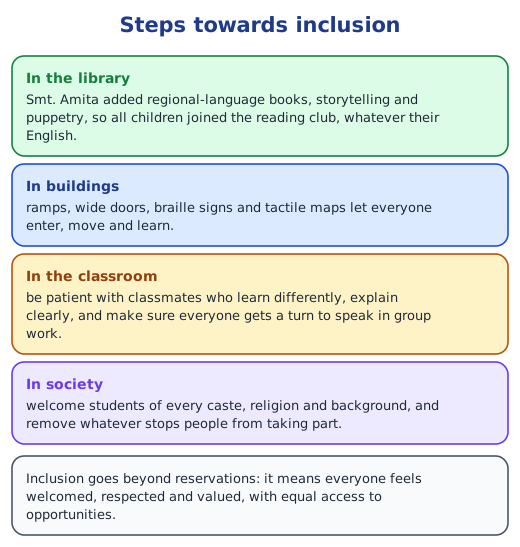
Fig. 5.14 compared with Fig. 5.3 (page 163). In Fig. 5.3 the fence stays, and the debate is about how to share boxes. In Fig. 5.14 there is no fence at all, so everyone watches the cricket match without any extra support. Removing the barrier itself is inclusion; Fig. 5.15 shows the same idea in a playground designed so a child in a wheelchair can play too.
Questions and activities (pages 165–166)
1. Why is it important to respect others’ religions? Freedom of religion is a Fundamental Right of every person, and India is home to many faiths. Respect keeps harmony and unity, which is also a Fundamental Duty, and it treats all faiths as equal in the eyes of the state, just as we want our own beliefs respected.
2. How would you feel if you were left out? Hurt, lonely and less confident, perhaps angry, and unwilling to try again. Remembering that feeling is a reason to notice when others are left out and to invite them in, as Sonali and Harshada did for Kruti.
3. If the Constitution promises rights, why is there still discrimination? Old prejudices and habits change slowly; many people do not know their rights or cannot easily go to court; invisible discrimination is hard to prove; and some people ignore the law. Laws are necessary, but attitudes and everyday actions must change too.
4. Can there be a conflict between rights and duties? Yes. Freedom of speech can clash with the duty to promote harmony, if speech insults another religion; the right to protest can clash with the duty to protect public property, if a protest turns violent. Reasonable restrictions and respect for others help balance them.
5. How does respecting diversity strengthen democracy? When every language, religion and culture is respected, all groups feel they belong and take part. More voices are heard, decisions reflect many views, conflicts reduce, and unity in diversity grows.
6. Does technology make citizenship easier or harder? Both. It is easier to learn about rights, reach officials, sign petitions and take part from far away, like the voting app in the mock parliament. It is harder because of false news, online bullying and hateful posts, and because not everyone has a phone or internet. Good digital citizens check facts, post respectfully and help others get access.
7. If everyone enjoyed rights but ignored duties? Streets would be dirty, public property broken, taxes unpaid and services would collapse, children might not be sent to school, and nature would be harmed. People’s freedoms would clash with no respect for others, so in the end no one’s rights would be safe.
8. How can students practise inclusion? Invite new or left-out classmates to sit and play with you; form mixed groups; learn words from classmates’ languages; be patient and help classmates with disabilities; celebrate all festivals; and stop teasing when you see it.
9. What can be done?
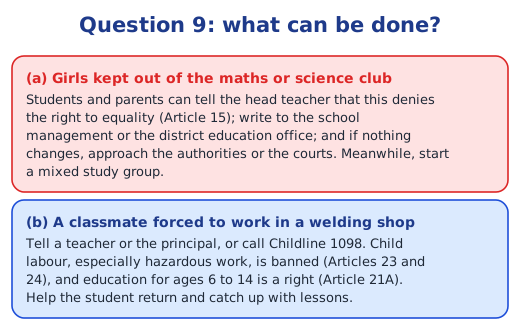
(a) Raise it with the head teacher, citing the right to equality and no discrimination by sex (Article 15); write to the school management or the district education office; and, if nothing changes, approach the authorities or the courts. (b) Tell a teacher or call Childline 1098: child labour, especially hazardous work, is banned (Articles 23 and 24), and education for ages 6 to 14 is a right (Article 21A). Then help the classmate catch up.
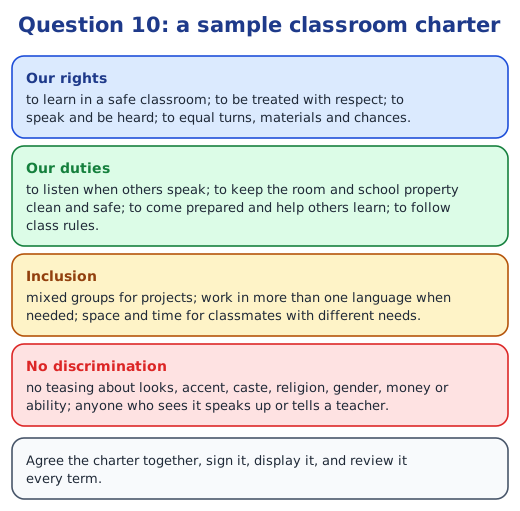
10. A classroom charter. List the class’s rights and duties, add rules for inclusion and against discrimination, agree on them together, sign the charter and display it.
Practice
-
Ravi is told he will be left out unless he joins a protest he disagrees with. Which right is involved?
Show answer
Answer: (b) freedom of speech and expression
-
In Fig. 5.14 everyone can watch the match without boxes because:
Show answer
Answer: (b) the fence has been removed
-
A duty that matches your right to education is:
Show answer
Answer: (b) attending school and learning sincerely
-
Give one example of a conflict between a right and a duty.
Show answer
Answer: Freedom of speech against the duty to promote harmony: a speech that insults another religion uses a right in a way that breaks a duty, which is why freedoms have reasonable restrictions.
-
What would you do if you saw a child working instead of being in school?
Show answer
Answer: Tell a teacher or the principal, or call Childline 1098, the national helpline for children, so that trained people can step in safely.
Stuck on a question?
Take a photo and Lagnever AI explains it step by step. Try it for 7 days for ₹2.
Get it on Google Play Open in browser
For parents: after the trial, the plan renews monthly by UPI or card autopay. You can cancel anytime in the app.