
Class 8 Social Science Part 2 Chapter 5: Citizenship: Rights and Duties Notes
This chapter in five lines
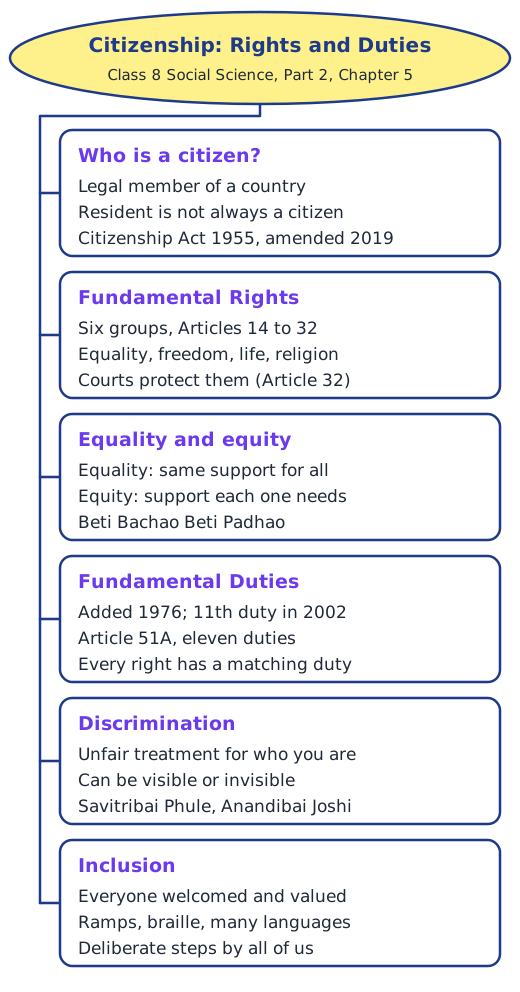
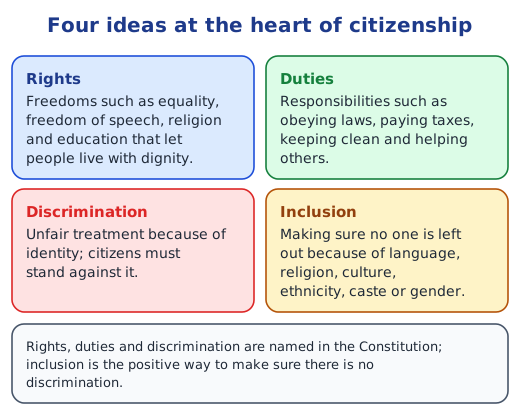
Citizenship: Rights and Duties explains what it means to be a citizen of India, both legally and in everyday life. The Constitution gives every citizen six Fundamental Rights, which the courts protect, and eleven Fundamental Duties. Rights and duties go together, and active citizens stand against discrimination and take deliberate steps so that everyone is included.
What is this chapter about?
The Big Questions ask what it means to be a citizen in everyday life, not just legally, why both rights and duties are essential, and how we can help create a society that is fair, respectful and welcoming to all. The chapter opens with Kruti, a new student teased for her accent, and two classmates who stopped the teasing and invited her into their badminton team: good citizenship in action.
Who is a citizen?
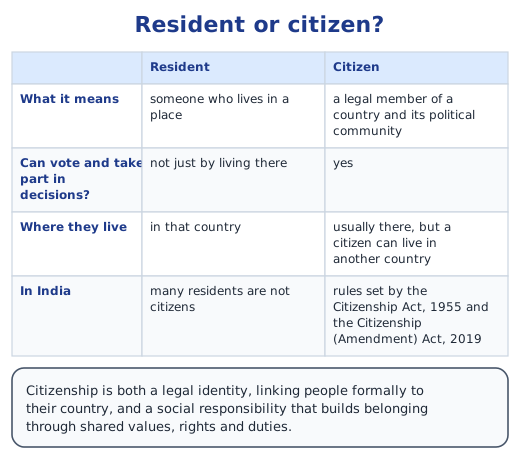
A citizen legally belongs to a country and its political community, and can take part in its decisions. In a democracy, citizenship brings rights, such as voting and freedom of speech, and duties, such as obeying the law and paying taxes. It is a legal tie to the country as well as a responsibility towards society. Merely living somewhere makes a person a resident. In India, two laws, the Citizenship Act, 1955 and the Citizenship (Amendment) Act, 2019, decide how citizenship is acquired or lost. Read who is a citizen?.
Rights
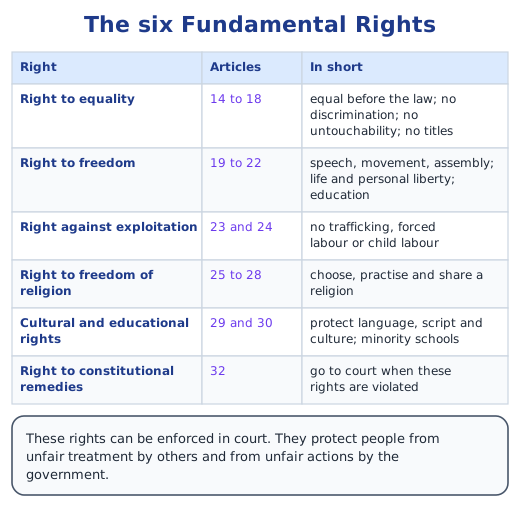
Rights are the things every person needs for a life of dignity, safety and respect, such as education, a livelihood and the freedom to share ideas; nothing that hurts others can count as a right. The Constitution lists six Fundamental Rights: equality, freedom, against exploitation, freedom of religion, cultural and educational rights, and constitutional remedies. They protect people from unfair treatment by others and by the government, and can be enforced in court. Read Fundamental Rights and Duties.
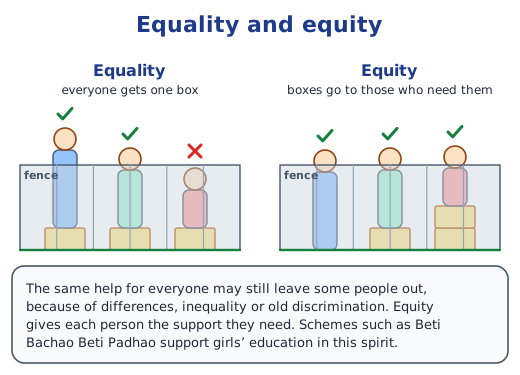
Equality and equity
Giving everyone exactly the same may still leave some people behind, because of differences or old discrimination. Equity gives each person the support they need. Campaigns such as Beti Bachao Beti Padhao support girls’ education in this spirit.
Fundamental Duties
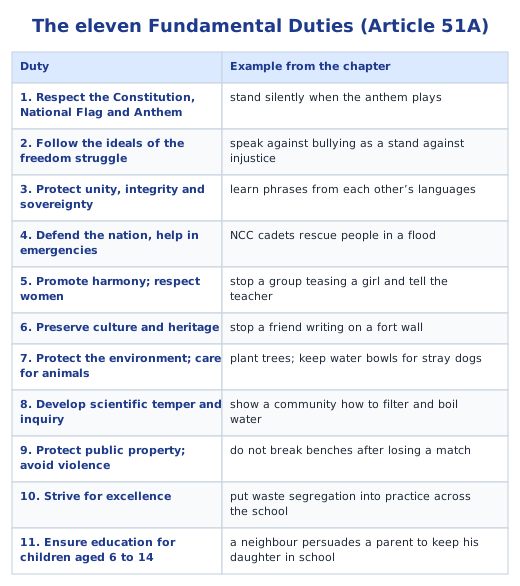
When the residents of Green Park Colony cleaned their park, planted saplings and fed street dogs, a little girl explained: “It’s our duty to care for our neighbourhood.” The Constitution had no duties in 1950; ten Fundamental Duties were added in 1976 in Article 51A, and an eleventh, on educating children aged 6 to 14, in 2002.
Rights and duties together
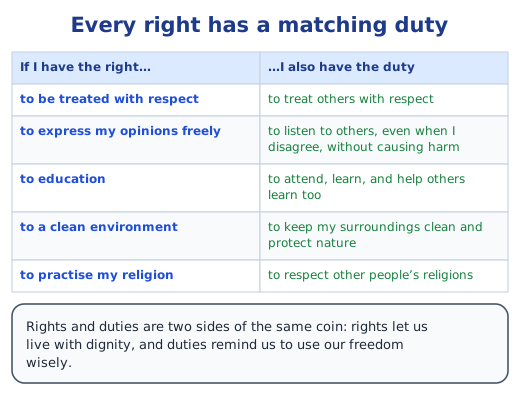
Rights and duties are two sides of the same coin: if I have the right to be heard, I have the duty to listen. Rights are protected by law, even against the government; duties are moral and social responsibilities, and fulfilling them protects everyone’s rights.
Discrimination and inclusion
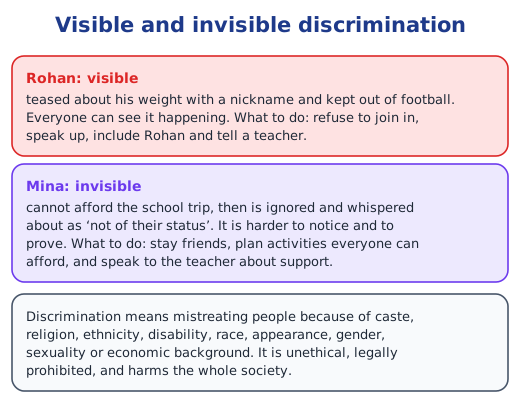
Discrimination is mistreating someone because of caste, religion, ethnicity, disability, race, appearance, gender, sexuality or economic background. It is unethical and legally prohibited, and it can be visible, like open teasing, or invisible, like quietly leaving someone out. Inclusion means everyone feels welcomed and valued, with equal access to opportunities: braille books, ramps, several languages and patience in group work. Read discrimination and inclusion.
Before we move on
Active citizens enjoy their own rights while respecting everyone else’s, speak up against unfairness and help everyone feel included. Democracy grows stronger when everyone can take part. Answers to every question are in the NCERT solutions for Part 2 Chapter 5.
Key terms
| Term | Meaning |
|---|---|
| Citizen | A person who legally belongs to a country and its political community, and can take part in its decisions. |
| Resident | A person who lives in a place; a resident is not always a citizen. |
| Rights | Justified claims that every person needs to live with dignity, safety and respect. |
| Fundamental Rights | Six groups of basic rights in the Constitution (Articles 14 to 32) that can be enforced in court. |
| Equality | Everyone is treated the same and receives exactly the same support. |
| Equity | Being fair by giving each person the support they need, taking account of existing inequalities. |
| Reasonable restrictions | Limits placed on freedoms to stop them being misused or hurting other people or the country. |
| Exploitation | Taking unfair advantage of others, such as bonded labour, trafficking or child labour. |
| Right to constitutional remedies | The right to approach the Supreme Court (Article 32) when Fundamental Rights are violated. |
| Fundamental Duties | Eleven responsibilities of citizens listed in Article 51A, added in 1976 and 2002. |
| Discrimination | Mistreating a person or group because of caste, religion, gender, disability, appearance, economic background and so on. |
| Invisible discrimination | Indirect unfair treatment, such as jibes or quietly leaving someone out, which is hard to prove. |
| Inclusion | Making sure everyone feels welcomed, respected and valued, with equal access to opportunities. |
| Dharma and rina | Ancient ideas linked to duty: dharma, what is right and beneficial; rina, the debts owed to the gods, ancestors, teachers, people and Nature. |
Topics in this chapter
Practice
-
Which Article lets citizens go to the Supreme Court to protect their Fundamental Rights?
Show answer
Answer: (c) Article 32
-
Fundamental Duties were first added to the Constitution in:
Show answer
Answer: (b) 1976
-
Giving each person the support they need is called:
Show answer
Answer: (b) equity
-
The national helpline for children is:
Show answer
Answer: (c) 1098
-
Child labour is banned by the:
Show answer
Answer: (b) right against exploitation
-
Who opened a school for girls in the 19th century despite being abused for it?
Show answer
Answer: (b) Savitribai Phule
Questions students ask
What are the main topics of Class 8 Social Science Part 2 Chapter 5?
Who a citizen is; rights and the six Fundamental Rights; equality and equity; the right against exploitation and Childline; constitutional remedies; Fundamental Duties and how they were added; how rights and duties go together; discrimination, visible and invisible; and inclusion.
Is Citizenship: Rights and Duties in the new NCERT Class 8 Social Science book?
Yes. It is Chapter 5 of Exploring Society: India and Beyond, Grade 8 Part 2, in the theme Governance and Democracy, on pages 143 to 166.
What is the difference between a resident and a citizen?
A resident is anyone who lives in a place, while citizenship is formal legal membership of a country. Many residents are not citizens, and citizens may live abroad.
How are rights and duties related?
They are two sides of the same coin. Every right has a matching duty: the right to be treated with respect goes with the duty to respect others. Rights are protected by law, while duties are moral and social responsibilities.
Stuck on a question?
Take a photo and Lagnever AI explains it step by step. Try it for 7 days for ₹2.
Get it on Google Play Open in browser
For parents: after the trial, the plan renews monthly by UPI or card autopay. You can cancel anytime in the app.