
Who is a citizen?
Answer in short
A citizen is a legal member of a country and its political community, with a say in how it is run. Citizenship is a legal tie and a responsibility towards society: it brings rights, such as voting and freedom of speech, and duties, such as following laws and paying taxes. Simply living somewhere makes you a resident.
Stuck on a question? Take a photo and Lagnever AI explains it step by step. Try it for 7 days for ₹2. Get it on Google Play
Citizens in everyday life
On her first days at a new school, Kruti was mocked on the playground because of how she spoke. Two classmates, Sonali and Harshada, told the bullies to stop, and then asked Kruti to play in their badminton team, so she no longer felt like an outsider. The chapter holds this up as good citizenship: defending someone who needs help and making sure nobody is left on the edges. Citizenship lives in such everyday acts, not only in documents.
The legal meaning
Legally, a citizen is a recognised member of a country and of its political community, with a share in the decisions the country makes. In a democracy that membership brings rights, among them voting, freedom of speech and the chance to live and work in safety, though none of these is unlimited. It also brings duties: following the law, paying taxes, treating others with respect and helping to keep everyone safe.
Citizenship therefore has two faces. As a legal identity, it ties a person officially to the nation. Seen as a social responsibility, it gives people a feeling of belonging and binds them together through common values, rights and duties.
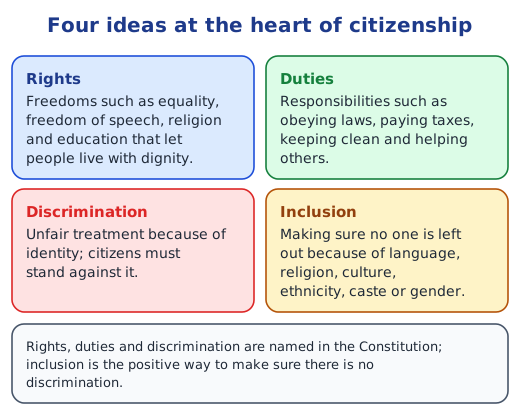
Resident or citizen?
A resident is simply someone who lives in a place; citizenship is membership recognised in law. The two do not always go together: many people live in a country without being its citizens, and citizens may live abroad. Active citizens also pay their taxes, help people in need, look after the environment, and use their rights to challenge unfair practices and defend what is right.
Every citizen of India is equal before the Constitution, whatever language they speak, whatever faith they follow and whatever culture they come from. Two laws, the Citizenship Act, 1955 and the Citizenship (Amendment) Act, 2019, lay down how citizenship is acquired or lost.
Four big ideas
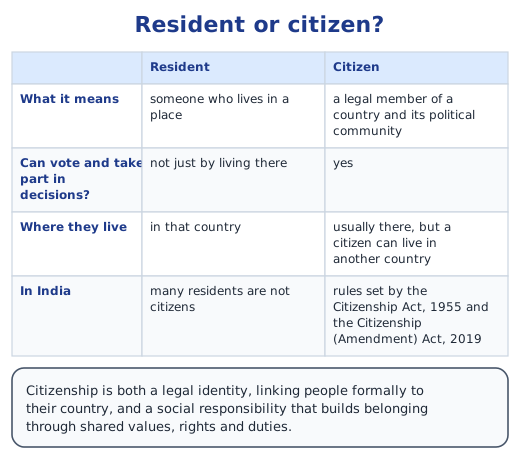
Four ideas run through the chapter. Rights are freedoms, such as equality, freedom of expression and of faith, and education, that allow a dignified life. Duties are responsibilities, such as following laws, paying taxes, keeping places clean and lending a hand. Discrimination means treating people unfairly because of who they are, and citizens should oppose it. Inclusion means nobody is shut out because of their language, faith, culture, ethnicity, caste or gender. The Constitution names the first three; inclusion is the positive step that keeps discrimination away.
Citizens who act: the town festival
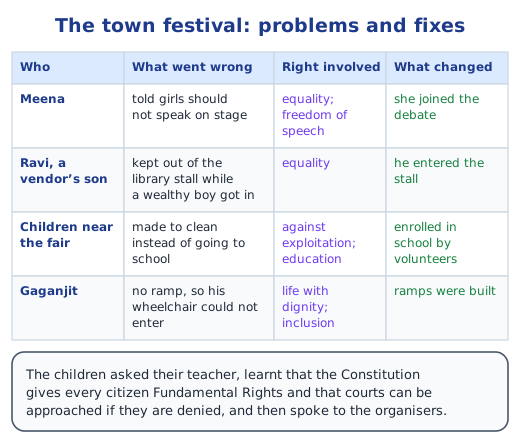
A town’s yearly festival ran into trouble. Meena was barred from the debate on the excuse that girls should not speak on stage. Ravi, whose father sells goods on the street, was turned away from the library stall, though a rich boy walked straight in. Some children near the fairground were made to sweep and clean when they should have been at school. And Gaganjit, a wheelchair user, was stuck outside the exhibition hall, which had no ramp.
The children took the matter to their teacher and learnt that every citizen has Fundamental Rights under the Constitution, among them equality, freedom of speech and expression, freedom of religion, a life of dignity and education, and that anyone denied these can go to court. With this knowledge they spoke to the organisers, and things changed step by step: Meena took part in the debate, Ravi went into the stall, volunteers got the working children admitted to school, and ramps were put in for Gaganjit.
Why it matters
The festival story shows what active citizenship looks like: knowing your rights, noticing when someone else is denied theirs, and acting through the proper channels. A democracy grows stronger when everyone can take part, and a peaceful society grows out of small daily choices, words and deeds.
Read on: Fundamental Rights and Duties, discrimination and inclusion, the chapter notes and the NCERT solutions.
Practice
-
Which law first set the rules for gaining or losing Indian citizenship?
Show answer
Answer: (a) the Citizenship Act, 1955
-
A person who lives in a country but is not its legal member is:
Show answer
Answer: (b) a resident
-
Citizenship is described in the chapter as:
Show answer
Answer: (c) a legal identity and a social responsibility at once
-
How did Sonali and Harshada show good citizenship?
Show answer
Answer: They told the bullies to stop teasing Kruti about her accent, and then invited her to join their badminton team so that she felt welcome and included.
-
Can an Indian citizen live in another country?
Show answer
Answer: Yes. Citizenship is legal membership of a country, not the place where you live, so a citizen can reside in another country and remain a citizen.
Questions students ask
What is a citizen?
A legal member of a country and its political community, who can therefore take part in the country’s decisions, for example by voting.
What makes citizenship a social responsibility?
Citizenship gives people a feeling of belonging and binds them together through common values, rights and duties. Citizens help those in need, care for the environment, challenge unfair practices and help keep everyone safe.
Which laws decide who is an Indian citizen?
Two laws, the Citizenship Act of 1955 and the Citizenship (Amendment) Act of 2019, lay down how Indian citizenship is acquired or lost. Under the Constitution every citizen is equal, whatever their language, religion or culture.
Stuck on a question?
Take a photo and Lagnever AI explains it step by step. Try it for 7 days for ₹2.
Get it on Google Play Open in browser
For parents: after the trial, the plan renews monthly by UPI or card autopay. You can cancel anytime in the app.