
Discrimination and inclusion
Answer in short
Discrimination is treating a person or group badly because of who they are: their caste, faith, ethnicity, race, disability, looks, gender, sexuality or income. It is wrong, banned by law and harmful to society, and can be open or hidden. Inclusion means everyone feels welcome, respected and valued, with the same chances and no barriers to taking part.
Stuck on a question? Take a photo and Lagnever AI explains it step by step. Try it for 7 days for ₹2. Get it on Google Play
What discrimination looks like
Sanya wanted to try out for the school play, but a few classmates muttered that she did not ‘look like’ a lead actor and should aim for a small part. She tried out anyway, won the teachers over with her confident acting, and got an important role. Afterwards the drama teacher told the class that shutting someone out or judging them by appearance is unfair, a kind of discrimination: what counts is talent and hard work, not looks.
Discrimination means treating a person or group badly because of who they are, for example their caste, religion, ethnicity, race, disability, looks, gender, sexuality or family income. It is morally wrong and against the law. It hurts the person or group affected, in mind and body, and it harms society as a whole. It also creates a social barrier that stops people from enjoying their Fundamental Rights. The chapter adds that someone who discriminates breaks the core of the Constitution, respect and unity, and so ethically stops being an active citizen.
Visible and invisible
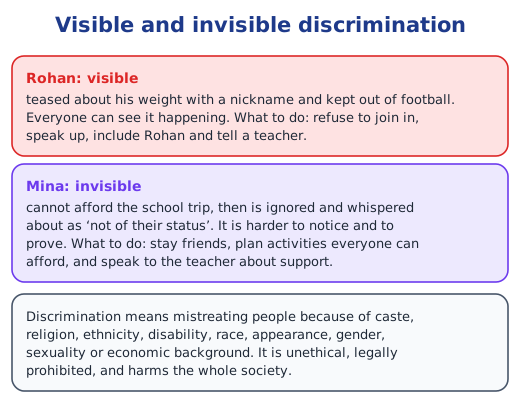
Some discrimination is out in the open. Rohan is mocked for his weight with a nickname and kept out of football while everyone watches. Other discrimination is quiet. Mina could not afford a school trip, and some friends began to ignore her, whispering that she “wasn’t fun” or “was not of their status”. Indirect discrimination, such as jibes or not including someone in a project or celebration because of their background, looks or supposed ability, is hard to prove and therefore hard to penalise.
Two women who refused to give in
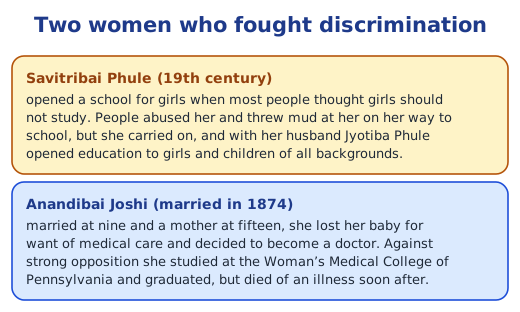
In the mid-19th century, Savitribai Phule opened a school for girls at a time when many believed girls should not study. People were further shocked that she came from the Mali community, then counted as a lower caste. She was abused and had mud thrown at her on the way to school, yet she carried on, and with her husband Jyotiba Phule worked to open education to girls and children from all backgrounds.
Anandibai Joshi was married at nine, in 1874, and lost her baby soon after birth for lack of medical care. She resolved to become a doctor, faced strong opposition, and studied at the Woman’s Medical College of Pennsylvania. She graduated, but died of an illness soon after.
What inclusion means
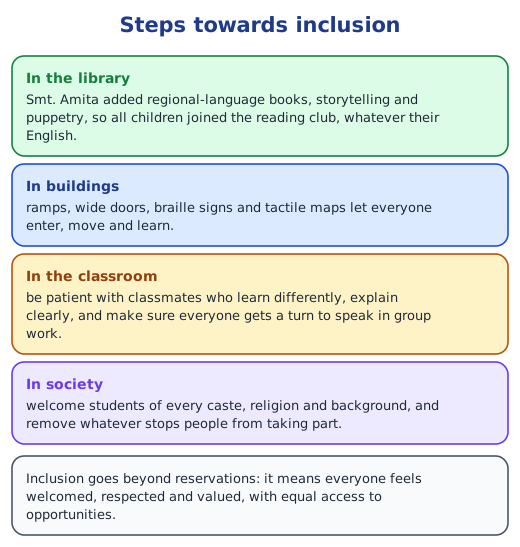
Smt. Amita noticed that fewer library books were being borrowed and started a reading club, but only confident English readers joined. When she added books in the regional language, along with storytelling and puppetry from the region, membership grew and all children took part, whatever their fluency.
Inclusion means shaping our schools and communities so that every person feels welcome, respected and valued, and has the same chances as everyone else. It matters most for groups excluded in the past because of their social or economic background. It goes beyond giving reservations: it means helping people who speak different languages to communicate, welcoming students of all castes, religions and backgrounds, giving extra help such as braille books, ramps and classroom support, and removing barriers to taking part.
From equality to inclusion
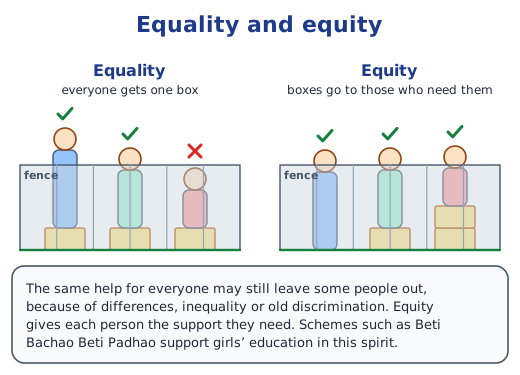
Equality gives everyone the same support, and equity gives each person what they need. Inclusion goes one step further and removes the barrier itself. In the book’s picture of a cricket match, there is no fence at all, so everyone can watch without any boxes; in its playground pictures, a child in a wheelchair moves from watching on the side to playing with everyone else.
What each of us can do
In class, be patient with a classmate who learns differently, explain clearly and make sure everyone gets a chance to speak. Outside class, speak up when you see unfairness, refuse to join in teasing, and help others feel respected. Deliberate actions, by people and institutions, are needed to prevent discrimination and ensure inclusion.
Read on: who is a citizen?, Fundamental Rights and Duties, the chapter notes and the NCERT solutions.
Practice
-
Which of these is an example of invisible discrimination?
Show answer
Answer: (b) quietly leaving a classmate out of a project because of their background
-
Savitribai Phule worked with her husband to:
Show answer
Answer: (b) spread education to girls and children of all backgrounds
-
Smt. Amita made her reading club inclusive by:
Show answer
Answer: (b) adding books in the regional language
-
Why is invisible discrimination a serious problem?
Show answer
Answer: Because it is hard to notice and hard to prove, so it is difficult to stop or punish, even though it hurts people and keeps them from enjoying their rights.
-
Name two ways to make a classroom more inclusive.
Show answer
Answer: For example: be patient with a classmate who reads or writes more slowly and make sure they get a turn to speak, and form mixed groups so that no one is left out.
Questions students ask
What is discrimination?
Treating people unfairly because of their identity, for example their caste, religion, race, ethnicity, disability, appearance, gender, sexuality or how much money their family has. It is unethical and against the law, and it hurts both the people targeted and society as a whole.
What is the difference between visible and invisible discrimination?
Visible discrimination happens openly, like teasing someone about their weight in front of others. Invisible discrimination is indirect, like jibes or quietly excluding someone because of their background, and is hard to prove and so hard to penalise.
What is inclusion?
Building surroundings in which every person feels welcome, respected and valued and gets the same chances, above all groups shut out in the past. It means removing whatever stops people from taking part.
Stuck on a question?
Take a photo and Lagnever AI explains it step by step. Try it for 7 days for ₹2.
Get it on Google Play Open in browser
For parents: after the trial, the plan renews monthly by UPI or card autopay. You can cancel anytime in the app.