
Fundamental Rights and Fundamental Duties
Answer in short
The Constitution gives six Fundamental Rights: equality, freedom, against exploitation, freedom of religion, cultural and educational rights, and constitutional remedies (Articles 14 to 32). They can be enforced in court. It also lists eleven Fundamental Duties in Article 51A, added in 1976 and 2002. Every right comes with a matching duty.
Stuck on a question? Take a photo and Lagnever AI explains it step by step. Try it for 7 days for ₹2. Get it on Google Play
What makes something a right?
Rights are the claims we can rightly make as human beings and as members of society: the things we need for a life of dignity, safety and respect, such as schooling, a livelihood or the freedom to share our views. Wanting something does not make it a right, and nothing that hurts us or other people can count as one. Real rights support everyone’s wellbeing and dignity, which is why they are called justified claims.
The six Fundamental Rights
The Constitution lists six groups of Fundamental Rights. They protect people from unfair treatment by others and from unfair actions by the government, and they can be enforced in court.
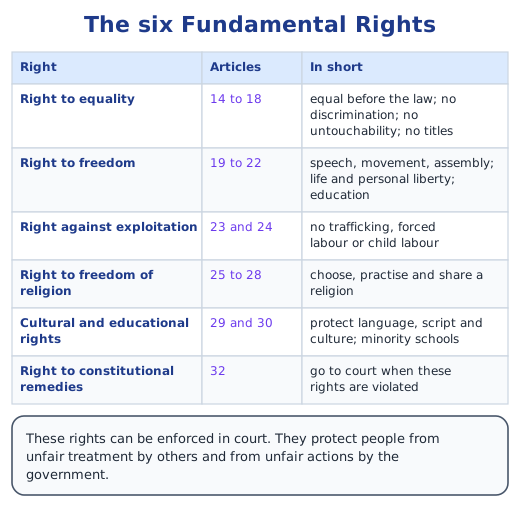
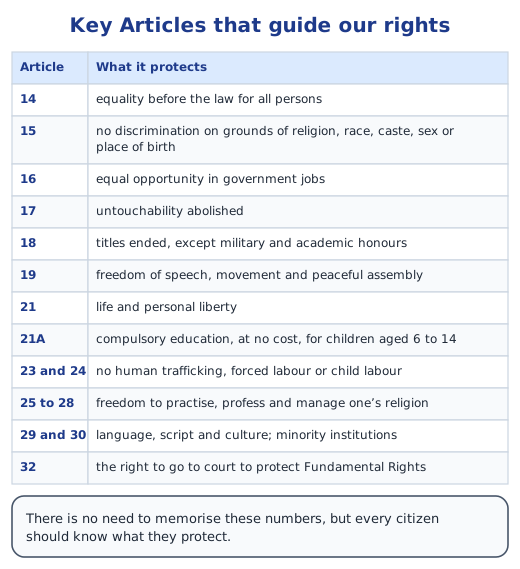
- Equality (Articles 14 to 18): equal treatment before the law, equal opportunity in jobs and education, no discrimination by caste, religion, race, gender or birthplace, an end to untouchability, and no special titles except military or academic honours.
- Freedom (Articles 19 to 22): to express ourselves, move freely and choose how to live and work, with reasonable restrictions. The right to life means living with dignity, including livelihood, education, health and a clean environment, and support for children with disabilities.
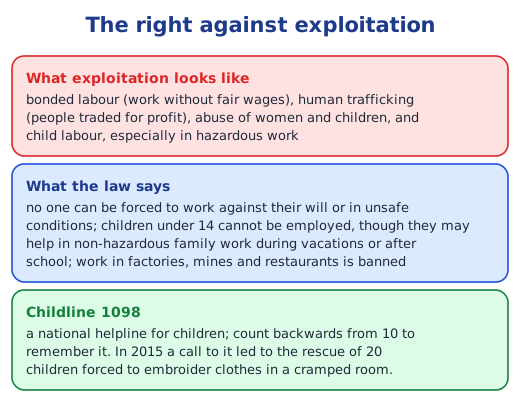
- Against exploitation (Articles 23 and 24): no bonded labour, trafficking or forced work; children under 14 cannot be employed, though they may help in non-hazardous family work during vacations or after school.
- Freedom of religion (Articles 25 to 28): everyone may choose, practise and share a religion, no one can be forced to follow or fund one, and government schools do not promote any religion.
- Cultural and educational rights (Articles 29 and 30): communities can keep alive their own language, script and customs, and minorities may run their own schools.
- Constitutional remedies (Article 32): citizens can approach the Supreme Court when these rights are violated. Dr B.R. Ambedkar called it the very soul and heart of the Constitution.
Protecting children
Children are especially vulnerable: they rely on adults for safety and may not know their rights or how to get help. Childline 1098, which started in the late 1990s as a project run by an educational institution, is now a national helpline; in 2015 a call to it led to the rescue of 20 children forced to embroider clothes in a cramped room.
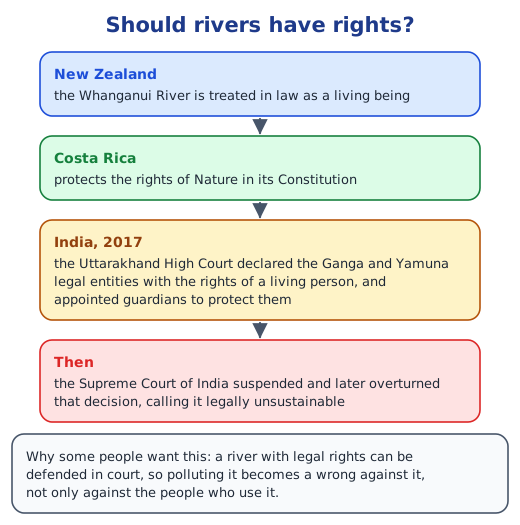
Some countries give rights to nature itself: New Zealand treats the Whanganui River as a living being. In 2017 the Uttarakhand High Court gave the Ganga and Yamuna the rights of a living person, but the Supreme Court overturned that decision.
The Fundamental Duties
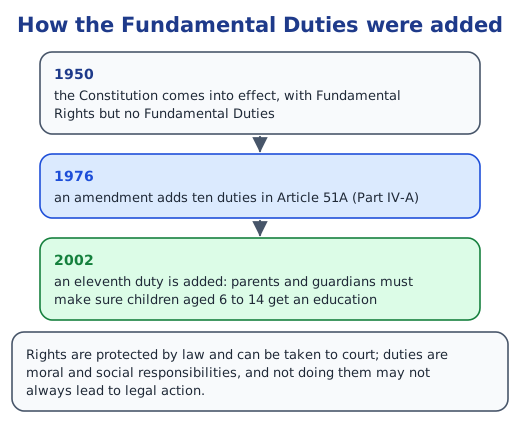
Alongside rights, the Constitution sets out what responsible citizens ought to do. These Fundamental Duties were not in the original Constitution of 1950. An amendment in 1976 added ten duties in Article 51A (Part IV-A), and in 2002 an eleventh was added: parents and guardians must make sure children aged 6 to 14 get an education.
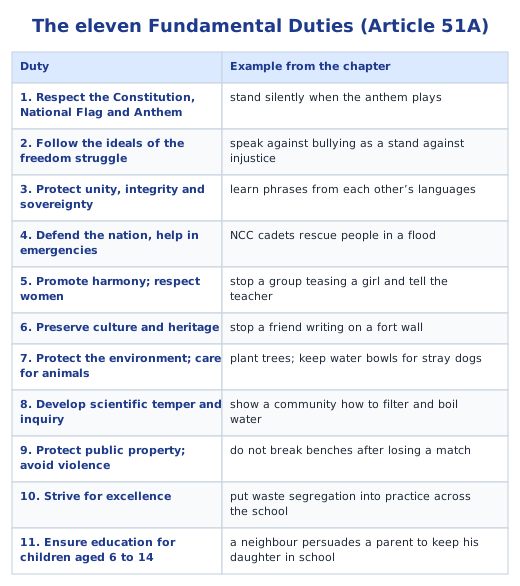
The duties ask us to respect the Constitution, flag and anthem; follow the ideals of the freedom struggle; protect India’s unity; defend the nation and help in emergencies; promote harmony and respect women; preserve our heritage; protect the environment and care for animals; develop a scientific temper; protect public property and avoid violence; strive for excellence; and educate children aged 6 to 14.
Rights and duties belong together
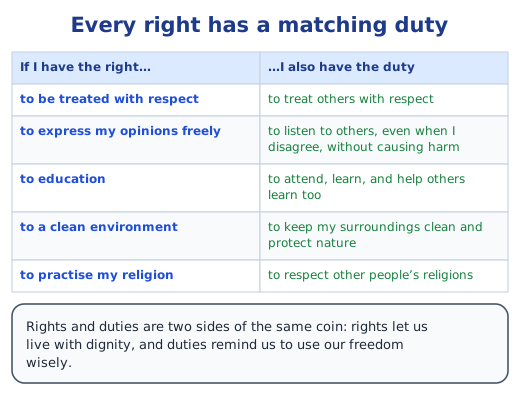
Rights and duties are partners: rights let us live with dignity, and duties keep us from using our freedom carelessly. Rights are protected by law, while duties are moral and social responsibilities. Old Indian ideas carry a similar sense: dharma, often translated as duty, and rina, the debts we owe to the gods, ancestors, teachers, fellow humans and Nature.
Read on: who is a citizen?, discrimination and inclusion, the chapter notes and the NCERT solutions.
Practice
-
Which Articles cover the right to equality?
Show answer
Answer: (a) 14 to 18
-
Under the right against exploitation, children below what age generally cannot be employed?
Show answer
Answer: (c) 14
-
The eleventh Fundamental Duty, added in 2002, is about:
Show answer
Answer: (b) educating children aged 6 to 14
-
Why did Dr B.R. Ambedkar call Article 32 the heart and soul of the Constitution?
Show answer
Answer: Because it lets citizens go to the Supreme Court when their Fundamental Rights are violated. Without a way to enforce them, the rights would only be promises on paper.
-
How are rights different from duties in law?
Show answer
Answer: Rights are protected by law, and people can go to court if they are violated, even by the government. Duties are moral and social responsibilities; not doing them may not always lead to legal action.
Questions students ask
What are the six Fundamental Rights?
The right to equality (Articles 14 to 18), the right to freedom (19 to 22), the right against exploitation (23 and 24), the right to freedom of religion (25 to 28), cultural and educational rights (29 and 30), and the right to constitutional remedies (32).
What does the right to life include?
Living with dignity, not merely staying alive: it covers earning a livelihood, education, health care, a clean environment and fair treatment by the law. It also protects children with disabilities, so that they can learn, play and take part on an equal basis.
How many Fundamental Duties are there?
Eleven, listed in Article 51A (Part IV-A). Ten were added in 1976 and the eleventh, on making sure children aged 6 to 14 get an education, in 2002.
Stuck on a question?
Take a photo and Lagnever AI explains it step by step. Try it for 7 days for ₹2.
Get it on Google Play Open in browser
For parents: after the trial, the plan renews monthly by UPI or card autopay. You can cancel anytime in the app.