
Human Genome Project aur DNA fingerprinting kya hain?
Short mein jawab
Human Genome Project 1990 mein launch hua aur 2003 mein poora hua; isne human genome ka sequence nikaala, jisme 3164.7 million base pairs hain. DNA fingerprinting, jise Alec Jeffreys ne develop kiya, logon ko unke repetitive DNA ke polymorphism se compare karti hai aur VNTR probe use karti hai. Ye forensic science aur paternity testing mein kaam aati hai.
Koi sawal atak gaya? Photo lo, Lagnever AI step-by-step samjhayega. 7 din ka trial sirf ₹2. Google Play se app lo
Human Genome Project kyun shuru hua?
Kisi individual ka genetic make-up uske DNA sequence mein hota hai. Agar do individuals alag hain, to unke DNA sequences bhi kam se kam kuch jagah alag honge. Isi se human genome ka poora DNA sequence nikaalne ka plan bana. Genetic engineering se DNA ke kisi bhi piece ko isolate aur clone karna mumkin ho gaya tha, aur sequencing ke tez methods bhi aa gaye the. Human Genome Project (HGP) 1990 mein launch hua.
Ye ek mega project tha. Lagbhag 3 × 10⁹ bp aur shuru ki estimated cost US $ 3 per bp ke hisaab se total lagbhag 9 billion US dollars aaya. Itne bade data ke storage, retrieval aur analysis ke liye high-speed computers chahiye the, isliye HGP ke saath biology ka ek naya area, bioinformatics, aage badha.
HGP ke goals kya the?
- Human DNA ke saare genes pehchanna, lagbhag 20,000–25,000.
- Uske 3 billion chemical base pairs ka sequence nikaalna.
- Is information ko databases mein rakhna.
- Data analysis ke behtar tools banana.
- Related technologies ko doosre sectors, jaise industry, tak pahunchana.
- Project se uthne wale ethical, legal aur social issues (ELSI) ko address karna.
HGP 13 saal ka project tha, jise U.S. Department of Energy aur National Institute of Health ne coordinate kiya. Wellcome Trust (U.K.) major partner bana, aur Japan, France, Germany, China aur doosron ne bhi contribute kiya. Ye 2003 mein poora hua. Kai non-human model organisms bhi sequence hue: bacteria, yeast, Caenorhabditis elegans (ek non-pathogenic nematode), Drosophila, aur plants mein rice aur Arabidopsis.
Genome sequence kaise kiya gaya?
Do approaches the. Ek ne un saare genes ko pehchana jo RNA ke roop mein express hote hain: Expressed Sequence Tags (ESTs). Doosre ne poora genome, coding aur non-coding, sequence kiya aur baad mein uske regions ko functions diye: sequence annotation.
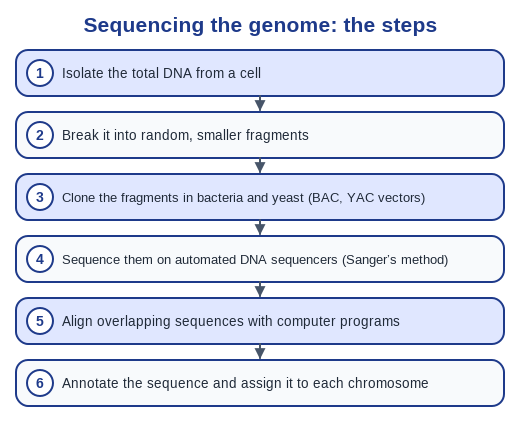
DNA itna lamba hai ki ek piece mein sequence nahi ho sakta, isliye use fragments mein toda gaya aur har fragment ko amplify karne ke liye clone kiya gaya. Hosts bacteria aur yeast the, aur vectors BAC aur YAC. Automated sequencers Frederick Sanger ke method par kaam karte the. Sequences ko computer programs se unke overlapping regions ke aadhar par arrange kiya gaya, annotate kiya gaya, aur har chromosome ko assign kiya gaya. Chromosome 1 un 24 human chromosomes (22 autosomes, X aur Y) mein se aakhiri tha jo poora hua, May 2006 mein.
Genetic aur physical maps restriction endonuclease recognition sites ke polymorphism aur microsatellites naam ke repetitive sequences se banaye gaye.
Human genome ke salient features kya hain?
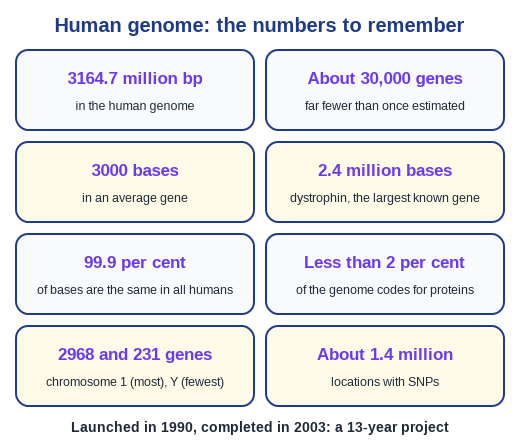
- Discover hue genes mein se 50 per cent se zyada ke functions pata nahi hain.
- Repeated sequences genome ka bahut bada hissa hain. Maana jaata hai ki inka koi direct coding function nahi hai, par ye chromosome structure, dynamics aur evolution ke baare mein batate hain.
- SNPs (single nucleotide polymorphisms, “snips”) wo locations hain jahan single-base differences milte hain. Ye disease-associated sequences dhoondhne aur human history trace karne mein madad karte hain.
DNA fingerprinting kya hai?
Do logon ko compare karne ke liye do poore genomes sequence karna slow aur mehenga hoga. DNA fingerprinting unhe compare karne ka tez tareeka hai. Ye repetitive DNA ko dekhti hai, jisme DNA ka chhota stretch kai baar repeat hota hai.
Density gradient centrifugation mein bulk DNA ek major peak banata hai aur repetitive DNA chhote peaks, jinhe satellite DNA kehte hain. Ye sequences normally proteins ke liye code nahi karte, par inme polymorphism bahut zyada hota hai. Non-coding DNA ke mutations reproduction par turant asar nahi daalte, isliye ye generation dar generation jama hote rehte hain.
DNA fingerprinting kaise ki jaati hai?
Ye technique Alec Jeffreys ne develop ki. Unka probe ek satellite DNA tha jise Variable Number of Tandem Repeats (VNTR) kehte hain; ise Southern blot hybridisation mein use kiya gaya.
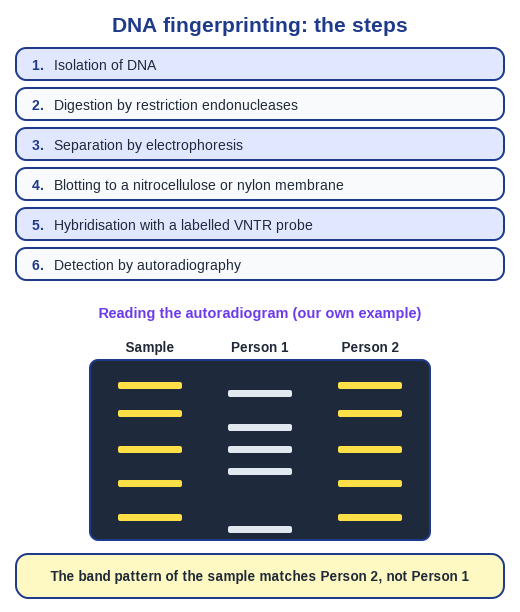
Steps: (1) DNA ka isolation, (2) restriction endonucleases se digestion, (3) electrophoresis se fragments ka separation, (4) nitrocellulose ya nylon membrane par blotting, (5) labelled VNTR probe se hybridisation, (6) autoradiography se detection.
VNTR mein ek chhota DNA sequence tandem mein kai copies mein laga hota hai. Copy number ek individual ke chromosome se chromosome mein alag hota hai, isliye VNTR ka size 0.1 se 20 kb tak hota hai. Hybridisation ke baad autoradiogram mein alag-alag size ke kai bands dikhte hain. Ye pattern ek individual ki pehchaan hai aur har person mein alag hota hai, sirf monozygotic (identical) twins ko chhodkar.
Polymerase chain reaction (PCR, jo Chapter 9 mein hai) ke saath ek single cell ka DNA bhi kaafi hai.
Ye kahan use hoti hai?
- Forensic science: identification tool ki tarah, kyunki ek person ke har tissue se same pattern milta hai.
- Paternity testing: polymorphisms parents se bachchon mein inherit hote hain.
- Population aur genetic diversity ki studies.
Wapas Chapter 5 ke notes par ya aage NCERT solutions par.
Practice karo
-
Human Genome Project kab poora hua?
Jawab dekho
Jawab: (c) 2003
-
Sabse bada known human gene hai:
Jawab dekho
Jawab: (b) dystrophin
-
Alec Jeffreys ne DNA fingerprinting mein kaun sa probe use kiya?
Jawab dekho
Jawab: (c) VNTR
-
Agar 3 × 10⁹ bp ka 99.9 per cent saare humans mein same hai, to do log kitne bases mein alag ho sakte hain?
Jawab dekho
Jawab: 3 × 10⁹ ka 0.1 per cent = 3 × 10⁶, yaani lagbhag 30 lakh (3 million) bases.
-
DNA fingerprinting ke liye kisi bhi tissue ka DNA kyun chal jaata hai?
Jawab dekho
Jawab: Ek person ke har tissue ka DNA, jaise blood, hair follicle, skin, bone, saliva ya sperm, same degree ka polymorphism dikhata hai. Isliye kisi se bhi wahi pattern milta hai.
Students ke sawal
Human Genome Project ko mega project kyun kaha gaya?
Genome mein lagbhag 3 × 10⁹ bp hain. Shuru ke estimate US $ 3 per bp se cost lagbhag 9 billion US dollars aayi. Ek cell ka sequence 1000 pages ki, har page par 1000 letters wali, lagbhag 3300 books bhar dega, isliye high-speed computers chahiye the.
ESTs aur sequence annotation kya hain?
Ye project ke do approaches hain. Expressed Sequence Tags un saare genes ko pehchante hain jo RNA ke roop mein express hote hain. Sequence annotation mein poora genome, coding aur non-coding, sequence kiya jaata hai aur baad mein uske regions ko functions diye jaate hain.
DNA polymorphism kya hai?
Ye genetic level ka variation hai jo mutations se aata hai. Jab koi inheritable mutation population mein high frequency par mile, yaani ek locus par ek se zyada allele 0.01 se zyada frequency par hon, to use DNA polymorphism kehte hain.
Satellite DNA kya hai?
Wo repetitive DNA jo density gradient centrifugation mein bulk genomic DNA se alag chhote peaks banata hai. Base composition, segment ki length aur repeats ki sankhya ke hisaab se ise micro-satellites, mini-satellites wagairah mein baanta jaata hai.
Koi sawal atak gaya?
Photo lo, Lagnever AI step-by-step samjhayega. 7 din ka trial sirf ₹2.
Google Play se app lo Browser mein kholo
Parents ke liye: trial ke baad plan har mahine UPI ya card autopay se renew hota hai. App mein kabhi bhi cancel kar sakte hain.