
What are the Human Genome Project and DNA fingerprinting?
Answer in short
The Human Genome Project, launched in 1990 and completed in 2003, found the sequence of the human genome, which contains 3164.7 million base pairs. DNA fingerprinting, developed by Alec Jeffreys, compares people by the polymorphism in their repetitive DNA, using a VNTR probe. It is used in forensic science and in paternity testing.
Stuck on a question? Take a photo and Lagnever AI explains it step by step. Try it for 7 days for ₹2. Get it on Google Play
Why was the Human Genome Project started?
The genetic make-up of an individual lies in the DNA sequence. If two individuals differ, their DNA sequences must differ at least at some places. This led to the plan of finding the complete DNA sequence of the human genome. Genetic engineering had made it possible to isolate and clone any piece of DNA, and quick methods of sequencing were available. The Human Genome Project (HGP) was launched in 1990.
It was a mega project. With about 3 × 10⁹ bp and an estimated starting cost of US $ 3 per bp, the total came to about 9 billion US dollars. The huge amount of data needed high-speed computers for storage, retrieval and analysis, so HGP grew together with a new area of biology, bioinformatics.
What were the goals of HGP?
- Find all the genes in human DNA, about 20,000–25,000 of them.
- Work out the sequence of its 3 billion chemical base pairs.
- Keep this information in databases.
- Develop better tools to analyse the data.
- Pass the related technologies on to other sectors, such as industry.
- Deal with the ethical, legal and social issues (ELSI) the project may raise.
HGP was a 13-year project coordinated by the U.S. Department of Energy and the National Institute of Health. The Wellcome Trust (U.K.) became a major partner, and Japan, France, Germany, China and others also contributed. It was completed in 2003. Many non-human model organisms were sequenced too: bacteria, yeast, Caenorhabditis elegans (a non-pathogenic nematode), Drosophila, and the plants rice and Arabidopsis.
How was the genome sequenced?
There were two approaches. One identified all the genes expressed as RNA: Expressed Sequence Tags (ESTs). The other sequenced the whole genome, coding and non-coding, and later assigned functions to its regions: sequence annotation.
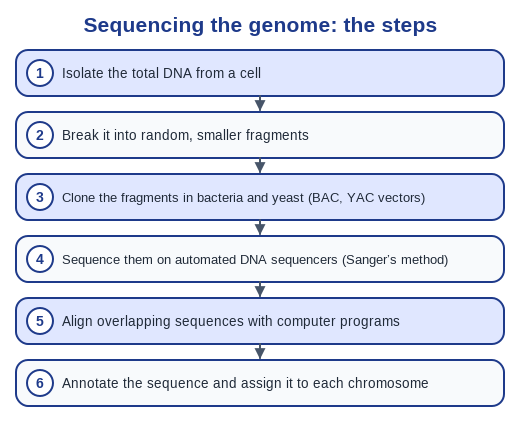
DNA is too long to sequence in one piece, so it was broken into fragments and cloned to amplify each fragment. The hosts were bacteria and yeast, and the vectors were BAC and YAC. Automated sequencers worked on the method of Frederick Sanger. The sequences were arranged by their overlapping regions with computer programs, annotated, and assigned to each chromosome. Chromosome 1 was the last of the 24 human chromosomes (22 autosomes, X and Y) to be completed, in May 2006.
Genetic and physical maps were made using polymorphism of restriction endonuclease recognition sites and repetitive sequences called microsatellites.
What are the salient features of the human genome?
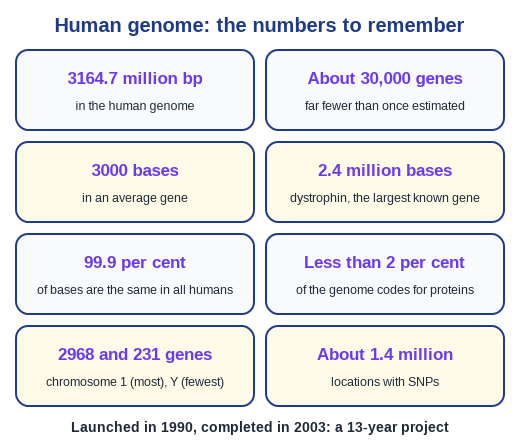
- The functions of over 50 per cent of the discovered genes are unknown.
- Repeated sequences make up a very large part of the genome. They are thought to have no direct coding function, but they tell us about chromosome structure, dynamics and evolution.
- SNPs (single nucleotide polymorphisms, “snips”) are locations where single-base differences occur. They help to find disease-associated sequences and to trace human history.
What is DNA fingerprinting?
Sequencing two whole genomes to compare two people would be slow and costly. DNA fingerprinting is a quick way to compare them. It looks at repetitive DNA, where a small stretch of DNA is repeated many times.
In density gradient centrifugation the bulk DNA forms a major peak and repetitive DNA forms small peaks called satellite DNA. These sequences normally do not code for proteins, but they show a high degree of polymorphism. Mutations in non-coding DNA do not affect reproduction at once, so they keep on accumulating from generation to generation.
How is DNA fingerprinting done?
The technique was developed by Alec Jeffreys. His probe was a satellite DNA called Variable Number of Tandem Repeats (VNTR), used in Southern blot hybridisation.
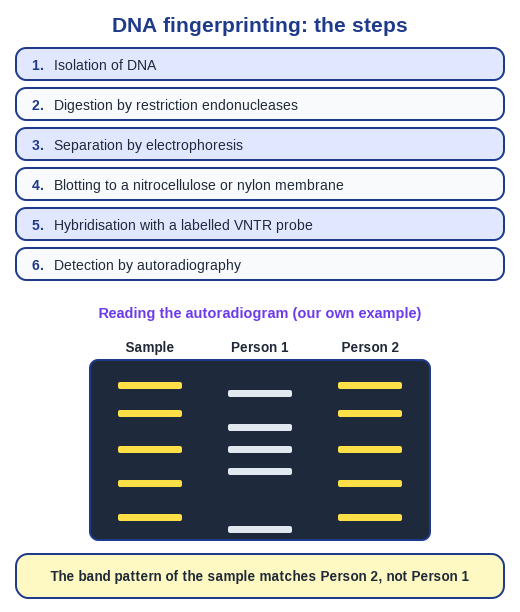
In a VNTR a small DNA sequence is arranged in tandem in many copies. The copy number varies from chromosome to chromosome in an individual, so the size of a VNTR varies from 0.1 to 20 kb. After hybridisation the autoradiogram shows many bands of different sizes. The pattern is characteristic of an individual and differs from person to person, except in monozygotic (identical) twins.
With the polymerase chain reaction (PCR, studied in Chapter 9), DNA from a single cell is enough.
Where is it used?
- Forensic science: as an identification tool, since every tissue of a person gives the same pattern.
- Paternity testing: polymorphisms are inherited from parents by children.
- Population and genetic diversity studies.
Back to the Chapter 5 notes or on to the NCERT solutions.
Practice
-
The Human Genome Project was completed in:
Show answer
Answer: (c) 2003
-
The largest known human gene is:
Show answer
Answer: (b) dystrophin
-
The probe used by Alec Jeffreys in DNA fingerprinting was:
Show answer
Answer: (c) VNTR
-
If 99.9 per cent of 3 × 10⁹ bp is the same in all humans, in how many bases can two people differ?
Show answer
Answer: 0.1 per cent of 3 × 10⁹ = 3 × 10⁶, that is, about 3 million bases.
-
Why is DNA from any tissue suitable for DNA fingerprinting?
Show answer
Answer: DNA from every tissue of a person, such as blood, hair follicle, skin, bone, saliva or sperm, shows the same degree of polymorphism. So any of them gives the same pattern.
Questions students ask
Why was the Human Genome Project called a mega project?
The genome has about 3 × 10⁹ bp. At the first estimate of US $ 3 per bp the cost came to about 9 billion US dollars. The sequence of one cell would fill about 3300 books of 1000 pages with 1000 letters each, so high-speed computers were needed.
What are ESTs and sequence annotation?
They are the two approaches of the project. Expressed Sequence Tags identify all the genes that are expressed as RNA. Sequence annotation means sequencing the whole genome, coding and non-coding, and later assigning functions to its regions.
What is DNA polymorphism?
It is variation at the genetic level, arising from mutations. An inheritable mutation seen in a population at high frequency, with more than one allele at a locus at a frequency greater than 0.01, is a DNA polymorphism.
What is satellite DNA?
Repetitive DNA that separates from the bulk genomic DNA as small peaks in density gradient centrifugation. By base composition, length of segment and number of repeats it is classed as micro-satellites, mini-satellites and so on.
Stuck on a question?
Take a photo and Lagnever AI explains it step by step. Try it for 7 days for ₹2.
Get it on Google Play Open in browser
For parents: after the trial, the plan renews monthly by UPI or card autopay. You can cancel anytime in the app.