
What are transcription and translation?
Answer in short
Transcription copies one strand of a DNA segment into RNA, using DNA-dependent RNA polymerase and the rule of complementarity. Translation is the polymerisation of amino acids into a polypeptide on the ribosome. The sequence of triplet codons in mRNA, read by the anticodons of tRNA, decides the order of the amino acids.
Stuck on a question? Take a photo and Lagnever AI explains it step by step. Try it for 7 days for ₹2. Get it on Google Play
What is a transcription unit?
Transcription copies genetic information from one strand of DNA into RNA. Only a segment of DNA is copied, and only one of its strands. A transcription unit has three regions: a promoter, the structural gene and a terminator.
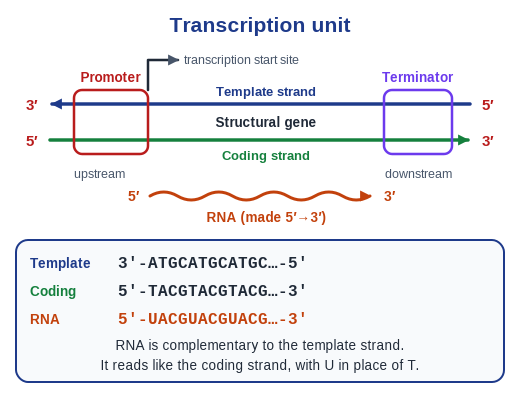
DNA-dependent RNA polymerase polymerises only 5′→3′. So the strand with polarity 3′→5′ is the template strand. The other strand, 5′→3′, has the same sequence as the RNA (with thymine in place of uracil) and is called the coding strand, although it codes for nothing.
All positions are described on the coding strand. The promoter lies towards its 5′-end (upstream) and gives RNA polymerase its binding site. The terminator lies towards its 3′-end (downstream) and usually marks the end of transcription.
A cistron is a segment of DNA coding for a polypeptide. Structural genes are mostly monocistronic in eukaryotes and polycistronic in bacteria. Eukaryotic genes are split: exons appear in mature RNA, and introns interrupt them.
How does transcription take place in bacteria?
Bacteria have three major RNAs: mRNA provides the template, tRNA brings amino acids and reads the code, and rRNAs play a structural and catalytic role. A single DNA-dependent RNA polymerase makes all of them.
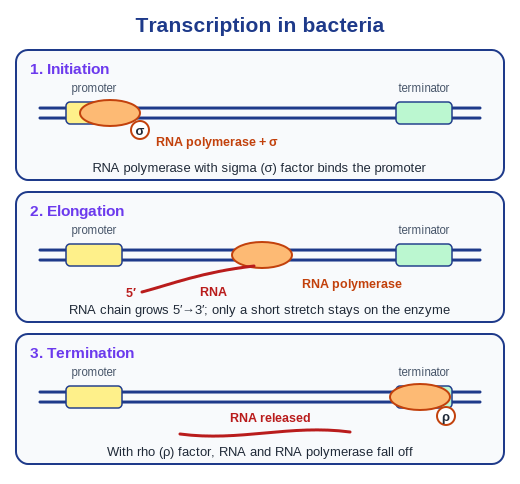
- Initiation: RNA polymerase binds the promoter. It associates for a short time with the initiation factor (σ).
- Elongation: using nucleoside triphosphates as substrate, it polymerises RNA by the rule of complementarity and helps to open the helix. Only a short stretch of RNA stays bound to the enzyme.
- Termination: at the terminator, with the termination factor (ρ), the new RNA and the polymerase fall off.
Because bacterial mRNA needs no processing and there is no separate nucleus, transcription and translation can be coupled.
What is different in eukaryotes?
- There are at least three RNA polymerases in the nucleus. RNA polymerase I transcribes rRNAs (28S, 18S and 5.8S). RNA polymerase II transcribes the precursor of mRNA, heterogeneous nuclear RNA (hnRNA). RNA polymerase III transcribes tRNA, 5S rRNA and snRNAs.
- The primary transcript has both exons and introns and is non-functional. It is processed.
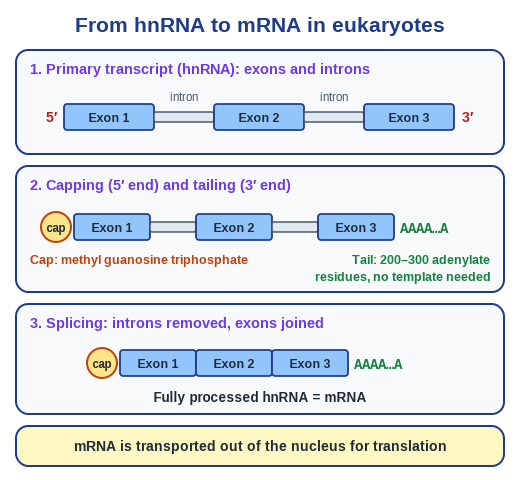
- Splicing: introns are removed and exons are joined in a defined order.
- Capping: an unusual nucleotide, methyl guanosine triphosphate, is added to the 5′-end.
- Tailing: 200–300 adenylate residues are added at the 3′-end, without a template.
The fully processed hnRNA is mRNA, which leaves the nucleus for translation.
What are the features of the genetic code?
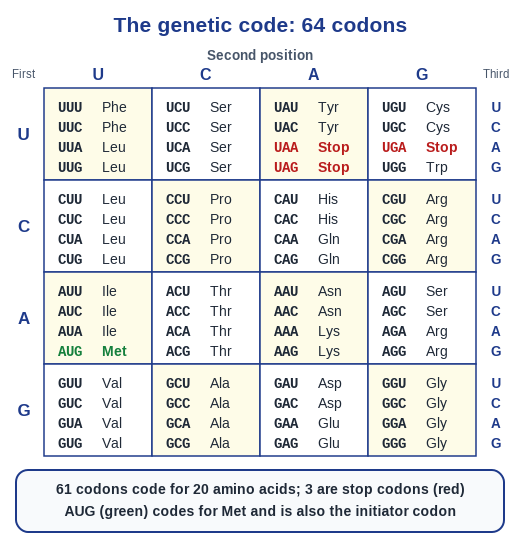
- The codon is a triplet. 61 codons code for amino acids; 3 do not and act as stop codons.
- The code is degenerate: some amino acids have more than one codon.
- Codons are read one after another, with no punctuation.
- The code is nearly universal: UUU codes for phenylalanine from bacteria to humans. Some exceptions occur in mitochondrial codons and in some protozoans.
- AUG codes for methionine and is also the initiator codon.
- UAA, UAG and UGA are the stop (terminator) codons.
How does tRNA read the code?
Francis Crick postulated an adapter that reads the code and also binds the amino acid. That adapter is tRNA, earlier called sRNA (soluble RNA).
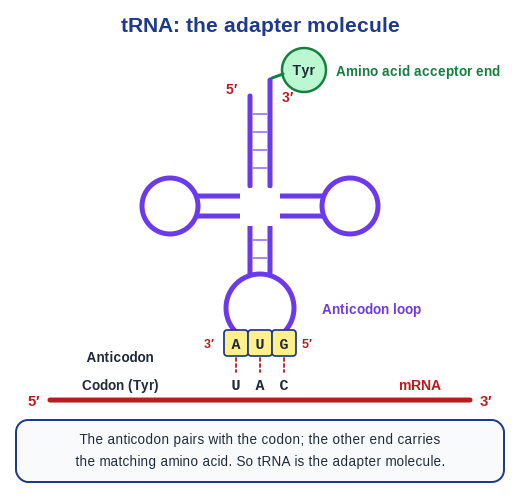
A tRNA has an anticodon loop, with bases complementary to the codon, and an amino acid acceptor end. Each amino acid has its specific tRNAs. There is a special initiator tRNA, and there are no tRNAs for stop codons. The secondary structure looks like a clover leaf; the actual molecule is compact and looks like an inverted L.
How is a polypeptide made?
Translation joins amino acids by peptide bonds. First, amino acids are activated with ATP and linked to their tRNA. This is charging, or aminoacylation, of tRNA.
The ribosome has structural RNAs and about 80 different proteins. When inactive it exists as a large and a small subunit. The large subunit has two sites where charged tRNAs sit close enough for a peptide bond to form. The ribosome is also the catalyst: in bacteria the 23S rRNA acts as the enzyme, a ribozyme.
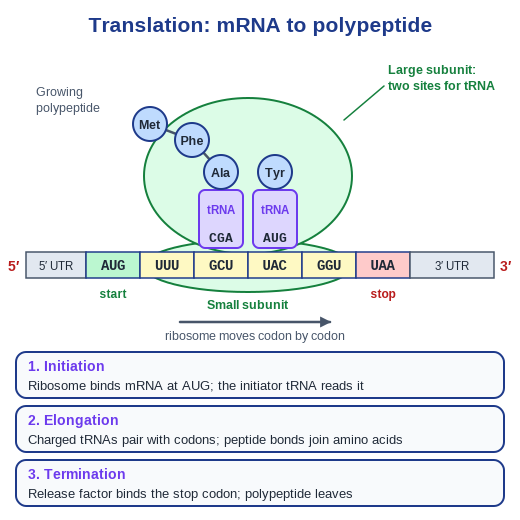
- Initiation: the small subunit meets the mRNA, and the ribosome binds at the start codon (AUG), which only the initiator tRNA recognises.
- Elongation: charged tRNAs bind one after another to the right codons by base pairing with their anticodons. The ribosome moves from codon to codon and amino acids are added one by one.
- Termination: a release factor binds the stop codon. Translation ends and the complete polypeptide is released.
The codons in the picture are our own example; their amino acids are read from the codon table.
Back to the Chapter 5 notes, or on to Human Genome Project and DNA fingerprinting and the NCERT solutions.
Practice
-
If the coding strand is 5′-TACG-3′, the RNA transcribed is:
Show answer
Answer: (a) 5′-UACG-3′
-
In eukaryotes, the precursor of mRNA (hnRNA) is transcribed by:
Show answer
Answer: (b) RNA polymerase II
-
How many codons code for amino acids?
Show answer
Answer: (b) 61
-
Why is the genetic code called degenerate?
Show answer
Answer: Because some amino acids are coded by more than one codon. For example, UUU and UUC both code for phenylalanine.
-
What are UTRs?
Show answer
Answer: Untranslated regions: sequences of mRNA that are not translated. They lie at the 5′-end, before the start codon, and at the 3′-end, after the stop codon, and are needed for efficient translation.
Questions students ask
Why is only one strand of DNA transcribed?
If both strands were copied, one DNA segment would give two different RNAs and so two different proteins. The two RNAs would also be complementary and would form double-stranded RNA, which could not be translated.
What is the difference between an exon and an intron?
Exons are the coding or expressed sequences that appear in mature, processed RNA. Introns are intervening sequences that interrupt the exons and do not appear in mature RNA; splicing removes them.
Why can transcription and translation be coupled in bacteria?
Bacterial mRNA needs no processing, and both processes take place in the same compartment because there is no separate nucleus. Translation can begin well before the mRNA is fully transcribed.
Why is tRNA called an adapter molecule?
On one side its anticodon reads the codon on mRNA; on the other side its acceptor end binds a specific amino acid. It links the code to the amino acid.
Stuck on a question?
Take a photo and Lagnever AI explains it step by step. Try it for 7 days for ₹2.
Get it on Google Play Open in browser
For parents: after the trial, the plan renews monthly by UPI or card autopay. You can cancel anytime in the app.