
Class 12 Biology Chapter 5: Molecular Basis of Inheritance Notes
This chapter in five lines
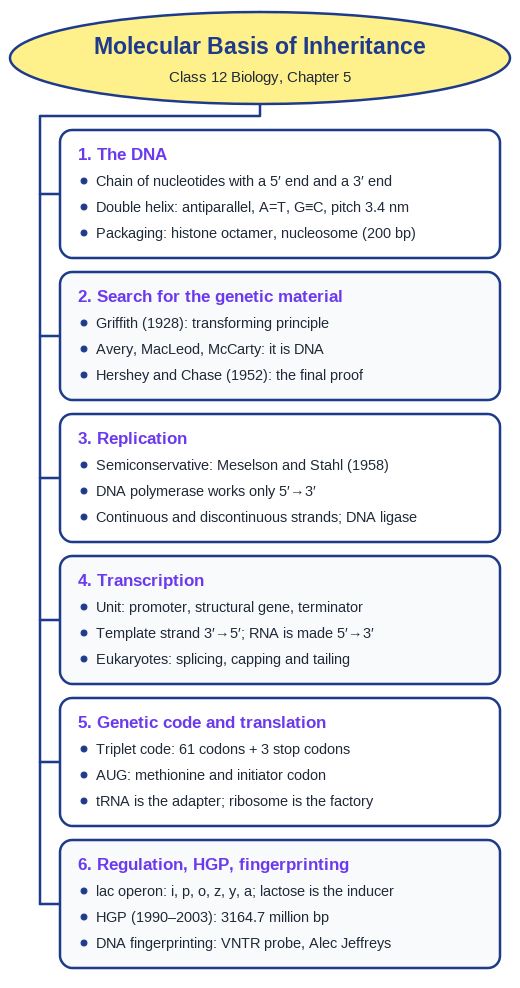
DNA is the genetic material of most organisms. It is a double helix of two antiparallel polynucleotide chains held by A–T and G–C base pairs. DNA replicates semiconservatively, is transcribed into RNA, and mRNA is translated into protein using a triplet genetic code. The chapter also covers the lac operon, the Human Genome Project and DNA fingerprinting.
What is this chapter about?
Chapter 4 showed how characters are inherited. This chapter asks what Mendel’s “factors” are made of. Over about a hundred years, biologists found that the genetic material of most organisms is DNA (deoxyribonucleic acid). RNA (ribonucleic acid) is the genetic material of some viruses, but mostly it works as a messenger. It also acts as an adapter, as a structural molecule and sometimes as a catalyst.
The chapter follows the path of genetic information: the structure of DNA, how DNA is copied (replication), how RNA is made from DNA (transcription), how the genetic code is read, and how proteins are made (translation). It ends with the regulation of genes, the Human Genome Project and DNA fingerprinting.
This is a long chapter. Three topic pages go deeper: DNA replication, transcription and translation and Human Genome Project and DNA fingerprinting.
What is DNA made of?
DNA is a long polymer of deoxyribonucleotides. Its length is given as the number of nucleotides, or of nucleotide pairs called base pairs (bp), and is characteristic of an organism.
| Organism | Length of DNA |
|---|---|
| Bacteriophage φ×174 | 5386 nucleotides |
| Bacteriophage lambda | 48502 bp |
| Escherichia coli | 4.6 × 10⁶ bp |
| Human (haploid content) | 3.3 × 10⁹ bp |
A nucleotide has three parts: a nitrogenous base, a pentose sugar (ribose in RNA, deoxyribose in DNA) and a phosphate group.
- Purines: adenine (A) and guanine (G).
- Pyrimidines: cytosine (C), thymine (T) and uracil (U). Cytosine is common to DNA and RNA. Thymine is found in DNA; uracil takes its place in RNA.
A base joined to the 1′ carbon of the sugar by an N-glycosidic linkage is a nucleoside (adenosine, guanosine, cytidine, uridine, or their deoxy forms). A phosphate joined to the 5′ carbon of a nucleoside by a phosphoester linkage makes a nucleotide. Two nucleotides are joined by a 3′–5′ phosphodiester linkage, and many of them make a polynucleotide chain.
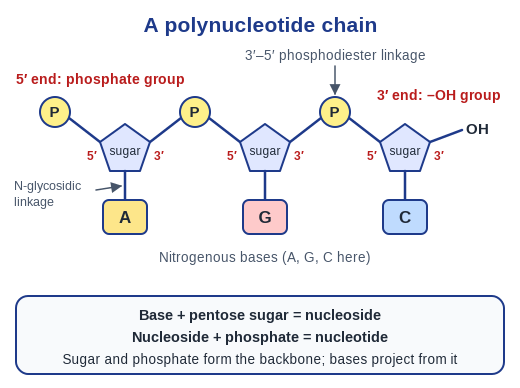
One end of the chain carries a phosphate on the 5′ carbon of the sugar: the 5′-end. The other end carries an –OH group on the 3′ carbon: the 3′-end. Sugar and phosphate form the backbone, and the bases project from it. RNA has an extra –OH group at the 2′ position of every ribose, and uracil in place of thymine (thymine is 5-methyl uracil).
What is the double helix model?
Friedrich Meischer first identified DNA in 1869 as an acidic substance in the nucleus and named it “nuclein”. In 1953 James Watson and Francis Crick, using the X-ray diffraction data of Maurice Wilkins and Rosalind Franklin, proposed the double helix model. It also rested on Erwin Chargaff’s observation that in double-stranded DNA the ratios of adenine to thymine and of guanine to cytosine are constant and equal one.
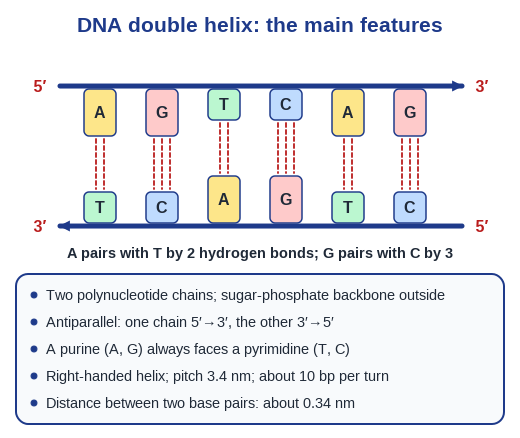
The main features:
- Two polynucleotide chains; the sugar-phosphate backbone is outside and the bases project inside.
- The chains are antiparallel: one runs 5′→3′, the other 3′→5′.
- Bases pair by hydrogen bonds: A with T (two bonds), G with C (three bonds). A purine always faces a pyrimidine, so the two strands stay at a nearly uniform distance.
- The helix is right-handed. Its pitch is 3.4 nm, with roughly 10 bp per turn, so the distance between two base pairs is about 0.34 nm.
- The plane of one base pair stacks over the next. This stacking, with the hydrogen bonds, makes the helix stable.
Because of base pairing the two strands are complementary: if the sequence of one is known, the other can be predicted.
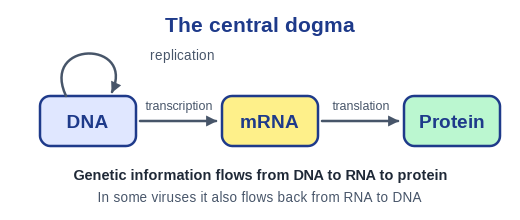
Soon afterwards Crick proposed the central dogma: genetic information flows from DNA to RNA to protein.
How is such a long molecule packed in a cell?
A typical mammalian cell has 6.6 × 10⁹ bp of DNA. At 0.34 nm per base pair its length is 6.6 × 10⁹ × 0.34 × 10⁻⁹ m, which is about 2.2 metres. The nucleus is only about 10⁻⁶ m across.
In prokaryotes such as E. coli there is no defined nucleus. The negatively charged DNA is held by some positively charged proteins in a region called the nucleoid, organised in large loops.
In eukaryotes the DNA is wrapped around histones, basic proteins rich in the amino acids lysine and arginine, whose side chains are positively charged. Eight histone molecules form a histone octamer. DNA wrapped around an octamer is a nucleosome; a typical nucleosome contains 200 bp of DNA helix.
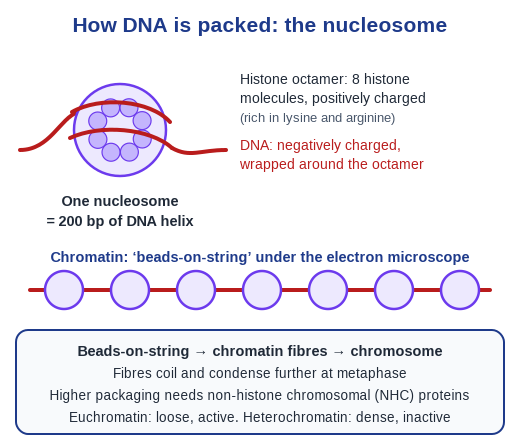
Nucleosomes are the repeating units of chromatin. Under the electron microscope they look like beads on a string. This structure is packed into chromatin fibres, which coil and condense further into chromosomes at metaphase. The higher levels of packing need non-histone chromosomal (NHC) proteins.
| Euchromatin | Heterochromatin | |
|---|---|---|
| Packing | Loose | Dense |
| Staining | Light | Dark |
| Transcription | Active | Inactive |
How was DNA shown to be the genetic material?
Griffith’s transforming principle (1928). Frederick Griffith worked with Streptococcus pneumoniae. The S strain forms smooth, shiny colonies because it has a mucous (polysaccharide) coat, and it is virulent. The R strain forms rough colonies and does not cause pneumonia.
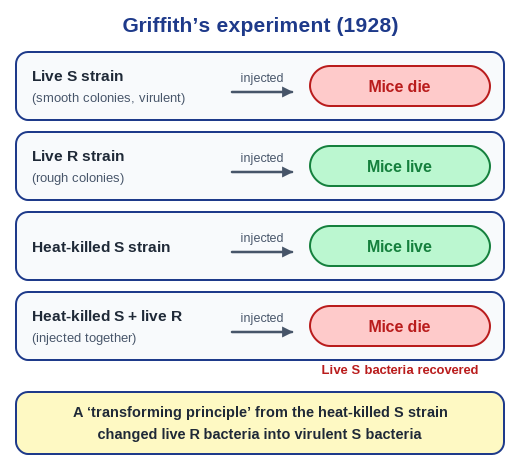
Heat-killed S bacteria alone did not harm the mice. But heat-killed S mixed with live R killed them, and live S bacteria were recovered. Griffith concluded that some transforming principle had passed from the dead S cells to the R cells. He could not say what it was made of.
Avery, MacLeod and McCarty (1933–44). Until their work, the genetic material was thought to be a protein. They purified proteins, DNA and RNA from heat-killed S cells. Only DNA transformed R cells. Proteases and RNases did not stop the transformation; DNase did. They concluded that DNA is the hereditary material, but not all biologists were convinced.
Hershey and Chase (1952). The clear proof came from bacteriophages, viruses that infect bacteria.
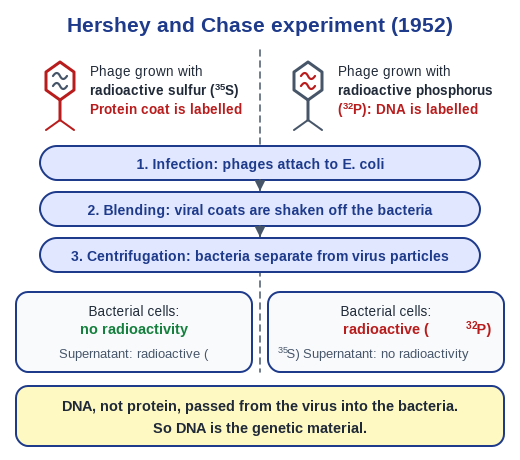
Phages grown with radioactive phosphorus had radioactive DNA, because DNA contains phosphorus and protein does not. Phages grown with radioactive sulfur had radioactive protein, because protein contains sulfur and DNA does not. Only the bacteria infected by phages with radioactive DNA became radioactive. So DNA, not protein, enters the bacterium and is the genetic material.
Why DNA and not RNA?
In some viruses, such as Tobacco Mosaic viruses and the QB bacteriophage, RNA is the genetic material. A genetic material must:
- be able to make its own replica (replication);
- be stable, chemically and structurally;
- allow slow changes (mutation) that evolution needs;
- be able to express itself as “Mendelian characters”.
| Property | DNA | RNA |
|---|---|---|
| Replication | Possible, by base pairing | Possible, by base pairing |
| Stability | More stable; has thymine | The 2′-OH group makes it reactive and easily degraded; it can also be catalytic |
| Mutation | Mutates slowly | Mutates faster, so RNA viruses evolve faster |
| Expression | Depends on RNA to make proteins | Can directly code for proteins |
So DNA, being more stable, is preferred for storing genetic information, while RNA is better for transmitting it.
RNA world. RNA was the first genetic material. Essential life processes such as metabolism, translation and splicing evolved around RNA, which acted both as genetic material and as a catalyst. Because a catalyst is reactive and so unstable, DNA evolved from RNA with chemical changes that made it more stable. Being double-stranded, DNA can also be repaired.
How does DNA replicate?
Watson and Crick suggested that the two strands separate and each acts as a template for a new complementary strand. Each daughter DNA then has one parental and one new strand. This is semiconservative replication, proved by Meselson and Stahl in 1958.
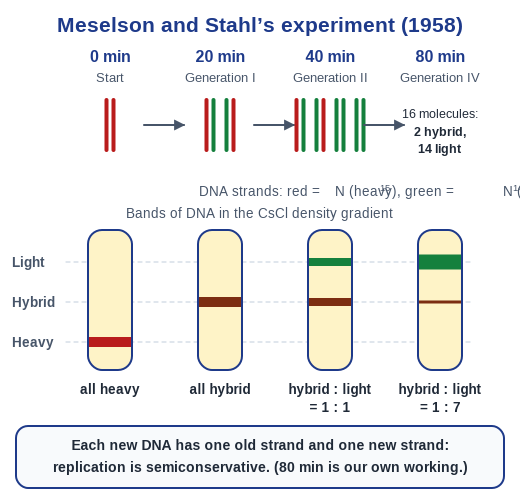
The main enzyme is DNA-dependent DNA polymerase, which adds nucleotides only in the 5′→3′ direction. So at the replication fork one strand is made continuously and the other in fragments, which DNA ligase joins.
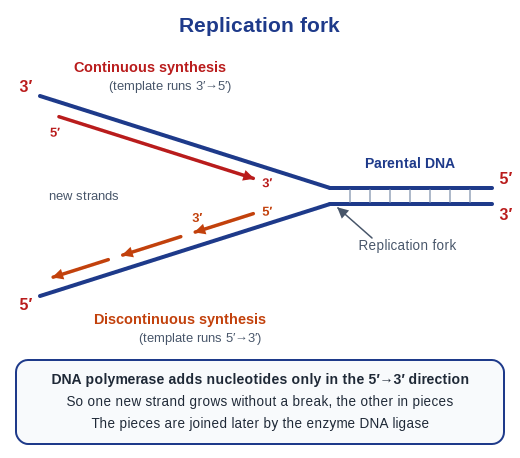
The experiment and the enzymes are explained step by step in DNA replication.
How is RNA made from DNA?
Transcription copies the information of one strand of a DNA segment into RNA. Adenine now pairs with uracil instead of thymine. A transcription unit has a promoter, a structural gene and a terminator.
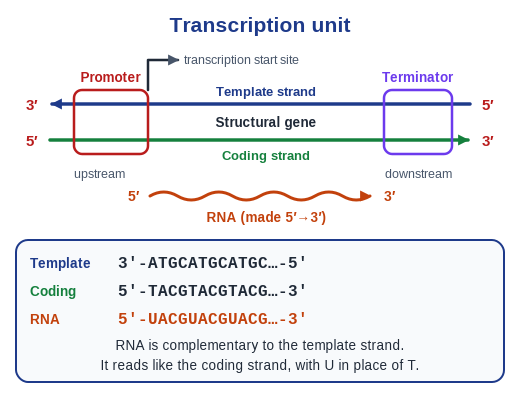
In bacteria a single DNA-dependent RNA polymerase makes mRNA, tRNA and rRNA. In eukaryotes there are at least three RNA polymerases in the nucleus, and the primary transcript (hnRNA) must be spliced, capped and tailed to become mRNA.
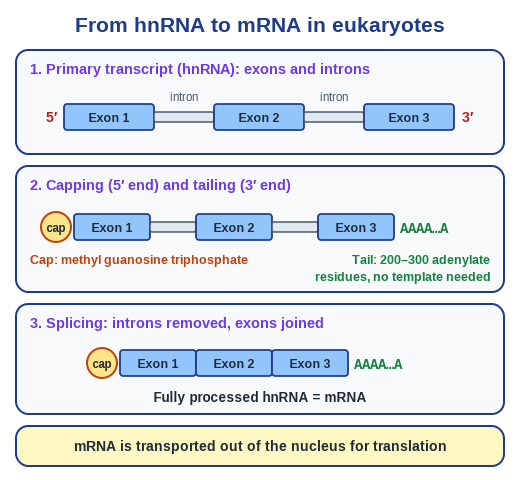
What is the genetic code, and how is it translated?
Four bases must code for 20 amino acids. The physicist George Gamow argued that the code must be a combination of three bases: 4 × 4 × 4 gives 64 codons, more than enough. Har Gobind Khorana made RNA molecules with defined combinations of bases, Marshall Nirenberg’s cell-free system for protein synthesis helped to decipher the code, and Severo Ochoa’s enzyme (polynucleotide phosphorylase) helped to polymerise RNA of defined sequences without a template.
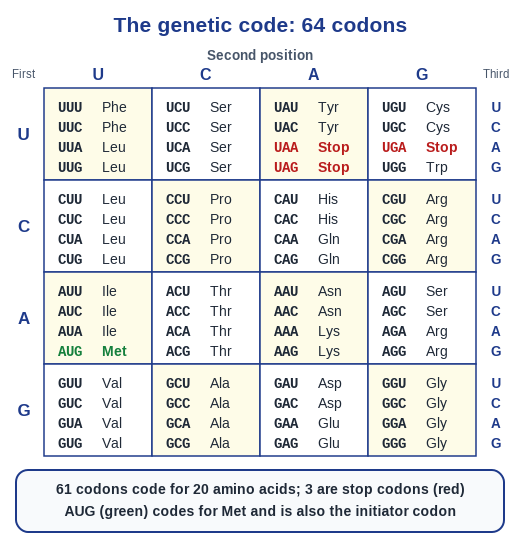
tRNA is the adapter that reads the code and carries the amino acid. Ribosomes join the amino acids into a polypeptide. The whole process is on the page transcription and translation.
Mutations and the code. A change of a single base pair is a point mutation; the classical example is the change in the gene for the beta globin chain that replaces glutamate by valine and causes sickle-cell anaemia. Inserting or deleting one or two bases changes the reading frame from that point onwards: a frameshift mutation. Inserting or deleting three bases (or a multiple of three) adds or removes whole codons, and the frame after that point stays the same.
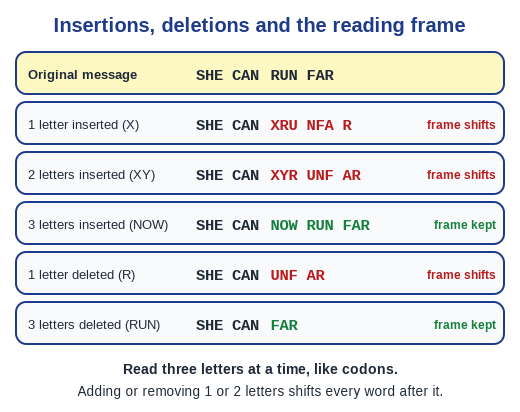
The sentence in the picture is our own; the book uses a similar sentence of three-letter words.
How is gene expression regulated?
In eukaryotes, regulation can act at four levels: (i) transcription (formation of the primary transcript), (ii) processing (splicing), (iii) transport of mRNA from the nucleus to the cytoplasm, and (iv) translation.
In prokaryotes, the main control is on the rate at which transcription starts. Regulatory proteins act positively (activators) or negatively (repressors). In many cases a repressor binds a sequence next to the promoter called the operator. Each operon has its own operator and its own repressor.
The lac operon was worked out by the geneticist Francois Jacob and the biochemist Jacque Monod. An operon is a polycistronic structural gene regulated by a common promoter and regulatory genes. Other examples are the trp, ara, his and val operons.
| Gene | Product | Function |
|---|---|---|
| i (regulatory; the i stands for inhibitor) | Repressor | Binds the operator |
| z | β-galactosidase | Hydrolyses lactose into galactose and glucose |
| y | Permease | Increases the permeability of the cell to β-galactosides |
| a | Transacetylase | Third product needed for lactose metabolism |
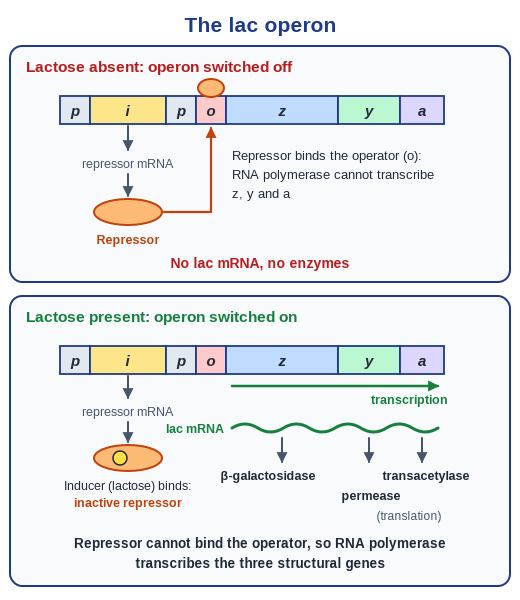
- The repressor is made all the time (constitutively) from the i gene. It binds the operator and prevents RNA polymerase from transcribing the operon.
- Lactose is the substrate of β-galactosidase and also the inducer. When a preferred carbon source such as glucose is absent and lactose is supplied, permease carries lactose into the cell. (A very low level of expression is always present, otherwise lactose could not enter.)
- The inducer (lactose or allolactose) inactivates the repressor. RNA polymerase gets access to the promoter and transcription proceeds.
- Glucose or galactose cannot act as inducers.
Control by the repressor is negative regulation. In effect, the synthesis of an enzyme is regulated by its own substrate. The lac operon is under positive regulation as well, but that is beyond this level.
What are the Human Genome Project and DNA fingerprinting?
The Human Genome Project (HGP) was launched in 1990 to find the complete DNA sequence of the human genome, and was completed in 2003. It was called a mega project, and it grew together with a new field, bioinformatics.
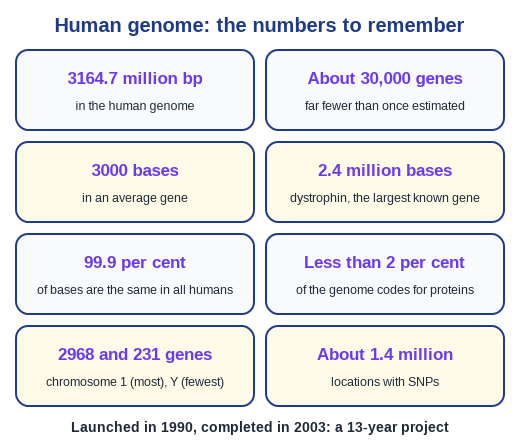
Of the base sequence, 99.9 per cent is the same in all humans. DNA fingerprinting is a quick way to compare the remaining differences. It looks at repetitive DNA (satellite DNA), which shows a high degree of polymorphism. The technique was developed by Alec Jeffreys, who used a satellite DNA called VNTR as a probe.
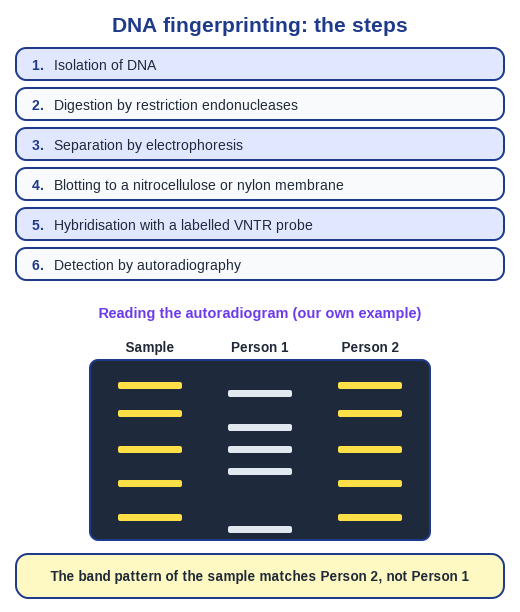
Both are explained in Human Genome Project and DNA fingerprinting.
Before we move on
Learn the scientists with their years and experiments, the numbers of the double helix and of the human genome, and the direction 5′→3′ for every polymerase. Practise writing complementary strands and reading the codon table. All 14 exercises are worked out in the NCERT solutions for Chapter 5.
Key terms
| Term | Meaning |
|---|---|
| Nucleotide | The unit of a nucleic acid: a nitrogenous base, a pentose sugar (deoxyribose in DNA, ribose in RNA) and a phosphate group. |
| Base pair (bp) | Two bases on opposite strands joined by hydrogen bonds: adenine with thymine (2 bonds) and guanine with cytosine (3 bonds). |
| Nucleosome | Negatively charged DNA wrapped around a positively charged histone octamer. A typical nucleosome holds 200 bp of DNA helix. |
| Transforming principle | Griffith's name for the substance from heat-killed S bacteria that changed live R bacteria into virulent S bacteria. It was later shown to be DNA. |
| Semiconservative replication | Each daughter DNA molecule has one parental strand and one newly made strand. |
| Replication fork | The small opening of the DNA helix inside which replication takes place. |
| Transcription | Copying the genetic information from one strand of DNA into RNA. |
| Template strand and coding strand | The 3′→5′ strand that is copied into RNA is the template strand. The other, 5′→3′ strand has the same sequence as the RNA (with T in place of U) and is the coding strand. |
| Exons and introns | Exons are the coding sequences that appear in mature RNA. Introns are intervening sequences that are removed by splicing. |
| Codon | A set of three bases on mRNA that codes for one amino acid. There are 64 codons: 61 code for amino acids and 3 are stop codons. |
| Anticodon | The three bases on a tRNA that are complementary to a codon on mRNA. |
| Translation | The polymerisation of amino acids into a polypeptide on the ribosome, in the order set by the bases of mRNA. |
| Operon | In bacteria, a polycistronic structural gene regulated by a common promoter and regulatory genes, such as the lac operon. |
| Inducer | A substance that switches an operon on. Lactose (or allolactose) is the inducer of the lac operon. |
| DNA polymorphism | An inheritable variation in DNA sequence found in a population at a frequency greater than 0.01. It is the basis of DNA fingerprinting. |
| VNTR | Variable Number of Tandem Repeats: a mini-satellite DNA in which a short sequence is repeated in tandem; the number of repeats varies from person to person. |
Topics in this chapter
Practice
-
The distance between two consecutive base pairs in the DNA double helix is about:
Show answer
Answer: (a) 0.34 nm
-
A typical nucleosome contains how much DNA helix?
Show answer
Answer: (c) 200 bp
-
Who gave the unequivocal proof that DNA is the genetic material?
Show answer
Answer: (c) Hershey and Chase
-
Which enzyme joins the discontinuously synthesised DNA fragments?
Show answer
Answer: (c) DNA ligase
-
Which of these is NOT a stop codon?
Show answer
Answer: (d) AUG
-
In the lac operon, the i gene codes for the:
Show answer
Answer: (b) repressor
Questions students ask
What are the main topics of Class 12 Biology Chapter 5?
The structure and packaging of DNA, the search for the genetic material, the RNA world, replication, transcription, the genetic code, translation, regulation of gene expression (the lac operon), the Human Genome Project and DNA fingerprinting.
Is Molecular Basis of Inheritance in the 2026-27 NCERT Class 12 Biology book?
Yes. It is Chapter 5, in Unit VII, Genetics and Evolution, of the Class 12 Biology textbook marked Reprint 2026-27, on pages 79 to 109. It has 14 end-of-chapter exercises.
What is the central dogma?
It is Francis Crick's statement that genetic information flows from DNA to RNA to protein. In some viruses the flow is also from RNA to DNA.
Which numbers should I remember from this chapter?
Pitch 3.4 nm, 10 bp per turn, 0.34 nm per base pair, 200 bp per nucleosome, 64 codons (61 + 3 stop), E. coli 4.6 × 10⁶ bp, human haploid DNA 3.3 × 10⁹ bp, and the human genome features such as 3164.7 million bp.
Stuck on a question?
Take a photo and Lagnever AI explains it step by step. Try it for 7 days for ₹2.
Get it on Google Play Open in browser
For parents: after the trial, the plan renews monthly by UPI or card autopay. You can cancel anytime in the app.