
How does DNA replicate?
Answer in short
DNA replicates semiconservatively: the two strands separate, each acts as a template, and every daughter molecule gets one parental and one new strand. Meselson and Stahl proved this in 1958. DNA-dependent DNA polymerase adds nucleotides only in the 5′→3′ direction, so one strand is made continuously and the other in fragments joined by DNA ligase.
Stuck on a question? Take a photo and Lagnever AI explains it step by step. Try it for 7 days for ₹2. Get it on Google Play
Why does the double helix suggest a way of copying?
The two strands of DNA are antiparallel and complementary: A pairs with T, and G pairs with C. If the sequence of one strand is known, the other can be worked out.
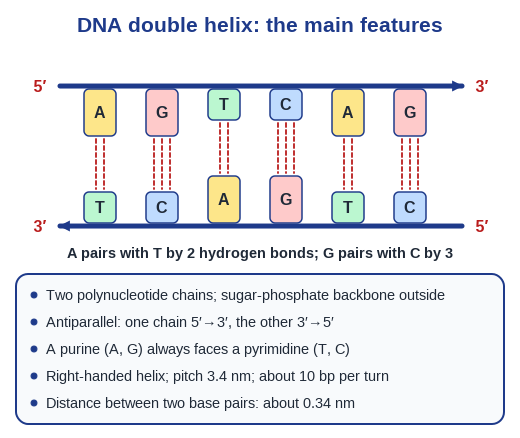
Watson and Crick saw at once that this pairing suggests a copying mechanism. In their scheme the two strands separate, and each acts as a template for a new complementary strand. When replication is complete, each DNA molecule has one parental strand and one newly synthesised strand. This is semiconservative DNA replication.
How did Meselson and Stahl prove it?
Matthew Meselson and Franklin Stahl did this experiment in 1958 on Escherichia coli.
- They grew E. coli for many generations in a medium with ¹⁵NH₄Cl as the only source of nitrogen. ¹⁵N is the heavy isotope of nitrogen, so the DNA became “heavy”. Heavy DNA can be told apart from normal DNA by centrifugation in a caesium chloride (CsCl) density gradient. ¹⁵N is not radioactive; it differs from ¹⁴N only in density.
- They moved the cells to a medium with normal ¹⁴NH₄Cl and took samples at definite intervals as the cells multiplied. E. coli divides in 20 minutes.
- They extracted the DNA and measured its density on CsCl gradients.
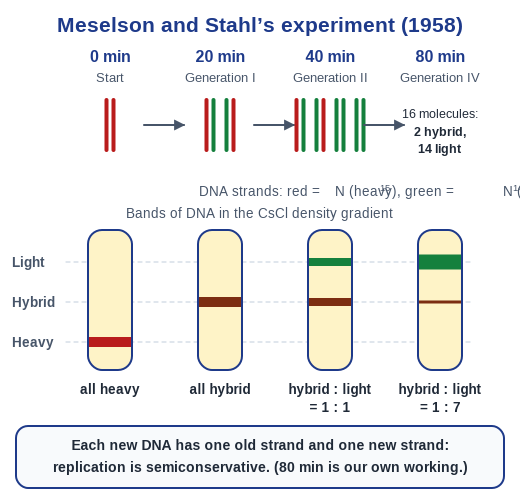
| Time in ¹⁴N medium | Generation | DNA found |
|---|---|---|
| 0 minutes | Start | All heavy (¹⁵N¹⁵N) |
| 20 minutes | I | All hybrid (¹⁵N¹⁴N), of intermediate density |
| 40 minutes | II | Hybrid and light (¹⁴N¹⁴N) in equal amounts |
Hybrid DNA after one generation means that every molecule had one old heavy strand and one new light strand. That is exactly what the semiconservative scheme predicts.
Worked out further (our own working, by the same rule): every generation doubles the number of molecules, but only the two original heavy strands remain, so there are always two hybrid molecules. After 80 minutes (four generations) there are 16 molecules for each starting molecule: 2 hybrid and 14 light. That is 12.5 per cent hybrid and 87.5 per cent light, a ratio of 1 : 7.
Taylor and colleagues did similar experiments in 1958 on Vicia faba (faba beans) with radioactive thymidine. They showed that the DNA in chromosomes also replicates semiconservatively.
Which enzymes are needed?
The main enzyme is DNA-dependent DNA polymerase. It uses a DNA template to catalyse the polymerisation of deoxynucleotides.
- It is fast. E. coli has 4.6 × 10⁶ bp and completes replication within 18 minutes. The book gives the average rate of polymerisation as approximately 2000 bp per second.
- It is accurate. Any mistake during replication would result in a mutation.
- It needs energy. Deoxyribonucleoside triphosphates are both the substrates and the source of energy. Their two terminal phosphates are high-energy phosphates, as in ATP.
Many other enzymes are also required to complete replication with high accuracy.
What happens at the replication fork?
The two strands of a long DNA molecule cannot be separated along their whole length, because that would need very high energy. Replication occurs inside a small opening of the helix, the replication fork.
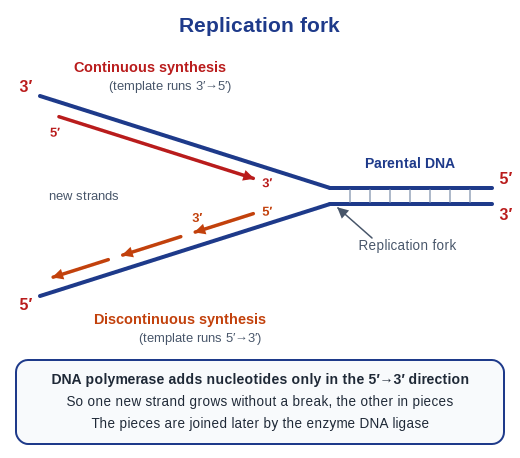
DNA polymerase works only in one direction, 5′→3′. The two template strands are antiparallel, so the two new strands cannot be made in the same way.
| Template strand | New strand | Synthesis |
|---|---|---|
| Polarity 3′→5′ | Grows without a break | Continuous |
| Polarity 5′→3′ | Made as separate fragments | Discontinuous |
The discontinuously synthesised fragments are later joined by the enzyme DNA ligase.
Where does replication begin?
DNA polymerases cannot start replication on their own, and replication does not start at any random place. There is a definite region in E. coli DNA where it begins: the origin of replication. This is why a piece of DNA that has to be propagated in recombinant DNA procedures needs a vector. The vector provides the origin of replication.
In eukaryotes, DNA replicates in the S phase of the cell cycle. Replication and cell division must be highly coordinated. If the cell fails to divide after its DNA has replicated, the result is polyploidy, a chromosomal anomaly.
Back to the Chapter 5 notes, or on to transcription and translation and the NCERT solutions.
Practice
-
In Meselson and Stahl's experiment, the DNA extracted after one generation in the ¹⁴N medium was:
Show answer
Answer: (b) all hybrid
-
DNA-dependent DNA polymerase catalyses polymerisation in the direction:
Show answer
Answer: (b) 5′→3′ only
-
In eukaryotes, DNA replicates in which phase of the cell cycle?
Show answer
Answer: (b) S phase
-
Why is replication discontinuous on one strand?
Show answer
Answer: The two template strands are antiparallel, but DNA polymerase adds nucleotides only in the 5′→3′ direction. On the template with polarity 3′→5′ the new strand can grow without a break. On the template with polarity 5′→3′ it has to be made in short fragments, which DNA ligase joins later.
-
What two jobs do deoxyribonucleoside triphosphates do in replication?
Show answer
Answer: They are the substrates that are joined into the new strand, and they supply the energy for polymerisation: their two terminal phosphates are high-energy phosphates, as in ATP.
Questions students ask
What does semiconservative replication mean?
After replication each DNA molecule has one parental (old) strand and one newly synthesised strand. Half of the parent molecule is conserved in each daughter molecule.
Why did Meselson and Stahl use ¹⁵N?
DNA made with the heavy isotope ¹⁵N is denser than normal ¹⁴N DNA. The two can be told apart as separate bands by centrifugation in a caesium chloride density gradient, so old and new DNA can be followed.
What is a replication fork?
The two strands of a long DNA molecule cannot be separated along their whole length, because that needs too much energy. Replication takes place inside a small opening of the helix, which is called the replication fork.
What is the origin of replication?
It is the definite region of DNA where replication starts. A piece of DNA to be multiplied in recombinant DNA work needs a vector because the vector provides the origin of replication.
Stuck on a question?
Take a photo and Lagnever AI explains it step by step. Try it for 7 days for ₹2.
Get it on Google Play Open in browser
For parents: after the trial, the plan renews monthly by UPI or card autopay. You can cancel anytime in the app.