
NCERT Solutions Class 12 Biology Chapter 5: Molecular Basis of Inheritance
Answers to all 14 end-of-chapter exercises of Chapter 5, Molecular Basis of Inheritance, of Biology, the Class 12 NCERT textbook. Page numbers follow the 2026-27 reprint (pages 79–109). The exercises are quoted from the book as printed; the answers are our own, built from the chapter. Every sequence and number here was worked out by a script. The questions that the chapter text asks along the way are answered in short at the end. The book prints no answer key for this chapter. Short notes: Chapter 5 notes.
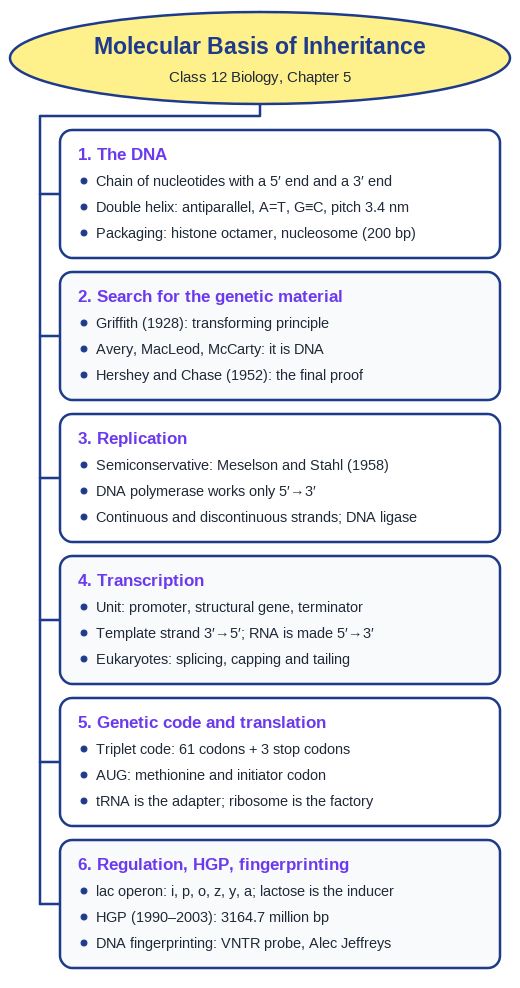
Exercises 1 to 4: bases, Chargaff’s rule and sequences
1. “Group the following as nitrogenous bases and nucleosides: Adenine, Cytidine, Thymine, Guanosine, Uracil and Cytosine.”
| Nitrogenous bases | Nucleosides |
|---|---|
| Adenine, Thymine, Uracil, Cytosine | Cytidine, Guanosine |
A nucleoside is a nitrogenous base joined to a pentose sugar by an N-glycosidic linkage. Cytidine is cytosine + sugar; guanosine is guanine + sugar.
2. “If a double stranded DNA has 20 per cent of cytosine, calculate the per cent of adenine in the DNA.”
In double-stranded DNA, cytosine pairs with guanine and adenine pairs with thymine (Chargaff’s observation), so C = G and A = T.
- C = 20 per cent, so G = 20 per cent.
- C + G = 40 per cent, so A + T = 100 − 40 = 60 per cent.
- A = T, so A = 60 ÷ 2 = 30 per cent.
Adenine is 30 per cent (and thymine is also 30 per cent).
3. “If the sequence of one strand of DNA is written as follows: 5′-ATGCATGCATGCATGCATGCATGCATGC-3′ Write down the sequence of complementary strand in 5′→3′ direction.”
Pair A with T and G with C. The two strands are antiparallel, so the complementary strand first comes out in the 3′→5′ direction:
3′-TACGTACGTACGTACGTACGTACGTACG-5′
Written from its 5′-end, the same strand is:
5′-GCATGCATGCATGCATGCATGCATGCAT-3′
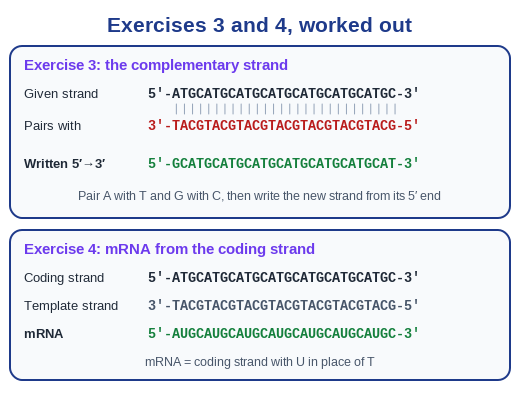
4. “If the sequence of the coding strand in a transcription unit is written as follows: 5′-ATGCATGCATGCATGCATGCATGCATGC-3′ Write down the sequence of mRNA.”
The mRNA is complementary to the template strand, so it has the same sequence and polarity as the coding strand, with uracil in place of thymine.
- Template strand: 3′-TACGTACGTACGTACGTACGTACGTACG-5′
- mRNA: 5′-AUGCAUGCAUGCAUGCAUGCAUGCAUGC-3′
Exercises 5 to 7: replication, polymerases and the genetic material
5. “Which property of DNA double helix led Watson and Crick to hypothesise semi-conservative mode of DNA replication? Explain.”
The property is the complementary base pairing between the two strands: adenine pairs only with thymine, and guanine only with cytosine.
- Because of this pairing, the sequence of one strand fixes the sequence of the other.
- So if the two strands separate, each can act as a template for a new complementary strand.
- Each of the two daughter molecules then has one parental strand and one newly synthesised strand, and both are identical to the parental molecule.
This scheme is the semiconservative mode of replication. Meselson and Stahl proved it in 1958.
6. “Depending upon the chemical nature of the template (DNA or RNA) and the nature of nucleic acids synthesised from it (DNA or RNA), list the types of nucleic acid polymerases.”
| Template | Product | Polymerase | Process |
|---|---|---|---|
| DNA | DNA | DNA-dependent DNA polymerase | Replication |
| DNA | RNA | DNA-dependent RNA polymerase | Transcription |
| RNA | DNA | RNA-dependent DNA polymerase | Flow of information from RNA to DNA in some viruses |
| RNA | RNA | RNA-dependent RNA polymerase | Copying of an RNA genome |
The chapter names the first two. It also says that in some viruses information flows from RNA to DNA. Extra (not in this chapter): the RNA-dependent DNA polymerase is called reverse transcriptase, and RNA-dependent RNA polymerase is found in many viruses with RNA genomes.
7. “How did Hershey and Chase differentiate between DNA and protein in their experiment while proving that DNA is the genetic material?”
They used two different radioactive labels, one for each molecule.
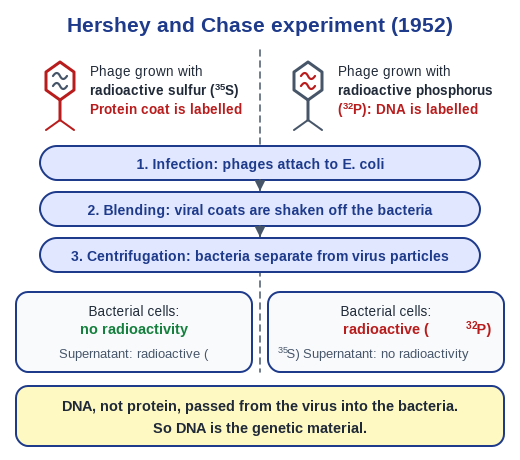
- DNA contains phosphorus but protein does not. Bacteriophages grown on a medium with radioactive phosphorus had radioactive DNA but not radioactive protein.
- Protein contains sulfur but DNA does not. Bacteriophages grown on a medium with radioactive sulfur had radioactive protein but not radioactive DNA.
- Each kind of phage was allowed to attach to E. coli. The viral coats were removed by agitating in a blender, and the virus particles were separated from the bacteria in a centrifuge.
- Bacteria infected by phages with radioactive DNA were radioactive. Bacteria infected by phages with radioactive protein were not.
So DNA, and not protein, passes from the virus into the bacterium. DNA is the genetic material.
Exercises 8 to 11: differences and functions
8. “Differentiate between the followings: (a) Repetitive DNA and Satellite DNA (b) mRNA and tRNA (c) Template strand and Coding strand”
(a)
| Repetitive DNA | Satellite DNA |
|---|---|
| DNA in which a small stretch is repeated many times, sometimes a hundred to a thousand times | The repetitive DNA that separates from the bulk genomic DNA as small peaks in density gradient centrifugation |
| A general term for all such repeated sequences | Classified by base composition (A : T rich or G : C rich), length of segment and number of repeats into micro-satellites, mini-satellites and so on |
(b)
| mRNA | tRNA |
|---|---|
| Messenger RNA; provides the template for protein synthesis | Transfer RNA; brings amino acids and reads the genetic code |
| Carries the codons | Carries the anticodon and an amino acid acceptor end |
| In eukaryotes it is made by RNA polymerase II as hnRNA and then processed | In eukaryotes it is made by RNA polymerase III |
| Has untranslated regions (UTRs) before the start codon and after the stop codon | Clover-leaf secondary structure; the actual molecule looks like an inverted L |
(c)
| Template strand | Coding strand |
|---|---|
| Polarity 3′→5′ | Polarity 5′→3′ |
| Acts as the template for RNA synthesis | Is displaced during transcription and codes for nothing |
| Its sequence is complementary to the RNA | Its sequence is the same as the RNA, with thymine in place of uracil |
9. “List two essential roles of ribosome during translation.”
- It provides the site. The ribosome binds the mRNA, and its large subunit has two sites where charged tRNAs sit close enough for their amino acids to be joined.
- It is the catalyst. The ribosome catalyses the formation of the peptide bond; in bacteria the 23S rRNA is the enzyme, a ribozyme.
10. “In the medium where E. coli was growing, lactose was added, which induced the lac operon. Then, why does lac operon shut down some time after addition of lactose in the medium?”
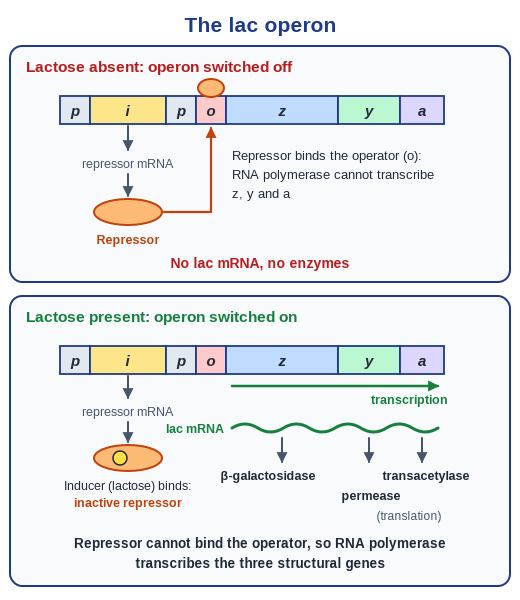
- Lactose is the inducer. It inactivates the repressor, so RNA polymerase transcribes the genes z, y and a.
- The z gene product, β-galactosidase, hydrolyses lactose into galactose and glucose, and the bacteria use them for energy. So the amount of lactose keeps falling.
- Glucose and galactose cannot act as inducers. When the lactose is used up, no inducer is left to bind the repressor.
- The repressor, which the i gene makes all the time, becomes active again and binds the operator. RNA polymerase can no longer transcribe the operon, and it shuts down.
The operon is therefore expressed only as long as lactose is present: the substrate regulates the synthesis of its own enzyme.
11. “Explain (in one or two lines) the function of the followings: (a) Promoter (b) tRNA (c) Exons”
- (a) Promoter: a DNA sequence towards the 5′-end (upstream) of the structural gene that provides the binding site for RNA polymerase. Its position also decides which strand is the template and which is the coding strand.
- (b) tRNA: the adapter molecule. Its anticodon reads the codon on mRNA, and its acceptor end carries the specific amino acid to the ribosome.
- (c) Exons: the coding or expressed sequences of a split gene. They appear in the mature, processed RNA and are joined in a defined order by splicing.
Exercises 12 to 14: the genome, fingerprinting and short notes
12. “Why is the Human Genome project called a mega project?”
Because of its size, cost and needs:
- The human genome has about 3 × 10⁹ bp. At the first estimate of US $ 3 per bp, the cost came to about 9 billion US dollars (3 × 10⁹ × 3 = 9 × 10⁹).
- If the sequence were typed in books with 1000 letters on a page and 1000 pages in a book, 3300 such books would be needed for the DNA of a single human cell.
- So much data needed high-speed computers for storage, retrieval and analysis, and led to the growth of bioinformatics.
- It was a 13-year project (1990–2003) coordinated by the U.S. Department of Energy and the National Institute of Health, with partners in several countries.
A note on the numbers: one book of this kind holds 1000 × 1000 = 10⁶ letters. For 3 × 10⁹ bp that gives 3000 books; the book’s 3300 fits its other figure of 3.3 × 10⁹ bp for the haploid genome.
13. “What is DNA fingerprinting? Mention its application.”
DNA fingerprinting is a very quick way to compare the DNA sequences of any two individuals. It finds differences in repetitive (satellite) DNA, which shows a high degree of polymorphism. The technique was developed by Alec Jeffreys, with VNTR as the probe.
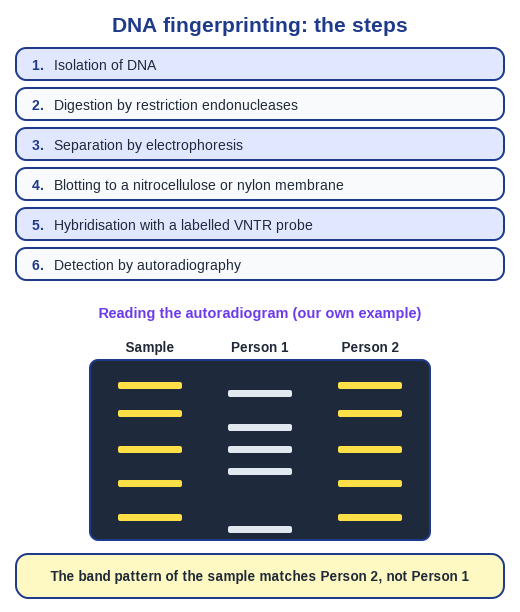
Applications:
- Forensic science: DNA from any tissue (blood, hair follicle, skin, bone, saliva, sperm) gives the same pattern, so it is an identification tool.
- Paternity testing in case of disputes, because polymorphisms are inherited from parents by children.
- Determining population and genetic diversity; the summary also names evolutionary biology.
14. “Briefly describe the following: (a) Transcription (b) Polymorphism (c) Translation (d) Bioinformatics”
(a) Transcription. The copying of genetic information from one strand of DNA into RNA.
- A transcription unit has three parts: a promoter, a structural gene and a terminator.
- DNA-dependent RNA polymerase binds the promoter.
- It uses the strand with 3′→5′ polarity as the template and makes RNA in the 5′→3′ direction.
- It stops when it reaches the terminator.
- In eukaryotes the first transcript (hnRNA) is then spliced, capped and tailed to give mRNA.
(b) Polymorphism. Variation at the genetic level, arising from mutations. If an inheritable mutation is observed in a population at high frequency (more than one allele at a locus with a frequency greater than 0.01), it is called a DNA polymorphism. It is more likely in non-coding DNA, and it is the basis of genetic mapping and of DNA fingerprinting.
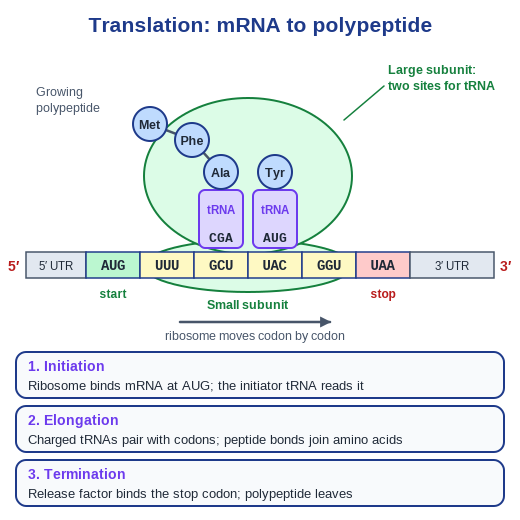
(c) Translation. The joining of amino acids into a polypeptide, in the order set by the bases of mRNA.
- Charging: each amino acid is activated with ATP and linked to its own tRNA.
- Initiation: the ribosome binds the mRNA at the start codon AUG.
- Elongation: charged tRNAs pair with the codons one after another, and peptide bonds join their amino acids.
- Termination: at a stop codon a release factor ends translation, and the polypeptide is released.
(d) Bioinformatics. A new area of biology that developed quickly along with the Human Genome Project. It uses high-speed computational devices to store, retrieve and analyse the enormous amount of DNA sequence data.
Questions asked inside the chapter
The chapter asks these questions in its text. They are restated here in our own words.
Page 82: why is the distance between the two chains of DNA almost constant? A purine (two rings) always pairs with a pyrimidine (one ring). Every base pair therefore has nearly the same width. (Extra: the ring counts are from Class 11.)
Page 83: a simple name for the flow of information from RNA to DNA. It is the reverse of transcription, so it can be called reverse transcription. (Extra: this is the accepted name.)
Page 83: the number of base pairs in E. coli DNA if its length is 1.36 mm. Number of bp = length ÷ distance between two base pairs = (1.36 × 10⁻³ m) ÷ (0.34 × 10⁻⁹ m) = 4 × 10⁶ bp. (Elsewhere the book gives 4.6 × 10⁶ bp for E. coli, which corresponds to about 1.56 mm.)
Page 83: the number of nucleosomes in a mammalian cell. 6.6 × 10⁹ bp ÷ 200 bp per nucleosome = 3.3 × 10⁷ nucleosomes.
Page 85: the difference between DNAs and DNase. “DNAs” is the plural of DNA, the nucleic acid. DNase is an enzyme that digests DNA.
Page 87: two chemical differences between DNA and RNA. (i) The sugar: deoxyribose in DNA; ribose, with an extra 2′-OH group, in RNA. (ii) The base: thymine in DNA; uracil in its place in RNA.
Page 89: why does a molecule of higher mass or density sediment faster? In a centrifuge the outward (centrifugal) force on a particle increases with its mass, so denser molecules move farther down the gradient. Extra: this idea is from physics, not from this chapter.
Page 90: the proportions of light and hybrid DNA after 80 minutes. 80 minutes is four generations. One starting molecule gives 2⁴ = 16 molecules, of which 2 are hybrid and 14 are light: 12.5 per cent hybrid and 87.5 per cent light (1 : 7).
Page 92: the RNA transcribed from the given DNA. The template is 3′-ATGCATGCATGCATGCATGCATGC-5′. The RNA is complementary to it and equals the coding strand with U for T: 5′-UACGUACGUACGUACGUACGUACG-3′.
Page 96: the amino acids coded by AUG UUU UUC UUC UUU UUU UUC. Met–Phe–Phe–Phe–Phe–Phe–Phe.
Page 97: predicting the mRNA from Met–Phe–Phe–Phe–Phe–Phe–Phe, and the two properties this shows. Met can only be AUG, but each Phe can be UUU or UUC, so the exact sequence cannot be predicted. Going from codon to amino acid there is no doubt; going back there is. The two properties: one codon codes for only one amino acid, and the code is degenerate (one amino acid can have more than one codon).
Page 101: for how long is the lac operon expressed in the presence of lactose? As long as lactose is present to inactivate the repressor. When it is used up, the operon shuts down (see Exercise 10).
Page 105: in how many bases would two humans differ if the genome is 3 × 10⁹ bp? 99.9 per cent is the same, so 0.1 per cent differs: 0.001 × 3 × 10⁹ = 3 × 10⁶ bases.
More practice: DNA replication, transcription and translation and Human Genome Project and DNA fingerprinting.
Practice
-
A double-stranded DNA has 30 per cent guanine. The per cent of thymine is:
Show answer
Answer: (a) 20
-
The strand complementary to 5′-AAGC-3′, written 5′→3′, is:
Show answer
Answer: (b) 5′-GCTT-3′
-
A DNA molecule is 3400 bp long. Its length is about:
Show answer
Answer: (b) 1156 nm
-
The template strand reads 3′-TACAAAAAG-5′. Which amino acids does its mRNA code for?
Show answer
Answer: The mRNA is 5′-AUGUUUUUC-3′, read as AUG UUU UUC: Met–Phe–Phe.
-
How many nucleotides of mRNA code for a polypeptide of 50 amino acids, if the stop codon is counted too?
Show answer
Answer: 50 codons × 3 = 150 nucleotides for the amino acids, plus 3 for the stop codon: 153 nucleotides.
Stuck on a question?
Take a photo and Lagnever AI explains it step by step. Try it for 7 days for ₹2.
Get it on Google Play Open in browser
For parents: after the trial, the plan renews monthly by UPI or card autopay. You can cancel anytime in the app.