
Class 12 Maths Chapter 5: Continuity and Differentiability Notes Hinglish mein
Ye chapter 5 lines mein
Function f, x = c par continuous hai jab x → c par f(x) ki limit f(c) ke barabar ho. f, c par differentiable hai jab h → 0 par [f(c + h) − f(c)]/h ki limit ho; har differentiable function continuous hota hai. Composite functions chain rule, dy/dx = (dy/dt) · (dt/dx), se differentiate hote hain, aur isi se implicit, inverse trigonometric, exponential, logarithmic aur parametric functions ke derivatives milte hain.
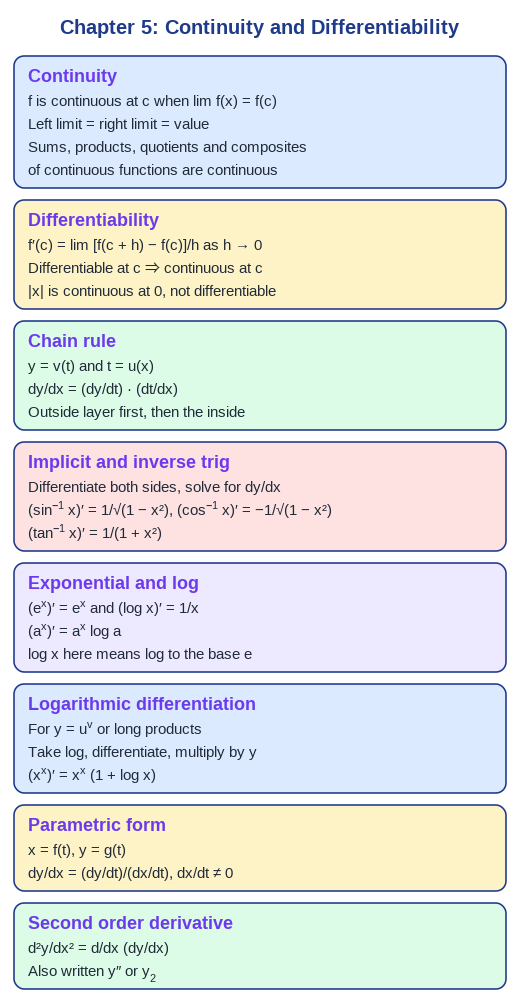
Is page par maths kaise likha hai. Jo function apne domain ke alag hisson par alag rule se diya ho, wo braces mein likha hai aur rules ke beech semicolon hai: f(x) = {x + 1, agar x ≤ 1; x − 1, agar x > 1}. log x natural logarithm (base e) hai, aur sin⁻¹ x inverse sine hai. y′ ya y₁ ka matlab dy/dx hai, aur y″ ya y₂ ka matlab d²y/dx².
Ye chapter kis baare mein hai?
Class 11 mein tumne limits aur polynomials aur trigonometric functions ke derivatives padhe. Ye chapter kisi point par function ke baare mein do sawal poochta hai: kya wahan uska graph toota nahi hai (continuity), aur kya wahan uska ek pakka slope hai (differentiability)? Phir derivatives nikaalne ke naye tools aate hain: chain rule, implicit differentiation, inverse trigonometric, exponential aur logarithmic functions, logarithmic differentiation, parametric forms aur second order derivative.
Function continuous kab hota hai?
Mote taur par, f kisi point par continuous hai agar uska graph us point se pen uthaye bina banaya ja sake. Theek-theek, f x = c par continuous hai agar c domain mein ho aur
limx → c f(x) = f(c),
yaani left hand limit, right hand limit aur value f(c) teeno barabar hon. x = 2 par f(x) = 3x + 1 ke liye limit 7 hai aur f(2) = 7, to f wahan continuous hai.
f(x) = {x + 1, agar x ≤ 1; x − 1, agar x > 1} lo. x = 1 par left hand limit 2 aur right hand limit 0 hai. Ye alag hain, to x = 1 ek point of discontinuity hai.
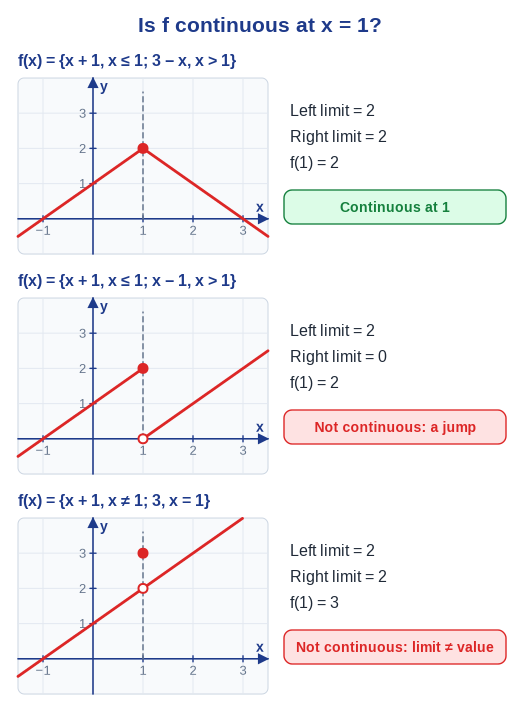
Function ko continuous function kehte hain agar wo apne domain ke har point par continuous ho. Polynomials, rational functions, sin x, cos x, tan x aur |x| apne domain par continuous hain. Greatest integer function [x] har integer par discontinuous hai. Continuous functions ke sum, difference, product aur quotient (jahan neeche 0 na ho) continuous hote hain, aur sin (x²) jaisa composite bhi. Hal kiye cases: continuity kya hai.
Differentiable ka matlab kya hai?
c par f ka derivative
f′(c) = limh → 0 [f(c + h) − f(c)]/h
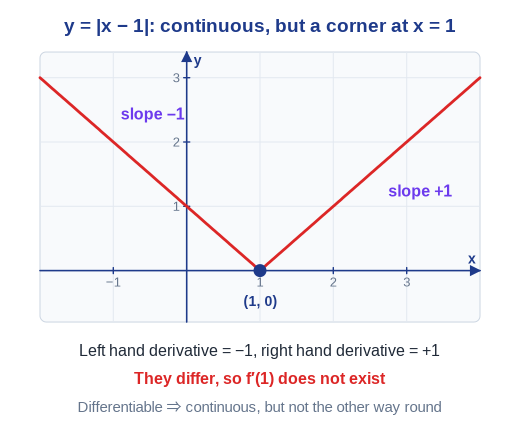
hai, agar ye limit ho. h < 0 se li gayi limit left hand derivative hai aur h > 0 se right hand derivative; f c par differentiable hai jab dono finite aur barabar hon.
Chapter sabit karta hai ki jo function kisi point par differentiable hai, wo us point par continuous hota hai. Ulta sahi nahi hai. x = 1 par f(x) = |x − 1| ka left hand derivative −1 aur right hand derivative 1 hai, to f wahan continuous hai lekin differentiable nahi: uske graph mein ek corner hai.
Chain rule kya hai?
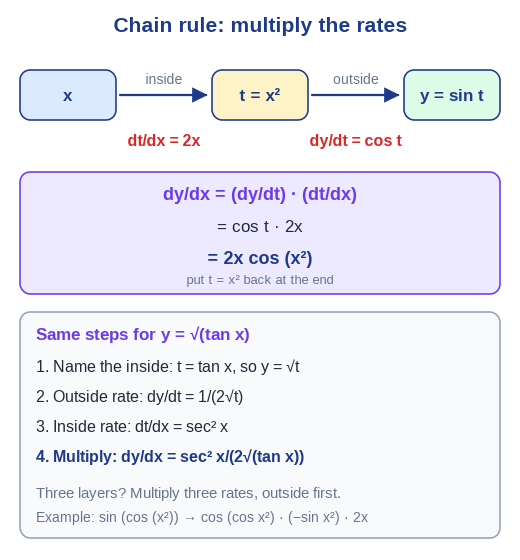
Composite function ke liye y = v(t) likho, jahan t = u(x). Tab
dy/dx = (dy/dt) · (dt/dx).
y = (x² + 1)⁵ ke liye t = x² + 1 rakho: dy/dx = 5t⁴ · 2x = 10x(x² + 1)⁴. Teen layers hon to teen derivatives guna karo, bahar wale se shuru karke.
Implicit aur inverse trigonometric functions kaise differentiate karte hain?
Jab relation y ke liye solve na kiya gaya ho, to dono sides ko x ke respect mein differentiate karo aur y ko x ka function maano. x² + y² = 25 ke liye: 2x + 2y · dy/dx = 0, to dy/dx = −x/y. Point (3, 4) par slope −3/4 hai.
Isi tareeke se inverse trigonometric functions ke derivatives milte hain. Agar y = sin⁻¹ x, to x = sin y, to 1 = cos y · dy/dx aur dy/dx = 1/cos y = 1/√(1 − x²). Chapter ki table:
- (sin⁻¹ x)′ = 1/√(1 − x²), −1 < x < 1 ke liye
- (cos⁻¹ x)′ = −1/√(1 − x²), −1 < x < 1 ke liye
- (tan⁻¹ x)′ = 1/(1 + x²), har real x ke liye
Steps aur examples: chain rule, implicit aur inverse trigonometric derivatives.
Exponential aur logarithmic functions kya hain?
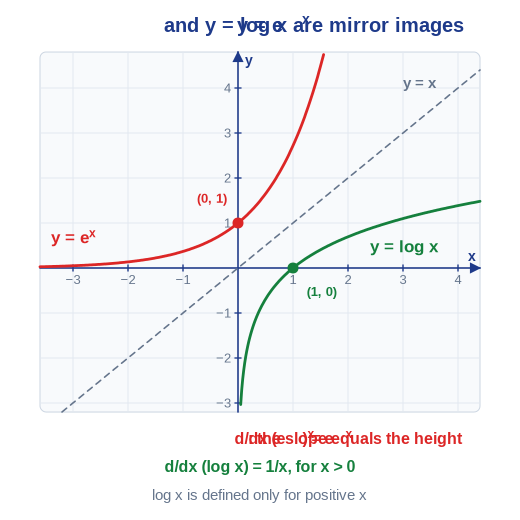
Base b > 1 wala exponential function y = bˣ hai. Iska domain saare real numbers hain, iski values hamesha positive hain, aur iska graph (0, 1) se guzarta hai aur badhta hi rehta hai. Base e, jo 2 aur 3 ke beech ka number hai, se natural exponential function eˣ milta hai.
Logarithm exponential ko ulat deta hai: logb a = x ka matlab bˣ = a. Is chapter mein log x base e wala logarithm hai. Ye sirf x > 0 ke liye defined hai aur iska graph (1, 0) se guzarta hai. Do khaas derivatives, jo chapter bina proof ke deta hai:
d/dx (eˣ) = eˣ aur d/dx (log x) = 1/x.
To chain rule se d/dx (e³ˣ) = 3e³ˣ aur d/dx [log (x² + 1)] = 2x/(x² + 1).
Logarithmic aur parametric differentiation kya hain?
y = xˣ ke liye na power rule lagta hai na aˣ wala rule, kyunki base aur power dono badalte hain. Pehle log lo: log y = x log x, to (1/y) dy/dx = 1 + log x aur dy/dx = xˣ(1 + log x). Yahi logarithmic differentiation hai. Iske liye function aur uska base positive hone chahiye.
Parametric form mein x aur y dono ek parameter t mein diye hote hain. Tab dy/dx = (dy/dt)/(dx/dt), jab dx/dt ≠ 0. x = t², y = 2t ke liye: dy/dx = 2/(2t) = 1/t. Aur: logarithmic aur parametric differentiation.
Second order derivative kya hai?
dy/dx ko ek baar aur differentiate karo to second order derivative milta hai, jise d²y/dx², y″, y₂ ya f″(x) likhte hain. y = x² log x ke liye:
dy/dx = 2x log x + x² · (1/x) = 2x log x + x, aur d²y/dx² = 2 log x + 2 + 1 = 2 log x + 3.
Kai exercise sawal kehte hain ki dikhao y, y₁ aur y₂ ke beech ka koi relation satisfy karta hai. y = e³ˣ ke liye y₁ = 3e³ˣ aur y₂ = 9e³ˣ, to y₂ − 9y = 0.
Aage badhne se pehle
Ye rationalised book hai (Reprint 2026-27). Chapter 5 mein Exercise 5.1 se 5.7 aur 22 sawalon ki Miscellaneous Exercise hai, aur Rolle’s Theorem ya Mean Value Theorem ka koi section nahi hai. Har example aur exercise Chapter 5 ke NCERT solutions mein hal kiya gaya hai.
Key terms (zaroori shabd)
| Term | Matlab |
|---|---|
| Continuous at a point | f, x = c par continuous hai agar left hand limit, right hand limit aur value f(c) teeno hon aur barabar hon, yaani x → c par lim f(x) = f(c). |
| Point of discontinuity | Domain ka wo point c jahan f continuous nahi hai. |
| Continuous function | Wo function jo apne domain ke har point par continuous ho. |
| Differentiable at a point | f, c par differentiable hai agar h → 0 par [f(c + h) − f(c)]/h ki limit ho; yahi limit derivative f′(c) hai. Left hand aur right hand limits finite aur barabar honi chahiye. |
| Chain rule | Composite function ka rule: agar y = v(t) aur t = u(x), to dy/dx = (dy/dt) · (dt/dx). |
| Implicit function | x aur y ke beech aisa relation, jaise x² + y² = 25, jo y ke liye solve nahi kiya gaya. Use waise hi differentiate karte hain, y ko x ka function maan kar. |
| Exponential function | y = bˣ, jahan base b > 1. Base e (2 aur 3 ke beech ka ek number) ke saath ye natural exponential function eˣ hai, jiska derivative khud eˣ hai. |
| Logarithm | log_b a = x ka matlab hai bˣ = a. Is chapter mein log x ka matlab natural logarithm hai, base e; iska derivative 1/x hai. |
| Logarithmic differentiation | Differentiate karne se pehle dono sides ka log lena. Ye y = uᵛ ke liye, jahan u aur v dono x par depend karte hain, aur lambe products aur quotients ke liye kaam aata hai. |
| Parametric form | x aur y dono ek teesre variable t (parameter) mein diye hon: x = f(t), y = g(t). Tab dy/dx = (dy/dt)/(dx/dt), jab dx/dt ≠ 0. |
| Second order derivative | dy/dx ka derivative, jise d²y/dx², y″, y₂ ya f″(x) likhte hain. |
Is chapter ke topics
Practice karo
-
f(x) = {kx + 1, agar x ≤ 2; 7, agar x > 2}, x = 2 par continuous hai jab k barabar hai:
Jawab dekho
Jawab: (b) 3
-
cos (x²) ka x ke respect mein derivative hai:
Jawab dekho
Jawab: (c) −2x sin (x²)
-
d/dx (tan⁻¹ x) barabar hai:
Jawab dekho
Jawab: (d) 1/(1 + x²)
-
Agar x = 2t aur y = t², to dy/dx barabar hai:
Jawab dekho
Jawab: (b) t
-
x = 0 par function f(x) = |x|:
Jawab dekho
Jawab: (a) continuous hai lekin differentiable nahi
Students ke sawal
Class 12 Maths Chapter 5 ke main topics kya hain?
Continuity aur continuous functions ka algebra, differentiability, chain rule, implicit aur inverse trigonometric functions ke derivatives, exponential aur logarithmic functions, logarithmic differentiation, parametric form ke functions ke derivatives aur second order derivatives. Chapter mein Exercise 5.1 se 5.7 aur ek Miscellaneous Exercise hai.
Kya har continuous function differentiable hota hai?
Nahi. Har differentiable function continuous hota hai, lekin continuous function differentiable na bhi ho sakta hai. f(x) = |x|, x = 0 par continuous hai, lekin wahan left hand derivative −1 aur right hand derivative 1 hai, to 0 par iska derivative nahi hai.
Kya Rolle's Theorem aur Mean Value Theorem 2026-27 ki book mein hain?
Nahi. Chapter 5 ke 2026-27 reprint mein Rolle's Theorem ya Mean Value Theorem ka na koi section hai na exercise, isliye ye notes unhe chhod dete hain. Extra: purane editions mein ye section tha, isliye purani guides mein abhi bhi mil sakta hai.
Is chapter mein log x ka matlab kya hai?
Iska matlab natural logarithm hai, yaani base e wala logarithm, jise kuch books ln x likhti hain. Iska derivative 1/x hai, aur ye sirf x > 0 ke liye defined hai.
Koi sawal atak gaya?
Photo lo, Lagnever AI step-by-step samjhayega. 7 din ka trial sirf ₹2.
Google Play se app lo Browser mein kholo
Parents ke liye: trial ke baad plan har mahine UPI ya card autopay se renew hota hai. App mein kabhi bhi cancel kar sakte hain.