
Class 12 Maths Chapter 5: Continuity and Differentiability Notes
This chapter in five lines
A function f is continuous at x = c when the limit of f(x) at c equals f(c). It is differentiable at c when the limit of [f(c + h) − f(c)]/h exists as h → 0; every differentiable function is continuous. Composite functions are differentiated by the chain rule, dy/dx = (dy/dt) · (dt/dx), which also gives the derivatives of implicit, inverse trigonometric, exponential, logarithmic and parametric functions.
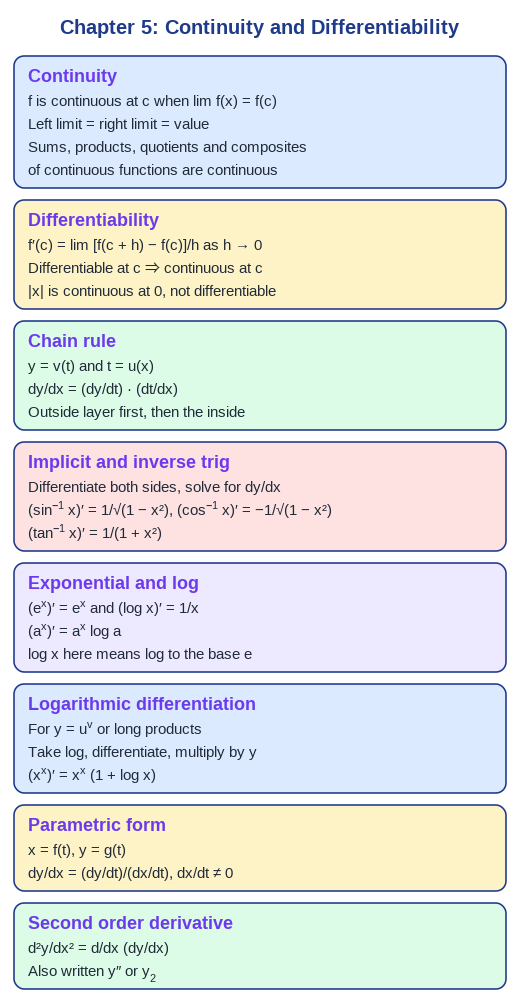
How the maths is written here. A function given by different rules on different parts of its domain is typed in braces with a semicolon between the rules: f(x) = {x + 1, if x ≤ 1; x − 1, if x > 1}. log x is the natural logarithm (base e), and sin⁻¹ x is the inverse sine. y′ or y₁ stands for dy/dx, and y″ or y₂ for d²y/dx².
What is this chapter about?
In Class 11 you learnt limits and the derivatives of polynomials and trigonometric functions. This chapter asks two questions about a function at a point: is its graph unbroken there (continuity), and does it have a definite slope there (differentiability)? It then adds new tools for finding derivatives: the chain rule, implicit differentiation, the inverse trigonometric, exponential and logarithmic functions, logarithmic differentiation, parametric forms and the second order derivative.
When is a function continuous?
Roughly, f is continuous at a point if you can draw its graph through that point without lifting the pen. Precisely, f is continuous at x = c if c is in the domain and
limx → c f(x) = f(c),
that is, the left hand limit, the right hand limit and the value f(c) are all equal. For f(x) = 3x + 1 at x = 2, the limit is 7 and f(2) = 7, so f is continuous there.
Take f(x) = {x + 1, if x ≤ 1; x − 1, if x > 1}. At x = 1 the left hand limit is 2 and the right hand limit is 0. They differ, so x = 1 is a point of discontinuity.
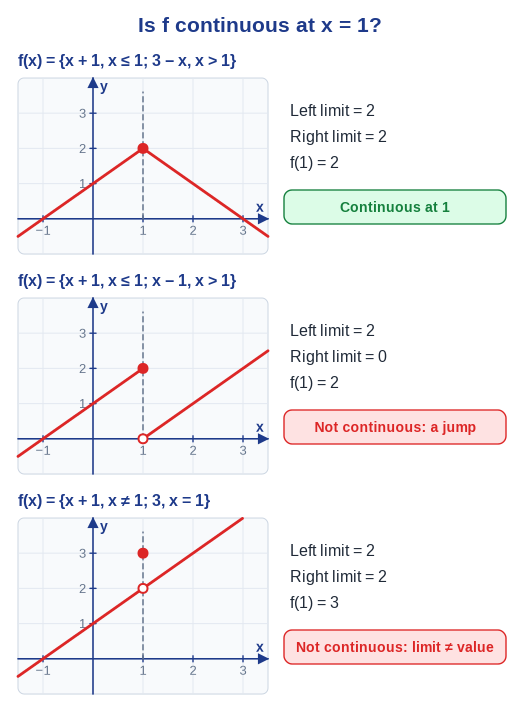
A function is called a continuous function if it is continuous at every point of its domain. Polynomials, rational functions, sin x, cos x, tan x and |x| are all continuous on their domains. The greatest integer function [x] is discontinuous at every integer. Sums, differences, products and quotients (where the bottom is not 0) of continuous functions are continuous, and so is a composite such as sin (x²). Worked cases: continuity of a function.
What does differentiable mean?
The derivative of f at c is
f′(c) = limh → 0 [f(c + h) − f(c)]/h,
when this limit exists. The limit taken with h < 0 is the left hand derivative and with h > 0 the right hand derivative; f is differentiable at c when both are finite and equal.
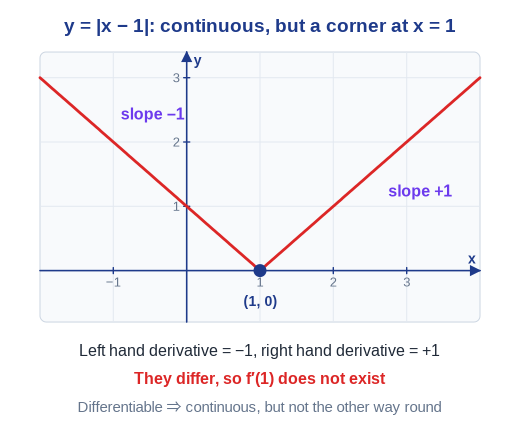
The chapter proves that a function differentiable at a point is continuous at that point. The converse is false. For f(x) = |x − 1| at x = 1, the left hand derivative is −1 and the right hand derivative is 1, so f is continuous there but not differentiable: its graph has a corner.
What is the chain rule?
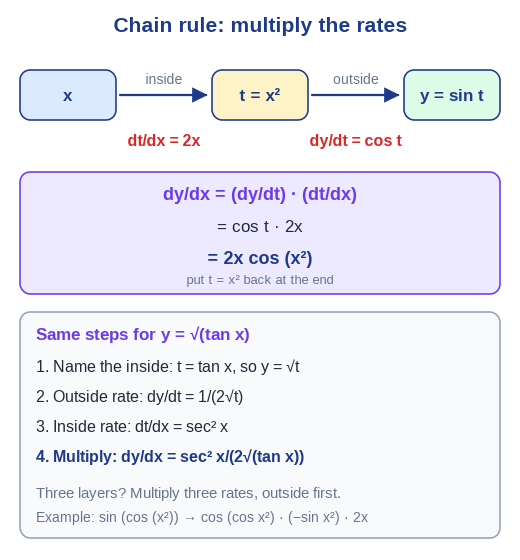
For a composite function, write y = v(t) with t = u(x). Then
dy/dx = (dy/dt) · (dt/dx).
For y = (x² + 1)⁵, put t = x² + 1: dy/dx = 5t⁴ · 2x = 10x(x² + 1)⁴. With three layers, multiply three derivatives, outside first.
How do you differentiate implicit and inverse trigonometric functions?
When a relation is not solved for y, differentiate both sides with respect to x and treat y as a function of x. For x² + y² = 25: 2x + 2y · dy/dx = 0, so dy/dx = −x/y. At the point (3, 4) the slope is −3/4.
The same idea gives the derivatives of the inverse trigonometric functions. If y = sin⁻¹ x, then x = sin y, so 1 = cos y · dy/dx and dy/dx = 1/cos y = 1/√(1 − x²). The chapter’s table:
- (sin⁻¹ x)′ = 1/√(1 − x²), for −1 < x < 1
- (cos⁻¹ x)′ = −1/√(1 − x²), for −1 < x < 1
- (tan⁻¹ x)′ = 1/(1 + x²), for all real x
Steps and examples: chain rule, implicit and inverse trigonometric derivatives.
What are the exponential and logarithmic functions?
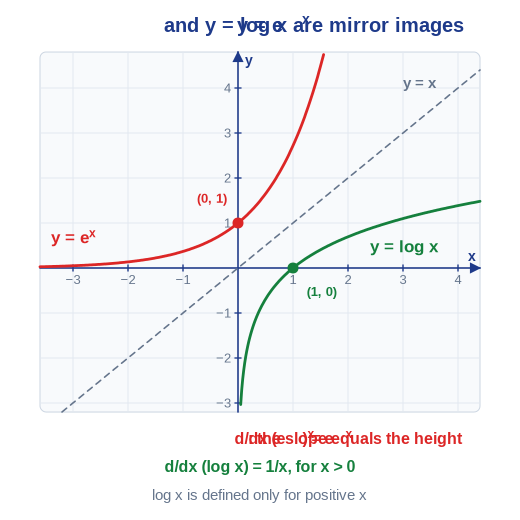
The exponential function with base b > 1 is y = bˣ. Its domain is all real numbers, its values are always positive, and its graph passes through (0, 1) and keeps rising. With the base e, a number between 2 and 3, we get the natural exponential function eˣ.
The logarithm undoes the exponential: logb a = x means bˣ = a. In this chapter log x is the logarithm to the base e. It is defined only for x > 0 and its graph passes through (1, 0). The two key derivatives, which the chapter states without proof, are
d/dx (eˣ) = eˣ and d/dx (log x) = 1/x.
So d/dx (e³ˣ) = 3e³ˣ and d/dx [log (x² + 1)] = 2x/(x² + 1), by the chain rule.
What are logarithmic and parametric differentiation?
For y = xˣ neither the power rule nor the rule for aˣ applies, because both the base and the power change. Take logs first: log y = x log x, so (1/y) dy/dx = 1 + log x and dy/dx = xˣ(1 + log x). This is logarithmic differentiation. It needs the function and its base to be positive.
In a parametric form, x and y are both given in terms of a parameter t. Then dy/dx = (dy/dt)/(dx/dt), when dx/dt ≠ 0. For x = t², y = 2t: dy/dx = 2/(2t) = 1/t. More: logarithmic and parametric differentiation.
What is a second order derivative?
Differentiate dy/dx once more and you get the second order derivative, written d²y/dx², y″, y₂ or f″(x). For y = x² log x:
dy/dx = 2x log x + x² · (1/x) = 2x log x + x, and d²y/dx² = 2 log x + 2 + 1 = 2 log x + 3.
Many exercise questions ask you to show that y satisfies a relation between y, y₁ and y₂. For y = e³ˣ, y₁ = 3e³ˣ and y₂ = 9e³ˣ, so y₂ − 9y = 0.
Before we move on
This is the rationalised book (marked Reprint 2026-27). Chapter 5 has Exercises 5.1 to 5.7 and a Miscellaneous Exercise of 22 questions, and no section on Rolle’s Theorem or the Mean Value Theorem. Every example and exercise is worked out in the NCERT solutions for Chapter 5.
Key terms
| Term | Meaning |
|---|---|
| Continuous at a point | f is continuous at x = c if the left hand limit, the right hand limit and the value f(c) all exist and are equal, that is, lim f(x) = f(c) as x → c. |
| Point of discontinuity | A point c of the domain at which f is not continuous. |
| Continuous function | A function that is continuous at every point of its domain. |
| Differentiable at a point | f is differentiable at c if the limit of [f(c + h) − f(c)]/h as h → 0 exists; the limit is the derivative f′(c). The left hand and right hand limits must be finite and equal. |
| Chain rule | The rule for a composite function: if y = v(t) and t = u(x), then dy/dx = (dy/dt) · (dt/dx). |
| Implicit function | A relation between x and y, such as x² + y² = 25, that is not solved for y. It is differentiated as it stands, treating y as a function of x. |
| Exponential function | y = bˣ with base b > 1. With base e (a number between 2 and 3) it is the natural exponential function eˣ, whose derivative is eˣ itself. |
| Logarithm | log_b a = x means bˣ = a. In this chapter log x means the natural logarithm, to the base e; its derivative is 1/x. |
| Logarithmic differentiation | Taking the log of both sides before differentiating. It is used for y = uᵛ, where both u and v depend on x, and for long products and quotients. |
| Parametric form | x and y both given in terms of a third variable t, the parameter: x = f(t), y = g(t). Then dy/dx = (dy/dt)/(dx/dt) when dx/dt ≠ 0. |
| Second order derivative | The derivative of dy/dx, written d²y/dx², y″, y₂ or f″(x). |
Topics in this chapter
Practice
-
The function f(x) = {kx + 1, if x ≤ 2; 7, if x > 2} is continuous at x = 2 when k equals:
Show answer
Answer: (b) 3
-
The derivative of cos (x²) with respect to x is:
Show answer
Answer: (c) −2x sin (x²)
-
d/dx (tan⁻¹ x) equals:
Show answer
Answer: (d) 1/(1 + x²)
-
If x = 2t and y = t², then dy/dx equals:
Show answer
Answer: (b) t
-
At x = 0, the function f(x) = |x| is:
Show answer
Answer: (a) continuous but not differentiable
Questions students ask
What are the main topics of Class 12 Maths Chapter 5?
Continuity and the algebra of continuous functions, differentiability, the chain rule, derivatives of implicit and inverse trigonometric functions, exponential and logarithmic functions, logarithmic differentiation, derivatives of functions in parametric forms and second order derivatives. The chapter has Exercises 5.1 to 5.7 and a Miscellaneous Exercise.
Is every continuous function differentiable?
No. Every differentiable function is continuous, but a continuous function can fail to be differentiable. f(x) = |x| is continuous at x = 0, yet its left hand derivative there is −1 and its right hand derivative is 1, so it has no derivative at 0.
Are Rolle's Theorem and the Mean Value Theorem in the 2026-27 book?
No. The 2026-27 reprint of Chapter 5 has no section and no exercise on Rolle's Theorem or the Mean Value Theorem, so these notes leave them out. Extra: older editions had such a section, so older guides may still carry it.
What does log x mean in this chapter?
It means the natural logarithm, the logarithm to the base e, which some books write as ln x. Its derivative is 1/x, and it is defined only for x > 0.
Stuck on a question?
Take a photo and Lagnever AI explains it step by step. Try it for 7 days for ₹2.
Get it on Google Play Open in browser
For parents: after the trial, the plan renews monthly by UPI or card autopay. You can cancel anytime in the app.