
NCERT Solutions Class 12 Maths Chapter 5: Continuity and Differentiability
Answers to all 137 questions of Exercises 5.1 to 5.7 and the Miscellaneous Exercise, and to all 43 worked examples, of Chapter 5, Continuity and Differentiability, of Mathematics Part I, the Class 12 NCERT textbook. Page numbers follow the 2026-27 reprint (pages 104–146). The exercise questions are quoted from the book; the examples are restated in short and labelled by number and page. Every derivative below was checked again by a script (numerical differentiation at several points), and every continuity answer by working out the function on both sides of the point. The few places where the book’s answer key needs a remark are listed in the last section. Short notes: Chapter 5 notes.
How the maths is written here. A function given by different rules on different parts of its domain is typed inside braces, with a semicolon between the rules: f(x) = {x, if x ≤ 1; 5, if x > 1} means f(x) = x when x ≤ 1 and f(x) = 5 when x > 1. A fraction is typed with a slash, with brackets around the top and the bottom when they are longer than one term. log x is the natural logarithm (base e), as in the book, and sin⁻¹ x is the inverse sine. y′ or y₁ stands for dy/dx, and y″ or y₂ for d²y/dx². “x → 1⁻” means x comes to 1 from the left and “x → 1⁺” from the right.
Results used again and again:
- f is continuous at x = c when the left hand limit, the right hand limit and f(c) all exist and are equal. Polynomials, sin x, cos x, |x|, ex and log x are continuous on their domains, and so are sums, differences, products, quotients (where the bottom is not 0) and composites of continuous functions.
- Chain rule: if y = v(t) and t = u(x), then dy/dx = (dy/dt) · (dt/dx).
- d/dx (sin⁻¹ x) = 1/√(1 − x²), d/dx (cos⁻¹ x) = −1/√(1 − x²), d/dx (tan⁻¹ x) = 1/(1 + x²), d/dx (ex) = ex, d/dx (log x) = 1/x.
- Parametric form: dy/dx = (dy/dt)/(dx/dt), when dx/dt ≠ 0.
Examples 1 to 9: continuity at a point and on a domain (pages 106–108)
Example 1 (page 106): is f(x) = 2x + 3 continuous at x = 1? f(1) = 5, and as x → 1, 2x + 3 → 5. The limit equals the value, so f is continuous at x = 1.
Example 2 (page 106): is f(x) = x² continuous at x = 0? f(0) = 0 and limx → 0 x² = 0 = f(0). Yes, it is continuous at x = 0.
Example 3 (page 106): continuity of f(x) = |x| at x = 0. f(x) = −x for x < 0 and f(x) = x for x ≥ 0. Left hand limit = limx → 0⁻ (−x) = 0, Right hand limit = limx → 0⁺ x = 0, f(0) = 0. All three agree, so f is continuous at x = 0.
Example 4 (pages 106–107): f(x) = {x³ + 3, if x ≠ 0; 1, if x = 0} is not continuous at x = 0. f(0) = 1, but limx → 0 (x³ + 3) = 3. The limit is not equal to f(0), so f is not continuous at x = 0; it is continuous at every other point.
Example 5 (page 107): where is the constant function f(x) = k continuous? For any real number c, f(c) = k and limx → c k = k. So f is continuous at every real number.
Example 6 (page 107): the identity function f(x) = x. f(c) = c and limx → c x = c, so f is continuous at every real number.
Example 7 (page 108): is f(x) = |x| a continuous function? For c < 0, limx → c (−x) = −c = f(c). For c > 0, limx → c x = c = f(c). At 0 it is continuous by Example 3. So f is continuous at every point.
Example 8 (page 108): f(x) = x³ + x² − 1. For every real c, limx → c (x³ + x² − 1) = c³ + c² − 1 = f(c). So f is a continuous function.
Example 9 (page 108): f(x) = 1/x, x ≠ 0. For every c ≠ 0, limx → c (1/x) = 1/c = f(c). So f is continuous at every point of its domain, that is, f is a continuous function. (0 is not in the domain. Near 0 the values become larger than any number on the right and smaller than any number on the left, so neither one-sided limit exists as a real number.)
Examples 10 to 15: functions given in pieces (pages 110–113)
Example 10 (page 110): f(x) = {x + 2, if x ≤ 1; x − 2, if x > 1}. Each piece is a polynomial, so f is continuous for c < 1 and for c > 1. At x = 1: Left hand limit = 1 + 2 = 3, Right hand limit = 1 − 2 = −1. They differ, so x = 1 is the only point of discontinuity.
Example 11 (page 110): f(x) = {x + 2, if x < 1; 0, if x = 1; x − 2, if x > 1}. As in Example 10, f is continuous for x ≠ 1, and at x = 1 the left hand limit is 3 and the right hand limit is −1. x = 1 is the only point of discontinuity.
Example 12 (page 111): f(x) = {x + 2, if x < 0; −x + 2, if x > 0}. The function is not defined at 0, so its domain is all real numbers except 0. For c < 0, lim f(x) = c + 2 = f(c); for c > 0, lim f(x) = −c + 2 = f(c). f is continuous at every point of its domain, so it is a continuous function.
Example 13 (pages 111–112): f(x) = {x, if x ≥ 0; x², if x < 0}. For x < 0 it is x² and for x > 0 it is x, both continuous. At 0: Left hand limit = 0² = 0, Right hand limit = 0, f(0) = 0. f is continuous at every point.
Example 14 (page 112): every polynomial function is continuous. For p(x) = a₀ + a₁x + … + anxn and any real c, the algebra of limits gives limx → c p(x) = p(c). So p is continuous at every real number.
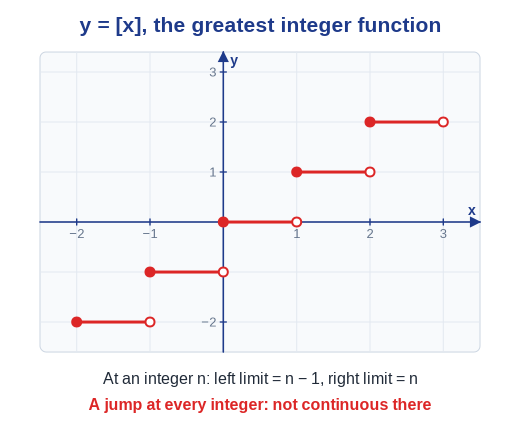
Example 15 (pages 112–113): the greatest integer function f(x) = [x]. If c is not an integer, [x] = [c] for all x close to c, so f is continuous at c. If c is an integer, then just to the left of c the value is c − 1 and just to the right it is c: left hand limit = c − 1, right hand limit = c. They differ, so f is discontinuous at every integer and continuous everywhere else.
Examples 16 to 20: algebra of continuous functions (pages 114–115)
Example 16 (page 114): every rational function is continuous. f(x) = p(x)/q(x) with p and q polynomials and q(x) ≠ 0. Polynomials are continuous (Example 14), and a quotient of continuous functions is continuous wherever the bottom is not 0. So f is continuous on its domain.
Example 17 (page 114): the sine function. Use limh → 0 sin h = 0 and limh → 0 cos h = 1. Put x = c + h:
limx → c sin x = limh → 0 sin (c + h) = limh → 0 (sin c cos h + cos c sin h) = sin c · 1 + cos c · 0 = sin c.
So sin x is continuous at every real number.
Example 18 (page 115): f(x) = tan x. tan x = sin x/cos x is a quotient of two continuous functions, so it is continuous wherever cos x ≠ 0, that is, for x ≠ (2n + 1)π/2. These are exactly the points of its domain, so tan x is a continuous function.
Example 19 (page 115): f(x) = sin (x²). f = g ∘ h with g(x) = sin x and h(x) = x². (g ∘ h, a composite, means “first apply h, then apply g”: (g ∘ h)(x) = g(h(x)).) Both are continuous, and a composite of continuous functions is continuous (Theorem 2). So f is continuous.
Example 20 (page 115): f(x) = |1 − x + |x||. Let g(x) = 1 − x + |x| and h(x) = |x|. Then f = h ∘ g. g is a sum of a polynomial and the modulus function, so it is continuous; h is continuous (Example 7). So f, a composite of two continuous functions, is continuous.
Exercise 5.1 (pages 116–118)
1. “Prove that the function f(x) = 5x – 3 is continuous at x = 0, at x = – 3 and at x = 5.”
f is a polynomial, so limx → c (5x − 3) = 5c − 3 = f(c) for every c.
- x = 0: f(0) = −3 and limx → 0 (5x − 3) = −3.
- x = −3: f(−3) = −18 and limx → −3 (5x − 3) = −18.
- x = 5: f(5) = 22 and limx → 5 (5x − 3) = 22.
At each point the limit equals the value, so f is continuous at x = 0, x = −3 and x = 5.
2. “Examine the continuity of the function f(x) = 2x² – 1 at x = 3.”
f(3) = 2(9) − 1 = 17 and limx → 3 (2x² − 1) = 17. f is continuous at x = 3.
3. “Examine the following functions for continuity. (a) f(x) = x – 5 (b) f(x) = 1/(x – 5), x ≠ 5 (c) f(x) = (x² – 25)/(x + 5), x ≠ –5 (d) f(x) = | x – 5 |”
(a) A polynomial: limx → c (x − 5) = c − 5 = f(c) for every real c. Continuous.
(b) For c ≠ 5, limx → c 1/(x − 5) = 1/(c − 5) = f(c). Continuous at every point of its domain.
(c) For c ≠ −5, limx → c (x² − 25)/(x + 5) = (c² − 25)/(c + 5) = f(c) (it is also equal to c − 5). Continuous at every point of its domain.
(d) f is the composite of the modulus function and the polynomial x − 5, both continuous. Directly at x = 5: left hand limit = lim (5 − x) = 0, right hand limit = lim (x − 5) = 0, f(5) = 0. Continuous.
So (a), (b), (c) and (d) are all continuous functions.
4. “Prove that the function f(x) = xⁿ is continuous at x = n, where n is a positive integer.”
f is a polynomial. f(n) = nn, and limx → n xn = nn. The limit equals the value, so f is continuous at x = n.
5. “Is the function f defined by f(x) = {x, if x ≤ 1; 5, if x > 1} continuous at x = 0? At x = 1? At x = 2?”
- x = 0: near 0, f(x) = x. limx → 0 x = 0 = f(0). Continuous.
- x = 1: Left hand limit = limx → 1⁻ x = 1, Right hand limit = limx → 1⁺ 5 = 5. They differ. Not continuous.
- x = 2: near 2, f(x) = 5. limx → 2 5 = 5 = f(2). Continuous.
“Find all points of discontinuity of f, where f is defined by”
In Questions 6 to 12 every piece is a polynomial (or a simple quotient), so f is continuous inside each piece. Only the points where the rule changes need checking.
6. “f(x) = {2x + 3, if x ≤ 2; 2x − 3, if x > 2}”
At x = 2: Left hand limit = 2(2) + 3 = 7, Right hand limit = 2(2) − 3 = 1. They differ, so f is discontinuous at x = 2 only.
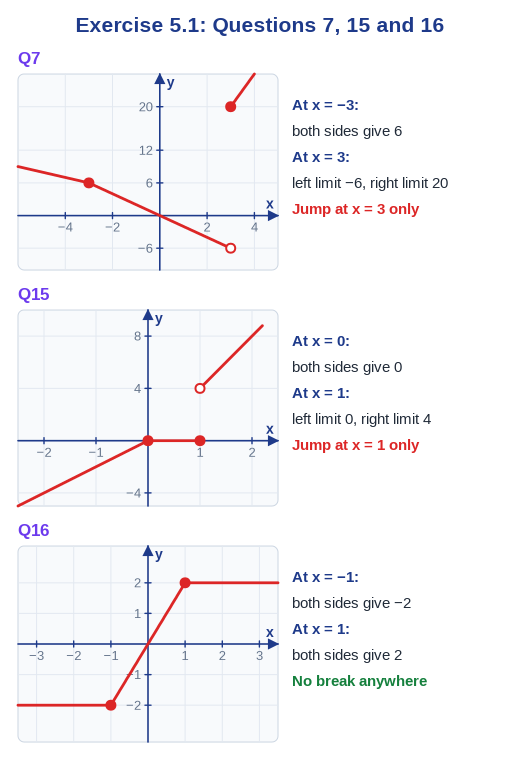
7. “f(x) = {|x| + 3, if x ≤ −3; −2x, if −3 < x < 3; 6x + 2, if x ≥ 3}”
At x = −3: Left hand limit = |−3| + 3 = 6, Right hand limit = −2(−3) = 6, f(−3) = 6. Continuous.
At x = 3: Left hand limit = −2(3) = −6, Right hand limit = 6(3) + 2 = 20. They differ, so f is discontinuous at x = 3 only.
8. “f(x) = {|x|/x, if x ≠ 0; 0, if x = 0}”
For x < 0, |x|/x = −x/x = −1; for x > 0, |x|/x = 1. At x = 0: left hand limit = −1, right hand limit = 1. They differ, so f is discontinuous at x = 0 only.
9. “f(x) = {x/|x|, if x < 0; −1, if x ≥ 0}”
For x < 0, x/|x| = x/(−x) = −1. So f(x) = −1 for every real x: a constant function. There is no point of discontinuity.
10. “f(x) = {x + 1, if x ≥ 1; x² + 1, if x < 1}”
At x = 1: Left hand limit = 1² + 1 = 2, Right hand limit = 1 + 1 = 2, f(1) = 2. All agree. There is no point of discontinuity.
11. “f(x) = {x³ − 3, if x ≤ 2; x² + 1, if x > 2}”
At x = 2: Left hand limit = 2³ − 3 = 5, Right hand limit = 2² + 1 = 5, f(2) = 5. There is no point of discontinuity.
12. “f(x) = {x¹⁰ − 1, if x ≤ 1; x², if x > 1}”
At x = 1: Left hand limit = 1¹⁰ − 1 = 0, Right hand limit = 1² = 1. They differ, so f is discontinuous at x = 1 only.
13. “Is the function defined by f(x) = {x + 5, if x ≤ 1; x – 5, if x > 1} a continuous function?”
At x = 1: Left hand limit = 1 + 5 = 6, Right hand limit = 1 − 5 = −4. They differ, so f is not continuous at x = 1. No, f is not a continuous function (it is continuous at every other point).
“Discuss the continuity of the function f, where f is defined by”
14. “f(x) = {3, if 0 ≤ x ≤ 1; 4, if 1 < x < 3; 5, if 3 ≤ x ≤ 10}”
The domain is [0, 10], and f is constant on each piece.
- x = 1: Left hand limit = 3, Right hand limit = 4. Not continuous.
- x = 3: Left hand limit = 4, Right hand limit = 5. Not continuous.
f is not continuous at x = 1 and x = 3, and continuous at every other point of [0, 10].
15. “f(x) = {2x, if x < 0; 0, if 0 ≤ x ≤ 1; 4x, if x > 1}”
- x = 0: Left hand limit = 2(0) = 0, Right hand limit = 0, f(0) = 0. Continuous.
- x = 1: Left hand limit = 0, Right hand limit = 4(1) = 4. Not continuous.
x = 1 is the only point of discontinuity.
16. “f(x) = {−2, if x ≤ −1; 2x, if −1 < x ≤ 1; 2, if x > 1}”
- x = −1: Left hand limit = −2, Right hand limit = 2(−1) = −2, f(−1) = −2. Continuous.
- x = 1: Left hand limit = 2(1) = 2, Right hand limit = 2, f(1) = 2. Continuous.
f is continuous at every real number.
17. “Find the relationship between a and b so that the function f defined by f(x) = {ax + 1, if x ≤ 3; bx + 3, if x > 3} is continuous at x = 3.”
Left hand limit = f(3) = 3a + 1, Right hand limit = 3b + 3. For continuity they must be equal: 3a + 1 = 3b + 3, so 3a = 3b + 2 and a = b + 2/3.
18. “For what value of λ is the function defined by f(x) = {λ(x² – 2x), if x ≤ 0; 4x + 1, if x > 0} continuous at x = 0? What about continuity at x = 1?”
At x = 0: Left hand limit = λ(0 − 0) = 0 = f(0) for every λ, while Right hand limit = 4(0) + 1 = 1. 0 ≠ 1 whatever λ is, so f is continuous at x = 0 for no value of λ.
At x = 1: near 1, f(x) = 4x + 1, so limx → 1 f(x) = 5 = f(1). f is continuous at x = 1 for every value of λ.
19. “Show that the function defined by g(x) = x – [x] is discontinuous at all integral points. Here [x] denotes the greatest integer less than or equal to x.”
Let n be any integer. Just to the left of n, [x] = n − 1; just to the right, [x] = n.
Left hand limit = limx → n⁻ (x − (n − 1)) = n − n + 1 = 1.
Right hand limit = limx → n⁺ (x − n) = 0, and g(n) = n − n = 0.
The left hand limit (1) is not equal to the right hand limit (0), so g is discontinuous at every integer.
20. “Is the function defined by f(x) = x² – sin x + 5 continuous at x = π?”
x², sin x and the constant 5 are continuous, so their combination is continuous. f(π) = π² − sin π + 5 = π² + 5, and limx → π f(x) = π² − 0 + 5 = π² + 5. Yes, f is continuous at x = π.
21. “Discuss the continuity of the following functions: (a) f(x) = sin x + cos x (b) f(x) = sin x – cos x (c) f(x) = sin x . cos x”
sin x and cos x are continuous at every real number. By the algebra of continuous functions (Theorem 1), their sum (a), difference (b) and product (c) are continuous too. All three are continuous for every real x.
22. “Discuss the continuity of the cosine, cosecant, secant and cotangent functions.”
Cosine. For any real c, put x = c + h:
limx → c cos x = limh → 0 (cos c cos h − sin c sin h) = cos c · 1 − sin c · 0 = cos c.
So cos x is continuous at every real number.
Cosecant. cosec x = 1/sin x is a quotient of continuous functions, so it is continuous wherever sin x ≠ 0: for all x except x = nπ, n ∈ Z.
Secant. sec x = 1/cos x is continuous wherever cos x ≠ 0: for all x except x = (2n + 1)π/2, n ∈ Z.
Cotangent. cot x = cos x/sin x is continuous wherever sin x ≠ 0: for all x except x = nπ, n ∈ Z.
(The excluded points are not in the domains of these functions, so each of them is continuous on its whole domain.)
23. “Find all points of discontinuity of f, where f(x) = {(sin x)/x, if x < 0; x + 1, if x ≥ 0}”
For x < 0, (sin x)/x is a quotient of continuous functions with x ≠ 0, so it is continuous. For x > 0, x + 1 is a polynomial.
At x = 0: Left hand limit = limx → 0⁻ (sin x)/x = 1, Right hand limit = 0 + 1 = 1, f(0) = 1. All agree. There is no point of discontinuity.
24. “Determine if f defined by f(x) = {x² sin (1/x), if x ≠ 0; 0, if x = 0} is a continuous function?”
For x ≠ 0, f is a product of the continuous functions x² and sin (1/x), so it is continuous.
At x = 0: since −1 ≤ sin (1/x) ≤ 1, we get −x² ≤ x² sin (1/x) ≤ x². Both −x² and x² tend to 0 as x → 0, so limx → 0 x² sin (1/x) = 0 = f(0).
Yes, f is continuous for all real x.
25. “Examine the continuity of f, where f is defined by f(x) = {sin x – cos x, if x ≠ 0; –1, if x = 0}”
For x ≠ 0, f is a difference of continuous functions. At x = 0: limx → 0 (sin x − cos x) = 0 − 1 = −1 = f(0). f is continuous for all real x.
“Find the values of k so that the function f is continuous at the indicated point in Exercises 26 to 29.”
26. “f(x) = {(k cos x)/(π − 2x), if x ≠ π/2; 3, if x = π/2} at x = π/2”
Put x = π/2 + h. Then cos x = −sin h and π − 2x = −2h, so
limx → π/2 (k cos x)/(π − 2x) = limh → 0 (−k sin h)/(−2h) = (k/2) limh → 0 (sin h)/h = k/2.
For continuity this must equal f(π/2) = 3: k/2 = 3, so k = 6.
27. “f(x) = {kx², if x ≤ 2; 3, if x > 2} at x = 2”
Left hand limit = f(2) = 4k, Right hand limit = 3. So 4k = 3 and k = 3/4.
28. “f(x) = {kx + 1, if x ≤ π; cos x, if x > π} at x = π”
Left hand limit = f(π) = kπ + 1, Right hand limit = cos π = −1. So kπ + 1 = −1 and k = −2/π.
29. “f(x) = {kx + 1, if x ≤ 5; 3x − 5, if x > 5} at x = 5”
Left hand limit = f(5) = 5k + 1, Right hand limit = 3(5) − 5 = 10. So 5k + 1 = 10 and k = 9/5.
30. “Find the values of a and b such that the function defined by f(x) = {5, if x ≤ 2; ax + b, if 2 < x < 10; 21, if x ≥ 10} is a continuous function.”
At x = 2: Left hand limit = 5, Right hand limit = 2a + b, so 2a + b = 5.
At x = 10: Left hand limit = 10a + b, Right hand limit = 21, so 10a + b = 21.
Subtract: 8a = 16, so a = 2 and b = 5 − 4 = 1. a = 2, b = 1.
31. “Show that the function defined by f(x) = cos (x²) is a continuous function.”
f = g ∘ h with g(x) = cos x and h(x) = x². Both are continuous at every real number, and f is defined everywhere. By Theorem 2 (a composite of continuous functions is continuous), f is continuous.
32. “Show that the function defined by f(x) = | cos x | is a continuous function.”
f = g ∘ h with g(x) = |x| and h(x) = cos x. The modulus function and the cosine function are both continuous, so by Theorem 2 f is continuous.
33. “Examine that sin | x | is a continuous function.”
sin |x| = (g ∘ h)(x) with g(x) = sin x and h(x) = |x|. Both are continuous at every real number, so by Theorem 2 sin |x| is a continuous function.
34. “Find all the points of discontinuity of f defined by f(x) = | x | – | x + 1 |.”
|x| is continuous. |x + 1| is the composite of the modulus function and the polynomial x + 1, so it is continuous too. A difference of two continuous functions is continuous. There is no point of discontinuity.
In pieces: f(x) = 1 for x ≤ −1, f(x) = −2x − 1 for −1 < x < 0, and f(x) = −1 for x ≥ 0. At x = −1 both sides give 1, and at x = 0 both sides give −1.
Example 21: the chain rule (pages 121–122)
Example 21 (pages 121–122): the derivative of f(x) = sin (x²). Put t = x². Then f = sin t, with d(sin t)/dt = cos t and dt/dx = 2x. By the chain rule, df/dx = cos t · 2x = 2x cos (x²).
Exercise 5.2 (page 122)
“Differentiate the functions with respect to x in Exercises 1 to 8.”
1. “sin (x² + 5)”
Put t = x² + 5. dy/dx = cos t · dt/dx = cos (x² + 5) · 2x = 2x cos (x² + 5).
2. “cos (sin x)”
Put t = sin x. dy/dx = −sin t · dt/dx = −sin (sin x) · cos x = −cos x sin (sin x).
3. “sin (ax + b)”
Put t = ax + b. dy/dx = cos t · a = a cos (ax + b).
4. “sec (tan (√x))”
There are three layers: sec of tan of √x. Use d(sec t)/dt = sec t tan t, d(tan s)/ds = sec² s and d(√x)/dx = 1/(2√x):
dy/dx = sec (tan √x) · tan (tan √x) · sec² (√x) · 1/(2√x)
= [sec (tan √x) · tan (tan √x) · sec² (√x)]/(2√x).
5. “(sin (ax + b))/(cos (cx + d))”
By the quotient rule,
dy/dx = [a cos (ax + b) · cos (cx + d) − sin (ax + b) · (−c sin (cx + d))]/cos² (cx + d)
= [a cos (ax + b) cos (cx + d) + c sin (ax + b) sin (cx + d)]/cos² (cx + d)
= a cos (ax + b) sec (cx + d) + c sin (ax + b) tan (cx + d) sec (cx + d).
6. “cos x³ . sin² (x⁵)”
By the product rule, with d(cos x³)/dx = −3x² sin x³ and d(sin² x⁵)/dx = 2 sin x⁵ · cos x⁵ · 5x⁴:
dy/dx = −3x² sin x³ · sin² x⁵ + cos x³ · 10x⁴ sin x⁵ cos x⁵
= 10x⁴ sin x⁵ cos x⁵ cos x³ − 3x² sin x³ sin² x⁵.
7. “2 √(cot (x²))”
dy/dx = 2 · 1/(2√(cot x²)) · (−cosec² x²) · 2x = −2x cosec² (x²)/√(cot (x²)).
The book’s answer looks different, but it is the same thing. To reach it:
- Write cosec² x² = 1/sin² x² and cot x² = cos x²/sin x². Then cosec² x²/√(cot x²) = 1/(sin² x² · √(cos x²/sin x²)).
- Take one sin x² inside the root: sin² x² · √(cos x²/sin x²) = sin x² · √(sin x² cos x²).
- Use sin x² cos x² = (1/2) sin 2x², so √(sin x² cos x²) = √(sin 2x²)/√2.
Answer: dy/dx = −2√2 x/(sin x² · √(sin 2x²)) (the same as −2x cosec² (x²)/√(cot (x²))).
8. “cos (√x)”
dy/dx = −sin (√x) · 1/(2√x) = −sin (√x)/(2√x).
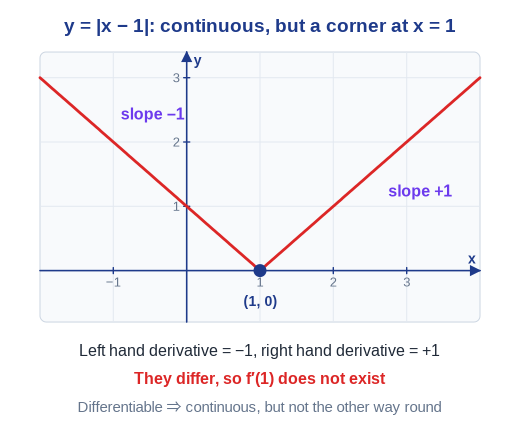
9. “Prove that the function f given by f(x) = | x – 1 |, x ∈ R is not differentiable at x = 1.”
f is differentiable at 1 only if the left hand and right hand limits of [f(1 + h) − f(1)]/h are finite and equal. Here f(1) = 0 and f(1 + h) = |h|.
Left hand derivative = limh → 0⁻ |h|/h = limh → 0⁻ (−h)/h = −1.
Right hand derivative = limh → 0⁺ |h|/h = limh → 0⁺ h/h = 1.
−1 ≠ 1, so the limit does not exist and f is not differentiable at x = 1. (It is continuous there: the graph has a sharp corner.)
10. “Prove that the greatest integer function defined by f(x) = [x], 0 < x < 3 is not differentiable at x = 1 and x = 2.”
A function is differentiable at a point when the slope from the left (left hand derivative) and the slope from the right (right hand derivative) are both finite and equal.
At x = 1. Here f(1) = [1] = 1.
- Take h a little less than 0, say h = −0.1. Then [1 + h] = [0.9] = 0. Left hand derivative = limh → 0⁻ (0 − 1)/h = limh → 0⁻ (−1/h). As h gets close to 0, −1/h grows without limit, so this is not a finite number.
- Take h a little more than 0. Then [1 + h] = 1. Right hand derivative = limh → 0⁺ (1 − 1)/h = 0.
- The left hand derivative is not finite, so f is not differentiable at x = 1.
At x = 2. Here f(2) = 2.
- For h a little less than 0, [2 + h] = 1. Left hand derivative = limh → 0⁻ (1 − 2)/h = limh → 0⁻ (−1/h), again not finite.
- For h a little more than 0, [2 + h] = 2. Right hand derivative = limh → 0⁺ (2 − 2)/h = 0.
- So f is not differentiable at x = 2.
Shorter way. [x] jumps at x = 1 and x = 2, so it is not continuous there (Example 15). A function that is differentiable at a point must be continuous there (Theorem 3).
Answer: f is not differentiable at x = 1 and at x = 2.
Examples 22 to 24: implicit functions and sin⁻¹ x (pages 123–124)
Example 22 (page 123): dy/dx if x − y = π. Solving, y = x − π, so dy/dx = 1. Directly: differentiating x − y = π gives 1 − dy/dx = 0, so dy/dx = 1.
Example 23 (page 123): dy/dx if y + sin y = cos x. Differentiate both sides with respect to x: dy/dx + cos y · dy/dx = −sin x, so dy/dx = −sin x/(1 + cos y), where y ≠ (2n + 1)π.
Example 24 (page 124): the derivative of sin⁻¹ x. Let y = sin⁻¹ x, so x = sin y. Differentiate both sides with respect to x: 1 = cos y · dy/dx, so dy/dx = 1/cos y. For x in (−1, 1), y lies in (−π/2, π/2), where cos y is positive, so cos y = √(1 − sin² y) = √(1 − x²). Hence d/dx (sin⁻¹ x) = 1/√(1 − x²), −1 < x < 1.
Exercise 5.3 (page 125)
“Find dy/dx in the following:”
In Questions 1 to 8, y is given implicitly: differentiate both sides with respect to x, remembering that d(y²)/dx = 2y · dy/dx and so on, then collect the dy/dx terms.
1. “2x + 3y = sin x”
2 + 3 dy/dx = cos x, so dy/dx = (cos x − 2)/3.
2. “2x + 3y = sin y”
2 + 3 dy/dx = cos y · dy/dx, so dy/dx (cos y − 3) = 2 and dy/dx = 2/(cos y − 3).
3. “ax + by² = cos y”
a + 2by · dy/dx = −sin y · dy/dx, so dy/dx (2by + sin y) = −a and dy/dx = −a/(2by + sin y).
4. “xy + y² = tan x + y”
y + x dy/dx + 2y dy/dx = sec² x + dy/dx, so dy/dx (x + 2y − 1) = sec² x − y and dy/dx = (sec² x − y)/(x + 2y − 1).
5. “x² + xy + y² = 100”
2x + y + x dy/dx + 2y dy/dx = 0, so dy/dx (x + 2y) = −(2x + y) and dy/dx = −(2x + y)/(x + 2y).
6. “x³ + x²y + xy² + y³ = 81”
3x² + (2xy + x² dy/dx) + (y² + 2xy dy/dx) + 3y² dy/dx = 0,
so dy/dx (x² + 2xy + 3y²) = −(3x² + 2xy + y²) and dy/dx = −(3x² + 2xy + y²)/(x² + 2xy + 3y²).
7. “sin² y + cos xy = κ”
κ is a constant. 2 sin y cos y · dy/dx − sin xy · (y + x dy/dx) = 0. With 2 sin y cos y = sin 2y:
dy/dx (sin 2y − x sin xy) = y sin xy, so dy/dx = (y sin xy)/(sin 2y − x sin xy).
8. “sin² x + cos² y = 1”
2 sin x cos x + 2 cos y (−sin y) dy/dx = 0, so sin 2x − sin 2y · dy/dx = 0 and dy/dx = sin 2x/sin 2y.
In Questions 9 to 15, a substitution turns the bracket into sin, cos or tan of a multiple angle, and the inverse function then undoes it.
9. “y = sin⁻¹ (2x/(1 + x²))”
Put x = tan θ, so θ = tan⁻¹ x. Then 2x/(1 + x²) = 2 tan θ/(1 + tan² θ) = sin 2θ, so y = sin⁻¹ (sin 2θ) = 2θ = 2 tan⁻¹ x.
dy/dx = 2/(1 + x²).
The step sin⁻¹ (sin 2θ) = 2θ needs 2θ in [−π/2, π/2], that is, −1 ≤ x ≤ 1; the derivative above holds for −1 < x < 1. The question gives no interval; see the last section.
10. “y = tan⁻¹ ((3x − x³)/(1 − 3x²)), −1/√3 < x < 1/√3”
Put x = tan θ. Then (3 tan θ − tan³ θ)/(1 − 3 tan² θ) = tan 3θ. Since −1/√3 < x < 1/√3, θ lies in (−π/6, π/6) and 3θ in (−π/2, π/2), so y = tan⁻¹ (tan 3θ) = 3θ = 3 tan⁻¹ x.
dy/dx = 3/(1 + x²).
11. “y = cos⁻¹ ((1 − x²)/(1 + x²)), 0 < x < 1”
Put x = tan θ. Then (1 − tan² θ)/(1 + tan² θ) = cos 2θ. Since 0 < x < 1, 2θ lies in (0, π/2), so y = cos⁻¹ (cos 2θ) = 2θ = 2 tan⁻¹ x.
dy/dx = 2/(1 + x²).
12. “y = sin⁻¹ ((1 − x²)/(1 + x²)), 0 < x < 1”
Put x = tan θ. Then (1 − x²)/(1 + x²) = cos 2θ = sin (π/2 − 2θ). Since 0 < 2θ < π/2, the angle π/2 − 2θ lies in (0, π/2), so y = π/2 − 2θ = π/2 − 2 tan⁻¹ x.
dy/dx = −2/(1 + x²).
13. “y = cos⁻¹ (2x/(1 + x²)), −1 < x < 1”
Put x = tan θ. Then 2x/(1 + x²) = sin 2θ = cos (π/2 − 2θ). Since −1 < x < 1, 2θ lies in (−π/2, π/2) and π/2 − 2θ in (0, π), so y = π/2 − 2θ = π/2 − 2 tan⁻¹ x.
dy/dx = −2/(1 + x²).
14. “y = sin⁻¹ (2x √(1 − x²)), −1/√2 < x < 1/√2”
Put x = sin θ. Then 2x √(1 − x²) = 2 sin θ cos θ = sin 2θ. Since −1/√2 < x < 1/√2, θ lies in (−π/4, π/4) and 2θ in (−π/2, π/2), so y = 2θ = 2 sin⁻¹ x.
dy/dx = 2/√(1 − x²).
15. “y = sec⁻¹ (1/(2x² − 1)), 0 < x < 1/√2”
Put x = cos θ. Then 2x² − 1 = 2 cos² θ − 1 = cos 2θ, so 1/(2x² − 1) = sec 2θ. Since 0 < x < 1/√2, θ lies in (π/4, π/2) and 2θ in (π/2, π), inside the principal range of sec⁻¹, so y = sec⁻¹ (sec 2θ) = 2θ = 2 cos⁻¹ x.
dy/dx = −2/√(1 − x²).
Examples 25 and 26: exponential and logarithmic functions (pages 129–130)
Example 25 (page 129): is x = elog x true for all real x? log x is defined only for x > 0, so the equation makes no sense for x ≤ 0. For x > 0, put y = elog x; then log y = log x · log e = log x, so y = x. It is true only for positive x.
Example 26 (pages 129–130): differentiate (i) e−x (ii) sin (log x), x > 0 (iii) cos⁻¹ (ex) (iv) ecos x. By the chain rule,
(i) e−x · (−1) = −e−x.
(ii) cos (log x) · (1/x) = cos (log x)/x.
(iii) −1/√(1 − (ex)²) · ex = −ex/√(1 − e2x).
(iv) ecos x · (−sin x) = −sin x · ecos x.
Exercise 5.4 (page 130)
“Differentiate the following w.r.t. x:”
1. “ex/sin x”
By the quotient rule, dy/dx = (ex sin x − ex cos x)/sin² x = ex (sin x − cos x)/sin² x, x ≠ nπ, n ∈ Z.
2. “esin⁻¹ x”
dy/dx = esin⁻¹ x · d(sin⁻¹ x)/dx = esin⁻¹ x/√(1 − x²), x ∈ (−1, 1).
3. “ex³”
dy/dx = ex³ · 3x² = 3x² ex³.
4. “sin (tan⁻¹ e−x)”
dy/dx = cos (tan⁻¹ e−x) · 1/(1 + (e−x)²) · (−e−x) = −e−x cos (tan⁻¹ e−x)/(1 + e−2x).
5. “log (cos ex)”
dy/dx = (1/cos ex) · (−sin ex) · ex = −ex tan ex. (The function is defined where cos ex > 0.)
6. “ex + ex² + … + ex⁵”
The five terms are ex, ex², ex³, ex⁴ and ex⁵. For each, d(exⁿ)/dx = exⁿ · nxn − 1:
dy/dx = ex + 2x ex² + 3x² ex³ + 4x³ ex⁴ + 5x⁴ ex⁵.
7. “√(e√x), x > 0”
dy/dx = 1/(2√(e√x)) · e√x · 1/(2√x) = e√x/(4√(x e√x)), x > 0.
8. “log (log x), x > 1”
dy/dx = (1/log x) · (1/x) = 1/(x log x), x > 1.
9. “(cos x)/(log x), x > 0”
By the quotient rule, dy/dx = [−sin x · log x − cos x · (1/x)]/(log x)² = −(x sin x · log x + cos x)/(x (log x)²), x > 0, x ≠ 1.
10. “cos (log x + ex), x > 0”
dy/dx = −sin (log x + ex) · (1/x + ex) = −(1/x + ex) sin (log x + ex), x > 0.
Examples 27 to 30: logarithmic differentiation (pages 131–133)
Example 27 (page 131): y = √[(x − 3)(x² + 4)/(3x² + 4x + 5)]. Take logarithms of both sides: log y = (1/2)[log (x − 3) + log (x² + 4) − log (3x² + 4x + 5)]. Differentiate both sides with respect to x:
(1/y) dy/dx = (1/2)[1/(x − 3) + 2x/(x² + 4) − (6x + 4)/(3x² + 4x + 5)],
so dy/dx = (1/2) √[(x − 3)(x² + 4)/(3x² + 4x + 5)] · [1/(x − 3) + 2x/(x² + 4) − (6x + 4)/(3x² + 4x + 5)].
Example 28 (page 131): y = ax, a > 0. log y = x log a, so (1/y) dy/dx = log a and d/dx (ax) = ax log a.
Example 29 (page 132): y = xsin x, x > 0. log y = sin x · log x. Differentiate both sides with respect to x: (1/y) dy/dx = sin x · (1/x) + cos x · log x, so dy/dx = xsin x [(sin x)/x + cos x · log x].
Example 30 (pages 132–133): dy/dx if yx + xy + xx = ab. Put u = yx, v = xy, w = xx, so u + v + w = ab and du/dx + dv/dx + dw/dx = 0. Taking logs of each:
- log u = x log y: du/dx = yx [(x/y) dy/dx + log y].
- log v = y log x: dv/dx = xy [y/x + log x · dy/dx].
- log w = x log x: dw/dx = xx (1 + log x).
Adding and collecting the dy/dx terms: (x yx − 1 + xy log x) dy/dx = −[yx log y + y xy − 1 + xx (1 + log x)], so
dy/dx = −[yx log y + y xy − 1 + xx (1 + log x)]/(x yx − 1 + xy log x).
Exercise 5.5 (page 134)
“Differentiate the functions given in Exercises 1 to 11 w.r.t. x.”
Two results are used throughout. If y = uv, then log y = v log u. And d/dx (xx) = xx (1 + log x), from log y = x log x.
1. “cos x . cos 2x . cos 3x”
Take logarithms of both sides: log y = log cos x + log cos 2x + log cos 3x. Differentiate both sides with respect to x:
(1/y) dy/dx = −tan x − 2 tan 2x − 3 tan 3x,
so dy/dx = −cos x cos 2x cos 3x [tan x + 2 tan 2x + 3 tan 3x].
2. “√[((x − 1)(x − 2))/((x − 3)(x − 4)(x − 5))]”
log y = (1/2)[log (x − 1) + log (x − 2) − log (x − 3) − log (x − 4) − log (x − 5)]. Differentiate both sides with respect to x:
(1/y) dy/dx = (1/2)[1/(x − 1) + 1/(x − 2) − 1/(x − 3) − 1/(x − 4) − 1/(x − 5)],
so dy/dx = (1/2) √[((x − 1)(x − 2))/((x − 3)(x − 4)(x − 5))] · [1/(x − 1) + 1/(x − 2) − 1/(x − 3) − 1/(x − 4) − 1/(x − 5)].
3. “(log x)cos x”
log y = cos x · log (log x). Differentiate both sides with respect to x:
(1/y) dy/dx = −sin x · log (log x) + cos x · 1/(x log x),
so dy/dx = (log x)cos x [(cos x)/(x log x) − sin x · log (log x)].
4. “xx − 2sin x”
d/dx (xx) = xx (1 + log x). For 2sin x, use d(at)/dt = at log a with the chain rule: d/dx (2sin x) = 2sin x · log 2 · cos x.
dy/dx = xx (1 + log x) − 2sin x cos x · log 2.
5. “(x + 3)² . (x + 4)³ . (x + 5)⁴”
log y = 2 log (x + 3) + 3 log (x + 4) + 4 log (x + 5). Differentiate both sides with respect to x:
(1/y) dy/dx = 2/(x + 3) + 3/(x + 4) + 4/(x + 5).
Multiply by y and take out the common factors:
dy/dx = (x + 3)(x + 4)²(x + 5)³ [2(x + 4)(x + 5) + 3(x + 3)(x + 5) + 4(x + 3)(x + 4)]
= (x + 3)(x + 4)²(x + 5)³ [(2x² + 18x + 40) + (3x² + 24x + 45) + (4x² + 28x + 48)]
= (x + 3)(x + 4)²(x + 5)³ (9x² + 70x + 133).
6. “(x + 1/x)x + x(1 + 1/x)”
A sum of two powers cannot be logged in one go (log of a sum does not split). So treat the two terms separately: let u = (x + 1/x)x and v = x(1 + 1/x). Then dy/dx = du/dx + dv/dx.
Term u. log u = x log (x + 1/x). Differentiate (product rule): (1/u) du/dx = log (x + 1/x) + x · (1 − 1/x²)/(x + 1/x). Multiply top and bottom of the last fraction by x: it becomes (x² − 1)/(x² + 1). So du/dx = u [log (x + 1/x) + (x² − 1)/(x² + 1)].
Term v. log v = (1 + 1/x) log x. Differentiate: (1/v) dv/dx = (−1/x²) log x + (1 + 1/x)(1/x) = (x + 1 − log x)/x². So dv/dx = v (x + 1 − log x)/x².
Answer: dy/dx = (x + 1/x)x [(x² − 1)/(x² + 1) + log (x + 1/x)] + x(1 + 1/x) · (x + 1 − log x)/x².
7. “(log x)x + xlog x”
Let u = (log x)x and v = xlog x.
log u = x log (log x): (1/u) du/dx = log (log x) + x · 1/(x log x) = log (log x) + 1/log x, so du/dx = (log x)x − 1 [1 + log x · log (log x)].
log v = log x · log x = (log x)²: (1/v) dv/dx = 2 log x/x, so dv/dx = 2xlog x − 1 log x.
dy/dx = (log x)x − 1 [1 + log x · log (log x)] + 2xlog x − 1 · log x.
8. “(sin x)x + sin⁻¹ √x”
Let u = (sin x)x. log u = x log sin x: (1/u) du/dx = log sin x + x cot x, so du/dx = (sin x)x (x cot x + log sin x).
Let v = sin⁻¹ √x. dv/dx = 1/√(1 − x) · 1/(2√x) = 1/(2√(x − x²)).
dy/dx = (sin x)x (x cot x + log sin x) + 1/(2√(x − x²)).
9. “xsin x + (sin x)cos x”
Let u = xsin x. log u = sin x · log x: du/dx = xsin x [(sin x)/x + cos x · log x].
Let v = (sin x)cos x. log v = cos x · log sin x: (1/v) dv/dx = −sin x · log sin x + cos x · cot x.
dy/dx = xsin x [(sin x)/x + cos x · log x] + (sin x)cos x [cos x cot x − sin x · log sin x].
10. “xx cos x + (x² + 1)/(x² − 1)”
Let u = xx cos x. log u = x cos x · log x: (1/u) du/dx = cos x · log x − x sin x · log x + x cos x · (1/x) = cos x (1 + log x) − x sin x log x.
Let v = (x² + 1)/(x² − 1). dv/dx = [2x(x² − 1) − 2x(x² + 1)]/(x² − 1)² = −4x/(x² − 1)².
dy/dx = xx cos x [cos x (1 + log x) − x sin x log x] − 4x/(x² − 1)².
11. “(x cos x)x + (x sin x)1/x”
Treat the two terms separately: y = u + v, so dy/dx = du/dx + dv/dx.
Term u = (x cos x)x. log u = x log (x cos x) = x (log x + log cos x). Differentiate (product rule): (1/u) du/dx = log (x cos x) + x (1/x − tan x) = 1 − x tan x + log (x cos x).
Term v = (x sin x)1/x. log v = (1/x)(log x + log sin x). Differentiate: (1/v) dv/dx = (−1/x²) log (x sin x) + (1/x)(1/x + cot x) = [x cot x + 1 − log (x sin x)]/x².
Multiply each bracket by its own u or v and add.
Answer: dy/dx = (x cos x)x [1 − x tan x + log (x cos x)] + (x sin x)1/x · [x cot x + 1 − log (x sin x)]/x².
“Find dy/dx of the functions given in Exercises 12 to 15.”
12. “xy + yx = 1”
Let u = xy and v = yx, so du/dx + dv/dx = 0.
log u = y log x: du/dx = xy [log x · dy/dx + y/x] = xy log x · dy/dx + y xy − 1.
log v = x log y: dv/dx = yx [log y + (x/y) dy/dx] = yx log y + x yx − 1 dy/dx.
Adding: (xy log x + x yx − 1) dy/dx = −(y xy − 1 + yx log y), so
dy/dx = −(y xy − 1 + yx log y)/(xy log x + x yx − 1).
13. “yx = xy”
Take logarithms of both sides: x log y = y log x. Differentiate both sides with respect to x:
log y + (x/y) dy/dx = log x · dy/dx + y/x,
so dy/dx (x/y − log x) = y/x − log y, that is, dy/dx · (x − y log x)/y = (y − x log y)/x. Hence
dy/dx = (y/x) · (y − x log y)/(x − y log x).
14. “(cos x)y = (cos y)x”
Take logarithms of both sides: y log cos x = x log cos y. Differentiate both sides with respect to x:
log cos x · dy/dx − y tan x = log cos y − x tan y · dy/dx,
so dy/dx (x tan y + log cos x) = y tan x + log cos y and
dy/dx = (y tan x + log cos y)/(x tan y + log cos x).
15. “xy = e(x − y)”
Take logarithms of both sides: log x + log y = x − y. Differentiate both sides with respect to x:
1/x + (1/y) dy/dx = 1 − dy/dx,
so dy/dx (1/y + 1) = 1 − 1/x, that is, dy/dx · (y + 1)/y = (x − 1)/x. Hence
dy/dx = y(x − 1)/(x(y + 1)).
16. “Find the derivative of the function given by f(x) = (1 + x) (1 + x²) (1 + x⁴) (1 + x⁸) and hence find f′(1).”
log f(x) = log (1 + x) + log (1 + x²) + log (1 + x⁴) + log (1 + x⁸). Differentiate both sides with respect to x:
f′(x)/f(x) = 1/(1 + x) + 2x/(1 + x²) + 4x³/(1 + x⁴) + 8x⁷/(1 + x⁸),
so f′(x) = (1 + x)(1 + x²)(1 + x⁴)(1 + x⁸) [1/(1 + x) + 2x/(1 + x²) + 4x³/(1 + x⁴) + 8x⁷/(1 + x⁸)].
At x = 1: f(1) = 2 × 2 × 2 × 2 = 16 and the bracket is 1/2 + 1 + 2 + 4 = 15/2, so f′(1) = 16 × 15/2 = 120.
17. “Differentiate (x² – 5x + 8) (x³ + 7x + 9) in three ways mentioned below: (i) by using product rule (ii) by expanding the product to obtain a single polynomial. (iii) by logarithmic differentiation. Do they all give the same answer?”
(i) Product rule:
dy/dx = (2x − 5)(x³ + 7x + 9) + (x² − 5x + 8)(3x² + 7)
= (2x⁴ − 5x³ + 14x² − 17x − 45) + (3x⁴ − 15x³ + 31x² − 35x + 56)
= 5x⁴ − 20x³ + 45x² − 52x + 11.
(ii) Expanding: y = x⁵ − 5x⁴ + 15x³ − 26x² + 11x + 72, so dy/dx = 5x⁴ − 20x³ + 45x² − 52x + 11.
(iii) log y = log (x² − 5x + 8) + log (x³ + 7x + 9), so
(1/y) dy/dx = (2x − 5)/(x² − 5x + 8) + (3x² + 7)/(x³ + 7x + 9).
Multiplying by y = (x² − 5x + 8)(x³ + 7x + 9) gives dy/dx = (2x − 5)(x³ + 7x + 9) + (3x² + 7)(x² − 5x + 8), the same expression as in (i).
Yes, all three ways give 5x⁴ − 20x³ + 45x² − 52x + 11.
18. “If u, v and w are functions of x, then show that d/dx (u. v. w) = (du/dx) v. w + u . (dv/dx) . w + u . v (dw/dx) in two ways - first by repeated application of product rule, second by logarithmic differentiation.”
Product rule twice. Treat uvw as (uv) · w:
d/dx (uvw) = [d(uv)/dx] · w + (uv) · dw/dx = [(du/dx) v + u (dv/dx)] w + uv (dw/dx)
= (du/dx) v w + u (dv/dx) w + u v (dw/dx).
Logarithmic differentiation. Let y = uvw. log y = log u + log v + log w. Differentiate both sides with respect to x:
(1/y) dy/dx = (1/u) du/dx + (1/v) dv/dx + (1/w) dw/dx.
Multiply by y = uvw: dy/dx = (du/dx) v w + u (dv/dx) w + u v (dw/dx), which is the required result.
Examples 31 to 34: parametric forms (pages 135–136)
Example 31 (page 135): x = a cos θ, y = a sin θ. dx/dθ = −a sin θ, dy/dθ = a cos θ, so dy/dx = (a cos θ)/(−a sin θ) = −cot θ.
Example 32 (page 135): x = at², y = 2at. dx/dt = 2at, dy/dt = 2a, so dy/dx = 2a/(2at) = 1/t.
Example 33 (page 136): x = a(θ + sin θ), y = a(1 − cos θ). dx/dθ = a(1 + cos θ), dy/dθ = a sin θ, so dy/dx = sin θ/(1 + cos θ) = [2 sin (θ/2) cos (θ/2)]/[2 cos² (θ/2)] = tan (θ/2).
Example 34 (page 136): dy/dx if x2/3 + y2/3 = a2/3. Take x = a cos³ θ and y = a sin³ θ; then x2/3 + y2/3 = a2/3(cos² θ + sin² θ) = a2/3, so this is a parametric form of the curve. dx/dθ = −3a cos² θ sin θ, dy/dθ = 3a sin² θ cos θ, so dy/dx = −tan θ = −∛(y/x).
Exercise 5.6 (page 137)
“If x and y are connected parametrically by the equations given in Exercises 1 to 10, without eliminating the parameter, Find dy/dx.”
1. “x = 2at², y = at⁴”
dx/dt = 4at, dy/dt = 4at³. dy/dx = 4at³/(4at) = t².
2. “x = a cos θ, y = b cos θ”
dx/dθ = −a sin θ, dy/dθ = −b sin θ. dy/dx = (−b sin θ)/(−a sin θ) = b/a.
3. “x = sin t, y = cos 2t”
dx/dt = cos t, dy/dt = −2 sin 2t = −4 sin t cos t. dy/dx = (−4 sin t cos t)/cos t = −4 sin t.
4. “x = 4t, y = 4/t”
dx/dt = 4, dy/dt = −4/t². dy/dx = (−4/t²)/4 = −1/t².
5. “x = cos θ − cos 2θ, y = sin θ − sin 2θ”
dx/dθ = −sin θ + 2 sin 2θ, dy/dθ = cos θ − 2 cos 2θ. dy/dx = (cos θ − 2 cos 2θ)/(2 sin 2θ − sin θ).
6. “x = a (θ − sin θ), y = a (1 + cos θ)”
dx/dθ = a(1 − cos θ), dy/dθ = −a sin θ.
dy/dx = −sin θ/(1 − cos θ) = −[2 sin (θ/2) cos (θ/2)]/[2 sin² (θ/2)] = −cot (θ/2).
7. “x = (sin³ t)/√(cos 2t), y = (cos³ t)/√(cos 2t)”
Step 1: dx/dt and dy/dt. Use the quotient rule, with d(√(cos 2t))/dt = −sin 2t/√(cos 2t):
dx/dt = [3 sin² t cos t · cos 2t + sin³ t · sin 2t]/(cos 2t)3/2,
dy/dt = [−3 cos² t sin t · cos 2t + cos³ t · sin 2t]/(cos 2t)3/2.
Step 2: divide. The bottoms (cos 2t)3/2 cancel. Write sin 2t = 2 sin t cos t; then sin t cos t is a common factor of both tops and also cancels:
dy/dx = [−3 cos t cos 2t + 2 cos³ t]/[3 sin t cos 2t + 2 sin³ t].
Step 3: simplify the top. Put cos 2t = 2 cos² t − 1: −6 cos³ t + 3 cos t + 2 cos³ t = −(4 cos³ t − 3 cos t) = −cos 3t (triple angle formula cos 3t = 4 cos³ t − 3 cos t).
Step 4: simplify the bottom. Put cos 2t = 1 − 2 sin² t: 3 sin t − 6 sin³ t + 2 sin³ t = 3 sin t − 4 sin³ t = sin 3t.
Answer: dy/dx = −cos 3t/sin 3t = −cot 3t.
8. “x = a (cos t + log tan (t/2)), y = a sin t”
d/dt [log tan (t/2)] = [1/tan (t/2)] · sec² (t/2) · (1/2) = 1/[2 sin (t/2) cos (t/2)] = 1/sin t.
dx/dt = a(−sin t + 1/sin t) = a(1 − sin² t)/sin t = a cos² t/sin t, and dy/dt = a cos t.
dy/dx = a cos t · sin t/(a cos² t) = tan t.
9. “x = a sec θ, y = b tan θ”
dx/dθ = a sec θ tan θ, dy/dθ = b sec² θ.
dy/dx = (b sec² θ)/(a sec θ tan θ) = (b/a) · sec θ/tan θ = (b/a) cosec θ.
10. “x = a (cos θ + θ sin θ), y = a (sin θ − θ cos θ)”
dx/dθ = a(−sin θ + sin θ + θ cos θ) = aθ cos θ, dy/dθ = a(cos θ − cos θ + θ sin θ) = aθ sin θ.
dy/dx = (aθ sin θ)/(aθ cos θ) = tan θ.
11. “If x = √(asin⁻¹ t), y = √(acos⁻¹ t), show that dy/dx = – y/x”
x = a(1/2) sin⁻¹ t, so with d(au)/dt = au log a · du/dt,
dx/dt = a(1/2) sin⁻¹ t · log a · 1/(2√(1 − t²)) = x log a/(2√(1 − t²)).
In the same way y = a(1/2) cos⁻¹ t gives dy/dt = y log a · (−1)/(2√(1 − t²)) = −y log a/(2√(1 − t²)).
dy/dx = (dy/dt)/(dx/dt) = −y/x, which is the required result.
Check: xy = √(asin⁻¹ t + cos⁻¹ t) = √(aπ/2), a constant, so x dy/dx + y = 0.
Examples 35 to 38: second order derivatives (pages 138–139)
Example 35 (page 138): d²y/dx² if y = x³ + tan x. dy/dx = 3x² + sec² x, so d²y/dx² = 6x + 2 sec x · sec x tan x = 6x + 2 sec² x tan x.
Example 36 (page 138): y = A sin x + B cos x; show that d²y/dx² + y = 0. dy/dx = A cos x − B sin x and d²y/dx² = −A sin x − B cos x = −y, so d²y/dx² + y = 0.
Example 37 (page 138): y = 3e2x + 2e3x; show that d²y/dx² − 5 dy/dx + 6y = 0. dy/dx = 6e2x + 6e3x and d²y/dx² = 12e2x + 18e3x. Then d²y/dx² − 5 dy/dx + 6y = (12 − 30 + 18)e2x + (18 − 30 + 12)e3x = 0.
Example 38 (page 139): y = sin⁻¹ x; show that (1 − x²) d²y/dx² − x dy/dx = 0. y₁ = 1/√(1 − x²), so (1 − x²) y₁² = 1. Differentiate again with respect to x: (1 − x²) · 2y₁y₂ − 2x y₁² = 0. Divide by 2y₁ (which is not 0): (1 − x²) y₂ − x y₁ = 0.
Exercise 5.7 (pages 139–140)
“Find the second order derivatives of the functions given in Exercises 1 to 10.”
1. “x² + 3x + 2”
dy/dx = 2x + 3. d²y/dx² = 2.
2. “x²⁰”
dy/dx = 20x¹⁹. d²y/dx² = 20 × 19 x¹⁸ = 380x¹⁸.
3. “x . cos x”
dy/dx = cos x − x sin x. d²y/dx² = −sin x − (sin x + x cos x) = −(x cos x + 2 sin x).
4. “log x”
dy/dx = 1/x. d²y/dx² = −1/x².
5. “x³ log x”
dy/dx = 3x² log x + x³ · (1/x) = 3x² log x + x².
d²y/dx² = 6x log x + 3x² · (1/x) + 2x = 6x log x + 5x = x(5 + 6 log x).
6. “ex sin 5x”
dy/dx = ex sin 5x + 5ex cos 5x = ex (sin 5x + 5 cos 5x).
d²y/dx² = ex (sin 5x + 5 cos 5x) + ex (5 cos 5x − 25 sin 5x) = ex (10 cos 5x − 24 sin 5x) = 2ex (5 cos 5x − 12 sin 5x).
7. “e6x cos 3x”
dy/dx = 6e6x cos 3x − 3e6x sin 3x = e6x (6 cos 3x − 3 sin 3x).
d²y/dx² = 6e6x (6 cos 3x − 3 sin 3x) + e6x (−18 sin 3x − 9 cos 3x) = e6x (27 cos 3x − 36 sin 3x) = 9e6x (3 cos 3x − 4 sin 3x).
8. “tan⁻¹ x”
dy/dx = 1/(1 + x²) = (1 + x²)⁻¹. d²y/dx² = −(1 + x²)⁻² · 2x = −2x/(1 + x²)².
9. “log (log x)”
dy/dx = 1/(x log x) = (x log x)⁻¹.
d²y/dx² = −(x log x)⁻² · d(x log x)/dx = −(x log x)⁻² · (log x + 1) = −(1 + log x)/(x log x)².
10. “sin (log x)”
dy/dx = cos (log x)/x.
By the quotient rule, d²y/dx² = [−sin (log x) · (1/x) · x − cos (log x) · 1]/x² = −[sin (log x) + cos (log x)]/x².
11. “If y = 5 cos x – 3 sin x, prove that d²y/dx² + y = 0”
dy/dx = −5 sin x − 3 cos x. d²y/dx² = −5 cos x + 3 sin x = −(5 cos x − 3 sin x) = −y.
Hence d²y/dx² + y = 0.
12. “If y = cos⁻¹ x, Find d²y/dx² in terms of y alone.”
y = cos⁻¹ x means x = cos y, with y in (0, π) for −1 < x < 1, where sin y > 0.
dy/dx = −1/√(1 − x²) = −1/√(1 − cos² y) = −1/sin y = −cosec y.
Differentiate again with respect to x: d²y/dx² = −(−cosec y cot y) · dy/dx = cosec y cot y · (−cosec y) = −cot y cosec² y.
13. “If y = 3 cos (log x) + 4 sin (log x), show that x² y₂ + xy₁ + y = 0”
y₁ = [−3 sin (log x) + 4 cos (log x)]/x, so x y₁ = −3 sin (log x) + 4 cos (log x).
Differentiate again with respect to x: x y₂ + y₁ = [−3 cos (log x) − 4 sin (log x)]/x = −y/x.
Multiply by x: x² y₂ + x y₁ = −y, so x² y₂ + x y₁ + y = 0.
14. “If y = Aemx + Benx, show that d²y/dx² – (m + n) dy/dx + mny = 0”
dy/dx = mAemx + nBenx and d²y/dx² = m²Aemx + n²Benx.
d²y/dx² − (m + n) dy/dx + mny = Aemx [m² − m(m + n) + mn] + Benx [n² − n(m + n) + mn] = Aemx · 0 + Benx · 0 = 0.
15. “If y = 500e7x + 600e– 7x, show that d²y/dx² = 49y”
dy/dx = 3500e7x − 4200e−7x. d²y/dx² = 24500e7x + 29400e−7x = 49(500e7x + 600e−7x) = 49y.
16. “If ey (x + 1) = 1, show that d²y/dx² = (dy/dx)²”
ey = 1/(x + 1), so y = −log (x + 1).
dy/dx = −1/(x + 1) and d²y/dx² = 1/(x + 1)².
(dy/dx)² = 1/(x + 1)². Hence d²y/dx² = (dy/dx)².
17. “If y = (tan⁻¹ x)², show that (x² + 1)² y₂ + 2x (x² + 1) y₁ = 2”
y₁ = 2 tan⁻¹ x · 1/(1 + x²), so (1 + x²) y₁ = 2 tan⁻¹ x.
Differentiate again with respect to x: (1 + x²) y₂ + 2x y₁ = 2/(1 + x²).
Multiply by (1 + x²): (x² + 1)² y₂ + 2x (x² + 1) y₁ = 2.
Miscellaneous Examples 39 to 43 (pages 140–144)
Example 39 (pages 140–141): differentiate (i) √(3x + 2) + 1/√(2x² + 4) (ii) log₇ (log x).
(i) y = (3x + 2)1/2 + (2x² + 4)−1/2, defined for x > −2/3. dy/dx = (1/2)(3x + 2)−1/2 · 3 − (1/2)(2x² + 4)−3/2 · 4x = 3/(2√(3x + 2)) − 2x/(2x² + 4)3/2.
(ii) By the change of base rule, y = log (log x)/log 7, x > 1. dy/dx = (1/log 7) · (1/log x) · (1/x) = 1/(x log 7 · log x).
Example 40 (pages 141–142): differentiate (i) cos⁻¹ (sin x) (ii) tan⁻¹ (sin x/(1 + cos x)) (iii) sin⁻¹ (2x + 1/(1 + 4x)).
(i) sin x = cos (π/2 − x), so f(x) = cos⁻¹ [cos (π/2 − x)] = π/2 − x and f′(x) = −1. (This simplification needs π/2 − x in [0, π], that is, −π/2 ≤ x ≤ π/2; see the last section.)
(ii) sin x/(1 + cos x) = [2 sin (x/2) cos (x/2)]/[2 cos² (x/2)] = tan (x/2), so f(x) = tan⁻¹ [tan (x/2)] = x/2 and f′(x) = 1/2 (for −π < x < π; cos x ≠ −1).
(iii) Put 2x = tan θ. Then 2x + 1/(1 + 4x) = 2 tan θ/(1 + tan² θ) = sin 2θ, so f(x) = sin⁻¹ (sin 2θ) = 2θ = 2 tan⁻¹ (2x). With d(2x)/dx = 2x log 2, f′(x) = 2 · 1/(1 + 4x) · 2x log 2 = 2x + 1 log 2/(1 + 4x). (The step sin⁻¹ (sin 2θ) = 2θ needs 2θ ≤ π/2, that is, x ≤ 0; see the last section.)
Example 41 (page 143): f′(x) if f(x) = (sin x)sin x, 0 < x < π. log y = sin x · log (sin x). (1/y) dy/dx = cos x · log (sin x) + sin x · (cos x/sin x) = (1 + log (sin x)) cos x, so f′(x) = (1 + log (sin x)) (sin x)sin x cos x.
Example 42 (pages 143–144): dy/dx if y = at + 1/t, x = (t + 1/t)a, a > 0. dy/dt = at + 1/t · log a · (1 − 1/t²) and dx/dt = a (t + 1/t)a − 1 · (1 − 1/t²). For t ≠ ±1, dx/dt ≠ 0, and dy/dx = at + 1/t log a/[a (t + 1/t)a − 1].
Example 43 (page 144): differentiate sin² x with respect to ecos x. Let u = sin² x and v = ecos x. du/dx = 2 sin x cos x, dv/dx = −sin x · ecos x. du/dv = (du/dx)/(dv/dx) = (2 sin x cos x)/(−sin x · ecos x) = −2 cos x/ecos x.
Miscellaneous Exercise on Chapter 5 (pages 144–145)
“Differentiate w.r.t. x the function in Exercises 1 to 11.”
1. “(3x² − 9x + 5)⁹”
dy/dx = 9(3x² − 9x + 5)⁸ · (6x − 9) = 27(3x² − 9x + 5)⁸ (2x − 3).
2. “sin³ x + cos⁶ x”
dy/dx = 3 sin² x cos x + 6 cos⁵ x (−sin x) = 3 sin x cos x (sin x − 2 cos⁴ x).
3. “(5x)3 cos 2x”
log y = 3 cos 2x · log 5x. Differentiate both sides with respect to x:
(1/y) dy/dx = −6 sin 2x · log 5x + 3 cos 2x · (1/x),
so dy/dx = (5x)3 cos 2x [(3 cos 2x)/x − 6 sin 2x · log 5x].
4. “sin⁻¹ (x √x), 0 ≤ x ≤ 1”
x√x = x3/2, and d(x3/2)/dx = (3/2)√x.
dy/dx = 1/√(1 − x³) · (3/2)√x = (3/2) √(x/(1 − x³)).
5. “(cos⁻¹ (x/2))/√(2x + 7), −2 < x < 2”
d/dx [cos⁻¹ (x/2)] = −1/√(1 − x²/4) · (1/2) = −1/√(4 − x²), and d/dx [√(2x + 7)] = 1/√(2x + 7). By the quotient rule,
dy/dx = [−√(2x + 7)/√(4 − x²) − cos⁻¹ (x/2)/√(2x + 7)]/(2x + 7)
= −[1/(√(4 − x²) · √(2x + 7)) + cos⁻¹ (x/2)/(2x + 7)3/2].
6. “cot⁻¹ [(√(1 + sin x) + √(1 − sin x))/(√(1 + sin x) − √(1 − sin x))], 0 < x < π/2”
1 ± sin x = cos² (x/2) + sin² (x/2) ± 2 sin (x/2) cos (x/2) = [cos (x/2) ± sin (x/2)]². For 0 < x < π/2, cos (x/2) > sin (x/2) > 0, so
√(1 + sin x) = cos (x/2) + sin (x/2) and √(1 − sin x) = cos (x/2) − sin (x/2).
The fraction is [2 cos (x/2)]/[2 sin (x/2)] = cot (x/2), so y = cot⁻¹ [cot (x/2)] = x/2.
dy/dx = 1/2.
7. “(log x)log x, x > 1”
log y = log x · log (log x). Differentiate both sides with respect to x:
(1/y) dy/dx = (1/x) log (log x) + log x · 1/(x log x) = [1 + log (log x)]/x,
so dy/dx = (log x)log x [1/x + log (log x)/x], x > 1.
8. “cos (a cos x + b sin x), for some constant a and b.”
dy/dx = −sin (a cos x + b sin x) · (−a sin x + b cos x) = (a sin x − b cos x) sin (a cos x + b sin x).
9. “(sin x − cos x)(sin x − cos x), π/4 < x < 3π/4”
On this interval sin x > cos x, so the base is positive. log y = (sin x − cos x) log (sin x − cos x). Differentiate both sides with respect to x:
(1/y) dy/dx = (cos x + sin x) log (sin x − cos x) + (sin x − cos x) · (cos x + sin x)/(sin x − cos x)
= (cos x + sin x)[1 + log (sin x − cos x)],
so dy/dx = (sin x − cos x)(sin x − cos x) (cos x + sin x)[1 + log (sin x − cos x)].
10. “xx + xa + ax + aa, for some fixed a > 0 and x > 0”
Term by term: d(xx)/dx = xx(1 + log x); d(xa)/dx = axa − 1; d(ax)/dx = ax log a; aa is a constant, with derivative 0.
dy/dx = xx (1 + log x) + axa − 1 + ax log a.
11. “x(x² − 3) + (x − 3)x², for x > 3”
Let u = x(x² − 3). log u = (x² − 3) log x: (1/u) du/dx = 2x log x + (x² − 3)/x.
Let v = (x − 3)x². log v = x² log (x − 3): (1/v) dv/dx = 2x log (x − 3) + x²/(x − 3).
dy/dx = x(x² − 3) [(x² − 3)/x + 2x log x] + (x − 3)x² [x²/(x − 3) + 2x log (x − 3)].
12. “Find dy/dx, if y = 12 (1 – cos t), x = 10 (t – sin t), –π/2 < t < π/2”
dy/dt = 12 sin t and dx/dt = 10(1 − cos t).
dy/dx = (12 sin t)/(10(1 − cos t)) = (6/5) · [2 sin (t/2) cos (t/2)]/[2 sin² (t/2)] = (6/5) cot (t/2) (t ≠ 0).
13. “Find dy/dx, if y = sin⁻¹ x + sin⁻¹ √(1 – x²), 0 < x < 1”
d/dx [sin⁻¹ √(1 − x²)] = 1/√(1 − (1 − x²)) · (−2x)/(2√(1 − x²)) = (1/√(x²)) · (−x/√(1 − x²)) = −1/√(1 − x²), because √(x²) = x for x > 0.
dy/dx = 1/√(1 − x²) − 1/√(1 − x²) = 0.
(Indeed sin⁻¹ √(1 − x²) = cos⁻¹ x here, so y = π/2, a constant.)
14. “If x √(1 + y) + y √(1 + x) = 0, for , – 1 < x < 1, prove that dy/dx = – 1/(1 + x)²”
The plan: first find y as a formula in x, then differentiate.
- Move one term across: x √(1 + y) = −y √(1 + x).
- Square both sides to remove the roots: x²(1 + y) = y²(1 + x), that is, x² − y² + x²y − xy² = 0.
- Factorise: (x − y)(x + y) + xy(x − y) = 0, so (x − y)(x + y + xy) = 0.
- So either y = x or x + y + xy = 0. Put y = x in the given equation: it becomes 2x√(1 + x) = 0, which is true only at x = 0. So y = x is not the curve we want, and x + y + xy = 0.
- Solve for y: y(1 + x) = −x, so y = −x/(1 + x).
- Quotient rule: dy/dx = −[(1 + x) · 1 − x · 1]/(1 + x)² = −1/(1 + x)².
Answer: dy/dx = −1/(1 + x)², which is the required result.
15. “If (x – a)² + (y – b)² = c², for some c > 0, prove that [1 + (dy/dx)²]3/2/(d²y/dx²) is a constant independent of a and b.”
The curve is a circle with centre (a, b) and radius c. Write y₁ = dy/dx and y₂ = d²y/dx².
- Differentiate with respect to x: 2(x − a) + 2(y − b) y₁ = 0, so y₁ = −(x − a)/(y − b).
- Differentiate (x − a) + (y − b) y₁ = 0 again (product rule on the second term): 1 + y₁ · y₁ + (y − b) y₂ = 0, so y₂ = −(1 + y₁²)/(y − b).
- Use step 1 and the circle’s equation: 1 + y₁² = [(y − b)² + (x − a)²]/(y − b)² = c²/(y − b)², so (1 + y₁²)1/2 = c/|y − b|.
- Put these in: [1 + y₁²]3/2/y₂ = (1 + y₁²)3/2 · [−(y − b)/(1 + y₁²)] = −(y − b)(1 + y₁²)1/2 = −(y − b) · c/|y − b|.
- On the upper half of the circle (y > b) this is −c. On the lower half (y < b) it is +c.
Answer: the expression equals −c (upper half) or +c (lower half). It contains only the radius c, so it is a constant independent of a and b.
16. “If cos y = x cos (a + y), with cos a ≠ ± 1, prove that dy/dx = cos² (a + y)/sin a.”
x = cos y/cos (a + y). Differentiate with respect to y by the quotient rule:
dx/dy = [−sin y cos (a + y) + cos y sin (a + y)]/cos² (a + y) = sin ((a + y) − y)/cos² (a + y) = sin a/cos² (a + y).
Since cos a ≠ ±1, sin a ≠ 0, so dy/dx = 1/(dx/dy) = cos² (a + y)/sin a, which is the required result.
17. “If x = a (cos t + t sin t) and y = a (sin t – t cos t), find d²y/dx².”
dx/dt = a(−sin t + sin t + t cos t) = at cos t and dy/dt = a(cos t − cos t + t sin t) = at sin t, so dy/dx = tan t.
d²y/dx² = d(tan t)/dx = sec² t · dt/dx = sec² t/(at cos t) = sec³ t/(at), 0 < t < π/2.
18. “If f(x) = | x |³, show that f ″(x) exists for all real x and find it.”
f(x) = x³ for x ≥ 0 and f(x) = −x³ for x < 0.
- x > 0: f′(x) = 3x², f″(x) = 6x.
- x < 0: f′(x) = −3x², f″(x) = −6x.
- x = 0: f′(0) = limh → 0 (|h|³ − 0)/h = limh → 0 h|h| = 0. So f′(x) = 3x|x| for all x, and f″(0) = limh → 0 (3h|h| − 0)/h = limh → 0 3|h| = 0.
Both one-sided limits agree at 0, so f″ exists everywhere: f″(x) = 6x for x ≥ 0 and −6x for x < 0, that is, f″(x) = 6|x|.
19. “Using the fact that sin (A + B) = sin A cos B + cos A sin B and the differentiation, obtain the sum formula for cosines.”
Keep B fixed and treat both sides as functions of A. Differentiate with respect to A:
cos (A + B) · 1 = cos A cos B + (−sin A) sin B.
Hence cos (A + B) = cos A cos B − sin A sin B.
20. “Does there exist a function which is continuous everywhere but not differentiable at exactly two points? Justify your answer.”
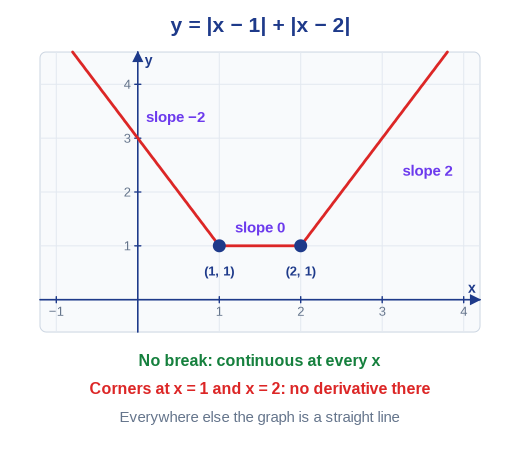
Yes. Take f(x) = |x − 1| + |x − 2|.
- It is a sum of two continuous functions, so it is continuous everywhere.
- In pieces: f(x) = 3 − 2x for x < 1, f(x) = 1 for 1 ≤ x ≤ 2, and f(x) = 2x − 3 for x > 2. Each piece is a straight line, so f is differentiable at every x other than 1 and 2.
- At x = 1: left hand derivative = −2, right hand derivative = 0. Not differentiable.
- At x = 2: left hand derivative = 0, right hand derivative = 2. Not differentiable.
So f is continuous everywhere and fails to be differentiable at exactly two points, x = 1 and x = 2.
21. “If y = |f(x), g(x), h(x); l, m, n; a, b, c|, prove that dy/dx = |f′(x), g′(x), h′(x); l, m, n; a, b, c|”
Here |…; …; …| is a determinant of order 3 typed row by row, with semicolons between the rows; l, m, n, a, b, c are constants. Expand along the first row:
y = f(x)(mc − nb) − g(x)(lc − na) + h(x)(lb − ma).
The brackets are constants, so
dy/dx = f′(x)(mc − nb) − g′(x)(lc − na) + h′(x)(lb − ma),
which is exactly the expansion of |f′(x), g′(x), h′(x); l, m, n; a, b, c| along its first row. This proves the result.
22. “If y = ea cos⁻¹ x, – 1 ≤ x ≤ 1, show that (1 – x²) d²y/dx² – x dy/dx – a² y = 0.”
y₁ = ea cos⁻¹ x · (−a)/√(1 − x²) = −ay/√(1 − x²), so √(1 − x²) · y₁ = −ay.
Square both sides: (1 − x²) y₁² = a² y².
Differentiate again with respect to x: −2x y₁² + (1 − x²) · 2y₁y₂ = 2a² y y₁.
Divide by 2y₁ (for a ≠ 0, y₁ is not 0): (1 − x²) y₂ − x y₁ − a² y = 0, which is the required result.
A note on this edition and the answer key
The 2026-27 reprint is the rationalised book: Chapter 5 has Exercises 5.1 to 5.7 and a Miscellaneous Exercise of 22 questions. All the answers above agree with the book’s answer key (pages 214–218). A few places need a remark:
- Exercise 5.3, Question 9. The question gives no interval. The key’s answer 2/(1 + x²) is the derivative for −1 < x < 1. Extra: for x > 1 or x < −1 the same function has the derivative −2/(1 + x²), because there sin⁻¹ (sin 2θ) is no longer 2θ.
- Exercise 5.4. In the key, the second term of Question 6 is printed with ex² raised as a power of 2x; it should read 2x ex². In Question 10 the key prints −1/x + ex without brackets; the factor is −(1/x + ex). In Question 5 the key adds the condition ex ≠ (2n + 1)π/2; the function log (cos ex) itself needs cos ex > 0.
- Example 40. Extra: in part (i), cos⁻¹ (sin x) = π/2 − x holds for −π/2 ≤ x ≤ π/2, so f′(x) = −1 on that interval (on the next interval, π/2 < x < 3π/2, the slope is +1). In part (iii) the book’s result is the derivative for x < 0; for x > 0 the sign changes. Both were checked numerically.
- Miscellaneous Exercise, Question 15. The constant is −c on the upper half of the circle and +c on the lower half; its size c is the radius.
- Extra: older editions of this book also had a section on Rolle’s Theorem and the Mean Value Theorem. It is not in the 2026-27 reprint, so it is not covered here.
Back to the notes: Chapter 5 notes, continuity of a function, chain rule, implicit and inverse trigonometric derivatives and logarithmic and parametric differentiation.
Practice
-
The derivative of sin (3x + 2) with respect to x is:
Show answer
Answer: (b) 3 cos (3x + 2)
-
The function f(x) = {x + 1, if x ≤ 2; 5 − x, if x > 2} at x = 2 is:
Show answer
Answer: (a) continuous
-
If x = t² and y = t³, then dy/dx equals:
Show answer
Answer: (c) 3t/2
-
Find dy/dx if y = x^(2x), x > 0.
Show answer
Answer: Take logs: log y = 2x log x. Differentiate: (1/y) dy/dx = 2 log x + 2x · (1/x) = 2 log x + 2. So dy/dx = 2x^(2x) (1 + log x).
-
If y = e^(3x), show that d²y/dx² − 9y = 0.
Show answer
Answer: dy/dx = 3e^(3x) and d²y/dx² = 9e^(3x) = 9y. So d²y/dx² − 9y = 0.
Stuck on a question?
Take a photo and Lagnever AI explains it step by step. Try it for 7 days for ₹2.
Get it on Google Play Open in browser
For parents: after the trial, the plan renews monthly by UPI or card autopay. You can cancel anytime in the app.