
Class 12 Maths Chapter 5 NCERT Solutions Hinglish mein: Continuity and Differentiability
Class 12 ki NCERT textbook Mathematics Part I ke Chapter 5, Continuity and Differentiability, ki Exercise 5.1 se 5.7 aur Miscellaneous Exercise ke saare 137 sawalon ke jawab, aur saare 43 worked examples. Page numbers 2026-27 reprint ke hisaab se hain (pages 104–146). Exercises ke sawal Hinglish mein diye hain; examples chhote mein apne shabdon mein, number aur page ke saath likhe hain. Neeche ka har derivative ek script ne dobara jaancha (kai points par numerical differentiation se), aur continuity ka har jawab point ke dono taraf function ki value nikaal kar. Jin thodi jagahon par book ki answer key par kuch kehna zaroori hai, wo aakhri section mein hain. Chhote notes: Chapter 5 ke notes.
Is page par maths kaise likha hai. Jo function apne domain ke alag hisson par alag rule se diya ho, wo braces mein likha hai aur rules ke beech semicolon hai: f(x) = {x, agar x ≤ 1; 5, agar x > 1} ka matlab hai x ≤ 1 par f(x) = x aur x > 1 par f(x) = 5. Fraction slash se likha hai, aur upar ya neeche ek se zyada term ho to brackets lage hain. log x natural logarithm (base e) hai, jaisa book mein hai, aur sin⁻¹ x inverse sine hai. y′ ya y₁ ka matlab dy/dx hai, aur y″ ya y₂ ka matlab d²y/dx². “x → 1⁻” matlab x left se 1 ki taraf aata hai aur “x → 1⁺” matlab right se.
Baar-baar kaam aane wale results:
- f, x = c par continuous hai jab left hand limit, right hand limit aur f(c) teeno hon aur barabar hon. Polynomials, sin x, cos x, |x|, ex aur log x apne domain par continuous hain, aur continuous functions ke sum, difference, product, quotient (jahan neeche 0 na ho) aur composite bhi.
- Chain rule: agar y = v(t) aur t = u(x), to dy/dx = (dy/dt) · (dt/dx).
- d/dx (sin⁻¹ x) = 1/√(1 − x²), d/dx (cos⁻¹ x) = −1/√(1 − x²), d/dx (tan⁻¹ x) = 1/(1 + x²), d/dx (ex) = ex, d/dx (log x) = 1/x.
- Parametric form: dy/dx = (dy/dt)/(dx/dt), jab dx/dt ≠ 0.
Examples 1 se 9: ek point par aur poore domain par continuity (pages 106–108)
Example 1 (page 106): kya f(x) = 2x + 3, x = 1 par continuous hai? f(1) = 5, aur x → 1 par 2x + 3 → 5. Limit aur value barabar hain, to f, x = 1 par continuous hai.
Example 2 (page 106): kya f(x) = x², x = 0 par continuous hai? f(0) = 0 aur limx → 0 x² = 0 = f(0). Haan, x = 0 par continuous hai.
Example 3 (page 106): f(x) = |x| ki x = 0 par continuity. x < 0 par f(x) = −x aur x ≥ 0 par f(x) = x. Left hand limit = limx → 0⁻ (−x) = 0, Right hand limit = limx → 0⁺ x = 0, f(0) = 0. Teeno barabar hain, to f, x = 0 par continuous hai.
Example 4 (pages 106–107): f(x) = {x³ + 3, agar x ≠ 0; 1, agar x = 0} x = 0 par continuous nahi hai. f(0) = 1, lekin limx → 0 (x³ + 3) = 3. Limit f(0) ke barabar nahi hai, to f, x = 0 par continuous nahi hai; baaki har point par continuous hai.
Example 5 (page 107): constant function f(x) = k kahan continuous hai? Kisi bhi real number c ke liye f(c) = k aur limx → c k = k. To f har real number par continuous hai.
Example 6 (page 107): identity function f(x) = x. f(c) = c aur limx → c x = c, to f har real number par continuous hai.
Example 7 (page 108): kya f(x) = |x| ek continuous function hai? c < 0 ke liye limx → c (−x) = −c = f(c). c > 0 ke liye limx → c x = c = f(c). 0 par Example 3 se continuous hai. To f har point par continuous hai.
Example 8 (page 108): f(x) = x³ + x² − 1. Har real c ke liye limx → c (x³ + x² − 1) = c³ + c² − 1 = f(c). To f ek continuous function hai.
Example 9 (page 108): f(x) = 1/x, x ≠ 0. Har c ≠ 0 ke liye limx → c (1/x) = 1/c = f(c). To f apne domain ke har point par continuous hai, yaani f ek continuous function hai. (0 domain mein nahi hai. 0 ke paas right mein values kisi bhi number se badi aur left mein kisi bhi number se chhoti ho jaati hain, to dono one-sided limits real number ke roop mein nahi hain.)
Examples 10 se 15: tukdon mein diye functions (pages 110–113)
Example 10 (page 110): f(x) = {x + 2, agar x ≤ 1; x − 2, agar x > 1}. Har tukda polynomial hai, to f, c < 1 aur c > 1 par continuous hai. x = 1 par: Left hand limit = 1 + 2 = 3, Right hand limit = 1 − 2 = −1. Ye alag hain, to x = 1 hi akela point of discontinuity hai.
Example 11 (page 110): f(x) = {x + 2, agar x < 1; 0, agar x = 1; x − 2, agar x > 1}. Example 10 ki tarah f, x ≠ 1 par continuous hai, aur x = 1 par left hand limit 3 aur right hand limit −1 hai. x = 1 hi akela point of discontinuity hai.
Example 12 (page 111): f(x) = {x + 2, agar x < 0; −x + 2, agar x > 0}. Function 0 par defined nahi hai, to iska domain 0 ko chhod kar saare real numbers hain. c < 0 ke liye lim f(x) = c + 2 = f(c); c > 0 ke liye lim f(x) = −c + 2 = f(c). f apne domain ke har point par continuous hai, to ye continuous function hai.
Example 13 (pages 111–112): f(x) = {x, agar x ≥ 0; x², agar x < 0}. x < 0 par ye x² hai aur x > 0 par x, dono continuous. 0 par: Left hand limit = 0² = 0, Right hand limit = 0, f(0) = 0. f har point par continuous hai.
Example 14 (page 112): har polynomial function continuous hota hai. p(x) = a₀ + a₁x + … + anxn aur kisi bhi real c ke liye limits ke algebra se limx → c p(x) = p(c). To p har real number par continuous hai.
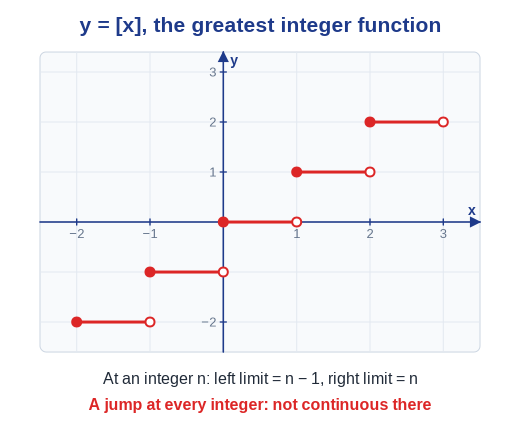
Example 15 (pages 112–113): greatest integer function f(x) = [x]. Agar c integer nahi hai, to c ke paas ke saare x ke liye [x] = [c], to f, c par continuous hai. Agar c integer hai, to c ke theek left mein value c − 1 aur theek right mein c hai: left hand limit = c − 1, right hand limit = c. Ye alag hain, to f har integer par discontinuous hai aur baaki sab jagah continuous.
Examples 16 se 20: continuous functions ka algebra (pages 114–115)
Example 16 (page 114): har rational function continuous hota hai. f(x) = p(x)/q(x), jahan p aur q polynomials hain aur q(x) ≠ 0. Polynomials continuous hote hain (Example 14), aur continuous functions ka quotient wahan continuous hota hai jahan neeche 0 na ho. To f apne domain par continuous hai.
Example 17 (page 114): sine function. limh → 0 sin h = 0 aur limh → 0 cos h = 1 use karo. x = c + h rakho:
limx → c sin x = limh → 0 sin (c + h) = limh → 0 (sin c cos h + cos c sin h) = sin c · 1 + cos c · 0 = sin c.
To sin x har real number par continuous hai.
Example 18 (page 115): f(x) = tan x. tan x = sin x/cos x do continuous functions ka quotient hai, to ye wahan continuous hai jahan cos x ≠ 0, yaani x ≠ (2n + 1)π/2. Yahi iske domain ke points hain, to tan x ek continuous function hai.
Example 19 (page 115): f(x) = sin (x²). f = g ∘ h, jahan g(x) = sin x aur h(x) = x². (g ∘ h, yaani composite, ka matlab hai “pehle h lagao, phir g”: (g ∘ h)(x) = g(h(x)).) Dono continuous hain, aur continuous functions ka composite continuous hota hai (Theorem 2). To f continuous hai.
Example 20 (page 115): f(x) = |1 − x + |x||. g(x) = 1 − x + |x| aur h(x) = |x| lo. Tab f = h ∘ g. g ek polynomial aur modulus function ka sum hai, to continuous hai; h continuous hai (Example 7). To f, do continuous functions ka composite, continuous hai.
Exercise 5.1 (pages 116–118)
1. Sabit karo ki function f(x) = 5x − 3, x = 0 par, x = −3 par aur x = 5 par continuous hai.
f polynomial hai, to har c ke liye limx → c (5x − 3) = 5c − 3 = f(c).
- x = 0: f(0) = −3 aur limx → 0 (5x − 3) = −3.
- x = −3: f(−3) = −18 aur limx → −3 (5x − 3) = −18.
- x = 5: f(5) = 22 aur limx → 5 (5x − 3) = 22.
Har point par limit aur value barabar hain, to f, x = 0, x = −3 aur x = 5 par continuous hai.
2. Function f(x) = 2x² − 1 ki x = 3 par continuity jaancho.
f(3) = 2(9) − 1 = 17 aur limx → 3 (2x² − 1) = 17. f, x = 3 par continuous hai.
3. Neeche ke functions ki continuity jaancho. (a) f(x) = x − 5 (b) f(x) = 1/(x − 5), x ≠ 5 (c) f(x) = (x² − 25)/(x + 5), x ≠ −5 (d) f(x) = |x − 5|
(a) Polynomial hai: har real c ke liye limx → c (x − 5) = c − 5 = f(c). Continuous.
(b) c ≠ 5 ke liye limx → c 1/(x − 5) = 1/(c − 5) = f(c). Apne domain ke har point par continuous.
(c) c ≠ −5 ke liye limx → c (x² − 25)/(x + 5) = (c² − 25)/(c + 5) = f(c) (ye c − 5 ke barabar bhi hai). Apne domain ke har point par continuous.
(d) f modulus function aur polynomial x − 5 ka composite hai, dono continuous. Seedhe x = 5 par: left hand limit = lim (5 − x) = 0, right hand limit = lim (x − 5) = 0, f(5) = 0. Continuous.
To (a), (b), (c) aur (d) sab continuous functions hain.
4. Sabit karo ki function f(x) = xⁿ, x = n par continuous hai, jahan n ek positive integer hai.
f polynomial hai. f(n) = nn, aur limx → n xn = nn. Limit aur value barabar hain, to f, x = n par continuous hai.
5. Kya f(x) = {x, agar x ≤ 1; 5, agar x > 1} se defined function f, x = 0 par continuous hai? x = 1 par? x = 2 par?
- x = 0: 0 ke paas f(x) = x. limx → 0 x = 0 = f(0). Continuous.
- x = 1: Left hand limit = limx → 1⁻ x = 1, Right hand limit = limx → 1⁺ 5 = 5. Ye alag hain. Continuous nahi.
- x = 2: 2 ke paas f(x) = 5. limx → 2 5 = 5 = f(2). Continuous.
f ke saare points of discontinuity nikaalo, jahan f yun defined hai:
Questions 6 se 12 mein har tukda polynomial (ya seedha quotient) hai, to f har tukde ke andar continuous hai. Sirf wo points jaanchne hain jahan rule badalta hai.
6. f(x) = {2x + 3, agar x ≤ 2; 2x − 3, agar x > 2}
x = 2 par: Left hand limit = 2(2) + 3 = 7, Right hand limit = 2(2) − 3 = 1. Ye alag hain, to f sirf x = 2 par discontinuous hai.
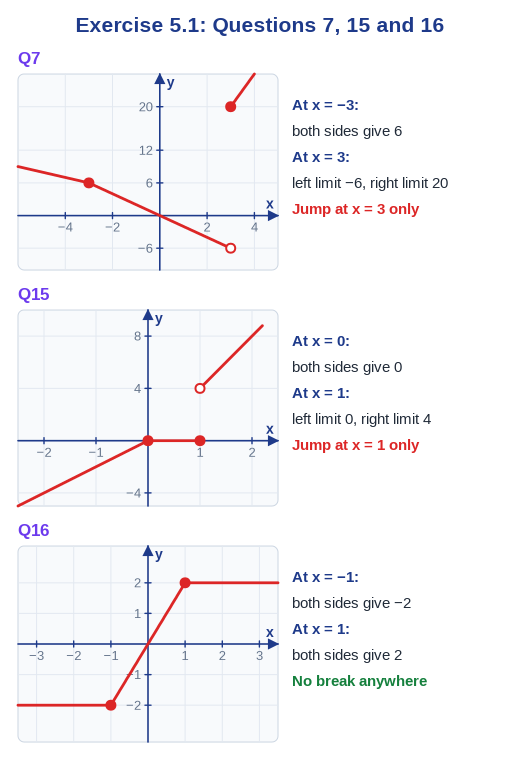
7. f(x) = {|x| + 3, agar x ≤ −3; −2x, agar −3 < x < 3; 6x + 2, agar x ≥ 3}
x = −3 par: Left hand limit = |−3| + 3 = 6, Right hand limit = −2(−3) = 6, f(−3) = 6. Continuous.
x = 3 par: Left hand limit = −2(3) = −6, Right hand limit = 6(3) + 2 = 20. Ye alag hain, to f sirf x = 3 par discontinuous hai.
8. f(x) = {|x|/x, agar x ≠ 0; 0, agar x = 0}
x < 0 par |x|/x = −x/x = −1; x > 0 par |x|/x = 1. x = 0 par: left hand limit = −1, right hand limit = 1. Ye alag hain, to f sirf x = 0 par discontinuous hai.
9. f(x) = {x/|x|, agar x < 0; −1, agar x ≥ 0}
x < 0 par x/|x| = x/(−x) = −1. To har real x ke liye f(x) = −1: ek constant function. Koi point of discontinuity nahi hai.
10. f(x) = {x + 1, agar x ≥ 1; x² + 1, agar x < 1}
x = 1 par: Left hand limit = 1² + 1 = 2, Right hand limit = 1 + 1 = 2, f(1) = 2. Sab barabar hain. Koi point of discontinuity nahi hai.
11. f(x) = {x³ − 3, agar x ≤ 2; x² + 1, agar x > 2}
x = 2 par: Left hand limit = 2³ − 3 = 5, Right hand limit = 2² + 1 = 5, f(2) = 5. Koi point of discontinuity nahi hai.
12. f(x) = {x¹⁰ − 1, agar x ≤ 1; x², agar x > 1}
x = 1 par: Left hand limit = 1¹⁰ − 1 = 0, Right hand limit = 1² = 1. Ye alag hain, to f sirf x = 1 par discontinuous hai.
13. Kya f(x) = {x + 5, agar x ≤ 1; x − 5, agar x > 1} se defined function ek continuous function hai?
x = 1 par: Left hand limit = 1 + 5 = 6, Right hand limit = 1 − 5 = −4. Ye alag hain, to f, x = 1 par continuous nahi hai. Nahi, f continuous function nahi hai (baaki har point par continuous hai).
Function f ki continuity par charcha karo, jahan f yun defined hai:
14. f(x) = {3, agar 0 ≤ x ≤ 1; 4, agar 1 < x < 3; 5, agar 3 ≤ x ≤ 10}
Domain [0, 10] hai, aur f har tukde par constant hai.
- x = 1: Left hand limit = 3, Right hand limit = 4. Continuous nahi.
- x = 3: Left hand limit = 4, Right hand limit = 5. Continuous nahi.
f, x = 1 aur x = 3 par continuous nahi hai, aur [0, 10] ke baaki har point par continuous hai.
15. f(x) = {2x, agar x < 0; 0, agar 0 ≤ x ≤ 1; 4x, agar x > 1}
- x = 0: Left hand limit = 2(0) = 0, Right hand limit = 0, f(0) = 0. Continuous.
- x = 1: Left hand limit = 0, Right hand limit = 4(1) = 4. Continuous nahi.
x = 1 hi akela point of discontinuity hai.
16. f(x) = {−2, agar x ≤ −1; 2x, agar −1 < x ≤ 1; 2, agar x > 1}
- x = −1: Left hand limit = −2, Right hand limit = 2(−1) = −2, f(−1) = −2. Continuous.
- x = 1: Left hand limit = 2(1) = 2, Right hand limit = 2, f(1) = 2. Continuous.
f har real number par continuous hai.
17. a aur b ke beech wo relation nikaalo jisse f(x) = {ax + 1, agar x ≤ 3; bx + 3, agar x > 3} se defined function f, x = 3 par continuous ho.
Left hand limit = f(3) = 3a + 1, Right hand limit = 3b + 3. Continuity ke liye ye barabar hone chahiye: 3a + 1 = 3b + 3, to 3a = 3b + 2 aur a = b + 2/3.
18. λ ki kis value ke liye f(x) = {λ(x² − 2x), agar x ≤ 0; 4x + 1, agar x > 0} se defined function x = 0 par continuous hai? x = 1 par continuity ka kya?
x = 0 par: Left hand limit = λ(0 − 0) = 0 = f(0) har λ ke liye, jabki Right hand limit = 4(0) + 1 = 1. λ kuch bhi ho, 0 ≠ 1, to λ ki kisi bhi value ke liye f, x = 0 par continuous nahi hai.
x = 1 par: 1 ke paas f(x) = 4x + 1, to limx → 1 f(x) = 5 = f(1). λ ki har value ke liye f, x = 1 par continuous hai.
19. Dikhao ki g(x) = x − [x] se defined function saare integral points par discontinuous hai. Yahan [x] ka matlab hai x se chhota ya barabar sabse bada integer.
n koi bhi integer lo. n ke theek left mein [x] = n − 1; theek right mein [x] = n.
Left hand limit = limx → n⁻ (x − (n − 1)) = n − n + 1 = 1.
Right hand limit = limx → n⁺ (x − n) = 0, aur g(n) = n − n = 0.
Left hand limit (1) right hand limit (0) ke barabar nahi hai, to g har integer par discontinuous hai.
20. Kya f(x) = x² − sin x + 5 se defined function x = π par continuous hai?
x², sin x aur constant 5 continuous hain, to inka combination bhi continuous hai. f(π) = π² − sin π + 5 = π² + 5, aur limx → π f(x) = π² − 0 + 5 = π² + 5. Haan, f, x = π par continuous hai.
21. Neeche ke functions ki continuity par charcha karo: (a) f(x) = sin x + cos x (b) f(x) = sin x − cos x (c) f(x) = sin x · cos x
sin x aur cos x har real number par continuous hain. Continuous functions ke algebra (Theorem 1) se inka sum (a), difference (b) aur product (c) bhi continuous hain. Teeno har real x ke liye continuous hain.
22. Cosine, cosecant, secant aur cotangent functions ki continuity par charcha karo.
Cosine. Kisi bhi real c ke liye x = c + h rakho:
limx → c cos x = limh → 0 (cos c cos h − sin c sin h) = cos c · 1 − sin c · 0 = cos c.
To cos x har real number par continuous hai.
Cosecant. cosec x = 1/sin x continuous functions ka quotient hai, to wahan continuous hai jahan sin x ≠ 0: x = nπ, n ∈ Z ko chhod kar har x par.
Secant. sec x = 1/cos x wahan continuous hai jahan cos x ≠ 0: x = (2n + 1)π/2, n ∈ Z ko chhod kar har x par.
Cotangent. cot x = cos x/sin x wahan continuous hai jahan sin x ≠ 0: x = nπ, n ∈ Z ko chhod kar har x par.
(Chhode gaye points in functions ke domain mein hain hi nahi, to har function apne poore domain par continuous hai.)
23. f ke saare points of discontinuity nikaalo, jahan f(x) = {(sin x)/x, agar x < 0; x + 1, agar x ≥ 0}
x < 0 par (sin x)/x continuous functions ka quotient hai aur x ≠ 0, to continuous hai. x > 0 par x + 1 polynomial hai.
x = 0 par: Left hand limit = limx → 0⁻ (sin x)/x = 1, Right hand limit = 0 + 1 = 1, f(0) = 1. Sab barabar hain. Koi point of discontinuity nahi hai.
24. Pata karo ki f(x) = {x² sin (1/x), agar x ≠ 0; 0, agar x = 0} se defined f continuous function hai ya nahi.
x ≠ 0 par f continuous functions x² aur sin (1/x) ka product hai, to continuous hai.
x = 0 par: kyunki −1 ≤ sin (1/x) ≤ 1, isliye −x² ≤ x² sin (1/x) ≤ x². x → 0 par −x² aur x² dono 0 ki taraf jaate hain, to limx → 0 x² sin (1/x) = 0 = f(0).
Haan, f har real x ke liye continuous hai.
25. f ki continuity jaancho, jahan f(x) = {sin x − cos x, agar x ≠ 0; −1, agar x = 0}
x ≠ 0 par f continuous functions ka difference hai. x = 0 par: limx → 0 (sin x − cos x) = 0 − 1 = −1 = f(0). f har real x ke liye continuous hai.
Exercises 26 se 29 mein k ki wo values nikaalo jinse function f diye gaye point par continuous ho.
26. f(x) = {(k cos x)/(π − 2x), agar x ≠ π/2; 3, agar x = π/2}, x = π/2 par
Rakho x = π/2 + h. Tab cos x = −sin h aur π − 2x = −2h, to
limx → π/2 (k cos x)/(π − 2x) = limh → 0 (−k sin h)/(−2h) = (k/2) limh → 0 (sin h)/h = k/2.
Continuity ke liye ye f(π/2) = 3 ke barabar hona chahiye: k/2 = 3, to k = 6.
27. f(x) = {kx², agar x ≤ 2; 3, agar x > 2}, x = 2 par
Left hand limit = f(2) = 4k, Right hand limit = 3. To 4k = 3 aur k = 3/4.
28. f(x) = {kx + 1, agar x ≤ π; cos x, agar x > π}, x = π par
Left hand limit = f(π) = kπ + 1, Right hand limit = cos π = −1. To kπ + 1 = −1 aur k = −2/π.
29. f(x) = {kx + 1, agar x ≤ 5; 3x − 5, agar x > 5}, x = 5 par
Left hand limit = f(5) = 5k + 1, Right hand limit = 3(5) − 5 = 10. To 5k + 1 = 10 aur k = 9/5.
30. a aur b ki wo values nikaalo jinse f(x) = {5, agar x ≤ 2; ax + b, agar 2 < x < 10; 21, agar x ≥ 10} se defined function continuous ho.
x = 2 par: Left hand limit = 5, Right hand limit = 2a + b, to 2a + b = 5.
x = 10 par: Left hand limit = 10a + b, Right hand limit = 21, to 10a + b = 21.
Ghatao: 8a = 16, to a = 2 aur b = 5 − 4 = 1. a = 2, b = 1.
31. Dikhao ki f(x) = cos (x²) se defined function continuous hai.
f = g ∘ h, jahan g(x) = cos x aur h(x) = x². Dono har real number par continuous hain, aur f har jagah defined hai. Theorem 2 (continuous functions ka composite continuous hota hai) se f continuous hai.
32. Dikhao ki f(x) = |cos x| se defined function continuous hai.
f = g ∘ h, jahan g(x) = |x| aur h(x) = cos x. Modulus function aur cosine function dono continuous hain, to Theorem 2 se f continuous hai.
33. Jaancho ki sin |x| ek continuous function hai.
sin |x| = (g ∘ h)(x), jahan g(x) = sin x aur h(x) = |x|. Dono har real number par continuous hain, to Theorem 2 se sin |x| ek continuous function hai.
34. f(x) = |x| − |x + 1| se defined f ke saare points of discontinuity nikaalo.
|x| continuous hai. |x + 1| modulus function aur polynomial x + 1 ka composite hai, to wo bhi continuous hai. Do continuous functions ka difference continuous hota hai. Koi point of discontinuity nahi hai.
Tukdon mein: x ≤ −1 par f(x) = 1, −1 < x < 0 par f(x) = −2x − 1, aur x ≥ 0 par f(x) = −1. x = −1 par dono taraf se 1 aata hai, aur x = 0 par dono taraf se −1.
Example 21: chain rule (pages 121–122)
Example 21 (pages 121–122): f(x) = sin (x²) ka derivative. Rakho t = x². Tab f = sin t, jismein d(sin t)/dt = cos t aur dt/dx = 2x. Chain rule se, df/dx = cos t · 2x = 2x cos (x²).
Exercise 5.2 (page 122)
Exercises 1 se 8 ke functions ko x ke respect mein differentiate karo.
1. sin (x² + 5)
Rakho t = x² + 5. dy/dx = cos t · dt/dx = cos (x² + 5) · 2x = 2x cos (x² + 5).
2. cos (sin x)
Rakho t = sin x. dy/dx = −sin t · dt/dx = −sin (sin x) · cos x = −cos x sin (sin x).
3. sin (ax + b)
Rakho t = ax + b. dy/dx = cos t · a = a cos (ax + b).
4. sec (tan (√x))
Teen layers hain: sec ke andar tan, uske andar √x. d(sec t)/dt = sec t tan t, d(tan s)/ds = sec² s aur d(√x)/dx = 1/(2√x) lagao:
dy/dx = sec (tan √x) · tan (tan √x) · sec² (√x) · 1/(2√x)
= [sec (tan √x) · tan (tan √x) · sec² (√x)]/(2√x).
5. (sin (ax + b))/(cos (cx + d))
Quotient rule se,
dy/dx = [a cos (ax + b) · cos (cx + d) − sin (ax + b) · (−c sin (cx + d))]/cos² (cx + d)
= [a cos (ax + b) cos (cx + d) + c sin (ax + b) sin (cx + d)]/cos² (cx + d)
= a cos (ax + b) sec (cx + d) + c sin (ax + b) tan (cx + d) sec (cx + d).
6. cos x³ . sin² (x⁵)
Product rule se, jismein d(cos x³)/dx = −3x² sin x³ aur d(sin² x⁵)/dx = 2 sin x⁵ · cos x⁵ · 5x⁴:
dy/dx = −3x² sin x³ · sin² x⁵ + cos x³ · 10x⁴ sin x⁵ cos x⁵
= 10x⁴ sin x⁵ cos x⁵ cos x³ − 3x² sin x³ sin² x⁵.
7. 2 √(cot (x²))
dy/dx = 2 · 1/(2√(cot x²)) · (−cosec² x²) · 2x = −2x cosec² (x²)/√(cot (x²)).
Book ka jawab alag dikhta hai, par wo yahi hai. Wahan tak pahunchne ke liye:
- cosec² x² = 1/sin² x² aur cot x² = cos x²/sin x² likho. Tab cosec² x²/√(cot x²) = 1/(sin² x² · √(cos x²/sin x²)).
- Ek sin x² ko root ke andar le jao: sin² x² · √(cos x²/sin x²) = sin x² · √(sin x² cos x²).
- sin x² cos x² = (1/2) sin 2x² lagao, to √(sin x² cos x²) = √(sin 2x²)/√2.
Answer: dy/dx = −2√2 x/(sin x² · √(sin 2x²)) (ye −2x cosec² (x²)/√(cot (x²)) hi hai).
8. cos (√x)
dy/dx = −sin (√x) · 1/(2√x) = −sin (√x)/(2√x).
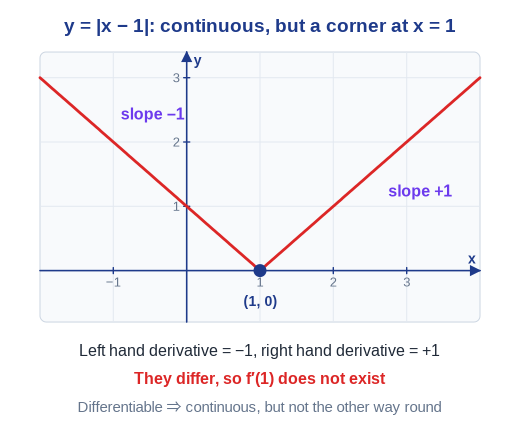
9. Sabit karo ki f(x) = |x − 1|, x ∈ R se diya function f, x = 1 par differentiable nahi hai.
f, 1 par tabhi differentiable hai jab [f(1 + h) − f(1)]/h ki left hand aur right hand limits finite aur barabar hon. Yahan f(1) = 0 aur f(1 + h) = |h|.
Left hand derivative = limh → 0⁻ |h|/h = limh → 0⁻ (−h)/h = −1.
Right hand derivative = limh → 0⁺ |h|/h = limh → 0⁺ h/h = 1.
−1 ≠ 1, to limit nahi hai aur f, x = 1 par differentiable nahi hai. (Wahan ye continuous hai: graph mein ek nukeela corner hai.)
10. Sabit karo ki f(x) = [x], 0 < x < 3 se defined greatest integer function x = 1 aur x = 2 par differentiable nahi hai.
Function kisi point par differentiable tab hota hai jab left se slope (left hand derivative) aur right se slope (right hand derivative) dono finite hon aur barabar hon.
x = 1 par. Yahan f(1) = [1] = 1.
- h ko 0 se thoda kam lo, jaise h = −0.1. Tab [1 + h] = [0.9] = 0. Left hand derivative = limh → 0⁻ (0 − 1)/h = limh → 0⁻ (−1/h). h jaise-jaise 0 ke paas aata hai, −1/h bina kisi had ke badhta jaata hai, to ye finite number nahi hai.
- h ko 0 se thoda zyada lo. Tab [1 + h] = 1. Right hand derivative = limh → 0⁺ (1 − 1)/h = 0.
- Left hand derivative finite nahi hai, to f, x = 1 par differentiable nahi hai.
x = 2 par. Yahan f(2) = 2.
- h thoda 0 se kam ho to [2 + h] = 1. Left hand derivative = limh → 0⁻ (1 − 2)/h = limh → 0⁻ (−1/h), phir se finite nahi.
- h thoda 0 se zyada ho to [2 + h] = 2. Right hand derivative = limh → 0⁺ (2 − 2)/h = 0.
- To f, x = 2 par differentiable nahi hai.
Chhota tareeka. [x], x = 1 aur x = 2 par jump karta hai, to wahan continuous nahi hai (Example 15). Jo function kisi point par differentiable ho, wo wahan continuous hona hi chahiye (Theorem 3).
Answer: f, x = 1 aur x = 2 par differentiable nahi hai.
Examples 22 se 24: implicit functions aur sin⁻¹ x (pages 123–124)
Example 22 (page 123): dy/dx agar x − y = π. Hal karne par y = x − π, to dy/dx = 1. Seedhe: x − y = π ko differentiate karne par 1 − dy/dx = 0, to dy/dx = 1.
Example 23 (page 123): dy/dx agar y + sin y = cos x. Dono sides ko x ke respect mein differentiate karo: dy/dx + cos y · dy/dx = −sin x, to dy/dx = −sin x/(1 + cos y), jahan y ≠ (2n + 1)π.
Example 24 (page 124): sin⁻¹ x ka derivative. Maan lo y = sin⁻¹ x, to x = sin y. Dono sides ko x ke respect mein differentiate karo: 1 = cos y · dy/dx, to dy/dx = 1/cos y. (−1, 1) ke x ke liye y, (−π/2, π/2) mein hai, jahan cos y positive hai, to cos y = √(1 − sin² y) = √(1 − x²). Isliye d/dx (sin⁻¹ x) = 1/√(1 − x²), −1 < x < 1.
Exercise 5.3 (page 125)
Neeche diye har relation mein dy/dx nikaalo:
Questions 1 se 8 mein y implicit roop mein diya hai: dono sides ko x ke respect mein differentiate karo, ye yaad rakhte hue ki d(y²)/dx = 2y · dy/dx wagairah, phir dy/dx wale terms ikatthe karo.
1. 2x + 3y = sin x
2 + 3 dy/dx = cos x, to dy/dx = (cos x − 2)/3.
2. 2x + 3y = sin y
2 + 3 dy/dx = cos y · dy/dx, to dy/dx (cos y − 3) = 2 aur dy/dx = 2/(cos y − 3).
3. ax + by² = cos y
a + 2by · dy/dx = −sin y · dy/dx, to dy/dx (2by + sin y) = −a aur dy/dx = −a/(2by + sin y).
4. xy + y² = tan x + y
y + x dy/dx + 2y dy/dx = sec² x + dy/dx, to dy/dx (x + 2y − 1) = sec² x − y aur dy/dx = (sec² x − y)/(x + 2y − 1).
5. x² + xy + y² = 100
2x + y + x dy/dx + 2y dy/dx = 0, to dy/dx (x + 2y) = −(2x + y) aur dy/dx = −(2x + y)/(x + 2y).
6. x³ + x²y + xy² + y³ = 81
3x² + (2xy + x² dy/dx) + (y² + 2xy dy/dx) + 3y² dy/dx = 0,
to dy/dx (x² + 2xy + 3y²) = −(3x² + 2xy + y²) aur dy/dx = −(3x² + 2xy + y²)/(x² + 2xy + 3y²).
7. sin² y + cos xy = κ
κ ek constant hai. 2 sin y cos y · dy/dx − sin xy · (y + x dy/dx) = 0. 2 sin y cos y = sin 2y lekar:
dy/dx (sin 2y − x sin xy) = y sin xy, to dy/dx = (y sin xy)/(sin 2y − x sin xy).
8. sin² x + cos² y = 1
2 sin x cos x + 2 cos y (−sin y) dy/dx = 0, to sin 2x − sin 2y · dy/dx = 0 aur dy/dx = sin 2x/sin 2y.
Questions 9 se 15 mein ek substitution bracket ko kisi multiple angle ke sin, cos ya tan mein badal deta hai, aur inverse function use khol deta hai.
9. y = sin⁻¹ (2x/(1 + x²))
Rakho x = tan θ, to θ = tan⁻¹ x. Tab 2x/(1 + x²) = 2 tan θ/(1 + tan² θ) = sin 2θ, to y = sin⁻¹ (sin 2θ) = 2θ = 2 tan⁻¹ x.
dy/dx = 2/(1 + x²).
sin⁻¹ (sin 2θ) = 2θ wale step ke liye 2θ ka [−π/2, π/2] mein hona zaroori hai, yaani −1 ≤ x ≤ 1; upar ka derivative −1 < x < 1 ke liye hai. Sawal mein koi interval nahi diya; aakhri section dekho.
10. y = tan⁻¹ ((3x − x³)/(1 − 3x²)), −1/√3 < x < 1/√3
Rakho x = tan θ. Tab (3 tan θ − tan³ θ)/(1 − 3 tan² θ) = tan 3θ. Kyunki −1/√3 < x < 1/√3, θ (−π/6, π/6) mein aur 3θ (−π/2, π/2) mein hai, to y = tan⁻¹ (tan 3θ) = 3θ = 3 tan⁻¹ x.
dy/dx = 3/(1 + x²).
11. y = cos⁻¹ ((1 − x²)/(1 + x²)), 0 < x < 1
Rakho x = tan θ. Tab (1 − tan² θ)/(1 + tan² θ) = cos 2θ. Kyunki 0 < x < 1, 2θ (0, π/2) mein hai, to y = cos⁻¹ (cos 2θ) = 2θ = 2 tan⁻¹ x.
dy/dx = 2/(1 + x²).
12. y = sin⁻¹ ((1 − x²)/(1 + x²)), 0 < x < 1
Rakho x = tan θ. Tab (1 − x²)/(1 + x²) = cos 2θ = sin (π/2 − 2θ). Kyunki 0 < 2θ < π/2, angle π/2 − 2θ (0, π/2) mein hai, to y = π/2 − 2θ = π/2 − 2 tan⁻¹ x.
dy/dx = −2/(1 + x²).
13. y = cos⁻¹ (2x/(1 + x²)), −1 < x < 1
Rakho x = tan θ. Tab 2x/(1 + x²) = sin 2θ = cos (π/2 − 2θ). Kyunki −1 < x < 1, 2θ (−π/2, π/2) mein aur π/2 − 2θ (0, π) mein hai, to y = π/2 − 2θ = π/2 − 2 tan⁻¹ x.
dy/dx = −2/(1 + x²).
14. y = sin⁻¹ (2x √(1 − x²)), −1/√2 < x < 1/√2
Rakho x = sin θ. Tab 2x √(1 − x²) = 2 sin θ cos θ = sin 2θ. Kyunki −1/√2 < x < 1/√2, θ (−π/4, π/4) mein aur 2θ (−π/2, π/2) mein hai, to y = 2θ = 2 sin⁻¹ x.
dy/dx = 2/√(1 − x²).
15. y = sec⁻¹ (1/(2x² − 1)), 0 < x < 1/√2
Rakho x = cos θ. Tab 2x² − 1 = 2 cos² θ − 1 = cos 2θ, to 1/(2x² − 1) = sec 2θ. Kyunki 0 < x < 1/√2, θ (π/4, π/2) mein aur 2θ (π/2, π) mein hai, jo sec⁻¹ ki principal range ke andar hai, to y = sec⁻¹ (sec 2θ) = 2θ = 2 cos⁻¹ x.
dy/dx = −2/√(1 − x²).
Examples 25 aur 26: exponential aur logarithmic functions (pages 129–130)
Example 25 (page 129): kya x = elog x har real x ke liye sahi hai? log x sirf x > 0 ke liye defined hai, to x ≤ 0 ke liye equation ka koi matlab nahi. x > 0 ke liye y = elog x rakho; tab log y = log x · log e = log x, to y = x. Ye sirf positive x ke liye sahi hai.
Example 26 (pages 129–130): differentiate karo: (i) e−x (ii) sin (log x), x > 0 (iii) cos⁻¹ (ex) (iv) ecos x. Chain rule se,
(i) e−x · (−1) = −e−x.
(ii) cos (log x) · (1/x) = cos (log x)/x.
(iii) −1/√(1 − (ex)²) · ex = −ex/√(1 − e2x).
(iv) ecos x · (−sin x) = −sin x · ecos x.
Exercise 5.4 (page 130)
Neeche ke functions ko x ke respect mein differentiate karo:
1. ex/sin x
Quotient rule se, dy/dx = (ex sin x − ex cos x)/sin² x = ex (sin x − cos x)/sin² x, x ≠ nπ, n ∈ Z.
2. esin⁻¹ x
dy/dx = esin⁻¹ x · d(sin⁻¹ x)/dx = esin⁻¹ x/√(1 − x²), x ∈ (−1, 1).
3. ex³
dy/dx = ex³ · 3x² = 3x² ex³.
4. sin (tan⁻¹ e−x)
dy/dx = cos (tan⁻¹ e−x) · 1/(1 + (e−x)²) · (−e−x) = −e−x cos (tan⁻¹ e−x)/(1 + e−2x).
5. log (cos ex)
dy/dx = (1/cos ex) · (−sin ex) · ex = −ex tan ex. (Function wahan defined hai jahan cos ex > 0.)
6. ex + ex² + … + ex⁵
Paanch terms ex, ex², ex³, ex⁴ aur ex⁵ hain. Har ek ke liye d(exⁿ)/dx = exⁿ · nxn − 1:
dy/dx = ex + 2x ex² + 3x² ex³ + 4x³ ex⁴ + 5x⁴ ex⁵.
7. √(e√x), x > 0
dy/dx = 1/(2√(e√x)) · e√x · 1/(2√x) = e√x/(4√(x e√x)), x > 0.
8. log (log x), x > 1
dy/dx = (1/log x) · (1/x) = 1/(x log x), x > 1.
9. (cos x)/(log x), x > 0
Quotient rule se, dy/dx = [−sin x · log x − cos x · (1/x)]/(log x)² = −(x sin x · log x + cos x)/(x (log x)²), x > 0, x ≠ 1.
10. cos (log x + ex), x > 0
dy/dx = −sin (log x + ex) · (1/x + ex) = −(1/x + ex) sin (log x + ex), x > 0.
Examples 27 se 30: logarithmic differentiation (pages 131–133)
Example 27 (page 131): y = √[(x − 3)(x² + 4)/(3x² + 4x + 5)]. Dono sides ka log lo: log y = (1/2)[log (x − 3) + log (x² + 4) − log (3x² + 4x + 5)]. Dono sides ko x ke respect mein differentiate karo:
(1/y) dy/dx = (1/2)[1/(x − 3) + 2x/(x² + 4) − (6x + 4)/(3x² + 4x + 5)],
to dy/dx = (1/2) √[(x − 3)(x² + 4)/(3x² + 4x + 5)] · [1/(x − 3) + 2x/(x² + 4) − (6x + 4)/(3x² + 4x + 5)].
Example 28 (page 131): y = ax, a > 0. log y = x log a, to (1/y) dy/dx = log a aur d/dx (ax) = ax log a.
Example 29 (page 132): y = xsin x, x > 0. log y = sin x · log x. Dono sides ko x ke respect mein differentiate karo: (1/y) dy/dx = sin x · (1/x) + cos x · log x, to dy/dx = xsin x [(sin x)/x + cos x · log x].
Example 30 (pages 132–133): dy/dx agar yx + xy + xx = ab. Rakho u = yx, v = xy, w = xx, to u + v + w = ab aur du/dx + dv/dx + dw/dx = 0. Har ek ka log lekar:
- log u = x log y: du/dx = yx [(x/y) dy/dx + log y].
- log v = y log x: dv/dx = xy [y/x + log x · dy/dx].
- log w = x log x: dw/dx = xx (1 + log x).
Jod kar dy/dx wale terms ikatthe karne par: (x yx − 1 + xy log x) dy/dx = −[yx log y + y xy − 1 + xx (1 + log x)], to
dy/dx = −[yx log y + y xy − 1 + xx (1 + log x)]/(x yx − 1 + xy log x).
Exercise 5.5 (page 134)
Exercises 1 se 11 mein diye functions ko x ke respect mein differentiate karo.
Do results har jagah kaam aate hain. Agar y = uv, to log y = v log u. Aur d/dx (xx) = xx (1 + log x), jo log y = x log x se milta hai.
1. cos x . cos 2x . cos 3x
Dono sides ka log lo: log y = log cos x + log cos 2x + log cos 3x. Dono sides ko x ke respect mein differentiate karo:
(1/y) dy/dx = −tan x − 2 tan 2x − 3 tan 3x,
to dy/dx = −cos x cos 2x cos 3x [tan x + 2 tan 2x + 3 tan 3x].
2. √[((x − 1)(x − 2))/((x − 3)(x − 4)(x − 5))]
log y = (1/2)[log (x − 1) + log (x − 2) − log (x − 3) − log (x − 4) − log (x − 5)]. Dono sides ko x ke respect mein differentiate karo:
(1/y) dy/dx = (1/2)[1/(x − 1) + 1/(x − 2) − 1/(x − 3) − 1/(x − 4) − 1/(x − 5)],
to dy/dx = (1/2) √[((x − 1)(x − 2))/((x − 3)(x − 4)(x − 5))] · [1/(x − 1) + 1/(x − 2) − 1/(x − 3) − 1/(x − 4) − 1/(x − 5)].
3. (log x)cos x
log y = cos x · log (log x). Dono sides ko x ke respect mein differentiate karo:
(1/y) dy/dx = −sin x · log (log x) + cos x · 1/(x log x),
to dy/dx = (log x)cos x [(cos x)/(x log x) − sin x · log (log x)].
4. xx − 2sin x
d/dx (xx) = xx (1 + log x). 2sin x ke liye d(at)/dt = at log a aur chain rule lagao: d/dx (2sin x) = 2sin x · log 2 · cos x.
dy/dx = xx (1 + log x) − 2sin x cos x · log 2.
5. (x + 3)² . (x + 4)³ . (x + 5)⁴
log y = 2 log (x + 3) + 3 log (x + 4) + 4 log (x + 5). Dono sides ko x ke respect mein differentiate karo:
(1/y) dy/dx = 2/(x + 3) + 3/(x + 4) + 4/(x + 5).
y se guna karo aur common factors bahar nikaalo:
dy/dx = (x + 3)(x + 4)²(x + 5)³ [2(x + 4)(x + 5) + 3(x + 3)(x + 5) + 4(x + 3)(x + 4)]
= (x + 3)(x + 4)²(x + 5)³ [(2x² + 18x + 40) + (3x² + 24x + 45) + (4x² + 28x + 48)]
= (x + 3)(x + 4)²(x + 5)³ (9x² + 70x + 133).
6. (x + 1/x)x + x(1 + 1/x)
Do powers ke sum ka ek saath log nahi le sakte (sum ka log todta nahi). Isliye dono terms alag lo: maan lo u = (x + 1/x)x aur v = x(1 + 1/x). Tab dy/dx = du/dx + dv/dx.
Term u. log u = x log (x + 1/x). Differentiate karo (product rule): (1/u) du/dx = log (x + 1/x) + x · (1 − 1/x²)/(x + 1/x). Aakhri fraction ke upar-neeche x se guna karo: ye (x² − 1)/(x² + 1) ban jaata hai. To du/dx = u [log (x + 1/x) + (x² − 1)/(x² + 1)].
Term v. log v = (1 + 1/x) log x. Differentiate karo: (1/v) dv/dx = (−1/x²) log x + (1 + 1/x)(1/x) = (x + 1 − log x)/x². To dv/dx = v (x + 1 − log x)/x².
Answer: dy/dx = (x + 1/x)x [(x² − 1)/(x² + 1) + log (x + 1/x)] + x(1 + 1/x) · (x + 1 − log x)/x².
7. (log x)x + xlog x
Maan lo u = (log x)x aur v = xlog x.
log u = x log (log x): (1/u) du/dx = log (log x) + x · 1/(x log x) = log (log x) + 1/log x, to du/dx = (log x)x − 1 [1 + log x · log (log x)].
log v = log x · log x = (log x)²: (1/v) dv/dx = 2 log x/x, to dv/dx = 2xlog x − 1 log x.
dy/dx = (log x)x − 1 [1 + log x · log (log x)] + 2xlog x − 1 · log x.
8. (sin x)x + sin⁻¹ √x
Maan lo u = (sin x)x. log u = x log sin x: (1/u) du/dx = log sin x + x cot x, to du/dx = (sin x)x (x cot x + log sin x).
Maan lo v = sin⁻¹ √x. dv/dx = 1/√(1 − x) · 1/(2√x) = 1/(2√(x − x²)).
dy/dx = (sin x)x (x cot x + log sin x) + 1/(2√(x − x²)).
9. xsin x + (sin x)cos x
Maan lo u = xsin x. log u = sin x · log x: du/dx = xsin x [(sin x)/x + cos x · log x].
Maan lo v = (sin x)cos x. log v = cos x · log sin x: (1/v) dv/dx = −sin x · log sin x + cos x · cot x.
dy/dx = xsin x [(sin x)/x + cos x · log x] + (sin x)cos x [cos x cot x − sin x · log sin x].
10. xx cos x + (x² + 1)/(x² − 1)
Maan lo u = xx cos x. log u = x cos x · log x: (1/u) du/dx = cos x · log x − x sin x · log x + x cos x · (1/x) = cos x (1 + log x) − x sin x log x.
Maan lo v = (x² + 1)/(x² − 1). dv/dx = [2x(x² − 1) − 2x(x² + 1)]/(x² − 1)² = −4x/(x² − 1)².
dy/dx = xx cos x [cos x (1 + log x) − x sin x log x] − 4x/(x² − 1)².
11. (x cos x)x + (x sin x)1/x
Dono terms alag lo: y = u + v, to dy/dx = du/dx + dv/dx.
Term u = (x cos x)x. log u = x log (x cos x) = x (log x + log cos x). Differentiate karo (product rule): (1/u) du/dx = log (x cos x) + x (1/x − tan x) = 1 − x tan x + log (x cos x).
Term v = (x sin x)1/x. log v = (1/x)(log x + log sin x). Differentiate karo: (1/v) dv/dx = (−1/x²) log (x sin x) + (1/x)(1/x + cot x) = [x cot x + 1 − log (x sin x)]/x².
Har bracket ko apne u ya v se guna karo aur jodo.
Answer: dy/dx = (x cos x)x [1 − x tan x + log (x cos x)] + (x sin x)1/x · [x cot x + 1 − log (x sin x)]/x².
Exercises 12 se 15 mein diye functions ka dy/dx nikaalo.
12. xy + yx = 1
Maan lo u = xy aur v = yx, to du/dx + dv/dx = 0.
log u = y log x: du/dx = xy [log x · dy/dx + y/x] = xy log x · dy/dx + y xy − 1.
log v = x log y: dv/dx = yx [log y + (x/y) dy/dx] = yx log y + x yx − 1 dy/dx.
Jodne par: (xy log x + x yx − 1) dy/dx = −(y xy − 1 + yx log y), to
dy/dx = −(y xy − 1 + yx log y)/(xy log x + x yx − 1).
13. yx = xy
Dono sides ka log lo: x log y = y log x. Dono sides ko x ke respect mein differentiate karo:
log y + (x/y) dy/dx = log x · dy/dx + y/x,
to dy/dx (x/y − log x) = y/x − log y, yaani dy/dx · (x − y log x)/y = (y − x log y)/x. Isliye
dy/dx = (y/x) · (y − x log y)/(x − y log x).
14. (cos x)y = (cos y)x
Dono sides ka log lo: y log cos x = x log cos y. Dono sides ko x ke respect mein differentiate karo:
log cos x · dy/dx − y tan x = log cos y − x tan y · dy/dx,
to dy/dx (x tan y + log cos x) = y tan x + log cos y aur
dy/dx = (y tan x + log cos y)/(x tan y + log cos x).
15. xy = e(x − y)
Dono sides ka log lo: log x + log y = x − y. Dono sides ko x ke respect mein differentiate karo:
1/x + (1/y) dy/dx = 1 − dy/dx,
to dy/dx (1/y + 1) = 1 − 1/x, yaani dy/dx · (y + 1)/y = (x − 1)/x. Isliye
dy/dx = y(x − 1)/(x(y + 1)).
16. f(x) = (1 + x)(1 + x²)(1 + x⁴)(1 + x⁸) se diye function ka derivative nikaalo aur usse f′(1) nikaalo.
log f(x) = log (1 + x) + log (1 + x²) + log (1 + x⁴) + log (1 + x⁸). Dono sides ko x ke respect mein differentiate karo:
f′(x)/f(x) = 1/(1 + x) + 2x/(1 + x²) + 4x³/(1 + x⁴) + 8x⁷/(1 + x⁸),
to f′(x) = (1 + x)(1 + x²)(1 + x⁴)(1 + x⁸) [1/(1 + x) + 2x/(1 + x²) + 4x³/(1 + x⁴) + 8x⁷/(1 + x⁸)].
x = 1 par: f(1) = 2 × 2 × 2 × 2 = 16 aur bracket hai 1/2 + 1 + 2 + 4 = 15/2, to f′(1) = 16 × 15/2 = 120.
17. (x² − 5x + 8)(x³ + 7x + 9) ko neeche ke teen tareekon se differentiate karo: (i) product rule se (ii) product ko khol kar ek polynomial bana kar (iii) logarithmic differentiation se. Kya teeno se ek hi jawab aata hai?
(i) Product rule:
dy/dx = (2x − 5)(x³ + 7x + 9) + (x² − 5x + 8)(3x² + 7)
= (2x⁴ − 5x³ + 14x² − 17x − 45) + (3x⁴ − 15x³ + 31x² − 35x + 56)
= 5x⁴ − 20x³ + 45x² − 52x + 11.
(ii) Khol kar: y = x⁵ − 5x⁴ + 15x³ − 26x² + 11x + 72, to dy/dx = 5x⁴ − 20x³ + 45x² − 52x + 11.
(iii) log y = log (x² − 5x + 8) + log (x³ + 7x + 9), to
(1/y) dy/dx = (2x − 5)/(x² − 5x + 8) + (3x² + 7)/(x³ + 7x + 9).
y = (x² − 5x + 8)(x³ + 7x + 9) se guna karne par dy/dx = (2x − 5)(x³ + 7x + 9) + (3x² + 7)(x² − 5x + 8), wahi expression jo (i) mein hai.
Haan, teeno tareekon se 5x⁴ − 20x³ + 45x² − 52x + 11 aata hai.
18. Agar u, v aur w, x ke functions hain, to do tareekon se dikhao ki d/dx (u · v · w) = (du/dx) v · w + u · (dv/dx) · w + u · v (dw/dx): pehle product rule ko baar-baar laga kar, phir logarithmic differentiation se.
Product rule do baar. uvw ko (uv) · w maano:
d/dx (uvw) = [d(uv)/dx] · w + (uv) · dw/dx = [(du/dx) v + u (dv/dx)] w + uv (dw/dx)
= (du/dx) v w + u (dv/dx) w + u v (dw/dx).
Logarithmic differentiation. Maan lo y = uvw. log y = log u + log v + log w. Dono sides ko x ke respect mein differentiate karo:
(1/y) dy/dx = (1/u) du/dx + (1/v) dv/dx + (1/w) dw/dx.
y = uvw se guna karo: dy/dx = (du/dx) v w + u (dv/dx) w + u v (dw/dx), yahi dikhana tha.
Examples 31 se 34: parametric forms (pages 135–136)
Example 31 (page 135): x = a cos θ, y = a sin θ. dx/dθ = −a sin θ, dy/dθ = a cos θ, to dy/dx = (a cos θ)/(−a sin θ) = −cot θ.
Example 32 (page 135): x = at², y = 2at. dx/dt = 2at, dy/dt = 2a, to dy/dx = 2a/(2at) = 1/t.
Example 33 (page 136): x = a(θ + sin θ), y = a(1 − cos θ). dx/dθ = a(1 + cos θ), dy/dθ = a sin θ, to dy/dx = sin θ/(1 + cos θ) = [2 sin (θ/2) cos (θ/2)]/[2 cos² (θ/2)] = tan (θ/2).
Example 34 (page 136): dy/dx agar x2/3 + y2/3 = a2/3. x = a cos³ θ aur y = a sin³ θ lo; tab x2/3 + y2/3 = a2/3(cos² θ + sin² θ) = a2/3, to ye curve ka parametric form hai. dx/dθ = −3a cos² θ sin θ, dy/dθ = 3a sin² θ cos θ, to dy/dx = −tan θ = −∛(y/x).
Exercise 5.6 (page 137)
Agar x aur y Exercises 1 se 10 mein di gayi equations se parametrically jude hain, to parameter ko hataye bina dy/dx nikaalo.
1. x = 2at², y = at⁴
dx/dt = 4at, dy/dt = 4at³. dy/dx = 4at³/(4at) = t².
2. x = a cos θ, y = b cos θ
dx/dθ = −a sin θ, dy/dθ = −b sin θ. dy/dx = (−b sin θ)/(−a sin θ) = b/a.
3. x = sin t, y = cos 2t
dx/dt = cos t, dy/dt = −2 sin 2t = −4 sin t cos t. dy/dx = (−4 sin t cos t)/cos t = −4 sin t.
4. x = 4t, y = 4/t
dx/dt = 4, dy/dt = −4/t². dy/dx = (−4/t²)/4 = −1/t².
5. x = cos θ − cos 2θ, y = sin θ − sin 2θ
dx/dθ = −sin θ + 2 sin 2θ, dy/dθ = cos θ − 2 cos 2θ. dy/dx = (cos θ − 2 cos 2θ)/(2 sin 2θ − sin θ).
6. x = a (θ − sin θ), y = a (1 + cos θ)
dx/dθ = a(1 − cos θ), dy/dθ = −a sin θ.
dy/dx = −sin θ/(1 − cos θ) = −[2 sin (θ/2) cos (θ/2)]/[2 sin² (θ/2)] = −cot (θ/2).
7. x = (sin³ t)/√(cos 2t), y = (cos³ t)/√(cos 2t)
Step 1: dx/dt aur dy/dt. Quotient rule lagao, jismein d(√(cos 2t))/dt = −sin 2t/√(cos 2t):
dx/dt = [3 sin² t cos t · cos 2t + sin³ t · sin 2t]/(cos 2t)3/2,
dy/dt = [−3 cos² t sin t · cos 2t + cos³ t · sin 2t]/(cos 2t)3/2.
Step 2: divide karo. Neeche ka (cos 2t)3/2 cancel ho jaata hai. sin 2t = 2 sin t cos t likho; tab dono ke upar sin t cos t common factor hai, wo bhi cancel:
dy/dx = [−3 cos t cos 2t + 2 cos³ t]/[3 sin t cos 2t + 2 sin³ t].
Step 3: upar wala hissa. cos 2t = 2 cos² t − 1 lagao: −6 cos³ t + 3 cos t + 2 cos³ t = −(4 cos³ t − 3 cos t) = −cos 3t (triple angle formula cos 3t = 4 cos³ t − 3 cos t).
Step 4: neeche wala hissa. cos 2t = 1 − 2 sin² t lagao: 3 sin t − 6 sin³ t + 2 sin³ t = 3 sin t − 4 sin³ t = sin 3t.
Answer: dy/dx = −cos 3t/sin 3t = −cot 3t.
8. x = a (cos t + log tan (t/2)), y = a sin t
d/dt [log tan (t/2)] = [1/tan (t/2)] · sec² (t/2) · (1/2) = 1/[2 sin (t/2) cos (t/2)] = 1/sin t.
dx/dt = a(−sin t + 1/sin t) = a(1 − sin² t)/sin t = a cos² t/sin t, aur dy/dt = a cos t.
dy/dx = a cos t · sin t/(a cos² t) = tan t.
9. x = a sec θ, y = b tan θ
dx/dθ = a sec θ tan θ, dy/dθ = b sec² θ.
dy/dx = (b sec² θ)/(a sec θ tan θ) = (b/a) · sec θ/tan θ = (b/a) cosec θ.
10. x = a (cos θ + θ sin θ), y = a (sin θ − θ cos θ)
dx/dθ = a(−sin θ + sin θ + θ cos θ) = aθ cos θ, dy/dθ = a(cos θ − cos θ + θ sin θ) = aθ sin θ.
dy/dx = (aθ sin θ)/(aθ cos θ) = tan θ.
11. Agar x = √(asin⁻¹ t), y = √(acos⁻¹ t), to dikhao ki dy/dx = −y/x
x = a(1/2) sin⁻¹ t, to d(au)/dt = au log a · du/dt se,
dx/dt = a(1/2) sin⁻¹ t · log a · 1/(2√(1 − t²)) = x log a/(2√(1 − t²)).
Isi tarah y = a(1/2) cos⁻¹ t se dy/dt = y log a · (−1)/(2√(1 − t²)) = −y log a/(2√(1 − t²)).
dy/dx = (dy/dt)/(dx/dt) = −y/x, yahi dikhana tha.
Jaanch: xy = √(asin⁻¹ t + cos⁻¹ t) = √(aπ/2), ek constant, to x dy/dx + y = 0.
Examples 35 se 38: second order derivatives (pages 138–139)
Example 35 (page 138): d²y/dx² agar y = x³ + tan x. dy/dx = 3x² + sec² x, to d²y/dx² = 6x + 2 sec x · sec x tan x = 6x + 2 sec² x tan x.
Example 36 (page 138): y = A sin x + B cos x; dikhao ki d²y/dx² + y = 0. dy/dx = A cos x − B sin x aur d²y/dx² = −A sin x − B cos x = −y, to d²y/dx² + y = 0.
Example 37 (page 138): y = 3e2x + 2e3x; dikhao ki d²y/dx² − 5 dy/dx + 6y = 0. dy/dx = 6e2x + 6e3x aur d²y/dx² = 12e2x + 18e3x. Tab d²y/dx² − 5 dy/dx + 6y = (12 − 30 + 18)e2x + (18 − 30 + 12)e3x = 0.
Example 38 (page 139): y = sin⁻¹ x; dikhao ki (1 − x²) d²y/dx² − x dy/dx = 0. y₁ = 1/√(1 − x²), to (1 − x²) y₁² = 1. x ke respect mein dobara differentiate karo: (1 − x²) · 2y₁y₂ − 2x y₁² = 0. 2y₁ (jo 0 nahi hai) se divide karo: (1 − x²) y₂ − x y₁ = 0.
Exercise 5.7 (pages 139–140)
Exercises 1 se 10 mein diye functions ke second order derivatives nikaalo.
1. x² + 3x + 2
dy/dx = 2x + 3. d²y/dx² = 2.
2. x²⁰
dy/dx = 20x¹⁹. d²y/dx² = 20 × 19 x¹⁸ = 380x¹⁸.
3. x . cos x
dy/dx = cos x − x sin x. d²y/dx² = −sin x − (sin x + x cos x) = −(x cos x + 2 sin x).
4. log x
dy/dx = 1/x. d²y/dx² = −1/x².
5. x³ log x
dy/dx = 3x² log x + x³ · (1/x) = 3x² log x + x².
d²y/dx² = 6x log x + 3x² · (1/x) + 2x = 6x log x + 5x = x(5 + 6 log x).
6. ex sin 5x
dy/dx = ex sin 5x + 5ex cos 5x = ex (sin 5x + 5 cos 5x).
d²y/dx² = ex (sin 5x + 5 cos 5x) + ex (5 cos 5x − 25 sin 5x) = ex (10 cos 5x − 24 sin 5x) = 2ex (5 cos 5x − 12 sin 5x).
7. e6x cos 3x
dy/dx = 6e6x cos 3x − 3e6x sin 3x = e6x (6 cos 3x − 3 sin 3x).
d²y/dx² = 6e6x (6 cos 3x − 3 sin 3x) + e6x (−18 sin 3x − 9 cos 3x) = e6x (27 cos 3x − 36 sin 3x) = 9e6x (3 cos 3x − 4 sin 3x).
8. tan⁻¹ x
dy/dx = 1/(1 + x²) = (1 + x²)⁻¹. d²y/dx² = −(1 + x²)⁻² · 2x = −2x/(1 + x²)².
9. log (log x)
dy/dx = 1/(x log x) = (x log x)⁻¹.
d²y/dx² = −(x log x)⁻² · d(x log x)/dx = −(x log x)⁻² · (log x + 1) = −(1 + log x)/(x log x)².
10. sin (log x)
dy/dx = cos (log x)/x.
Quotient rule se, d²y/dx² = [−sin (log x) · (1/x) · x − cos (log x) · 1]/x² = −[sin (log x) + cos (log x)]/x².
11. Agar y = 5 cos x − 3 sin x, to sabit karo ki d²y/dx² + y = 0
dy/dx = −5 sin x − 3 cos x. d²y/dx² = −5 cos x + 3 sin x = −(5 cos x − 3 sin x) = −y.
Isliye d²y/dx² + y = 0.
12. Agar y = cos⁻¹ x, to d²y/dx² ko sirf y mein nikaalo.
y = cos⁻¹ x ka matlab x = cos y, jahan −1 < x < 1 ke liye y, (0, π) mein hai aur wahan sin y > 0.
dy/dx = −1/√(1 − x²) = −1/√(1 − cos² y) = −1/sin y = −cosec y.
x ke respect mein dobara differentiate karo: d²y/dx² = −(−cosec y cot y) · dy/dx = cosec y cot y · (−cosec y) = −cot y cosec² y.
13. Agar y = 3 cos (log x) + 4 sin (log x), to dikhao ki x² y₂ + xy₁ + y = 0
y₁ = [−3 sin (log x) + 4 cos (log x)]/x, to x y₁ = −3 sin (log x) + 4 cos (log x).
x ke respect mein dobara differentiate karo: x y₂ + y₁ = [−3 cos (log x) − 4 sin (log x)]/x = −y/x.
x se guna karo: x² y₂ + x y₁ = −y, to x² y₂ + x y₁ + y = 0.
14. Agar y = Aemx + Benx, to dikhao ki d²y/dx² − (m + n) dy/dx + mny = 0
dy/dx = mAemx + nBenx aur d²y/dx² = m²Aemx + n²Benx.
d²y/dx² − (m + n) dy/dx + mny = Aemx [m² − m(m + n) + mn] + Benx [n² − n(m + n) + mn] = Aemx · 0 + Benx · 0 = 0.
15. Agar y = 500e7x + 600e−7x, to dikhao ki d²y/dx² = 49y
dy/dx = 3500e7x − 4200e−7x. d²y/dx² = 24500e7x + 29400e−7x = 49(500e7x + 600e−7x) = 49y.
16. Agar ey (x + 1) = 1, to dikhao ki d²y/dx² = (dy/dx)²
ey = 1/(x + 1), to y = −log (x + 1).
dy/dx = −1/(x + 1) aur d²y/dx² = 1/(x + 1)².
(dy/dx)² = 1/(x + 1)². Isliye d²y/dx² = (dy/dx)².
17. Agar y = (tan⁻¹ x)², to dikhao ki (x² + 1)² y₂ + 2x (x² + 1) y₁ = 2
y₁ = 2 tan⁻¹ x · 1/(1 + x²), to (1 + x²) y₁ = 2 tan⁻¹ x.
x ke respect mein dobara differentiate karo: (1 + x²) y₂ + 2x y₁ = 2/(1 + x²).
(1 + x²) se guna karo: (x² + 1)² y₂ + 2x (x² + 1) y₁ = 2.
Miscellaneous Examples 39 se 43 (pages 140–144)
Example 39 (pages 140–141): differentiate karo: (i) √(3x + 2) + 1/√(2x² + 4) (ii) log₇ (log x).
(i) y = (3x + 2)1/2 + (2x² + 4)−1/2, jo defined hai x > −2/3 ke liye. dy/dx = (1/2)(3x + 2)−1/2 · 3 − (1/2)(2x² + 4)−3/2 · 4x = 3/(2√(3x + 2)) − 2x/(2x² + 4)3/2.
(ii) Change of base rule se, y = log (log x)/log 7, x > 1. dy/dx = (1/log 7) · (1/log x) · (1/x) = 1/(x log 7 · log x).
Example 40 (pages 141–142): differentiate karo: (i) cos⁻¹ (sin x) (ii) tan⁻¹ (sin x/(1 + cos x)) (iii) sin⁻¹ (2x + 1/(1 + 4x)).
(i) sin x = cos (π/2 − x), to f(x) = cos⁻¹ [cos (π/2 − x)] = π/2 − x aur f′(x) = −1. (Is simplification ke liye π/2 − x ka [0, π] mein hona zaroori hai, yaani −π/2 ≤ x ≤ π/2; aakhri section dekho.)
(ii) sin x/(1 + cos x) = [2 sin (x/2) cos (x/2)]/[2 cos² (x/2)] = tan (x/2), to f(x) = tan⁻¹ [tan (x/2)] = x/2 aur f′(x) = 1/2 (−π < x < π ke liye; cos x ≠ −1).
(iii) Rakho 2x = tan θ. Tab 2x + 1/(1 + 4x) = 2 tan θ/(1 + tan² θ) = sin 2θ, to f(x) = sin⁻¹ (sin 2θ) = 2θ = 2 tan⁻¹ (2x). d(2x)/dx = 2x log 2 se, f′(x) = 2 · 1/(1 + 4x) · 2x log 2 = 2x + 1 log 2/(1 + 4x). (sin⁻¹ (sin 2θ) = 2θ wale step ke liye 2θ ≤ π/2 chahiye, yaani x ≤ 0; aakhri section dekho.)
Example 41 (page 143): f′(x) agar f(x) = (sin x)sin x, 0 < x < π. log y = sin x · log (sin x). (1/y) dy/dx = cos x · log (sin x) + sin x · (cos x/sin x) = (1 + log (sin x)) cos x, to f′(x) = (1 + log (sin x)) (sin x)sin x cos x.
Example 42 (pages 143–144): dy/dx agar y = at + 1/t, x = (t + 1/t)a, a > 0. dy/dt = at + 1/t · log a · (1 − 1/t²) aur dx/dt = a (t + 1/t)a − 1 · (1 − 1/t²). t ≠ ±1 ke liye dx/dt ≠ 0, aur dy/dx = at + 1/t log a/[a (t + 1/t)a − 1].
Example 43 (page 144): sin² x ko ecos x ke respect mein differentiate karo. Maan lo u = sin² x aur v = ecos x. du/dx = 2 sin x cos x, dv/dx = −sin x · ecos x. du/dv = (du/dx)/(dv/dx) = (2 sin x cos x)/(−sin x · ecos x) = −2 cos x/ecos x.
Chapter 5 ki Miscellaneous Exercise (pages 144–145)
Exercises 1 se 11 ke functions ko x ke respect mein differentiate karo.
1. (3x² − 9x + 5)⁹
dy/dx = 9(3x² − 9x + 5)⁸ · (6x − 9) = 27(3x² − 9x + 5)⁸ (2x − 3).
2. sin³ x + cos⁶ x
dy/dx = 3 sin² x cos x + 6 cos⁵ x (−sin x) = 3 sin x cos x (sin x − 2 cos⁴ x).
3. (5x)3 cos 2x
log y = 3 cos 2x · log 5x. Dono sides ko x ke respect mein differentiate karo:
(1/y) dy/dx = −6 sin 2x · log 5x + 3 cos 2x · (1/x),
to dy/dx = (5x)3 cos 2x [(3 cos 2x)/x − 6 sin 2x · log 5x].
4. sin⁻¹ (x √x), 0 ≤ x ≤ 1
x√x = x3/2, aur d(x3/2)/dx = (3/2)√x.
dy/dx = 1/√(1 − x³) · (3/2)√x = (3/2) √(x/(1 − x³)).
5. (cos⁻¹ (x/2))/√(2x + 7), −2 < x < 2
d/dx [cos⁻¹ (x/2)] = −1/√(1 − x²/4) · (1/2) = −1/√(4 − x²), aur d/dx [√(2x + 7)] = 1/√(2x + 7). Quotient rule se,
dy/dx = [−√(2x + 7)/√(4 − x²) − cos⁻¹ (x/2)/√(2x + 7)]/(2x + 7)
= −[1/(√(4 − x²) · √(2x + 7)) + cos⁻¹ (x/2)/(2x + 7)3/2].
6. cot⁻¹ [(√(1 + sin x) + √(1 − sin x))/(√(1 + sin x) − √(1 − sin x))], 0 < x < π/2
1 ± sin x = cos² (x/2) + sin² (x/2) ± 2 sin (x/2) cos (x/2) = [cos (x/2) ± sin (x/2)]². 0 < x < π/2 ke liye cos (x/2) > sin (x/2) > 0, to
√(1 + sin x) = cos (x/2) + sin (x/2) aur √(1 − sin x) = cos (x/2) − sin (x/2).
Fraction hai [2 cos (x/2)]/[2 sin (x/2)] = cot (x/2), to y = cot⁻¹ [cot (x/2)] = x/2.
dy/dx = 1/2.
7. (log x)log x, x > 1
log y = log x · log (log x). Dono sides ko x ke respect mein differentiate karo:
(1/y) dy/dx = (1/x) log (log x) + log x · 1/(x log x) = [1 + log (log x)]/x,
to dy/dx = (log x)log x [1/x + log (log x)/x], x > 1.
8. cos (a cos x + b sin x), jahan a aur b constants hain.
dy/dx = −sin (a cos x + b sin x) · (−a sin x + b cos x) = (a sin x − b cos x) sin (a cos x + b sin x).
9. (sin x − cos x)(sin x − cos x), π/4 < x < 3π/4
Is interval mein sin x > cos x, to base positive hai. log y = (sin x − cos x) log (sin x − cos x). Dono sides ko x ke respect mein differentiate karo:
(1/y) dy/dx = (cos x + sin x) log (sin x − cos x) + (sin x − cos x) · (cos x + sin x)/(sin x − cos x)
= (cos x + sin x)[1 + log (sin x − cos x)],
to dy/dx = (sin x − cos x)(sin x − cos x) (cos x + sin x)[1 + log (sin x − cos x)].
10. xx + xa + ax + aa, jahan a > 0 fixed hai aur x > 0
Ek-ek term: d(xx)/dx = xx(1 + log x); d(xa)/dx = axa − 1; d(ax)/dx = ax log a; aa constant hai, jiska derivative 0 hai.
dy/dx = xx (1 + log x) + axa − 1 + ax log a.
11. x(x² − 3) + (x − 3)x², jahan x > 3
Maan lo u = x(x² − 3). log u = (x² − 3) log x: (1/u) du/dx = 2x log x + (x² − 3)/x.
Maan lo v = (x − 3)x². log v = x² log (x − 3): (1/v) dv/dx = 2x log (x − 3) + x²/(x − 3).
dy/dx = x(x² − 3) [(x² − 3)/x + 2x log x] + (x − 3)x² [x²/(x − 3) + 2x log (x − 3)].
12. dy/dx nikaalo, agar y = 12 (1 − cos t), x = 10 (t − sin t), −π/2 < t < π/2
dy/dt = 12 sin t aur dx/dt = 10(1 − cos t).
dy/dx = (12 sin t)/(10(1 − cos t)) = (6/5) · [2 sin (t/2) cos (t/2)]/[2 sin² (t/2)] = (6/5) cot (t/2) (t ≠ 0).
13. dy/dx nikaalo, agar y = sin⁻¹ x + sin⁻¹ √(1 − x²), 0 < x < 1
d/dx [sin⁻¹ √(1 − x²)] = 1/√(1 − (1 − x²)) · (−2x)/(2√(1 − x²)) = (1/√(x²)) · (−x/√(1 − x²)) = −1/√(1 − x²), kyunki x > 0 ke liye √(x²) = x.
dy/dx = 1/√(1 − x²) − 1/√(1 − x²) = 0.
(Yahan sin⁻¹ √(1 − x²) = cos⁻¹ x hai, to y = π/2, ek constant.)
14. Agar x √(1 + y) + y √(1 + x) = 0, −1 < x < 1 ke liye, to sabit karo ki dy/dx = −1/(1 + x)²
Plan: pehle y ko x ke formula mein nikaalo, phir differentiate karo.
- Ek term doosri taraf le jao: x √(1 + y) = −y √(1 + x).
- Roots hatane ke liye dono sides ka square karo: x²(1 + y) = y²(1 + x), yaani x² − y² + x²y − xy² = 0.
- Factorise karo: (x − y)(x + y) + xy(x − y) = 0, to (x − y)(x + y + xy) = 0.
- To ya y = x, ya x + y + xy = 0. Di gayi equation mein y = x rakho: ye 2x√(1 + x) = 0 ban jaati hai, jo sirf x = 0 par sahi hai. To y = x wo curve nahi hai, aur x + y + xy = 0.
- y nikaalo: y(1 + x) = −x, to y = −x/(1 + x).
- Quotient rule: dy/dx = −[(1 + x) · 1 − x · 1]/(1 + x)² = −1/(1 + x)².
Answer: dy/dx = −1/(1 + x)², yahi dikhana tha.
15. Agar (x − a)² + (y − b)² = c², jahan c > 0, to sabit karo ki [1 + (dy/dx)²]3/2/(d²y/dx²) ek constant hai jo a aur b par depend nahi karta.
Ye curve ek circle hai jiska centre (a, b) aur radius c hai. y₁ = dy/dx aur y₂ = d²y/dx² likho.
- x ke respect mein differentiate karo: 2(x − a) + 2(y − b) y₁ = 0, to y₁ = −(x − a)/(y − b).
- (x − a) + (y − b) y₁ = 0 ko dobara differentiate karo (doosre term par product rule): 1 + y₁ · y₁ + (y − b) y₂ = 0, to y₂ = −(1 + y₁²)/(y − b).
- Step 1 aur circle ki equation se: 1 + y₁² = [(y − b)² + (x − a)²]/(y − b)² = c²/(y − b)², to (1 + y₁²)1/2 = c/|y − b|.
- Ye sab rakho: [1 + y₁²]3/2/y₂ = (1 + y₁²)3/2 · [−(y − b)/(1 + y₁²)] = −(y − b)(1 + y₁²)1/2 = −(y − b) · c/|y − b|.
- Circle ke upari half (y > b) par ye −c hai. Nichle half (y < b) par +c hai.
Answer: expression −c (upari half) ya +c (nichla half) ke barabar hai. Ismein sirf radius c hai, to ye a aur b se independent ek constant hai.
16. Agar cos y = x cos (a + y), jahan cos a ≠ ±1, to sabit karo ki dy/dx = cos² (a + y)/sin a.
x = cos y/cos (a + y). Quotient rule se y ke respect mein differentiate karo:
dx/dy = [−sin y cos (a + y) + cos y sin (a + y)]/cos² (a + y) = sin ((a + y) − y)/cos² (a + y) = sin a/cos² (a + y).
Kyunki cos a ≠ ±1, sin a ≠ 0, to dy/dx = 1/(dx/dy) = cos² (a + y)/sin a, yahi dikhana tha.
17. Agar x = a (cos t + t sin t) aur y = a (sin t − t cos t), to d²y/dx² nikaalo.
dx/dt = a(−sin t + sin t + t cos t) = at cos t aur dy/dt = a(cos t − cos t + t sin t) = at sin t, to dy/dx = tan t.
d²y/dx² = d(tan t)/dx = sec² t · dt/dx = sec² t/(at cos t) = sec³ t/(at), 0 < t < π/2.
18. Agar f(x) = |x|³, to dikhao ki f″(x) har real x ke liye hota hai aur use nikaalo.
x ≥ 0 par f(x) = x³ aur x < 0 par f(x) = −x³.
- x > 0: f′(x) = 3x², f″(x) = 6x.
- x < 0: f′(x) = −3x², f″(x) = −6x.
- x = 0: f′(0) = limh → 0 (|h|³ − 0)/h = limh → 0 h|h| = 0. To har x ke liye f′(x) = 3x|x|, aur f″(0) = limh → 0 (3h|h| − 0)/h = limh → 0 3|h| = 0.
0 par dono one-sided limits barabar hain, to f″ har jagah hai: x ≥ 0 par f″(x) = 6x aur x < 0 par −6x, yaani f″(x) = 6|x|.
19. sin (A + B) = sin A cos B + cos A sin B aur differentiation ka use karke cosines ka sum formula nikaalo.
B ko fixed rakho aur dono sides ko A ke functions maano. A ke respect mein differentiate karo:
cos (A + B) · 1 = cos A cos B + (−sin A) sin B.
Isliye cos (A + B) = cos A cos B − sin A sin B.
20. Kya aisa koi function hai jo har jagah continuous ho lekin theek do points par differentiable na ho? Apne jawab ko justify karo.
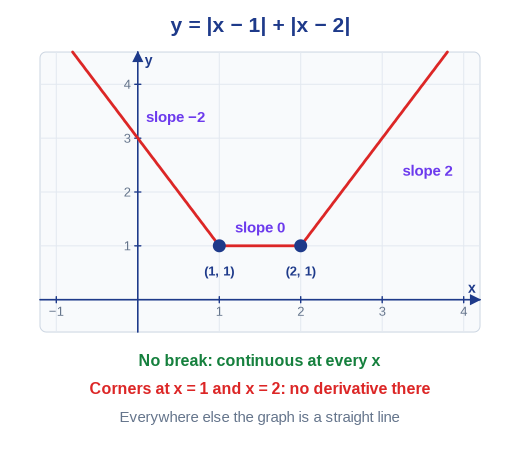
Haan. f(x) = |x − 1| + |x − 2| lo.
- Ye do continuous functions ka sum hai, to har jagah continuous hai.
- Tukdon mein: x < 1 par f(x) = 3 − 2x, 1 ≤ x ≤ 2 par f(x) = 1, aur x > 2 par f(x) = 2x − 3. Har tukda seedhi line hai, to 1 aur 2 ke alawa har x par f differentiable hai.
- x = 1 par: left hand derivative = −2, right hand derivative = 0. Differentiable nahi.
- x = 2 par: left hand derivative = 0, right hand derivative = 2. Differentiable nahi.
To f har jagah continuous hai aur theek do points, x = 1 aur x = 2, par differentiable nahi hai.
21. Agar y = |f(x), g(x), h(x); l, m, n; a, b, c|, to sabit karo ki dy/dx = |f′(x), g′(x), h′(x); l, m, n; a, b, c|
Yahan |…; …; …| order 3 ka determinant hai jo row-by-row likha hai, rows ke beech semicolon; l, m, n, a, b, c constants hain. Pehli row ke saath expand karo:
y = f(x)(mc − nb) − g(x)(lc − na) + h(x)(lb − ma).
Brackets constants hain, to
dy/dx = f′(x)(mc − nb) − g′(x)(lc − na) + h′(x)(lb − ma),
jo |f′(x), g′(x), h′(x); l, m, n; a, b, c| ka pehli row ke saath expansion hi hai. Yahi dikhana tha.
22. Agar y = ea cos⁻¹ x, −1 ≤ x ≤ 1, to dikhao ki (1 − x²) d²y/dx² − x dy/dx − a² y = 0.
y₁ = ea cos⁻¹ x · (−a)/√(1 − x²) = −ay/√(1 − x²), to √(1 − x²) · y₁ = −ay.
Dono sides ka square karo: (1 − x²) y₁² = a² y².
x ke respect mein dobara differentiate karo: −2x y₁² + (1 − x²) · 2y₁y₂ = 2a² y y₁.
2y₁ se divide karo (a ≠ 0 ke liye y₁, 0 nahi hai): (1 − x²) y₂ − x y₁ − a² y = 0, yahi dikhana tha.
Is edition aur answer key ke baare mein
2026-27 reprint rationalised book hai: Chapter 5 mein Exercise 5.1 se 5.7 aur 22 sawalon ki Miscellaneous Exercise hai. Upar ke saare jawab book ki answer key (pages 214–218) se milte hain. Kuch jagahon par ek baat kehni zaroori hai:
- Exercise 5.3, Question 9. Sawal mein koi interval nahi hai. Key ka jawab 2/(1 + x²), −1 < x < 1 ke liye derivative hai. Extra: x > 1 ya x < −1 ke liye isi function ka derivative −2/(1 + x²) hai, kyunki wahan sin⁻¹ (sin 2θ), 2θ nahi rehta.
- Exercise 5.4. Key mein Question 6 ka doosra term aise chhapa hai ki ex², 2x ki power lagta hai; use 2x ex² padhna chahiye. Question 10 mein key −1/x + ex bina brackets ke chhapti hai; factor −(1/x + ex) hai. Question 5 mein key ex ≠ (2n + 1)π/2 ki condition jodti hai; function log (cos ex) ke liye khud cos ex > 0 chahiye.
- Example 40. Extra: part (i) mein cos⁻¹ (sin x) = π/2 − x, −π/2 ≤ x ≤ π/2 ke liye sahi hai, to us interval par f′(x) = −1 (agle interval π/2 < x < 3π/2 par slope +1 hai). Part (iii) mein book ka result x < 0 ke liye derivative hai; x > 0 ke liye sign badal jaata hai. Dono numerically jaanche gaye.
- Miscellaneous Exercise, Question 15. Constant circle ke upari half par −c aur nichle half par +c hai; iska size c radius hai.
- Extra: is book ke purane editions mein Rolle’s Theorem aur Mean Value Theorem ka section bhi tha. Wo 2026-27 reprint mein nahi hai, isliye yahan nahi hai.
Notes par wapas: Chapter 5 ke notes, continuity kya hai, chain rule, implicit aur inverse trigonometric derivatives aur logarithmic aur parametric differentiation.
Practice karo
-
sin (3x + 2) ka x ke respect mein derivative hai:
Jawab dekho
Jawab: (b) 3 cos (3x + 2)
-
Function f(x) = {x + 1, agar x ≤ 2; 5 − x, agar x > 2}, x = 2 par:
Jawab dekho
Jawab: (a) continuous hai
-
Agar x = t² aur y = t³, to dy/dx barabar hai:
Jawab dekho
Jawab: (c) 3t/2
-
y = x^(2x), x > 0 ho to dy/dx nikaalo.
Jawab dekho
Jawab: Log lo: log y = 2x log x. Differentiate karo: (1/y) dy/dx = 2 log x + 2x · (1/x) = 2 log x + 2. To dy/dx = 2x^(2x) (1 + log x).
-
Agar y = e^(3x), to dikhao ki d²y/dx² − 9y = 0.
Jawab dekho
Jawab: dy/dx = 3e^(3x) aur d²y/dx² = 9e^(3x) = 9y. To d²y/dx² − 9y = 0.
Koi sawal atak gaya?
Photo lo, Lagnever AI step-by-step samjhayega. 7 din ka trial sirf ₹2.
Google Play se app lo Browser mein kholo
Parents ke liye: trial ke baad plan har mahine UPI ya card autopay se renew hota hai. App mein kabhi bhi cancel kar sakte hain.