
How do the chain rule and implicit differentiation work?
Answer in short
The chain rule differentiates a composite function: if y = v(t) and t = u(x), then dy/dx = (dy/dt) · (dt/dx). For an implicit relation, differentiate both sides with respect to x and solve for dy/dx. This gives (sin⁻¹ x)′ = 1/√(1 − x²) and (tan⁻¹ x)′ = 1/(1 + x²).
Stuck on a question? Take a photo and Lagnever AI explains it step by step. Try it for 7 days for ₹2. Get it on Google Play
How the maths is written here. sin⁻¹ x is the inverse sine (not 1/sin x), and y′ stands for dy/dx. A fraction is typed with a slash, with brackets around a top or bottom of more than one term.
When is a function differentiable?
The derivative of f at a point c is
f′(c) = limh → 0 [f(c + h) − f(c)]/h,
when this limit exists. Taking h → 0 through negative values gives the left hand derivative, and through positive values the right hand derivative. f is differentiable at c when both are finite and equal.
The chapter proves that a function that is differentiable at a point is continuous there. The reverse fails: f(x) = |x − 1| is continuous at 1, but (|h| − 0)/h is −1 for h < 0 and 1 for h > 0, so it has no derivative at 1. Where a graph has a sharp corner or a jump, there is no derivative.
The rules from Class 11 still hold: (u ± v)′ = u′ ± v′, (uv)′ = u′v + uv′ and (u/v)′ = (u′v − uv′)/v².
What is the chain rule?
Many functions are composites: one function inside another. In y = (x² + 1)⁵ the inside is t = x² + 1 and the outside is y = t⁵.
Chain rule. If y = v(t) and t = u(x), and both dy/dt and dt/dx exist, then
dy/dx = (dy/dt) · (dt/dx).
To use it:
- Name the inside function t.
- Differentiate the outside with respect to t.
- Differentiate the inside with respect to x.
- Multiply, and write t back in terms of x.
For y = (x² + 1)⁵: dy/dt = 5t⁴ and dt/dx = 2x, so dy/dx = 5(x² + 1)⁴ · 2x = 10x(x² + 1)⁴.
For y = sin (3x + 2): dy/dx = cos (3x + 2) · 3 = 3 cos (3x + 2).
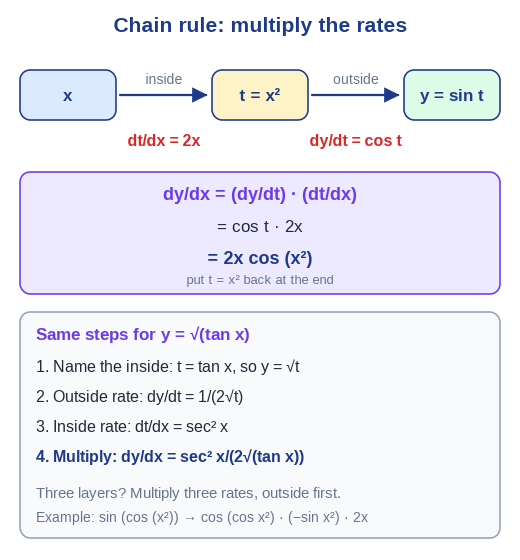
With three layers the rule is used twice. For y = sin (cos (x²)): the outside gives cos (cos x²), the middle gives −sin x², and the inside gives 2x. So dy/dx = −2x sin (x²) cos (cos (x²)).
How do you differentiate an implicit function?
Sometimes x and y are tied together by a relation that is not solved for y, such as x² + y² = 25. Then y is given implicitly. You do not have to solve for y first:
- Differentiate both sides with respect to x.
- Each time you differentiate a term in y, multiply by dy/dx (the chain rule): d(y²)/dx = 2y · dy/dx, d(sin y)/dx = cos y · dy/dx.
- Collect the dy/dx terms on one side and solve.
For x² + y² = 25: 2x + 2y · dy/dx = 0, so dy/dx = −x/y. At the point (3, 4) the slope is −3/4.
For xy + y² = 6, the term xy needs the product rule: (y + x · dy/dx) + 2y · dy/dx = 0, so dy/dx = −y/(x + 2y). At the point (1, 2), which lies on the curve because 2 + 4 = 6, the slope is −2/5.
The answer usually contains both x and y. That is normal.
What are the derivatives of the inverse trigonometric functions?
They come from implicit differentiation. Let y = tan⁻¹ x. Then x = tan y. Differentiate both sides with respect to x:
1 = sec² y · dy/dx, so dy/dx = 1/sec² y = 1/(1 + tan² y) = 1/(1 + x²).
The chapter’s table has three results:
- d/dx (sin⁻¹ x) = 1/√(1 − x²), for −1 < x < 1
- d/dx (cos⁻¹ x) = −1/√(1 − x²), for −1 < x < 1
- d/dx (tan⁻¹ x) = 1/(1 + x²), for all real x
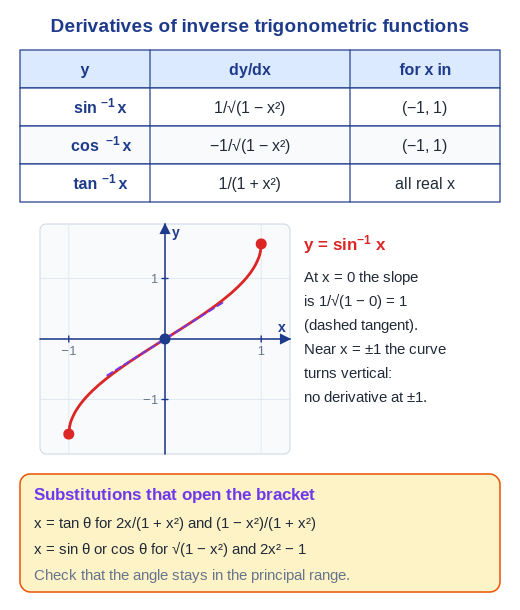
With the chain rule: d/dx [sin⁻¹ (3x)] = 3/√(1 − 9x²), and d/dx [tan⁻¹ (x²)] = 2x/(1 + x⁴).
How does a substitution make these easier?
Some expressions simplify before any differentiation. Take y = tan⁻¹ (2x/(1 − x²)) for −1 < x < 1. Put x = tan θ. Then
2x/(1 − x²) = 2 tan θ/(1 − tan² θ) = tan 2θ.
Since −1 < x < 1, θ lies between −π/4 and π/4, so 2θ lies between −π/2 and π/2, inside the principal range of tan⁻¹. So y = tan⁻¹ (tan 2θ) = 2θ = 2 tan⁻¹ x, and dy/dx = 2/(1 + x²).
Always check that the angle stays in the principal range. Outside it, tan⁻¹ (tan 2θ) is not 2θ, and the answer changes.
Read next: continuity of a function, logarithmic and parametric differentiation and the NCERT solutions.
Practice
-
The derivative of cos (5x − 1) with respect to x is:
Show answer
Answer: (c) −5 sin (5x − 1)
-
The derivative of (2x + 3)⁴ with respect to x is:
Show answer
Answer: (a) 8(2x + 3)³
-
If x² + y² = 1, then dy/dx equals:
Show answer
Answer: (b) −x/y
-
Find dy/dx if x³ + y³ = 9.
Show answer
Answer: Differentiate both sides with respect to x: 3x² + 3y² · dy/dx = 0. So dy/dx = −x²/y².
-
Differentiate cos⁻¹ (2x) with respect to x.
Show answer
Answer: Put t = 2x. dy/dx = −1/√(1 − t²) · dt/dx = −1/√(1 − 4x²) · 2 = −2/√(1 − 4x²), for −1/2 < x < 1/2.
Questions students ask
When do I need the chain rule?
Whenever one function sits inside another, as in sin (3x + 2), (x² + 1)⁵ or √(tan x). Differentiate the outside function, keep the inside unchanged, and multiply by the derivative of the inside.
What is the difference between an explicit and an implicit function?
In an explicit function y is written directly in terms of x, as in y = x − π. In an implicit function x and y are mixed in one relation, as in x + sin xy − y = 0, which cannot easily be solved for y.
Why is the derivative of sin⁻¹ x not defined at x = 1 and x = −1?
The formula 1/√(1 − x²) has 0 in the bottom at x = ±1. On the graph of y = sin⁻¹ x the curve turns vertical at these two end points.
Can a function be continuous but not differentiable?
Yes. f(x) = |x − 1| is continuous at x = 1, but its left hand derivative there is −1 and its right hand derivative is 1. They differ, so f′(1) does not exist.
Stuck on a question?
Take a photo and Lagnever AI explains it step by step. Try it for 7 days for ₹2.
Get it on Google Play Open in browser
For parents: after the trial, the plan renews monthly by UPI or card autopay. You can cancel anytime in the app.