
What is the continuity of a function?
Answer in short
A function f is continuous at x = c if c is in its domain and the limit of f(x) as x → c equals f(c): the left hand limit, the right hand limit and the value must agree. Otherwise c is a point of discontinuity. A continuous function is continuous at every point of its domain.
Stuck on a question? Take a photo and Lagnever AI explains it step by step. Try it for 7 days for ₹2. Get it on Google Play
How the maths is written here. A function given by different rules on different parts of its domain is typed in braces with a semicolon between the rules: f(x) = {x + 1, if x ≤ 1; x − 1, if x > 1} means f(x) = x + 1 when x ≤ 1 and f(x) = x − 1 when x > 1. “x → 1⁻” means x comes to 1 from the left, and “x → 1⁺” from the right.
What does continuous at a point mean?
In everyday words, a function is continuous at a point if its graph passes through that point without a break, so that you can draw it there without lifting the pen. The exact meaning uses limits.
Let c be a point in the domain of f. Then f is continuous at x = c if
limx → c f(x) = f(c).
In full: the left hand limit, the right hand limit and the value f(c) all exist and are equal. If f is not continuous at c, then c is called a point of discontinuity of f.
For f(x) = 3x + 1 at x = 2: f(2) = 7, and as x → 2 the value 3x + 1 → 7. The limit equals the value, so f is continuous at x = 2.
How do you test a function given in pieces?
Inside each piece the function is usually a polynomial, and so continuous. Trouble can come only at a point where the rule changes. At such a point c:
- Find the left hand limit, using the rule for x < c.
- Find the right hand limit, using the rule for x > c.
- Find f(c), using the rule that covers x = c.
- If all three are equal, f is continuous at c. If not, c is a point of discontinuity.
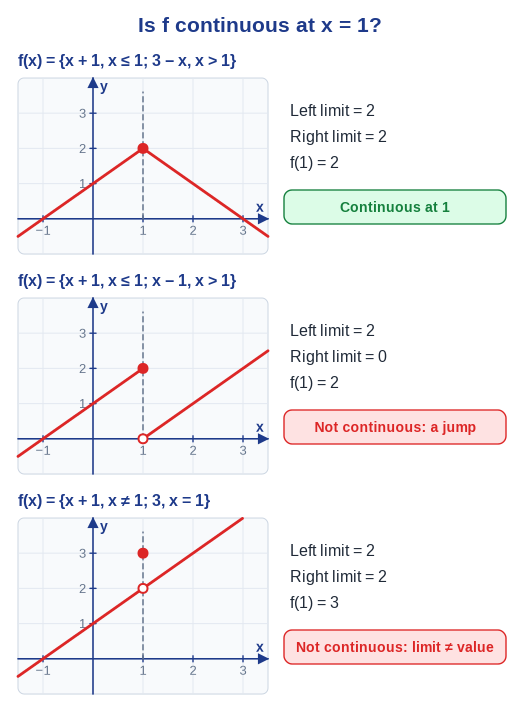
Three functions, all tested at x = 1:
- f(x) = {x + 1, if x ≤ 1; 3 − x, if x > 1}: left hand limit = 2, right hand limit = 2, f(1) = 2. Continuous.
- f(x) = {x + 1, if x ≤ 1; x − 1, if x > 1}: left hand limit = 2, right hand limit = 0. The limits differ. Not continuous: the graph jumps.
- f(x) = {x + 1, if x ≠ 1; 3, if x = 1}: both limits are 2, but f(1) = 3. The limit is not equal to the value. Not continuous.
What is a continuous function?
A function is a continuous function if it is continuous at every point of its domain. Only points of the domain are tested. So f(x) = 1/x, x ≠ 0, is a continuous function: at every c ≠ 0 the limit is 1/c = f(c), and 0 is not in the domain at all.
If the domain is a closed interval [a, b], then at the end point a only the right hand limit is used, and at b only the left hand limit.
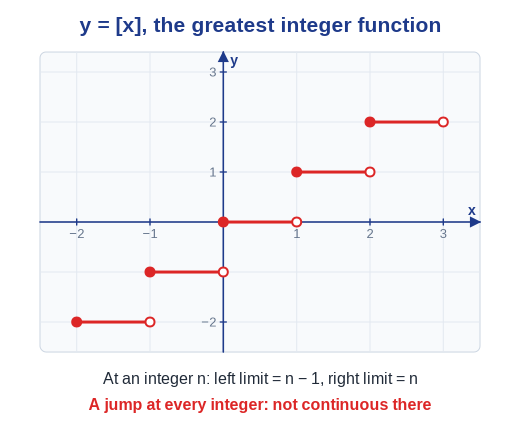
The greatest integer function f(x) = [x] is defined everywhere but is not a continuous function. At an integer n the left hand limit is n − 1 and the right hand limit is n, so there is a jump at every integer. Between two integers it is constant, and so continuous.
Which functions are continuous without any testing?
The chapter builds a stock of continuous functions:
- every constant function and the identity function f(x) = x;
- every polynomial function;
- every rational function p(x)/q(x), at all points where q(x) ≠ 0;
- sin x and cos x for all real x, and tan x wherever cos x ≠ 0;
- the modulus function |x|.
Two theorems then make new continuous functions out of old ones.
Algebra of continuous functions. If f and g are continuous at c, then f + g, f − g and f · g are continuous at c, and f/g is continuous at c provided g(c) ≠ 0.
Composite functions. If g is continuous at c and f is continuous at g(c), then f ∘ g is continuous at c.
So x² + sin x is continuous (a sum), x cos x is continuous (a product), and cos (3x + 1) and |sin x| are continuous (composites). No limits need to be worked out.
How do you find a constant that makes a function continuous?
Set the left hand limit equal to the right hand limit at the point where the rule changes, and solve.
Find k so that f(x) = {kx + 1, if x ≤ 2; 7, if x > 2} is continuous at x = 2.
Left hand limit = f(2) = 2k + 1 and right hand limit = 7. For continuity 2k + 1 = 7, so k = 3. Check: with k = 3 the left piece gives 3(2) + 1 = 7, the same as the right piece.
Sometimes no value works. For f(x) = {kx², if x ≤ 0; x + 1, if x > 0} at x = 0, the left hand limit is 0 for every k, while the right hand limit is 1. The function is discontinuous at 0 whatever k is.
Read next: chain rule, implicit and inverse trigonometric derivatives, logarithmic and parametric differentiation and the NCERT solutions.
Practice
-
For f(x) = {x², if x ≤ 1; 2x − 1, if x > 1}, at x = 1 the function is:
Show answer
Answer: (a) continuous
-
For f(x) = {2x + 1, if x < 1; 5, if x ≥ 1}, the left hand limit at x = 1 is:
Show answer
Answer: (c) 3
-
The greatest integer function f(x) = [x] is discontinuous at:
Show answer
Answer: (b) every integer
-
Find a so that f(x) = {ax + 2, if x ≤ 1; 3x, if x > 1} is continuous at x = 1.
Show answer
Answer: Left hand limit = f(1) = a + 2 and right hand limit = 3(1) = 3. For continuity a + 2 = 3, so a = 1.
-
Is f(x) = |x − 2| continuous at x = 2?
Show answer
Answer: Yes. For x < 2, f(x) = 2 − x, so the left hand limit is 0. For x > 2, f(x) = x − 2, so the right hand limit is 0. Also f(2) = 0. All three agree, so f is continuous at x = 2.
Questions students ask
What are the three things to check for continuity at a point?
First, f(c) must be defined. Second, the left hand limit and the right hand limit at c must exist and be equal. Third, this common limit must equal f(c). If any one fails, f is not continuous at c.
Is f(x) = 1/x a continuous function?
Yes. Its domain is all real numbers except 0, and at every point c of that domain the limit of 1/x is 1/c, the value. The point 0 is not in the domain, so it is not counted.
Why is the greatest integer function discontinuous at integers?
Just to the left of an integer n, [x] is n − 1, and just to the right it is n. The left hand limit n − 1 and the right hand limit n are different, so the function jumps at n.
Is a continuous function always differentiable?
No. f(x) = |x| is continuous at 0 but not differentiable there, because its left hand derivative is −1 and its right hand derivative is 1. The reverse is true: a differentiable function is always continuous.
Stuck on a question?
Take a photo and Lagnever AI explains it step by step. Try it for 7 days for ₹2.
Get it on Google Play Open in browser
For parents: after the trial, the plan renews monthly by UPI or card autopay. You can cancel anytime in the app.