
What are logarithmic and parametric differentiation?
Answer in short
Logarithmic differentiation means taking the log of both sides before differentiating; it suits y = uᵛ and long products. For a parametric form x = f(t), y = g(t), dy/dx = (dy/dt)/(dx/dt), where dx/dt ≠ 0. Both use (eˣ)′ = eˣ and (log x)′ = 1/x.
Stuck on a question? Take a photo and Lagnever AI explains it step by step. Try it for 7 days for ₹2. Get it on Google Play
How the maths is written here. log x is the natural logarithm, to the base e, as in the book. Powers that do not fit on one line are typed with a caret: x^(2x) means x raised to the power 2x. y′ stands for dy/dx.
What are the exponential and logarithmic functions?
The exponential function with base b > 1 is y = bˣ. It is defined for every real x, its values are always positive, its graph passes through (0, 1), and it keeps rising. For large x it grows faster than any power of x. The base 10 gives the common exponential function. The base e, a number between 2 and 3, gives the natural exponential function eˣ.
The logarithm reverses this: logb a = x means bˣ = a. So log₂ 8 = 3 because 2³ = 8. As a function, log x is defined only for x > 0, takes every real value, passes through (1, 0) and keeps rising. In this chapter log x always means the logarithm to the base e.
Three properties are used all the time: log (pq) = log p + log q, log (p/q) = log p − log q and log (pⁿ) = n log p. The base can be changed with loga p = logb p/logb a.
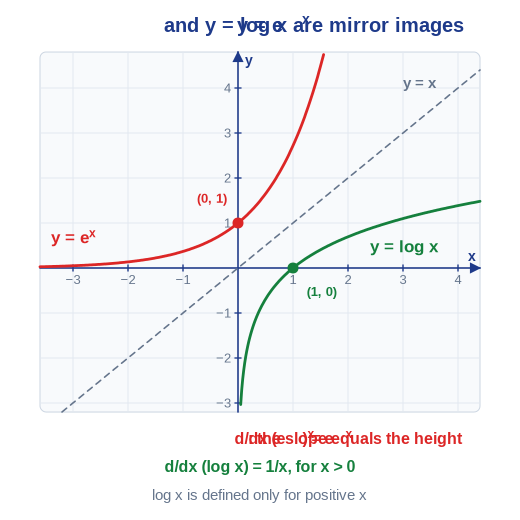
What are the derivatives of eˣ and log x?
The chapter states two results without proof:
d/dx (eˣ) = eˣ and d/dx (log x) = 1/x.
With the chain rule they cover many functions:
- d/dx (e³ˣ) = 3e³ˣ
- d/dx [log (x² + 1)] = 2x/(x² + 1)
- d/dx [e^(sin x)] = cos x · e^(sin x)
- d/dx [log (sin x)] = cos x/sin x = cot x, where sin x > 0
How does logarithmic differentiation work?
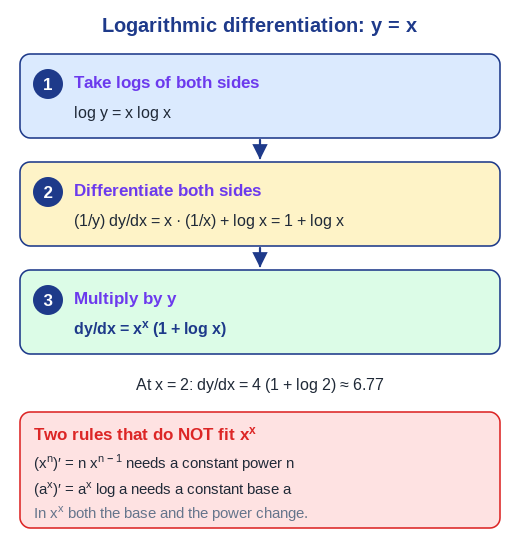
It is a three-step method for a function y that is awkward to differentiate directly:
- Take the log of both sides and simplify with the properties of logs.
- Differentiate both sides with respect to x. The left side becomes (1/y) dy/dx.
- Multiply by y, and write y back in terms of x.
Take y = xˣ, x > 0. Then log y = x log x. Differentiating, (1/y) dy/dx = x · (1/x) + log x = 1 + log x. So dy/dx = xˣ (1 + log x). At x = 2 this is 4(1 + log 2), about 6.77.
A power uv. For y = xcos x, x > 0: log y = cos x · log x, so (1/y) dy/dx = cos x · (1/x) − sin x · log x, and
dy/dx = xcos x [(cos x)/x − sin x · log x].
A long product. For y = (x + 1)²(x + 2)³: log y = 2 log (x + 1) + 3 log (x + 2), so
(1/y) dy/dx = 2/(x + 1) + 3/(x + 2) = (5x + 7)/((x + 1)(x + 2)),
and dy/dx = (x + 1)(x + 2)²(5x + 7).
A constant base. For y = aˣ with a > 0: log y = x log a, so (1/y) dy/dx = log a and dy/dx = aˣ log a. For example d/dx (2ˣ) = 2ˣ log 2.
The method makes sense only where y and the base are positive, since the log of a negative number or of zero is not defined.
What is a parametric form?
Sometimes x and y are not related directly. Instead, each is given in terms of a third variable t, called the parameter:
x = f(t), y = g(t).
By the chain rule, dy/dt = (dy/dx) · (dx/dt). So
dy/dx = (dy/dt)/(dx/dt), wherever dx/dt ≠ 0.
There is no need to remove t first, and the answer is normally left in terms of t.
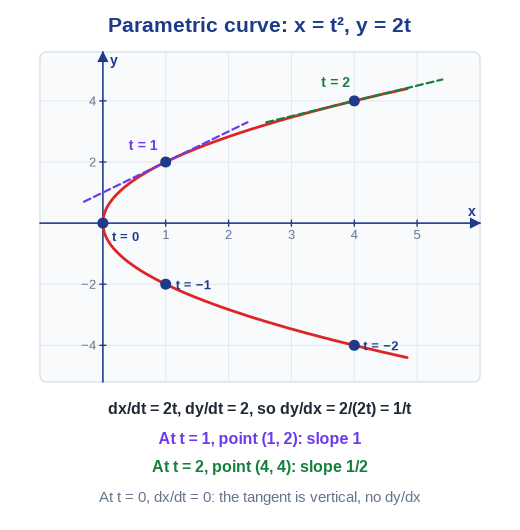
For x = t², y = 2t: dx/dt = 2t and dy/dt = 2, so dy/dx = 2/(2t) = 1/t. At t = 1, the point (1, 2), the slope is 1. At t = 2, the point (4, 4), the slope is 1/2. At t = 0, dx/dt = 0 and the formula gives no value.
For x = 3 cos θ, y = 2 sin θ: dx/dθ = −3 sin θ and dy/dθ = 2 cos θ, so dy/dx = −(2/3) cot θ.
To differentiate one function with respect to another, treat x as the parameter. For u = x⁶ and v = x²: du/dv = (du/dx)/(dv/dx) = 6x⁵/(2x) = 3x⁴.
Read next: continuity of a function, chain rule, implicit and inverse trigonometric derivatives and the NCERT solutions.
Practice
-
The derivative of e⁵ˣ with respect to x is:
Show answer
Answer: (b) 5e⁵ˣ
-
The derivative of log (3x), x > 0, with respect to x is:
Show answer
Answer: (c) 1/x
-
If x = 4t and y = t² + 1, then dy/dx equals:
Show answer
Answer: (a) t/2
-
Differentiate y = x^(2x), x > 0.
Show answer
Answer: Take logs: log y = 2x log x. Differentiate: (1/y) dy/dx = 2 log x + 2x · (1/x) = 2 log x + 2. Multiply by y: dy/dx = 2x^(2x) (1 + log x).
-
Find dy/dx if x = 3 cos θ and y = 2 sin θ.
Show answer
Answer: dx/dθ = −3 sin θ and dy/dθ = 2 cos θ. So dy/dx = (2 cos θ)/(−3 sin θ) = −(2/3) cot θ, where sin θ ≠ 0.
Questions students ask
When should I use logarithmic differentiation?
Use it when the variable is in both the base and the power, as in xˣ or (sin x)ˣ, and when a function is a product or quotient of many factors or has a root over them. Taking logs turns powers into products and products into sums.
What is the difference between the derivatives of xⁿ, aˣ and xˣ?
For xⁿ the power is constant: the derivative is nxⁿ⁻¹. For aˣ the base is constant: the derivative is aˣ log a. For xˣ both change, so take logs: the derivative is xˣ (1 + log x).
What is a parameter?
A third variable, often t or θ, in terms of which both x and y are written, as in x = t², y = 2t. Each value of the parameter gives one point (x, y) of the curve.
Why must dx/dt not be zero in the parametric formula?
Because dy/dx = (dy/dt)/(dx/dt) divides by dx/dt. Where dx/dt = 0 the formula gives no value. For x = t², y = 2t this happens at t = 0, where the tangent is vertical.
Stuck on a question?
Take a photo and Lagnever AI explains it step by step. Try it for 7 days for ₹2.
Get it on Google Play Open in browser
For parents: after the trial, the plan renews monthly by UPI or card autopay. You can cancel anytime in the app.